
SOCS-4 Antibody (517331)
R&D Systems | Catalog # MAB5628


Scientific images may be resized, cropped, or adjusted for brightness or contrast for presentation purposes. These updates are limited to presentation and do not affect the underlying scientific interpretation of the data. Where available, additional source data may be provided upon request.
Key Product Details
Species Reactivity
Validated:
Cited:
Applications
Validated:
Cited:
Label
Antibody Source
Product Specifications
Immunogen
Met1-Cys440
Accession # Q8WXH5
Specificity
Clonality
Host
Isotype
Scientific Data Images for SOCS-4 Antibody (517331)
Detection of Human/Mouse SOCS‑4 by Western Blot.
Western blot shows lysates of NC-37 human Burkitt's lymphoma B lymphoblast cell line, HeLa human cervical epithelial carcinoma cell line, 293T human embryonic kidney cell line, and NIH-3T3 mouse embryonic fibroblast cell line. PVDF membrane was probed with 0.1 µg/mL of Human/Mouse SOCS-4 Monoclonal Antibody (Catalog # MAB5628) followed by HRP-conjugated Anti-Mouse IgG Secondary Antibody (Catalog # HAF007). A specific band was detected for SOCS-4 at approximately 51 kDa (as indicated). This experiment was conducted under reducing conditions and using Immunoblot Buffer Group 1.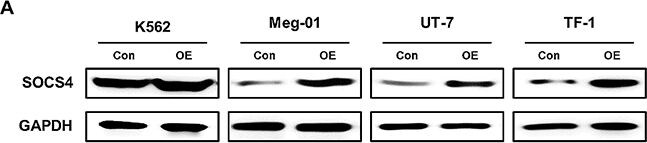
Detection of SOCS-4 by Western Blot
SOCS4 overexpression (OE) induces erythroid differentiation, but reduces megakaryocytic differentiation. (A-C) Detection of SOCS4 expression under SOCS4 gene upregulation. pcDNA3.0-SOCS4-neomycin plasmid or pcDNA3.0-neomycin control plasmid were transfected into the K562, Meg-01, UT-7 and TF-1 cells. Stable overexpressed cell lines were selected using G418. The protein levels of SOCS4 were analyzed by Western blot (A), and normalized by GAPDH (B). The mRNA levels of SOCS4 were examined by RT-qPCR (C). (D) Detection of TF-1 cell erythroid differentiation under SOCS4 upregulation. The stable SOCS4 overexpressed TF-1 cells were induced to erythroid differentiation and the expression of CD71 and CD235a were examined by flow cytometry. (E, F) Detection of K562 cell erythroid differentiation under SOCS4 upregulation. Stable SOCS4 overexpressed K562 cells were induced to erythroid differentiation and enucleation, flow cytometry was used to examine CD71 and CD235a (E) and the proportion of enucleated cells (DRAQ5 negative cells, F). (G, H) Detection of leukemia cell Meg-01 and K562 megakaryocytic differentiation under SOCS4 upregulation. Stable SOCS4 overexpressed Meg-01 cells (G) and K562 cells (H) were induced to megakaryocyte. CD41 and CD61 were examined by flow cytometry. (I) Detection of K562 cell erythroid differentiation under SOCS4 overexpression and miR-1915-3p upregulation. Stable miR-1915-3p overexpressing K562 cells were transiently transfected with pcDNA3.0-SOCS4-neomycin (or pcDNA3.0-neomycin control plasmid), then induced to erythroid differentiation. CD71 and CD235a were examined by flow cytometry on day 4. Data are presented as mean ± SEM Image collected and cropped by CiteAb from the following open publication (https://thrombosisjournal.biomedcentral.com/articles/10.1186/s12959-024…), licensed under a CC-BY license. Not internally tested by R&D Systems.Applications for SOCS-4 Antibody (517331)
Western Blot
Sample: NC-37 human Burkitt's lymphoma B lymphoblast cell line, HeLa human cervical epithelial carcinoma cell line, 293T human embryonic kidney cell line, and NIH-3T3 mouse embryonic fibroblast cell line
Formulation, Preparation, and Storage
Purification
Reconstitution
Reconstitute at 0.5 mg/mL in sterile PBS. For liquid material, refer to CoA for concentration.
Formulation
Shipping
Stability & Storage
- 12 months from date of receipt, -20 to -70 °C as supplied.
- 1 month, 2 to 8 °C under sterile conditions after reconstitution.
- 6 months, -20 to -70 °C under sterile conditions after reconstitution.
Calculators
Background: SOCS-4
Long Name
Alternate Names
Gene Symbol
UniProt
Additional SOCS-4 Products
Product Documents for SOCS-4 Antibody (517331)
Certificate of Analysis
To download a Certificate of Analysis, please enter a lot or batch number in the search box below.
Note: Certificate of Analysis not available for kit components.
Product Specific Notices for SOCS-4 Antibody (517331)
For research use only
Related Research Areas
Citations for SOCS-4 Antibody (517331)
 Powered by Bioz
Customer Reviews for SOCS-4 Antibody (517331)
There are currently no reviews for this product. Be the first to review SOCS-4 Antibody (517331) and earn rewards!
Have you used SOCS-4 Antibody (517331)?
Submit a review and receive an Amazon gift card!
$25/€18/£15/$25CAN/¥2500 for a review with an image
$10/€7/£6/$10CAN/¥1110 for a review without an image
Submit a review
Protocols
Find general support by application which include: protocols, troubleshooting, illustrated assays, videos and webinars.
- Cellular Response to Hypoxia Protocols
- R&D Systems Quality Control Western Blot Protocol
- Troubleshooting Guide: Western Blot Figures
- Western Blot Conditions
- Western Blot Protocol
- Western Blot Protocol for Cell Lysates
- Western Blot Troubleshooting
- Western Blot Troubleshooting Guide
- View all Protocols, Troubleshooting, Illustrated assays and Webinars