
PCK1 (Phosphoenolpyruvate carboxykinase 1; also PEPCK-C [cytosolic]) is a monomeric, 67-68 kDa member of the PEP carboxykinase family of enzymes. It is expressed in postnatal cells such as mammary epithelium, white and brown adipocytes, skeletal muscle cells and hepatocytes. PCK1 has multiple functions, some of which are cell-specific. In particular, PCK1 has both cataplerotic (Greek: to fill down, or remove) and anaplerotic (to fill up, or replace) activity, where it removes and replaces elements of the TCA cycle. It is also gluconeogenic, and promotes glucose formation via PEP generation. Finally, it is glyceroneogenic, creating glycerol-3-phosphate that is used to reesterify and store just-released free fatty acids in adipocytes. Mouse PCK1 is 622 amino acids (aa) in length. It contains one kinase domain (aa 27-615), and two potential acetylation sites at Lys70 and 71. There are four potential splice forms. Two have alternative start sites at Met460 and Met315, while two others show a deletion of aa 34-546, plus a three aa substitution for aa 85-204, respectively. Over aa 551-622, mouse PCK1 shares 93% and 82% aa identity with rat and human PCK1, respectively.

Scientific images may be resized, cropped, or adjusted for brightness or contrast for presentation purposes. These updates are limited to presentation and do not affect the underlying scientific interpretation of the data. Where available, additional source data may be provided upon request.
Key Product Details
Species Reactivity
Applications
Label
Antibody Source
Product Specifications
Immunogen
Met1-Ile88
Accession # P35558
Specificity
Clonality
Host
Isotype
Scientific Data Images for Human PCK1 Antibody (789114)
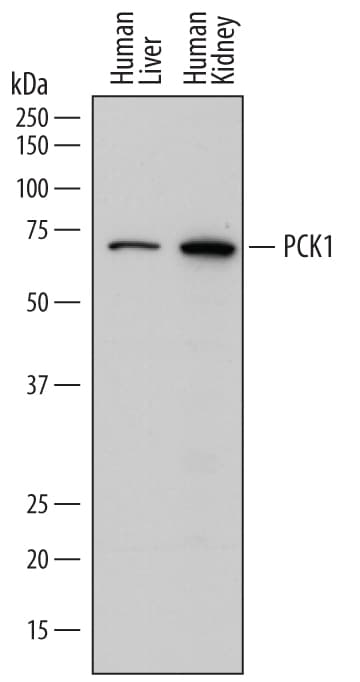
Detection of Human PCK1 by Western Blot.
Western blot shows lysates of human liver tissue and human kidney tissue. PVDF membrane was probed with 1 µg/mL of Mouse Anti-Human PCK1 Monoclonal Antibody (Catalog # MAB7316) followed by HRP-conjugated Anti-Mouse IgG Secondary Antibody (Catalog # HAF018). A specific band was detected for PCK1 at approximately 68 kDa (as indicated). This experiment was conducted under reducing conditions and using Immunoblot Buffer Group 1.Applications for Human PCK1 Antibody (789114)
Western Blot
Sample: Human liver tissue and human kidney tissue
Formulation, Preparation, and Storage
Purification
Reconstitution
Sterile PBS to a final concentration of 0.5 mg/mL. For liquid material, refer to CoA for concentration.
Formulation
Shipping
Stability & Storage
- 12 months from date of receipt, -20 to -70 °C as supplied.
- 1 month, 2 to 8 °C under sterile conditions after reconstitution.
- 6 months, -20 to -70 °C under sterile conditions after reconstitution.
Calculators
Background: PCK1
Long Name
Alternate Names
Gene Symbol
UniProt
Additional PCK1 Products
Product Documents for Human PCK1 Antibody (789114)
Certificate of Analysis
To download a Certificate of Analysis, please enter a lot or batch number in the search box below.
Note: Certificate of Analysis not available for kit components.
Product Specific Notices for Human PCK1 Antibody (789114)
For research use only
Related Research Areas
Customer Reviews for Human PCK1 Antibody (789114)
There are currently no reviews for this product. Be the first to review Human PCK1 Antibody (789114) and earn rewards!
Have you used Human PCK1 Antibody (789114)?
Submit a review and receive an Amazon gift card!
$25/€18/£15/$25CAN/¥2500 for a review with an image
$10/€7/£6/$10CAN/¥1110 for a review without an image
Submit a review
Protocols
Find general support by application which include: protocols, troubleshooting, illustrated assays, videos and webinars.
- Cellular Response to Hypoxia Protocols
- R&D Systems Quality Control Western Blot Protocol
- Troubleshooting Guide: Western Blot Figures
- Western Blot Conditions
- Western Blot Protocol
- Western Blot Protocol for Cell Lysates
- Western Blot Troubleshooting
- Western Blot Troubleshooting Guide
- View all Protocols, Troubleshooting, Illustrated assays and Webinars