
Pentraxin 3 (PTX3), TSG-14, was initially identified as a TNF-alpha or IL-1 beta inducible gene (1 - 3). It belongs to the pentraxin family, which was named originally for the homo-pentameric structure formed by its members (4). The pentraxin family is divided into two subfamilies: the “short” and the “long” pentraxins with approximate molecular weights of 25 kDa and 50 kDa, respectively. TSG-14 is a member of the long pentraxin subfamily, which also includes the Xenopus laevis XL-PXN1, the guinea pig apexin/p50, the rat neuronal pentraxin I (NPI) and NPR, the human neuronal pentraxin II (NPTX2) and the human neuronal activity-related pentraxin (5). Mature secreted TSG-14 contains a pentaxin-like domain at its carboxy-terminus that shares 23 - 28% amino acid (aa) sequence similarity to C-reactive protein (CRP) and serum amyloid P component (SAP), which belongs to the short pentraxin subfamily. However, the N-terminal sequence of TSG-14 does not share aa sequence homology with any of the “short” pentaxins (3). Unlike CRP and SAP, which forms pentamers only, TSG-14 forms both pentameric and higher ordered oligomers (5). Similarly to CRP and SAP, TSG-14 binds to the complement cascade component C1q (6). However, TSG-14 does not bind to phosphoethanolamine, phosphocholine, or high pyruvate agarose, which are known ligands for CRP and SAP. TSG-14 is a marker of the acute phase response and is highly expressed in advanced atherosclerotic plaques (12). While CRP and SAP are primarily produced in the liver, TSG-14 expression is strongly upregulated by TNF-alpha, IL-1 beta, and bacterial LPS in peripheral fibroblasts, endothelial cells, and macrophages (7). At the amino acid level, human and mouse TSG-14 share 88% aa sequence homology (8). TSG-14 concentration is elevated in the joint fluid of patients with rheumatoid arthritis (RA), indicating that TSG-14 may be a potential mediator of immune response (9). TSG‑14 may also function in the regulation of the uptake and clearance of apoptotic cells by dendritic cells (10). In vivo study showed that TSG-14 transgenic mice are more resistant to sepsis and endotoxemia compared to wild type during the inflammatory injury (11). Increased expression of TSG-14 may enhance the immune response to protect the host from infection.
Human Pentraxin 3/TSG-14 Antibody (247936)
R&D Systems | Catalog # MAB18261

Scientific images may be resized, cropped, or adjusted for brightness or contrast for presentation purposes. These updates are limited to presentation and do not affect the underlying scientific interpretation of the data. Where available, additional source data may be provided upon request.
Key Product Details
Species Reactivity
Applications
Label
Antibody Source
Product Specifications
Immunogen
Glu18-Ser381
Accession # P26022
Specificity
Clonality
Host
Isotype
Scientific Data Images for Human Pentraxin 3/TSG-14 Antibody (247936)
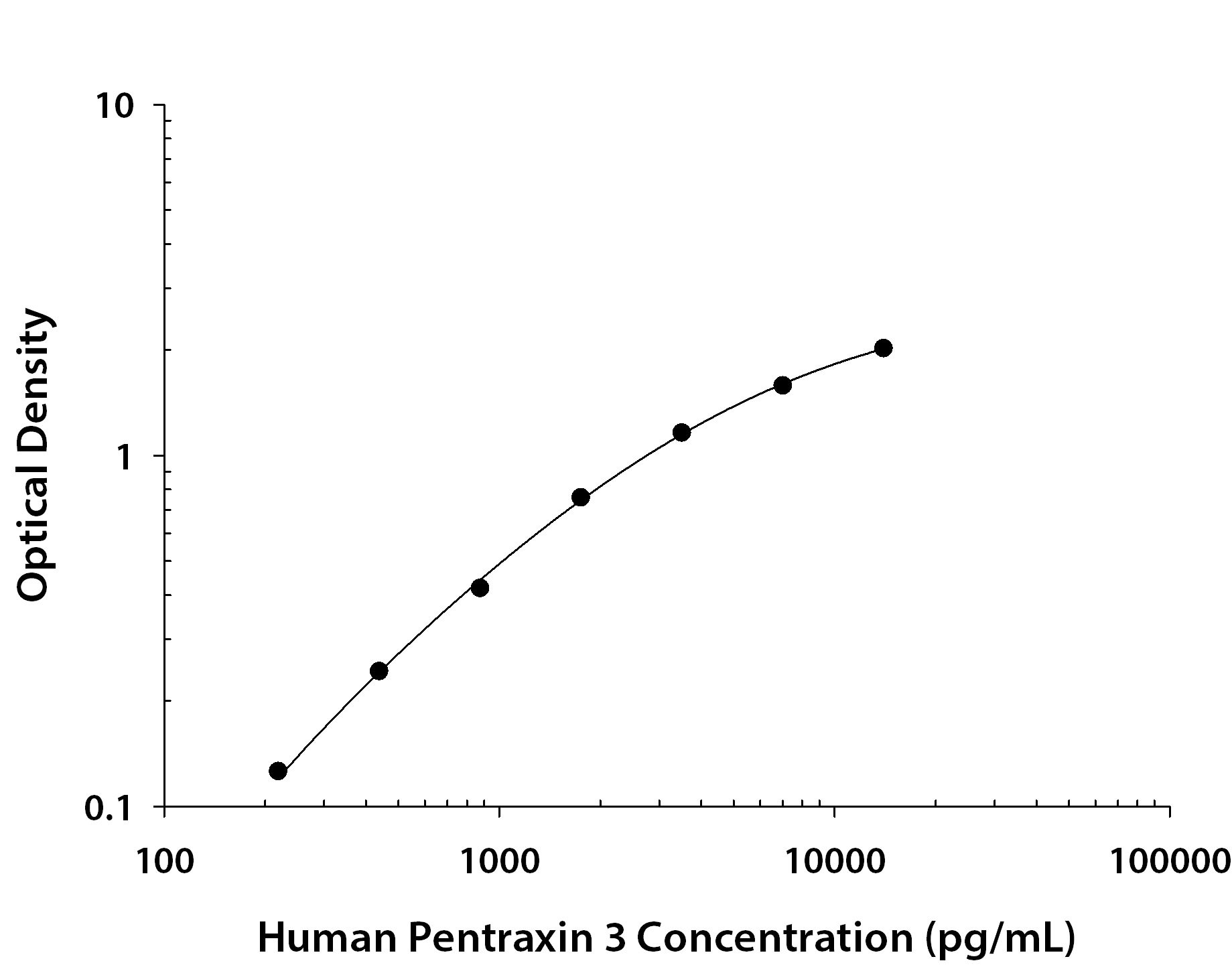
Human Pentraxin 3/TSG‑14 ELISA Standard Curve.
Recombinant Human Pentraxin 3/TSG‑14 protein was serially diluted 2-fold and captured by Mouse Anti-Human Pentraxin 3/TSG‑14 Monoclonal Antibody (Catalog # MAB1826) coated on a Clear Polystyrene Microplate (Catalog # DY990). Mouse Anti-Human Pentraxin 3/TSG‑14 Monoclonal Antibody (Catalog # MAB18261) was biotinylated and incubated with the protein captured on the plate. Detection of the standard curve was achieved by incubating Streptavidin-HRP (Catalog # DY998) followed by Substrate Solution (Catalog # DY999) and stopping the enzymatic reaction with Stop Solution (Catalog # DY994).Applications for Human Pentraxin 3/TSG-14 Antibody (247936)
ELISA
This antibody functions as an ELISA detection antibody when paired with Mouse Anti-Human Pentraxin 3/TSG‑14 Monoclonal Antibody (Catalog # MAB1826).
This product is intended for assay development on various assay platforms requiring antibody pairs. We recommend the Human Pentraxin 3/TSG-14 DuoSet ELISA Kit (Catalog # DY1826) for convenient development of a sandwich ELISA or the Human Pentraxin 3/TSG-14 Quantikine ELISA Kit (Catalog # DPTX30B) for a complete optimized ELISA.
Formulation, Preparation, and Storage
Purification
Reconstitution
Reconstitute at 0.5 mg/mL in sterile PBS. For liquid material, refer to CoA for concentration.
Formulation
Shipping
Stability & Storage
- 12 months from date of receipt, -20 to -70 °C as supplied.
- 1 month, 2 to 8 °C under sterile conditions after reconstitution.
- 6 months, -20 to -70 °C under sterile conditions after reconstitution.
Calculators
Background: Pentraxin 3/TSG-14
References
- Lee, T.H. et al. (1990) Mol. Cell. Biol. 10:1982.
- Breviario, F. et al. (1992) J. Biol. Chem. 267:22190.
- Lee, G.W. et al. (1993) J. Immunol. 150:1804.
- Osmand, A.P. et al. (1977) Proc. Natl. Acad. Sci. USA 74:739.
- Goodman A.R. et al. (1996) Cytokine & Growth Factor Reviews 7:191.
- Bottazzi, B. et al. (1997) J. Biol. Chem. 272:32817.
- Introna, M. et al. (1996) Blood 87:1862.
- Altmeyer, A. et al. (1995) J. Biol. Chem. 270:25584.
- Luchetti, M.M. et al. (2000) Clin. Exp. Immunol. 119:196.
- Rovere, P. et al. (2000) Blood 96:4300.
- Dias, A.A.M. et al. (2001) J. Leukocyte Biol. 69:928.
- Rolph, M.S. et al. (2002) Arterioscler. Throm. Vasc. Biol. 22:e10-4.
Long Name
Alternate Names
Gene Symbol
UniProt
Additional Pentraxin 3/TSG-14 Products
Product Documents for Human Pentraxin 3/TSG-14 Antibody (247936)
Certificate of Analysis
To download a Certificate of Analysis, please enter a lot or batch number in the search box below.
Note: Certificate of Analysis not available for kit components.
Product Specific Notices for Human Pentraxin 3/TSG-14 Antibody (247936)
For research use only
Related Research Areas
Customer Reviews for Human Pentraxin 3/TSG-14 Antibody (247936)
There are currently no reviews for this product. Be the first to review Human Pentraxin 3/TSG-14 Antibody (247936) and earn rewards!
Have you used Human Pentraxin 3/TSG-14 Antibody (247936)?
Submit a review and receive an Amazon gift card!
$25/€18/£15/$25CAN/¥2500 for a review with an image
$10/€7/£6/$10CAN/¥1110 for a review without an image
Submit a review
Protocols
Find general support by application which include: protocols, troubleshooting, illustrated assays, videos and webinars.
- ELISA Sample Preparation & Collection Guide
- ELISA Troubleshooting Guide
- How to Run an R&D Systems DuoSet ELISA
- How to Run an R&D Systems Quantikine ELISA
- How to Run an R&D Systems Quantikine™ QuicKit™ ELISA
- Quantikine HS ELISA Kit Assay Principle, Alkaline Phosphatase
- Quantikine HS ELISA Kit Principle, Streptavidin-HRP Polymer
- Sandwich ELISA (Colorimetric) – Biotin/Streptavidin Detection Protocol
- Sandwich ELISA (Colorimetric) – Direct Detection Protocol
- Troubleshooting Guide: ELISA
- View all Protocols, Troubleshooting, Illustrated assays and Webinars