
Axl (Ufo, Ark), Dtk (Sky, Tyro3, Rse, Brt), and Mer (human and mouse homologues of chicken c-Eyk) constitute a subfamily of the receptor tyrosine kinases (1, 2). The extracellular domains of these proteins contain two Ig-like motifs and two fibronectin type III motifs. This characteristic topology is also found in neural cell adhesion molecules and in receptor tyrosine phosphatases. The human Axl cDNA encodes an 887 amino acid (aa) precursor that includes an 18 aa signal sequence, a 426 aa extracellular domain, a 21 aa transmembrane segment, and a 422 aa cytoplasmic domain. The extracellular domains of human and mouse Axl share 81% aa sequence identity. A short alternately spliced form of human Axl is distinguished by a 9 aa deletion in the extracellular juxtamembrane region. These receptors bind the vitamin K‑dependent protein growth arrest specific gene 6 (Gas6) which is structurally related to the anticoagulation factor protein S. Binding of Gas6 induces receptor autophosphorylation and downstream signaling pathways that can lead to cell proliferation, migration, or the prevention of apoptosis (3). This family of tyrosine kinase receptors is involved in hematopoiesis, embryonic development, tumorigenesis, and regulation of testicular functions. Phosphorylation of Tyrosine 779 provides a docking site for p85 subunits of PI 3-Kinase (4).
Human phospho-Axl (Y779) Antibody (713610)
R&D Systems | Catalog # MAB6965

Scientific images may be resized, cropped, or adjusted for brightness or contrast for presentation purposes. These updates are limited to presentation and do not affect the underlying scientific interpretation of the data. Where available, additional source data may be provided upon request.
Key Product Details
Validated by
Species Reactivity
Validated:
Cited:
Applications
Validated:
Cited:
Label
Antibody Source
Product Specifications
Immunogen
Specificity
Clonality
Host
Isotype
Scientific Data Images for Human phospho-Axl (Y779) Antibody (713610)
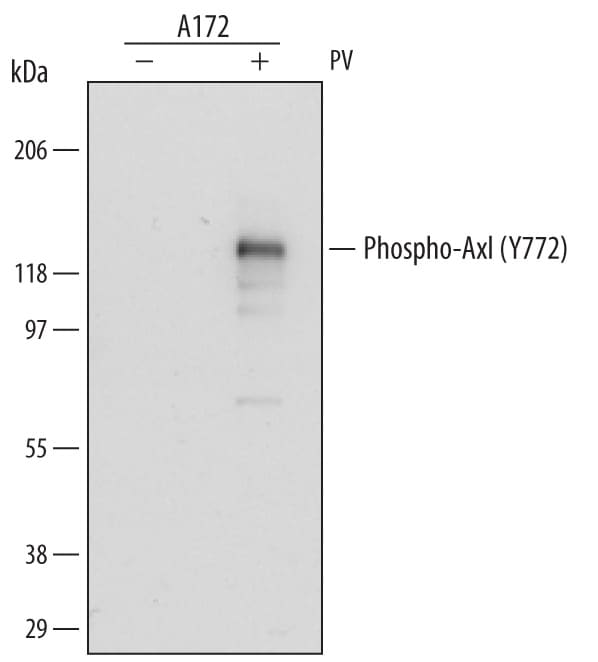
Detection of Human Phospho-Axl (Y779) by Western Blot.
Western blot shows lysates of A172 human glioblastoma cell line untreated (-) or treated (+) with 1 mM Pervanadate (PV) for 30 minutes. PVDF membrane was probed with 0.2 µg/mL of Mouse Anti-Human Phospho-Axl (Y779) Monoclonal Antibody (Catalog # MAB6965) followed by HRP-conjugated Anti-Mouse IgG Secondary Antibody (Catalog # HAF007). A specific band was detected for Phospho-Axl (Y779) at approximately 140 kDa (as indicated). This experiment was conducted under reducing conditions and using Immunoblot Buffer Group 1.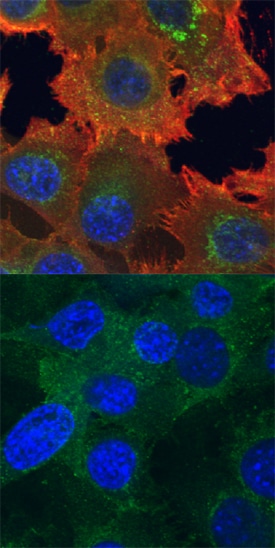
Phospho-Axl (Y779) in A172 Human Cell Line.
Axl phosphorylated at Y779 and total Axl were assessed in immersion fixed A172 human glioblastoma cells incubated with (upper panel) or without (lower panel) the phosphatase inhibitor pervanadate at 100 µM for 5 minutes. Phospho-Axl was detected using Mouse Anti-Human Phospho-Axl (Y779) Monoclonal Antibody (Catalog # MAB6965) at 10 µg/mL for 3 hours at room temperature. Cells were stained using the NorthernLights™ 557-conjugated Anti-Mouse IgG Secondary Antibody (red; Catalog # NL007) and counterstained using DAPI (blue). Total Axl was detected using Goat Anti-Human Axl Antigen Affinity-purified Polyclonal Antibody (Catalog # AF154). Cells were stained using the NorthernLights™ 493-conjugated Anti-Goat IgG Secondary Antibody (green; Catalog # NL003). Specific staining was localized to cytoplasm and cell surfaces. View our protocol for Fluorescent ICC Staining of Cells on Coverslips.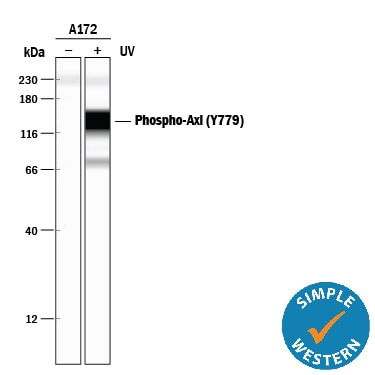
Detection of Human Phospho-Axl (Y779) by Simple WesternTM.
Simple Western lane view shows lysates of A172 human glioblastoma cell line untreated (-) or treated (+) with 1 mM Pervanadate (PV) for 30 minutes, loaded at 0.2 mg/mL. A specific band was detected for Phospho-Axl (Y779) at approximately 150 kDa (as indicated) using 4 µg/mL of Mouse Anti-Human Phospho-Axl (Y779) Monoclonal Antibody (Catalog # MAB6965). This experiment was conducted under reducing conditions and using the 12-230 kDa separation system.*Non-specific interaction with the 230 kDa Simple Western standard may be seen with this antibody.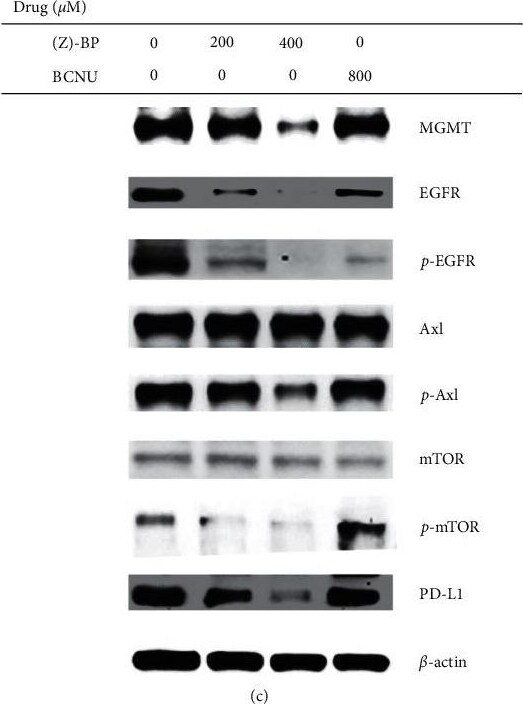
Detection of Human Axl by Western Blot
Clinical drug responses were evaluated in the patient-derived primary culture GBM cells. (a) Most of the primary culture cancer cells were CD133 (green) and SOX2 (red), highly expressed using flow cytometry analysis and immunofluorescence assay. Hoechst33342-labeled nuclei. Bar = 50 μm. MFI: mean fluorescent intensity. (b) Flow cytometry analysis and immunofluorescence assay in GBM primary cultured spheroid cells to detect the high expression of CD133 (green) and SOX2 (red) cultured with serum-free medium. Hoechst33342-labeled nuclei. Bar = 50 μm. MFI: mean fluorescent intensity. (c) Primary culture cancer cells, treated with (Z)-BP and temozolomide (active form MTIC was used), presented relatively low IC50, compared to BCNU. Additionally, dosing (Z)-BP in IC30 concentration could reduce the required amount of TMZ for determining the synergistic effect on eliminating primary culture gliomas. (d) Using (Z)-BP (200 or 400 μM) to expose the primary culture cells could reduce the level of MGMT, in comparison to vehicle control and BCNU (800 μM). Further, receptor tyrosine kinases including EGFR, phosphorylated EGFR, and Axl were also downregulated. Upstream mTOR activity was inactivated (p-mTOR) by (Z)-BP, and this could mutually affect Axl and EGFR signaling and then decrease the protein level of PD-L1. beta -Actin was used as an internal control. Image collected and cropped by CiteAb from the following open publication (https://pubmed.ncbi.nlm.nih.gov/35646111), licensed under a CC-BY license. Not internally tested by R&D Systems.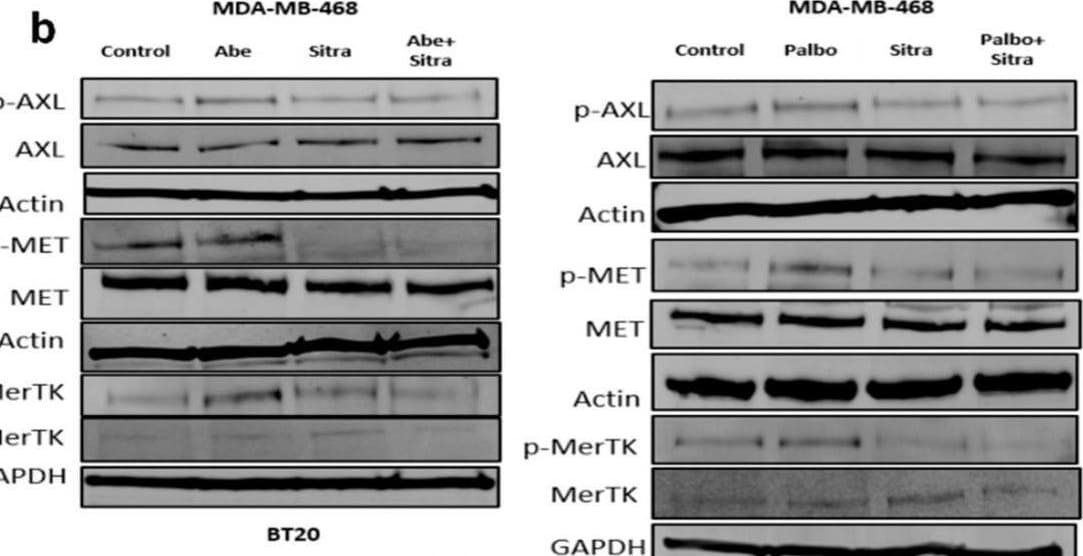
Detection of Phospho-Axl (Y779) by Western Blot
The combination of sitravatinib with abemaciclib or palbociclib is highly toxic against TNBC cells. (a) Chemical structure of sitravatinib (Sitra). (b) Immunoblot was performed on cell lines treated for 24 h with Abe (2 μm), Palbo (5 μm), and/or Sitra (2 μm). Protein levels were determined for phospho-AXL, phosho-MET, and phosho-MERTK. (c) The clonogenic assay showing that the combination of Abe or Palbo with Sitra significantly decreased the colony formation capacity of TNBC cells. Representative images of stained colonies. (d) Combination index (CI) values for the combinations of sitravatinib or merestinib with CDK4/6 inhibitor abemaciclib using different doses. Circles represent experimentally determined CI values using the Chou–Talalay method. The colors (orange and blue) represent the fixed ratio mixtures. (e,f) Overview of the toxicity and synergy scores of the drug combinations for TNBC lines. The heatmaps show the level of toxicity (e) and Bliss number (f) for the cell lines tested in this study. Average values of toxicity (e) or Bliss number (f) for cells treated with sitravatinib (S) at varying doses (S0 = No Drug, S1 = 1 μm, S2 = 2 μm, and S3 = 3 μm) in combination with either abemaciclib (A) at varying doses (A0 = No Drug, A1 = 1 μm, A2 =2 μm, A3 = 3 μm, and A4 = 4 μm) or palbociclib at varying doses (P0 = No Drug, P1 = 1 μm, P2 = 2 μm, P3 = 3 μm, and P4 = 4 μm). (g) Shown is the caspase-3/7 activity measured upon 24 h of drug treatments. The data are presented as mean ± SEM from three independent experiments, expressed as ratios to untreated control values, with associated p values as indicated (One-way ANOVA with Dunnett’s multiple comparisons test analysis). Abe: abemaciclib; Palbo: palbociclib. The original western blot figures can be found in File S1. Image collected and cropped by CiteAb from the following open publication (https://pubmed.ncbi.nlm.nih.gov/38927958), licensed under a CC-BY license. Not internally tested by R&D Systems.Applications for Human phospho-Axl (Y779) Antibody (713610)
Immunocytochemistry
Sample: Immersion fixed A172 human glioblastoma cell line treated with or without pervanadate
Simple Western
Sample: A172 human glioblastoma cell line treated with Pervanadate (PV)
Western Blot
Sample: A172 human glioblastoma cell line treated with Pervanadate (PV)
Formulation, Preparation, and Storage
Purification
Reconstitution
Sterile PBS to a final concentration of 0.5 mg/mL. For liquid material, refer to CoA for concentration.
Formulation
Shipping
Stability & Storage
- 12 months from date of receipt, -20 to -70 °C as supplied.
- 1 month, 2 to 8 °C under sterile conditions after reconstitution.
- 6 months, -20 to -70 °C under sterile conditions after reconstitution.
Calculators
Background: Axl
References
- Yanagita, M. (2004) Curr. Opin. Nephrol. Hypertens. 13:465.
- Nagata, K. et al. (1996) J. Biol. Chem. 22:30022.
- Holland, S. et al. (2005) Canc. Res. 65:9294.
- Weinger, J.G. et al. (2008) J. Neurochem. 106:134.
Long Name
Alternate Names
Gene Symbol
Additional Axl Products
Product Documents for Human phospho-Axl (Y779) Antibody (713610)
Certificate of Analysis
To download a Certificate of Analysis, please enter a lot or batch number in the search box below.
Note: Certificate of Analysis not available for kit components.
Product Specific Notices for Human phospho-Axl (Y779) Antibody (713610)
For research use only
Related Research Areas
Citations for Human phospho-Axl (Y779) Antibody (713610)
 Powered by Bioz
Customer Reviews for Human phospho-Axl (Y779) Antibody (713610)
There are currently no reviews for this product. Be the first to review Human phospho-Axl (Y779) Antibody (713610) and earn rewards!
Have you used Human phospho-Axl (Y779) Antibody (713610)?
Submit a review and receive an Amazon gift card!
$25/€18/£15/$25CAN/¥2500 for a review with an image
$10/€7/£6/$10CAN/¥1110 for a review without an image
Submit a review
Protocols
Find general support by application which include: protocols, troubleshooting, illustrated assays, videos and webinars.
- Appropriate Fixation of IHC/ICC Samples
- Cellular Response to Hypoxia Protocols
- ClariTSA™ Fluorophore Kits
- Detection & Visualization of Antibody Binding
- ICC Cell Smear Protocol for Suspension Cells
- ICC Immunocytochemistry Protocol Videos
- ICC for Adherent Cells
- Immunocytochemistry (ICC) Protocol
- Immunocytochemistry Troubleshooting
- Immunofluorescence of Organoids Embedded in Cultrex Basement Membrane Extract
- Immunohistochemistry (IHC) and Immunocytochemistry (ICC) Protocols
- Preparing Samples for IHC/ICC Experiments
- Preventing Non-Specific Staining (Non-Specific Binding)
- Primary Antibody Selection & Optimization
- Protocol for VisUCyte™ HRP Polymer Detection Reagent
- Protocol for the Fluorescent ICC Staining of Cell Smears - Graphic
- Protocol for the Fluorescent ICC Staining of Cultured Cells on Coverslips - Graphic
- Protocol for the Preparation and Fluorescent ICC Staining of Cells on Coverslips
- Protocol for the Preparation and Fluorescent ICC Staining of Non-adherent Cells
- Protocol for the Preparation and Fluorescent ICC Staining of Stem Cells on Coverslips
- Protocol for the Preparation of a Cell Smear for Non-adherent Cell ICC - Graphic
- R&D Systems Quality Control Western Blot Protocol
- TUNEL and Active Caspase-3 Detection by IHC/ICC Protocol
- The Importance of IHC/ICC Controls
- Troubleshooting Guide: Western Blot Figures
- Western Blot Conditions
- Western Blot Protocol
- Western Blot Protocol for Cell Lysates
- Western Blot Troubleshooting
- Western Blot Troubleshooting Guide
- View all Protocols, Troubleshooting, Illustrated assays and Webinars