Key Product Details

Species Reactivity

Validated:

Human

Cited:

Human, Mouse

Applications

Validated:

Immunohistochemistry, Western Blot, ELISA Capture (Matched Antibody Pair), Immunoprecipitation

Cited:

Immunohistochemistry, Western Blot, Neutralization, Immunocytochemistry, ELISA Detection

Label

Unconjugated

Antibody Source

Monoclonal Mouse IgG1 Clone # 183551
Loading...

Product Specifications

Immunogen

Mouse myeloma cell line NS0-derived recombinant human TIMP-3
Cys24-Pro211
Accession # P35625

Specificity

Detects human TIMP-3 in ELISAs and Western blots. In Western blots, no cross-reactivity with recombinant human TIMP-1, -2, or -4 is observed.

Clonality

Monoclonal

Host

Mouse

Isotype

IgG1

Scientific Data Images for Human TIMP‑3 Antibody

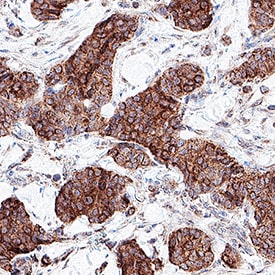
Detection of TIMP‑3 in Human Breast Tumor.

TIMP‑3 was detected in immersion fixed paraffin-embedded sections of human breast tumor using Mouse Anti-Human TIMP‑3 Monoclonal Antibody (Catalog # MAB973) at 5 µg/ml for 1 hour at room temperature followed by incubation with the Anti-Mouse IgG VisUCyte™ HRP Polymer Antibody (Catalog # VC001) or the HRP-conjugated Anti-Mouse IgG Secondary Antibody (Catalog # HAF007). Before incubation with the primary antibody, tissue was subjected to heat-induced epitope retrieval using VisUCyte Antigen Retrieval Reagent-Basic (Catalog # VCTS021). Tissue was stained using DAB (brown) and counterstained with hematoxylin (blue). Specific staining was localized to the cytoplasm of tumor cells. View our protocol for IHC Staining with VisUCyte HRP Polymer Detection Reagents.
Detection of TIMP-3 by Western Blot

Detection of TIMP-3 by Western Blot

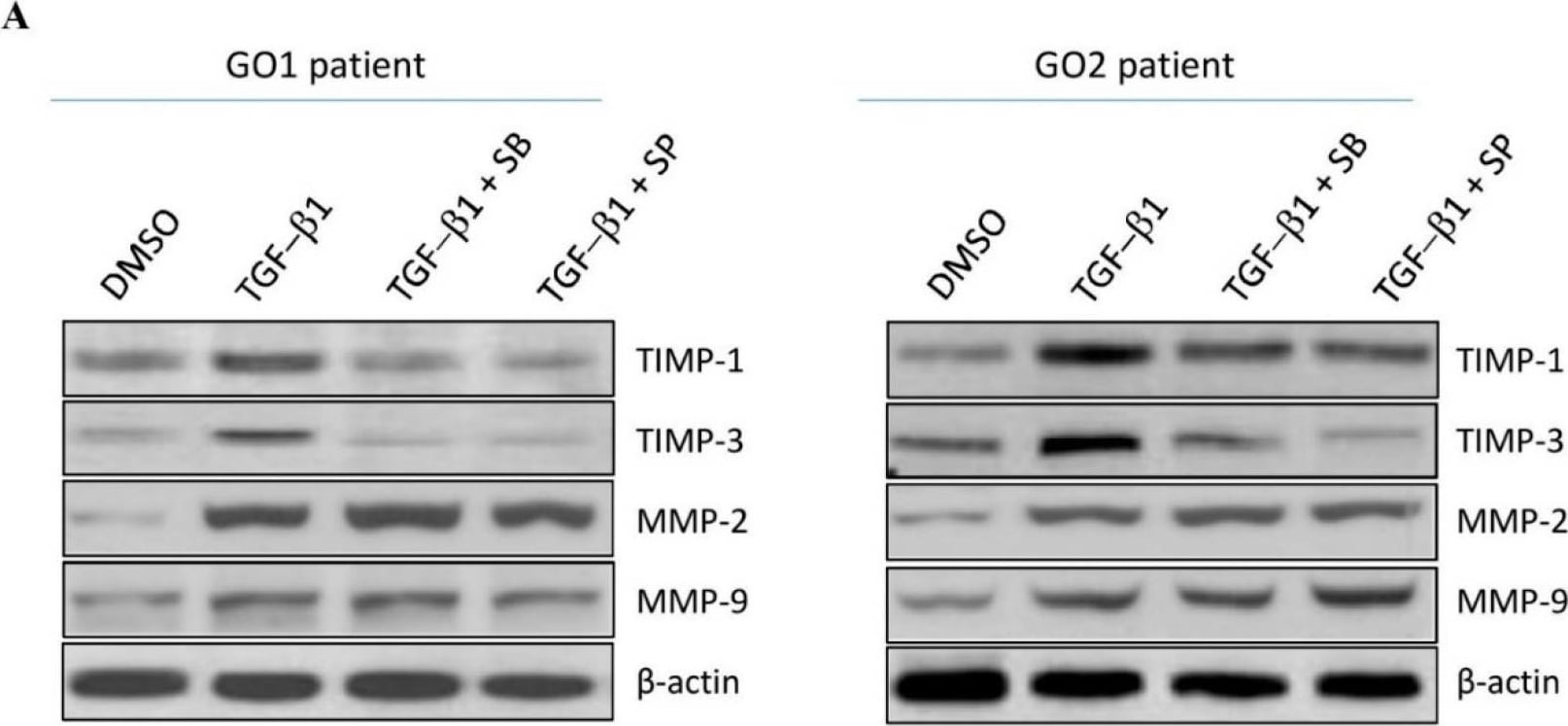
Abolishment of TGF-beta 1-mediated matrix remodeling by p38 and JNK inhibitors in the primary cultured orbital fibroblasts from patients with Graves’ ophthalmopathy (GO). (A) Orbital fibroblasts from GO patients were preincubated with the p38 inhibitor SB202190 (20 μM) and the JNK inhibitor SP600125 (20 μM), respectively, for 1 h, followed by TGF-beta 1 (5 ng/mL) treatment for another 24 h. Then, the expression levels of TIMP-1, TIMP-3, MMP-2, and MMP-9 were analyzed by Western blots; (B) The relative intensities of TIMP-1, TIMP-3, MMP-2, and MMP-9 expression normalized to each GAPDH control and DMSO control without TGF-beta 1 treatment were defined as 1.0. Then, the other relative intensity (folds) was presented. By three independent Western blot experiments, together data from the same patient strain were averaged. Then, the means of different patient (GO1–GO4, n = 4) strains were averaged; (C) The enzyme activities of MMP-2/-9 from the cultured medium were determined. The representative histogram was plotted based on the mean values of relative fluorescence units from the primary cultured orbital fibroblasts from the four GO patients. Data were presented as means ± S.D. of the results from three independent experiments. * p < 0.05 and ** p < 0.01 vs. control without TGF-beta 1 treatment; # p < 0.05 and ## p < 0.01 vs. TGF-beta 1 treatment. Image collected and cropped by CiteAb from the following open publication (https://pubmed.ncbi.nlm.nih.gov/33799469), licensed under a CC-BY license. Not internally tested by R&D Systems.

Applications for Human TIMP‑3 Antibody

Application
Recommended Usage

Immunohistochemistry

5-25 µg/mL
Sample: Immersion fixed paraffin-embedded sections of human breast cancer tissue

Immunoprecipitation

25 µg/mL
Sample: Conditioned cell culture medium spiked with Recombinant Human TIMP‑3 (Catalog # 973-TM), see our available Western blot detection antibodies

Western Blot

1 µg/mL
Sample: Recombinant Human TIMP‑3 (Catalog # 973-TM)

Human TIMP-3 Sandwich Immunoassay

ELISA Capture (Matched Antibody Pair)
Recommended Concentration: 2-8 µg/mL
Use in combination with these reagents:
  • Detection Reagent: Human TIMP‑3 Biotinylated Antibody (Catalog # BAM9731)
  • Standard: Recombinant Human TIMP-3 Protein, CF (Catalog # 973-TM)
Please Note: Optimal dilutions of this antibody should be experimentally determined.

Reviewed Applications

Read 1 review rated 1 using MAB973 in the following applications:

Formulation, Preparation, and Storage

Purification

Protein A or G purified from hybridoma culture supernatant

Reconstitution

Reconstitute at 0.5 mg/mL in sterile PBS. For liquid material, refer to CoA for concentration.


Loading...

Formulation

Lyophilized from a 0.2 μm filtered solution in PBS with Trehalose. See Certificate of Analysis for details.
*Small pack size (-SP) is supplied either lyophilized or as a 0.2 µm filtered solution in PBS.

Shipping

Lyophilized product is shipped at ambient temperature. Liquid small pack size (-SP) is shipped with polar packs. Upon receipt, store immediately at the temperature recommended below.

Stability & Storage

Use a manual defrost freezer and avoid repeated freeze-thaw cycles.
  • 12 months from date of receipt, -20 to -70 °C as supplied.
  • 1 month, 2 to 8 °C under sterile conditions after reconstitution.
  • 6 months, -20 to -70 °C under sterile conditions after reconstitution.

Calculators

The reconstitution calculator allows you to quickly calculate the volume of a reagent to reconstitute your vial. Simply enter the mass of reagent and the target concentration and the calculator will determine the rest.

=
÷

Background: TIMP-3

Tissue inhibitors of metalloproteinases (TIMPs) are a family of proteins that regulate the activation and proteolytic activity of the zinc enzymes known as matrix metalloproteinases (MMPs). There are four members of the family, TIMP-1, TIMP-2, TIMP-3 and TIMP-4. TIMP-3 is a glycoprotein with a molecular mass of 30 kDa produced by a wide range of cell types. TIMP-3 inhibits active MMP-mediated proteolysis by forming a non-covalent binary complex with the MMP active site through its N-terminal domain. In addition, TIMP-3 is the only known member of the TIMP family that is an effective inhibitor of ADAMs such as TACE (1).

TIMP-3 is unique among the TIMPs because of its high affinity for binding to the extracellular matrix (2). Point mutations in the TIMP-3 C-terminal domain have been reported to result in Sorsby's fundus dystrophy, a disease leading to macular degeneration and loss of vision.

References

  1. Amour, A. et al. (1998) FEBS Lett. 435:39.
  2. Leco, K.J. et al. (1994) J. Biol. Chem. 269:9352.

Long Name

Tissue Inhibitors of Metalloproteinases 3

Alternate Names

TIMP3

Entrez Gene IDs

7078 (Human); 21859 (Mouse); 25358 (Rat)

Gene Symbol

TIMP3

UniProt

Additional TIMP-3 Products

Product Documents for Human TIMP‑3 Antibody

Certificate of Analysis

To download a Certificate of Analysis, please enter a lot or batch number in the search box below.

Note: Certificate of Analysis not available for kit components.

Product Specific Notices for Human TIMP‑3 Antibody

For research use only

Citations for Human TIMP‑3 Antibody

Customer Reviews for Human TIMP‑3 Antibody (1)

1 out of 5
1 Customer Rating
5 Stars
0%
4 Stars
0%
3 Stars
0%
2 Stars
0%
1 Stars
100%

Have you used Human TIMP‑3 Antibody?

Submit a review and receive an Amazon gift card!

$25/€18/£15/$25CAN/¥2500 Yen for a review with an image

$10/€7/£6/$10CAN/¥1110 Yen for a review without an image

Submit a review
Amazon Gift Card

Customer Images


Showing  1 - 1 of 1 review Showing All
Filter By:
  • Human TIMP-3 Antibody
    Name: Techung Lee
    Application: Human TIMP3 cDNA overexpressed in HepG2 cells using a pCMV expression vector.
    Sample Tested: HepG2 human hepatocellular carcinoma cell line
    Species: Human
    Verified Customer | Posted 05/15/2020
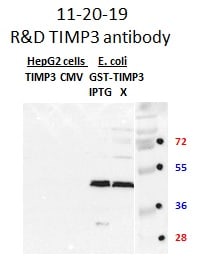
    Human TIMP3 cDNA was overexpressed in HepG2 cells using a pCMV expression vector. The cDNA was also fused to GST and expressed in E. coli BL21 cells using an IPTG inducible system.
    Human TIMP‑3 Antibody MAB973
    Bio-Techne Response
    Thank you for reviewing our product. We are sorry to hear that this product did not perform as expected. We have been in touch with the customer to resolve this issue according to our Product Guarantee and to the customer’s satisfaction.

There are no reviews that match your criteria.

Showing  1 - 1 of 1 review Showing All

Protocols

Find general support by application which include: protocols, troubleshooting, illustrated assays, videos and webinars.

FAQs

No product specific FAQs exist for this product.

View all FAQs for Antibodies
Loading...