
CD27 ligand (CD27L), also named CD70, is a type II transmembrane glycoprotein belonging to the TNF superfamily (TNFSF) and has been designated TNFSF7 (1, 2). Mouse CD27L cDNA encodes a 195 amino acid (aa) residue protein with a 23 aa N-terminal cytoplasmic domain, a 21 transmembrane domain and a 151 aa C‑terminal extracellular domain. Mouse and human CD27L share approximated 56% aa sequence identity. By analogy to other TNFSF ligands, CD27L is expected to exist as non-covalent homotrimers. The expression of CD27L is highly regulated at the transcription and posttranslational level (3). CD27L cell surface expression is induced by antigen receptor activation in B cells and at low levels in mouse T cells. Although CD27L expression is not detected on human dendritic cells (DC), membrane expression on mature mouse DCs has been reported. CD27L expression is also present in the thymus medulla in both human and mouse. CD27L interacts with CD27, a member of the TNF receptor superfamily that is expressed on natural killer (NK) cells and subsets of T and B cells (2, 4, 5). Ligation of CD27 on T cells provides costimulatory signals that are required for T cell proliferation, clonal expansion, and the promotion of effector T cell formation (2). Ligation of CD27 on mouse B cell has been shown to inhibit terminal differentiation of activated B cells into plasma cells and enhances commitment to memory B cell responses (5, 6). On NK cells, ligation of CD27 induces proliferation and IFN-gamma production (4).
Mouse CD27 Ligand/TNFSF7 Antibody
R&D Systems | Catalog # AF783


Scientific images may be resized, cropped, or adjusted for brightness or contrast for presentation purposes. These updates are limited to presentation and do not affect the underlying scientific interpretation of the data. Where available, additional source data may be provided upon request.
Key Product Details
Species Reactivity
Validated:
Cited:
Applications
Validated:
Cited:
Label
Antibody Source
Product Specifications
Immunogen
Gln47-Pro195
Accession # O55237
Specificity
Clonality
Host
Isotype
Endotoxin Level
Scientific Data Images for Mouse CD27 Ligand/TNFSF7 Antibody
Cell Proliferation Induced by CD27 Ligand/TNFSF7 and Neutralization by Mouse CD27 Ligand/TNFSF7 Anti-body.
In the presence of sub-optimal amounts of Mouse CD3e Monoclonal Antibody (Catalog # MAB484), Recombinant Mouse CD27 Ligand/TNFSF7 (Catalog # 783-CL) stimulates proliferation in mouse splenic T cells in a dose-dependent manner (orange line). Under these conditions, proliferation elicited by Recombinant Mouse CD27 Ligand/TNFSF7 (10 µg/mL) is neutralized (green line) by increasing concentrations of Goat Anti-Mouse CD27 Ligand/TNFSF7 Antigen Affinity-purified Polyclonal Antibody (Catalog # AF783). The ND50 is typically 3-12 µg/mL.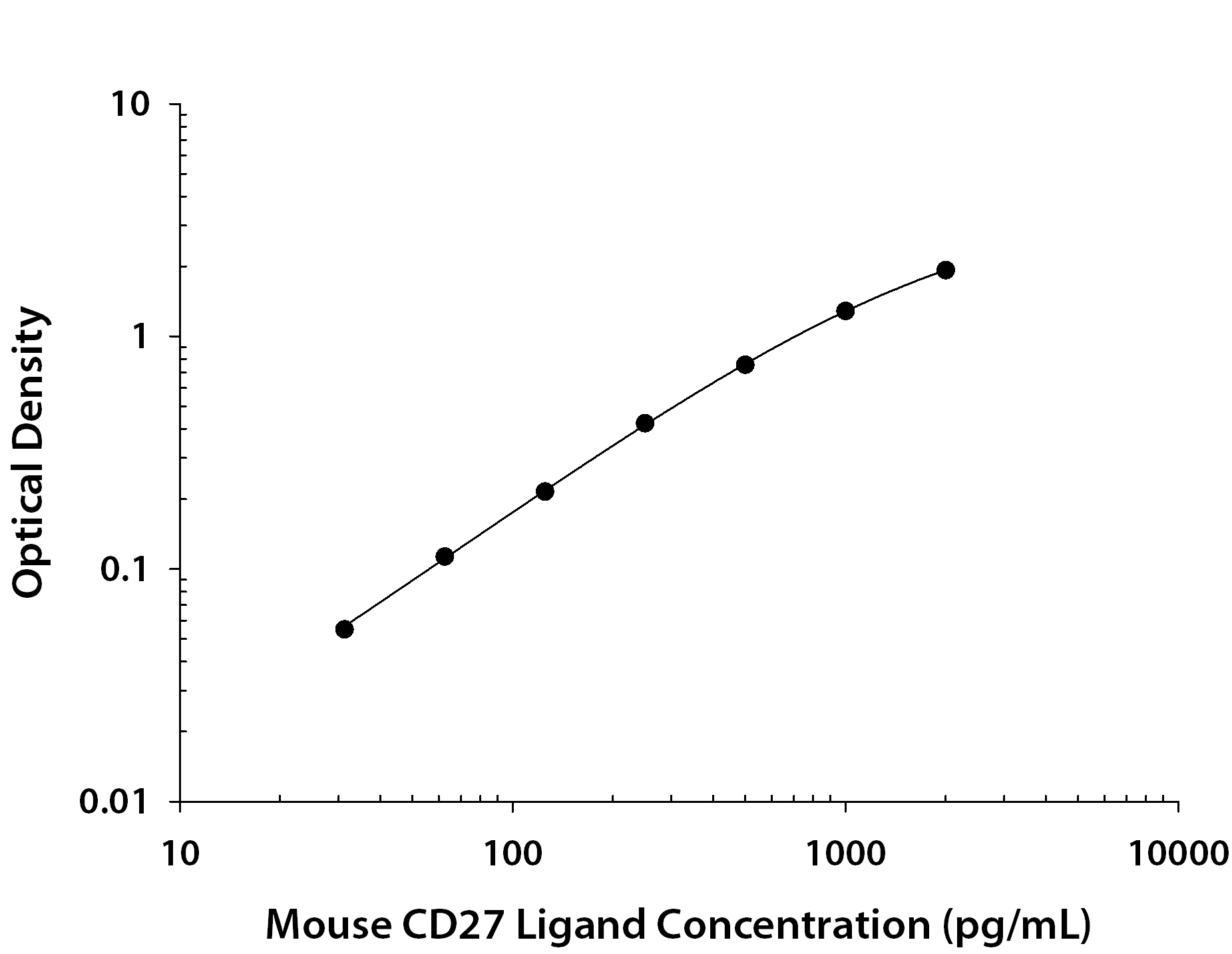
Mouse CD27 Ligand / TNFSF7 ELISA Standard Curve
Recombinant Mouse CD27 Ligand/TNFSF7 (Catalog # 783-CL) was serially diluted and captured by Rat Anti-Mouse CD27 Ligand/TNFSF7 Monoclonal Antibody (Catalog # MAB783) coated on a Clear Polystyrene Microplate (Catalog # DY990). Goat Anti-Mouse CD27 Ligand/TNFSF7 Antigen Affinity-purified Polyclonal Antibody (Catalog # AF783) was biotinylated and incubated with the protein captured on the plate. Detection of the standard curve was achieved by incubating Streptavidin-HRP (Catalog # DY998)Applications for Mouse CD27 Ligand/TNFSF7 Antibody
Western Blot
Sample: Recombinant Mouse CD27 Ligand/TNFSF7 (Catalog # 783-CL)
Neutralization
Formulation, Preparation, and Storage
Purification
Reconstitution
Reconstitute at 0.2 mg/mL in sterile PBS. For liquid material, refer to CoA for concentration.
Formulation
Shipping
Stability & Storage
- 12 months from date of receipt, -20 to -70 °C as supplied.
- 1 month, 2 to 8 °C under sterile conditions after reconstitution.
- 6 months, -20 to -70 °C under sterile conditions after reconstitution.
Calculators
Background: CD27 Ligand/TNFSF7
References
- Hitzen, R.Q. et al. (1994) Immunol. Today 15:307.
- Croft, M. (2003) Nature Reviews Immunol. 3:609.
- Tesselaar, K. et al. (2003) J. Immunol. 169:33.
- Takeda, K. et al. (2000) J. Immunol. 164:1741.
- Kobata, T.S. et al. (1995) Proc. Natl. Acad. Sci. USA 92:11249.
- Raman, V.S. et al. (2003) J. Immunol. 171:5876.
Alternate Names
Gene Symbol
UniProt
Additional CD27 Ligand/TNFSF7 Products
Product Documents for Mouse CD27 Ligand/TNFSF7 Antibody
Certificate of Analysis
To download a Certificate of Analysis, please enter a lot or batch number in the search box below.
Note: Certificate of Analysis not available for kit components.
Product Specific Notices for Mouse CD27 Ligand/TNFSF7 Antibody
For research use only
Citations for Mouse CD27 Ligand/TNFSF7 Antibody
 Powered by Bioz
Customer Reviews for Mouse CD27 Ligand/TNFSF7 Antibody
There are currently no reviews for this product. Be the first to review Mouse CD27 Ligand/TNFSF7 Antibody and earn rewards!
Have you used Mouse CD27 Ligand/TNFSF7 Antibody?
Submit a review and receive an Amazon gift card!
$25/€18/£15/$25CAN/¥2500 for a review with an image
$10/€7/£6/$10CAN/¥1110 for a review without an image
Submit a review
Protocols
Find general support by application which include: protocols, troubleshooting, illustrated assays, videos and webinars.
- Cellular Response to Hypoxia Protocols
- R&D Systems Quality Control Western Blot Protocol
- Troubleshooting Guide: Western Blot Figures
- Western Blot Conditions
- Western Blot Protocol
- Western Blot Protocol for Cell Lysates
- Western Blot Troubleshooting
- Western Blot Troubleshooting Guide
- View all Protocols, Troubleshooting, Illustrated assays and Webinars
Associated Pathways
