
Mouse IFITM3/CD225 (also Fragilis) is a 137 amino acids (aa) 2-transmembrane protein that belongs to the Fragilis family of interferon-inducible genes. It contains two terminal extracellular domains (aa 1-57 and 131-137) and one cytoplasmic region that potentially allows for multiple phosphorylations. The N-terminal extracellular region of mouse IFITM3 shares 54%, 91%, and 58% amino acid sequence identity to the equivalent region in bovine, rat and human IFITM3, respectively. IFITM3 seems to be involved in primordial germ cell clustering and regionalization.
Mouse IFITM3/Fragilis Antibody
R&D Systems | Catalog # AF3377


Scientific images may be resized, cropped, or adjusted for brightness or contrast for presentation purposes. These updates are limited to presentation and do not affect the underlying scientific interpretation of the data. Where available, additional source data may be provided upon request.
Key Product Details
Validated by
Biological Validation
Species Reactivity
Validated:
Mouse
Cited:
Human, Mouse
Applications
Validated:
Immunohistochemistry, Western Blot
Cited:
Immunohistochemistry-Paraffin, Western Blot, Immunocytochemistry
Label
Unconjugated
Antibody Source
Polyclonal Goat IgG
Loading...
Product Specifications
Immunogen
E. coli-derived recombinant mouse IFITM3/Fragilis
Asn2-His57
Accession # Q9CQW9
Asn2-His57
Accession # Q9CQW9
Specificity
Detects mouse IFITM3/Fragilis in direct ELISAs and Western blots. In direct ELISAs, approximately 50% cross-reactivity with recombinant human IFITM3 is observed.
Clonality
Polyclonal
Host
Goat
Isotype
IgG
Scientific Data Images for Mouse IFITM3/Fragilis Antibody
Detection of Mouse IFITM3/Fragilis by Western Blot.
Western blot shows lysates of NIH-3T3 mouse embryonic fibroblast cell line, D3 mouse embryonic stem cell line, and NTera-2 human testicular embryonic carcinoma cell line. PVDF membrane was probed with 1 µg/mL of Goat Anti-Mouse IFITM3/Fragilis Antigen Affinity-purified Polyclonal Antibody (Catalog # AF3377) followed by HRP-conjugated Anti-Goat IgG Secondary Antibody (Catalog # HAF019). A specific band was detected for IFITM3/Fragilis at approximately 17 kDa (as indicated). This experiment was conducted under reducing conditions and using Immunoblot Buffer Group 8.
IFITM3/Fragilis in Embryonic Mouse Ovary.
IFITM3/Fragilis was detected in immersion fixed frozen sections of embryonic mouse ovary (E13.5) using 10 µg/mL Goat Anti-Mouse IFITM3/Fragilis Antigen Affinity-purified Polyclonal Antibody (Catalog # AF3377) overnight at 4 °C. Tissue was stained with the NorthernLights™ 557-conjugated Anti-Goat IgG Secondary Antibody (red; Catalog # NL001) and counterstained with DAPI (blue). View our protocol for Fluorescent IHC Staining of Frozen Tissue Sections.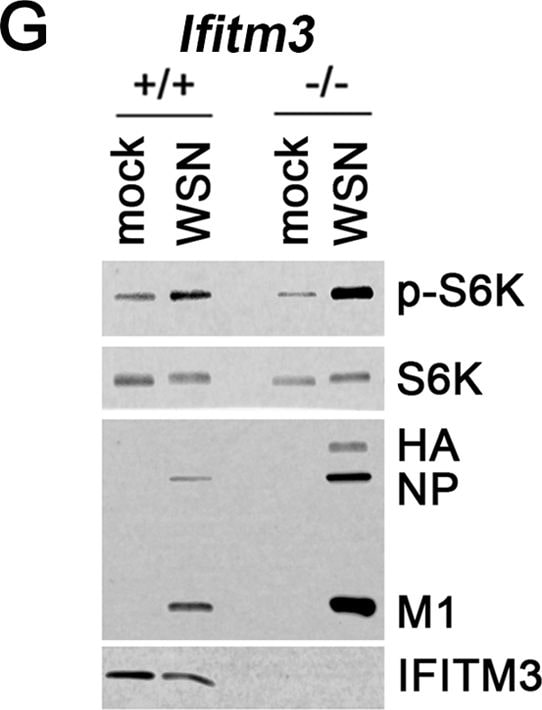
Detection of Mouse IFITM3/Fragilis by Western Blot
Viral replication is required for influenza virus to activate mTORC1 independently of NS1.(A, B) Vero cells were infected with (A) WSN or (B) PR8 wild-type or mutant viruses lacking NS1 at MOI of 2 PFU/cell for 6 h. (C,D) HCT116 Akt1/2+/+ and Akt1/2-/- were infected with WSN delta NS1 or WSN at MOI of 5 PFU/cell for 10h. (E) A549 cells were infected with WSN or UV-inactivated WSN at MOI of 2 PFU/cell for 6h. (F) Mavs+/+ and Mavs-/- or (G) Ifitm3+/+ and Ifitm3-/- MEFs were infected with WSN at an MOI of 2 PFU/cell for 6 h. Immunoblot analyses were performed for detection of viral proteins (NS1, HA, NP and M1) and host proteins ( beta -actin, MAVS, IFITM3 as well as total and phosphorylated S6K, AKT and 4E-BP1). beta -actin and total S6K serve as loading controls. The upper band in the S6K/p-S6K blots is p85 S6K whereas the lower band is p70 S6K. Data are representative of three independent experiments. Image collected and cropped by CiteAb from the following publication (https://dx.plos.org/10.1371/journal.ppat.1006635), licensed under a CC-BY license. Not internally tested by R&D Systems.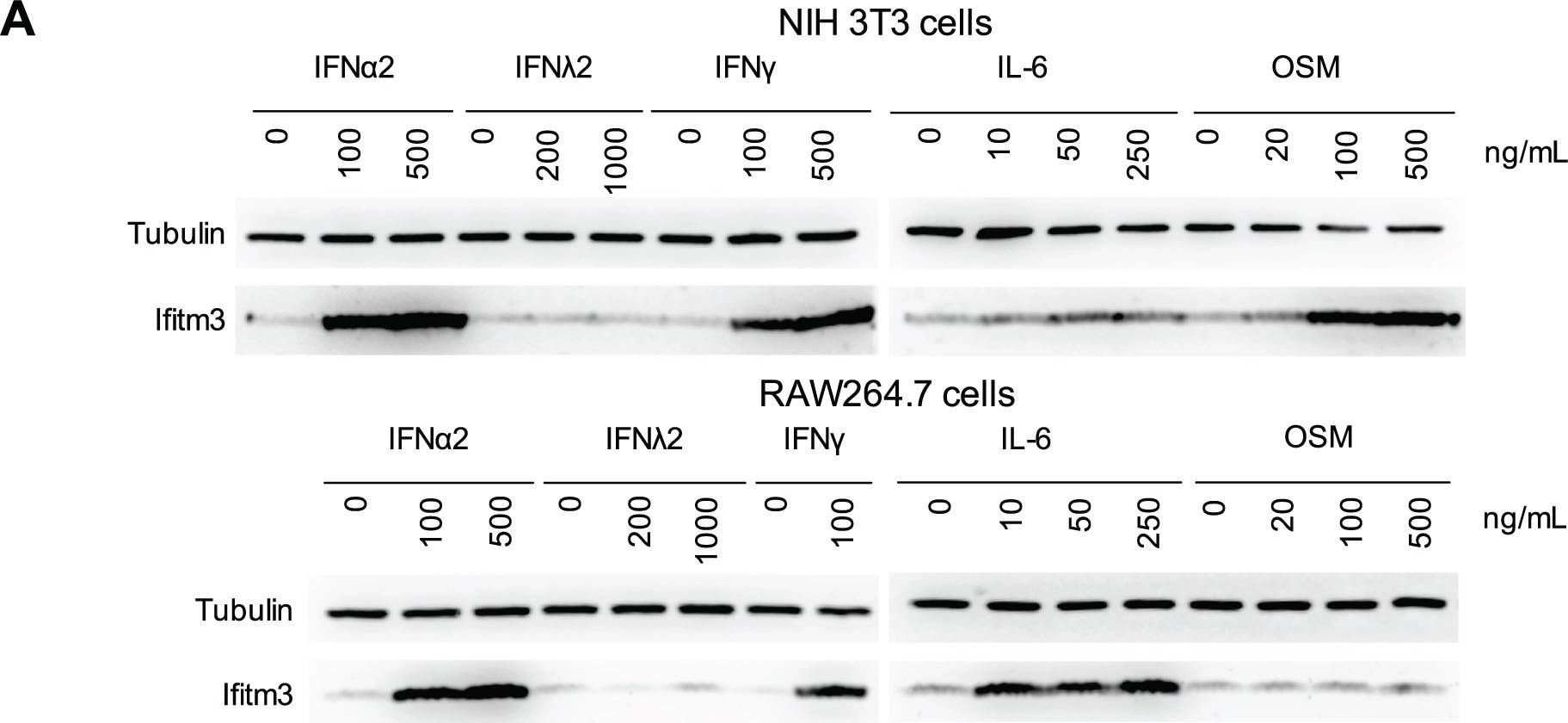
Detection of Mouse IFITM3/Fragilis by Western Blot
Both interferons and gp130-mediated cytokines induce Ifitm3 expression.Ifitm3 protein expression can also be induced by gp130-family cytokines in cells expressing appropriate receptors. The Ifitm3 promoter alone among murine Ifitm promoters is interferon responsive. (A) Expression of Ifitm3 was determined by western blot in NIH 3T3 and RAW 264.7 cells treated for 2 days with the indicated cytokines. IFN lambda 2 failed to induce Ifitm3 expression at similar concentrations, likely due to lack of the type III IFN receptor. The gp130-family cytokine oncostatin M (OSM) was a potent inducer of Ifitm3 expression in 3T3 cells whereas RAW264.7 cells were responsive to IL-6, but not OSM. (B) Surface expression of the OSM receptor, IL-6 receptor, and gp130 by NIH 3T3 and RAW264.7 cells was determined by flow cytometry. Solid blue lines correspond to the fluorescence signal of the indicated receptor-binding antibodies and red lines show fluorescence of the isotype control. The responsiveness of 3T3 and RAW cells to OSM and IL-6 respectively (as shown in panel A) correlates with their expression of their corresponding receptors. (C) Activities of the six murine Ifitm promoters were assayed in mock-treated, IFN alpha 2-treated, and IFN gamma -treated NIH 3T3 cells transfected with plasmids encoding luciferase under the control of the indicated promoters. Ifitm1, 2, and 6 promoters appear constitutively active, and in contrast to human orthologs, insensitive to interferon stimulation. The Ifitm5 promoter shows almost no activity under any condition, consistent with its tissue-restricted expression in vivo[15]. The Ifitm3 promoter alone is interferon responsive (4.4-fold induction with IFN alpha 2; 2.2-fold with IFN gamma ). Bars show mean of triplicates ± SEM. Asterisk indicates p<0.0001 (two-factor ANOVA Bonferroni post test). (D) Cytokine regulation of Ifitm1, 2, and 3 was confirmed at the mRNA level by qRT-PCR in both 3T3 and RAW cells. Bars depict fold upregulation of the indicated transcripts following aApplications for Mouse IFITM3/Fragilis Antibody
Application
Recommended Usage
Immunohistochemistry
5-15 µg/mL
Sample: Immersion fixed frozen sections of embryonic mouse ovary (E13.5)
Sample: Immersion fixed frozen sections of embryonic mouse ovary (E13.5)
Western Blot
1 µg/mL
Sample: NIH‑3T3 mouse embryonic fibroblast cell line, D3 mouse embryonic stem cell line, and NTera‑2 human testicular embryonic carcinoma cell line
Sample: NIH‑3T3 mouse embryonic fibroblast cell line, D3 mouse embryonic stem cell line, and NTera‑2 human testicular embryonic carcinoma cell line
Formulation, Preparation, and Storage
Purification
Antigen Affinity-purified
Reconstitution
Reconstitute at 0.2 mg/mL in sterile PBS. For liquid material, refer to CoA for concentration.
Loading...
Formulation
Lyophilized from a 0.2 μm filtered solution in PBS with Trehalose. *Small pack size (SP) is supplied either lyophilized or as a 0.2 µm filtered solution in PBS.
Shipping
Lyophilized product is shipped at ambient temperature. Liquid small pack size (-SP) is shipped with polar packs. Upon receipt, store immediately at the temperature recommended below.
Stability & Storage
Use a manual defrost freezer and avoid repeated freeze-thaw cycles.
- 12 months from date of receipt, -20 to -70 °C as supplied.
- 1 month, 2 to 8 °C under sterile conditions after reconstitution.
- 6 months, -20 to -70 °C under sterile conditions after reconstitution.
Calculators
Background: IFITM3/Fragilis
Long Name
Interferon-induced Transmembrane Protein 3
Alternate Names
Fragilis, IP15, mil-1
Gene Symbol
IFITM3
UniProt
Additional IFITM3/Fragilis Products
Product Documents for Mouse IFITM3/Fragilis Antibody
Certificate of Analysis
To download a Certificate of Analysis, please enter a lot or batch number in the search box below.
Note: Certificate of Analysis not available for kit components.
Product Specific Notices for Mouse IFITM3/Fragilis Antibody
For research use only
Related Research Areas
Citations for Mouse IFITM3/Fragilis Antibody
 Powered by Bioz
Customer Reviews for Mouse IFITM3/Fragilis Antibody
There are currently no reviews for this product. Be the first to review Mouse IFITM3/Fragilis Antibody and earn rewards!
Have you used Mouse IFITM3/Fragilis Antibody?
Submit a review and receive an Amazon gift card!
$25/€18/£15/$25CAN/¥2500 for a review with an image
$10/€7/£6/$10CAN/¥1110 for a review without an image
Submit a review
Protocols
Find general support by application which include: protocols, troubleshooting, illustrated assays, videos and webinars.
- Antigen Retrieval Protocol (PIER)
- Antigen Retrieval for Frozen Sections Protocol
- Appropriate Fixation of IHC/ICC Samples
- Cellular Response to Hypoxia Protocols
- Chromogenic IHC Staining of Formalin-Fixed Paraffin-Embedded (FFPE) Tissue Protocol
- Chromogenic Immunohistochemistry Staining of Frozen Tissue
- ClariTSA™ Fluorophore Kits
- Detection & Visualization of Antibody Binding
- Fluorescent IHC Staining of Frozen Tissue Protocol
- Graphic Protocol for Heat-induced Epitope Retrieval
- Graphic Protocol for the Preparation and Fluorescent IHC Staining of Frozen Tissue Sections
- Graphic Protocol for the Preparation and Fluorescent IHC Staining of Paraffin-embedded Tissue Sections
- Graphic Protocol for the Preparation of Gelatin-coated Slides for Histological Tissue Sections
- IHC Sample Preparation (Frozen sections vs Paraffin)
- Immunofluorescent IHC Staining of Formalin-Fixed Paraffin-Embedded (FFPE) Tissue Protocol
- Immunohistochemistry (IHC) and Immunocytochemistry (ICC) Protocols
- Immunohistochemistry Frozen Troubleshooting
- Immunohistochemistry Paraffin Troubleshooting
- Preparing Samples for IHC/ICC Experiments
- Preventing Non-Specific Staining (Non-Specific Binding)
- Primary Antibody Selection & Optimization
- Protocol for Heat-Induced Epitope Retrieval (HIER)
- Protocol for Making a 4% Formaldehyde Solution in PBS
- Protocol for VisUCyte™ HRP Polymer Detection Reagent
- Protocol for the Preparation & Fixation of Cells on Coverslips
- Protocol for the Preparation and Chromogenic IHC Staining of Frozen Tissue Sections
- Protocol for the Preparation and Chromogenic IHC Staining of Frozen Tissue Sections - Graphic
- Protocol for the Preparation and Chromogenic IHC Staining of Paraffin-embedded Tissue Sections
- Protocol for the Preparation and Chromogenic IHC Staining of Paraffin-embedded Tissue Sections - Graphic
- Protocol for the Preparation and Fluorescent IHC Staining of Frozen Tissue Sections
- Protocol for the Preparation and Fluorescent IHC Staining of Paraffin-embedded Tissue Sections
- Protocol for the Preparation of Gelatin-coated Slides for Histological Tissue Sections
- R&D Systems Quality Control Western Blot Protocol
- TUNEL and Active Caspase-3 Detection by IHC/ICC Protocol
- The Importance of IHC/ICC Controls
- Troubleshooting Guide: Immunohistochemistry
- Troubleshooting Guide: Western Blot Figures
- Western Blot Conditions
- Western Blot Protocol
- Western Blot Protocol for Cell Lysates
- Western Blot Troubleshooting
- Western Blot Troubleshooting Guide
- View all Protocols, Troubleshooting, Illustrated assays and Webinars
Loading...