

Key Product Details

Validated by

Biological Validation

Species Reactivity

Validated:

Mouse

Cited:

Mouse, Rat

Applications

Validated:

Immunohistochemistry, Western Blot, Neutralization

Cited:

Immunohistochemistry, Immunohistochemistry-Paraffin, Immunohistochemistry-Frozen, Western Blot, Neutralization, Flow Cytometry, In vivo assay, Neutralizing

Label

Unconjugated

Antibody Source

Polyclonal Goat IgG
Loading...

Product Specifications

Immunogen

E. coli-derived recombinant mouse OSM
Ala24-Arg206
Accession # P53347

Specificity

Detects mouse OSM in direct ELISAs and Western blots. In direct ELISAs, less than 2% cross-reactivity with recombinant human OSM is observed.

Clonality

Polyclonal

Host

Goat

Isotype

IgG

Endotoxin Level

<0.10 EU per 1 μg of the antibody by the LAL method.

Scientific Data Images for Mouse Oncostatin M/OSM Antibody

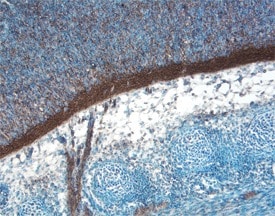
Oncostatin M/OSM antibody in Mouse Embryo by Immunohistochemistry (IHC-Fr).

Oncostatin M/OSM in Mouse Embryo.

Oncostatin M/OSM was detected in immersion fixed frozen sections of mouse embryo (15 d.p.c, section through spinal cord) using Mouse Oncostatin M/OSM Antigen Affinity-purified Polyclonal Antibody (Catalog # AF-495-NA) at 15 µg/mL overnight at 4 °C. Tissue was stained using the Anti-Goat HRP-DAB Cell & Tissue Staining Kit (brown; Catalog # CTS008) and counterstained with hematoxylin (blue). View our protocol for Chromogenic IHC Staining of Frozen Tissue Sections.
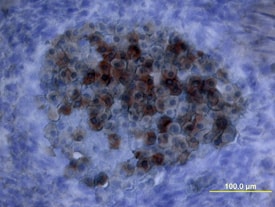
Oncostatin M/OSM antibody in Mouse Embryo by Immunohistochemistry (IHC-Fr).

Oncostatin M/OSM in Mouse Embryo.

Oncostatin M/OSM was detected in immersion fixed frozen sections of mouse embryo using Mouse Oncostatin M/OSM Antigen Affinity-purified Polyclonal Antibody (Catalog # AF-495-NA) at 15 µg/mL overnight at 4 °C. Tissue was stained using the Anti-Goat HRP-DAB Cell & Tissue Staining Kit (brown; Catalog # CTS008) and counterstained with hematoxylin (blue). View our protocol for Chromogenic IHC Staining of Frozen Tissue Sections.
Cell Proliferation Induced by Oncostatin M/OSM and Neutralization by Mouse Oncostatin M/OSM Antibody.

Cell Proliferation Induced by Oncostatin M/OSM and Neutralization by Mouse Oncostatin M/OSM Antibody.

Recombinant Mouse Oncostatin M/OSM (Catalog # 495-MO) stimulates proliferation in the NIH‑3T3 mouse embryonic fibroblast cell line in a dose-dependent manner (orange line). Proliferation elicited by Recombinant Mouse Oncostatin M/OSM (15 ng/mL) is neutralized (green line) by increasing concentrations of Mouse Oncostatin M/OSM Antigen Affinity-purified Polyclonal Antibody (Catalog # AF-495-NA). The ND50 is typically 0.6-3.0 µg/mL.
Detection of Mouse Oncostatin M/OSM by Western Blot

Detection of Mouse Oncostatin M/OSM by Western Blot

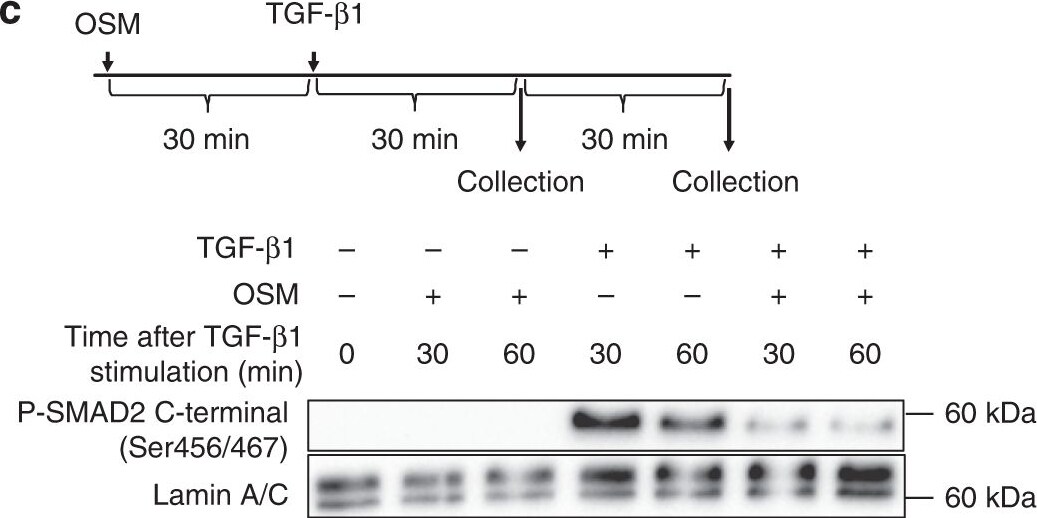
OSM suppresses SMAD signaling. a After pretreatment with the OSM (10 ng per ml) or IL6 (20 ng per ml), C3H/10T1/2 cells were stimulated with TGF-beta 1 (2.5 ng per ml, 12 h) and the relative expression level of alpha SMA mRNA was calculated. The one-way ANOVA and Dunnett’s multiple comparisons test were used for the statistical analysis (F (2, 6) = 97.35). b Immunoblot analysis of phospho-ERK1/2, total ERK1/2, phospho-SMAD2 linker (Ser245/250/255) and total SMAD2 protein. Thirty minutes after U0126 (20 nM) pretreatment, C3H/10T1/2 cells were stimulated with OSM (10 ng per ml) or IL6 (20 ng per ml) for 30 min. and collected for the analysis. U0126: a selective MEK1/2 inhibitor. c Immunoblot analysis of phospho-SMAD2 C-terminal (Ser465/467) and Lamin A/C. Thirty minutes after OSM (10 ng per ml) pretreatment, C3H/10T1/2 cells were stimulated with TGF-beta 1 (2.5 ng per ml, 12 h) and collected at indicated time points. d After pretreatment with U0126 (20 μM, 60 min) and OSM (10 ng per ml, 30 min), C3H/10T1/2 cells were stimulated with TGF-beta 1 (2.5 ng per ml, 12 h) and the relative expression level of alpha SMA mRNA was calculated. Two-tailed t-test with Welch’s correction was used for the statistical analysis (t = 3.212, df = 3.172). Data show the mean and the standard deviation (error bar) of technical triplicates from a representative experiment (a, d). *p < 0.05. Image collected and cropped by CiteAb from the following open publication (https://pubmed.ncbi.nlm.nih.gov/31249305), licensed under a CC-BY license. Not internally tested by R&D Systems.
Detection of Mouse Oncostatin M/OSM by Immunohistochemistry

Detection of Mouse Oncostatin M/OSM by Immunohistochemistry

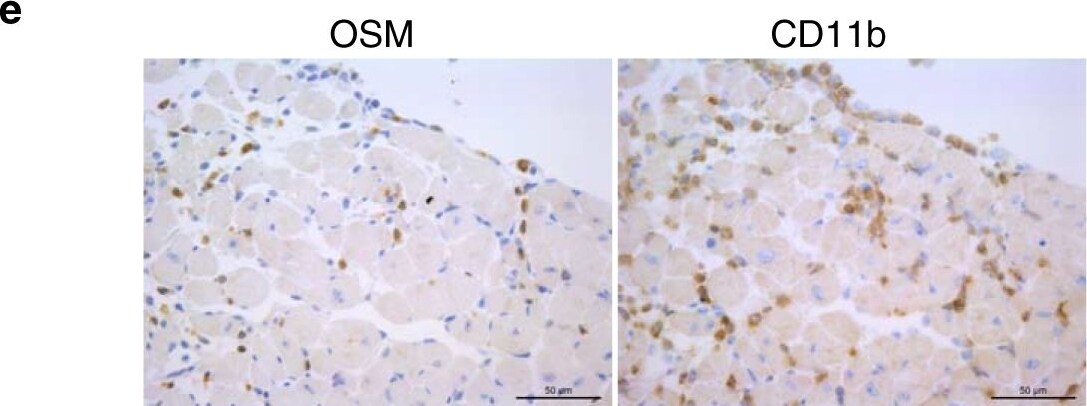
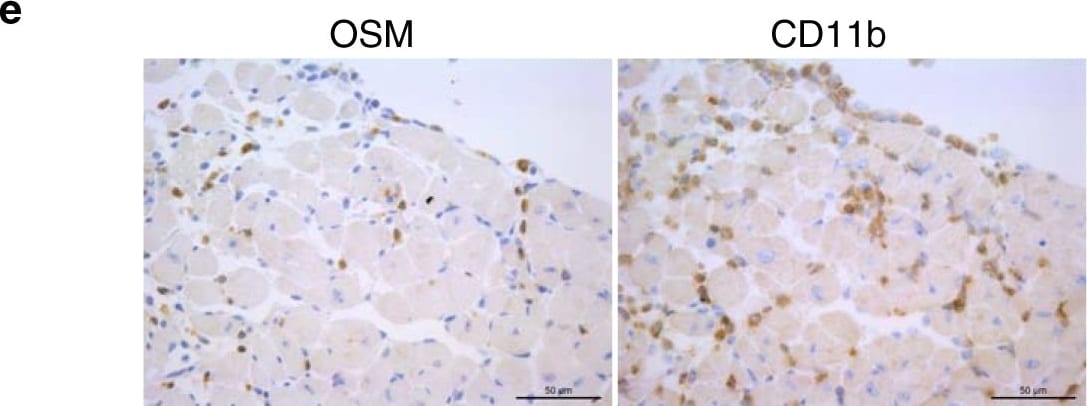
Oncostatin M from hypoxic MΦ inhibits fibroblast activation. a Supernatants were collected from thioglycollate-elicited peritoneal macrophages (TEPMs) under normoxic or hypoxic condition. After pretreatment with the supernatants, C3H/10T1/2 cells were stimulated with TGF-beta 1 (2.5 ng per ml, 12 h) and the relative expression of alpha SMA mRNA was calculated (right). The one-way ANOVA and Dunnett’s multiple comparisons test were used for the statistical analysis (F (2, 6) = 6.019). b We performed transcriptome analysis in isolated primary TEPMs from hematopoietic/endothelial-specific HIF-1 alpha conditional knockout mice (HIF-1 alpha flox/flox; Tie2-cre+/− mice; HIF-1 alpha KO) or cre negative littermate control. Flow chart shows the strategy to identify hypoxia-inducible secretory factors (left). Table illustrates the identified 11 hypoxia-inducible secretory factors (right). c The effect of each hypoxic inducible secretory factor in fibroblasts activation was examined (20 ng per ml for CTGF, CXCL2, CXCL3, LIF and 10 ng per ml for OSM). Thirty minutes after pretreatment with hypoxia-inducible secretory factors, C3H/10T1/2 cells were stimulated with TGF-beta 1 (2.5 ng per ml, 12 h) and the relative expression of alpha SMA mRNA was calculated. The one-way ANOVA and Dunnett’s multiple comparisons test were used for the statistical analysis (F (5, 12) = 68.07). d The effect of oncostatin M (OSM) (10 ng per ml) in primary cardiac fibroblasts activation was examined. Thirty minutes after pretreatment with OSM (10 ng per ml, 12 h), C3H/10T1/2 cells were stimulated with TGF-beta 1 (2.5 ng per ml, 12 h) and the relative expression of alpha SMA mRNA was calculated. Two-tailed t-test with Welch’s correction was used for the statistical analysis (t = 10.89, df = 2.208). Data show the mean and the standard deviation (error bar) of technical triplicates from a representative experiment. e Immunohistological staining were performed using cardiac tissues from TAC operated mice (day 3). OSM (left), CD11b (right). Scale bar = 50 μm. *p < 0.05. Image collected and cropped by CiteAb from the following open publication (https://pubmed.ncbi.nlm.nih.gov/31249305), licensed under a CC-BY license. Not internally tested by R&D Systems.
Detection of Mouse Oncostatin M/OSM by Immunohistochemistry

Detection of Mouse Oncostatin M/OSM by Immunohistochemistry

Oncostatin M from hypoxic MΦ inhibits fibroblast activation. a Supernatants were collected from thioglycollate-elicited peritoneal macrophages (TEPMs) under normoxic or hypoxic condition. After pretreatment with the supernatants, C3H/10T1/2 cells were stimulated with TGF-beta 1 (2.5 ng per ml, 12 h) and the relative expression of alpha SMA mRNA was calculated (right). The one-way ANOVA and Dunnett’s multiple comparisons test were used for the statistical analysis (F (2, 6) = 6.019). b We performed transcriptome analysis in isolated primary TEPMs from hematopoietic/endothelial-specific HIF-1 alpha conditional knockout mice (HIF-1 alpha flox/flox; Tie2-cre+/− mice; HIF-1 alpha KO) or cre negative littermate control. Flow chart shows the strategy to identify hypoxia-inducible secretory factors (left). Table illustrates the identified 11 hypoxia-inducible secretory factors (right). c The effect of each hypoxic inducible secretory factor in fibroblasts activation was examined (20 ng per ml for CTGF, CXCL2, CXCL3, LIF and 10 ng per ml for OSM). Thirty minutes after pretreatment with hypoxia-inducible secretory factors, C3H/10T1/2 cells were stimulated with TGF-beta 1 (2.5 ng per ml, 12 h) and the relative expression of alpha SMA mRNA was calculated. The one-way ANOVA and Dunnett’s multiple comparisons test were used for the statistical analysis (F (5, 12) = 68.07). d The effect of oncostatin M (OSM) (10 ng per ml) in primary cardiac fibroblasts activation was examined. Thirty minutes after pretreatment with OSM (10 ng per ml, 12 h), C3H/10T1/2 cells were stimulated with TGF-beta 1 (2.5 ng per ml, 12 h) and the relative expression of alpha SMA mRNA was calculated. Two-tailed t-test with Welch’s correction was used for the statistical analysis (t = 10.89, df = 2.208). Data show the mean and the standard deviation (error bar) of technical triplicates from a representative experiment. e Immunohistological staining were performed using cardiac tissues from TAC operated mice (day 3). OSM (left), CD11b (right). Scale bar = 50 μm. *p < 0.05 Image collected and cropped by CiteAb from the following open publication (https://pubmed.ncbi.nlm.nih.gov/31249305), licensed under a CC-BY license. Not internally tested by R&D Systems.
Detection of Mouse Oncostatin M/OSM by Flow Cytometry

Detection of Mouse Oncostatin M/OSM by Flow Cytometry

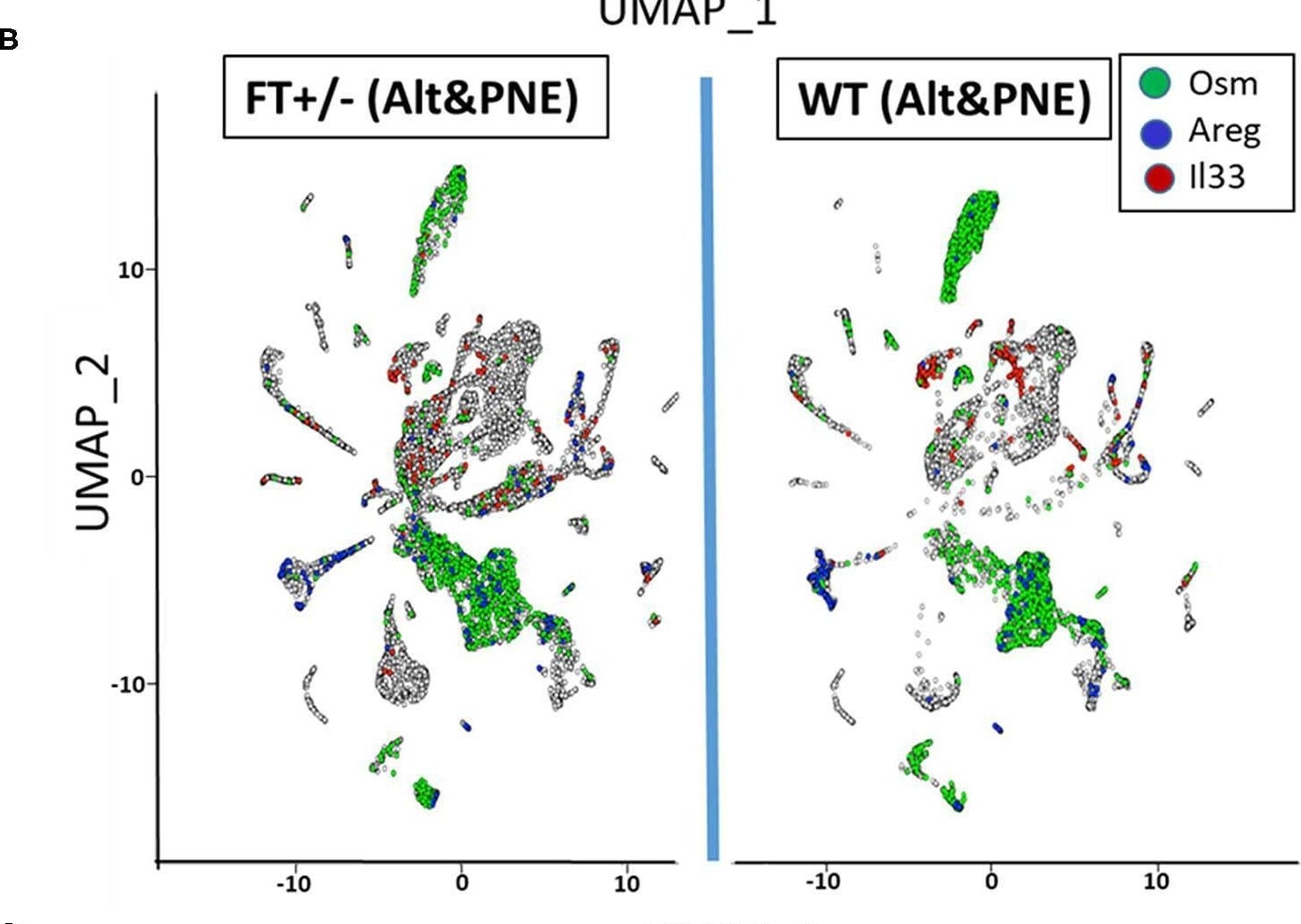
UMAP visualization of skin scRNAseq analysis. (A) UMAPs of scRNAseq from skin punches of FT+/− and WT neonates treated with Alt or Alt/PNE with cluster-specific cell type annotation. (B) UMAP projection of skin cells expressing Osm (green), Areg (blue), and Il33 (red) above the threshold expression value (Seurat log Normalized) >1.5. Annotated cell type designation to numbered clusters in (A) is listed as follows; Dendritic, dendritic cells; Endo, endothelial cells; Fib, fibroblasts; ILC, innate lymphoid cells; KC, keratinocytes; Mac, macrophages; PMN, neutrophils; SM, smooth muscle cells; Stem, stem cells. (C) Cell clusters with abundant gene expression of Osm, Areg, and Il33. Image collected and cropped by CiteAb from the following open publication (https://pubmed.ncbi.nlm.nih.gov/35387035), licensed under a CC-BY license. Not internally tested by R&D Systems.

Applications for Mouse Oncostatin M/OSM Antibody

Application
Recommended Usage

Immunohistochemistry

5-15 µg/mL
Sample: Immersion fixed frozen sections of mouse embryo (E15) and thymus

Western Blot

0.1 µg/mL
Sample: Recombinant Mouse Oncostatin M/OSM (Catalog # 495-MO)

Neutralization

Measured by its ability to neutralize Oncostatin M/OSM-induced proliferation in the NIH‑3T3 mouse embryonic fibroblast cell line. The Neutralization Dose (ND50) is typically 0.6-3.0 µg/mL in the presence of 15 ng/mL Recombinant Mouse Oncostatin M/OSM.

Formulation, Preparation, and Storage

Purification

Antigen Affinity-purified

Reconstitution

Reconstitute at 0.2 mg/mL in sterile PBS. For liquid material, refer to CoA for concentration.


Loading...

Formulation

Lyophilized from a 0.2 μm filtered solution in PBS with Trehalose. *Small pack size (SP) is supplied either lyophilized or as a 0.2 µm filtered solution in PBS.

Shipping

Lyophilized product is shipped at ambient temperature. Liquid small pack size (-SP) is shipped with polar packs. Upon receipt, store immediately at the temperature recommended below.

Stability & Storage

Use a manual defrost freezer and avoid repeated freeze-thaw cycles.
  • 12 months from date of receipt, -20 to -70 °C as supplied.
  • 1 month, 2 to 8 °C under sterile conditions after reconstitution.
  • 6 months, -20 to -70 °C under sterile conditions after reconstitution.

Calculators

The reconstitution calculator allows you to quickly calculate the volume of a reagent to reconstitute your vial. Simply enter the mass of reagent and the target concentration and the calculator will determine the rest.

=
÷

Background: Oncostatin M/OSM

Oncostatin M (OSM) is a member of a cytokine subfamily that includes IL-6, IL-11, LIF, CNTF, and cardiotrophin-1. These cytokines have overlapping biological functions and shared receptor components. Mouse OSM was cloned and identified as an immediate early gene induced in various myeloid and lymphoid cell lines by a subset of cytokines including IL-2, IL-3, GM-CSF, and EPO. The mouse OSM cDNA encodes a 263 amino acid residue precursor protein that shows 48% identity with human OSM. Similar to human OSM, the C-terminal region of mouse OSM contains a highly charged region. Deletion of this C-terminal region appears to be essential for the formation of biologically active mOSM.

The biological activity of human OSM has been shown to be mediated either by the LIF/OSM receptor complex composed of gp130 and LIF R alpha or by a human OSM specific receptor composed of gp130 and OSM R alpha. It remains to be determined if the biological activities of mouse OSM can also be mediated by both receptor complexes in mouse cells.

References

  1. Yoshimura, A. et al. (1996) The EMBO Journal 15:1055.
  2. Ray, P. et al. (1996) Endocrinology 137:1151.
  3. Rose, T.M. and A.G. Bruce (1994) in Guidebook to Cytokines and Their Receptors, N.A. Nicola, editor, Oxford University Press, New York, p. 127.

Alternate Names

MGC20461, oncostatin M, oncostatin-M

Entrez Gene IDs

5008 (Human); 18413 (Mouse)

Gene Symbol

OSM

UniProt

Additional Oncostatin M/OSM Products

Product Documents for Mouse Oncostatin M/OSM Antibody

Certificate of Analysis

To download a Certificate of Analysis, please enter a lot or batch number in the search box below.

Note: Certificate of Analysis not available for kit components.

Product Specific Notices for Mouse Oncostatin M/OSM Antibody

For research use only

Citations for Mouse Oncostatin M/OSM Antibody

Customer Reviews for Mouse Oncostatin M/OSM Antibody

There are currently no reviews for this product. Be the first to review Mouse Oncostatin M/OSM Antibody and earn rewards!

Have you used Mouse Oncostatin M/OSM Antibody?

Submit a review and receive an Amazon gift card!

$25/€18/£15/$25CAN/¥2500 Yen for a review with an image

$10/€7/£6/$10CAN/¥1110 Yen for a review without an image

Submit a review
Amazon Gift Card

Protocols

Find general support by application which include: protocols, troubleshooting, illustrated assays, videos and webinars.

FAQs

No product specific FAQs exist for this product.

View all FAQs for Antibodies
Loading...
