
Carboxylesterase 1 (CES-1) is a member of a large family of carboxylesterases that are responsible for the hydrolysis of ester and amide bonds (1, 2). They have broad substrate specificity ranging from small molecule esters such as phenylester to long chain fatty acid esters and thioesters. They play a major role as determinants of pharmacokinetic behavior for most therapeutic agents containing an ester. By de-esterification, they can activate or inactivate the agents. They also participate in detoxification of drugs such as cocaine and heroin in serum and liver. The resulting de-esterified metabolites are secreted out in urine. They can also detoxify organophosphate and carbamate analogues used in agrochemicals or chemical nerve agents, such as malathion, sarin, tabun, and VX. In addition to the hydrolytic activity, they can perform transesterification, a reaction important for cholesterol homeostasis. Carboxylesterase deficiency may be associated with non-Hodgkin lymphoma or B-cell lymphocytic leukemia. CES-1 shares the serine hydrolase fold observed in other esterases (3). CES-1 possesses an endoplasmic reticulum retention signal (HIEL) at its C-terminus.
Human Carboxylesterase 1/CES1 Antibody (544623)
R&D Systems | Catalog # MAB4920

Scientific images may be resized, cropped, or adjusted for brightness or contrast for presentation purposes. These updates are limited to presentation and do not affect the underlying scientific interpretation of the data. Where available, additional source data may be provided upon request.
Key Product Details
Species Reactivity
Validated:
Cited:
Applications
Validated:
Cited:
Label
Antibody Source
Product Specifications
Immunogen
His19-Glu563
Accession # P23141
Specificity
Clonality
Host
Isotype
Scientific Data Images for Human Carboxylesterase 1/CES1 Antibody (544623)
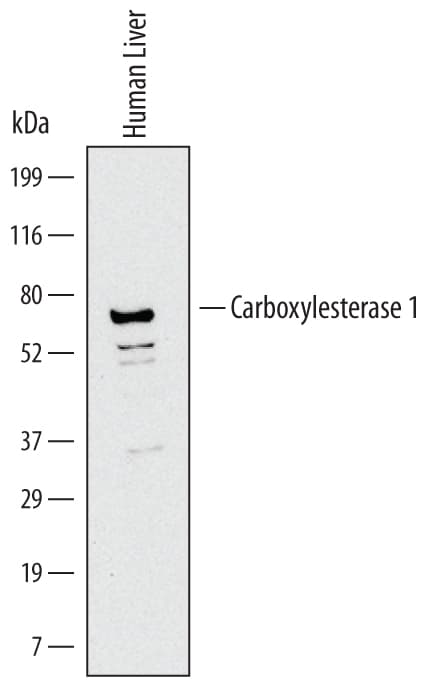
Detection of Human Carboxylesterase 1/CES1 by Western Blot.
Western blot shows lysates of human liver tissue. PVDF Membrane was probed with 2 µg/mL of Mouse Anti-Human Carboxylesterase 1/CES1 Monoclonal Antibody (Catalog # MAB4920) followed by HRP-conjugated Anti-Mouse IgG Secondary Antibody (Catalog # HAF007). A specific band was detected for Carboxylesterase 1/CES1 at approximately 70 kDa (as indicated). This experiment was conducted under reducing conditions and using Immunoblot Buffer Group 1.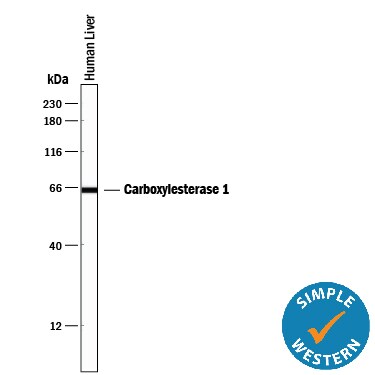
Detection of Human Carboxylesterase 1/CES1 by Simple WesternTM.
Simple Western lane view shows lysates of human liver tissue, loaded at 0.2 mg/mL. A specific band was detected for Carboxylesterase 1/CES1 at approximately 65 kDa (as indicated) using 10 µg/mL of Mouse Anti-Human Carboxylesterase 1/CES1 Monoclonal Antibody (Catalog # MAB4920). This experiment was conducted under reducing conditions and using the 12-230 kDa separation system.Applications for Human Carboxylesterase 1/CES1 Antibody (544623)
Immunoprecipitation
Sample: Conditioned cell culture medium spiked with Recombinant Human Carboxylesterase 1/CES1 (Catalog # 4920-CE), see our available Western blot detection antibodies
Simple Western
Sample: Human liver tissue
Western Blot
Sample: Human liver tissue
Formulation, Preparation, and Storage
Purification
Reconstitution
Sterile PBS to a final concentration of 0.5 mg/mL. For liquid material, refer to CoA for concentration.
Formulation
Shipping
Stability & Storage
- 12 months from date of receipt, -20 to -70 °C as supplied.
- 1 month, 2 to 8 °C under sterile conditions after reconstitution.
- 6 months, -20 to -70 °C under sterile conditions after reconstitution.
Calculators
Background: Carboxylesterase 1/CES1
References
- Redinbo, M.R. and P.M. Potter (2005) Drug Discovery Today 10:313.
- Satoh, T. and M. Hosokawa (2006) Chem. Biol. Interactions 162:195.
- Fleming, C.D. et al. (2007) Biochemistry 46:5603.
Alternate Names
Gene Symbol
UniProt
Additional Carboxylesterase 1/CES1 Products
Product Documents for Human Carboxylesterase 1/CES1 Antibody (544623)
Certificate of Analysis
To download a Certificate of Analysis, please enter a lot or batch number in the search box below.
Note: Certificate of Analysis not available for kit components.
Product Specific Notices for Human Carboxylesterase 1/CES1 Antibody (544623)
For research use only
Related Research Areas
Citations for Human Carboxylesterase 1/CES1 Antibody (544623)
 Powered by Bioz
Customer Reviews for Human Carboxylesterase 1/CES1 Antibody (544623)
There are currently no reviews for this product. Be the first to review Human Carboxylesterase 1/CES1 Antibody (544623) and earn rewards!
Have you used Human Carboxylesterase 1/CES1 Antibody (544623)?
Submit a review and receive an Amazon gift card!
$25/€18/£15/$25CAN/¥2500 for a review with an image
$10/€7/£6/$10CAN/¥1110 for a review without an image
Submit a review
Protocols
Find general support by application which include: protocols, troubleshooting, illustrated assays, videos and webinars.
- Cellular Response to Hypoxia Protocols
- Immunoprecipitation Protocol
- R&D Systems Quality Control Western Blot Protocol
- Troubleshooting Guide: Western Blot Figures
- Western Blot Conditions
- Western Blot Protocol
- Western Blot Protocol for Cell Lysates
- Western Blot Troubleshooting
- Western Blot Troubleshooting Guide
- View all Protocols, Troubleshooting, Illustrated assays and Webinars