Human CCL3/MIP-1 alpha Antibody Summary
Applications
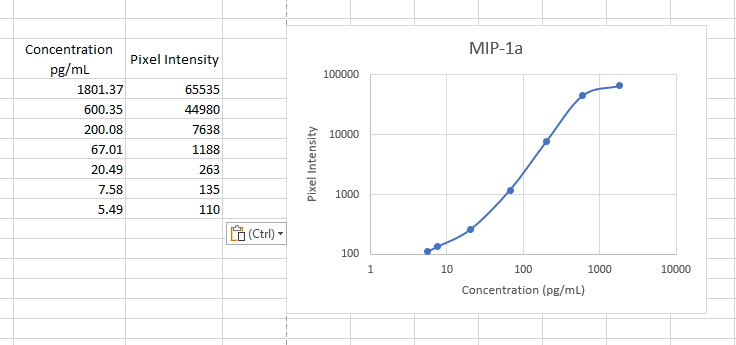
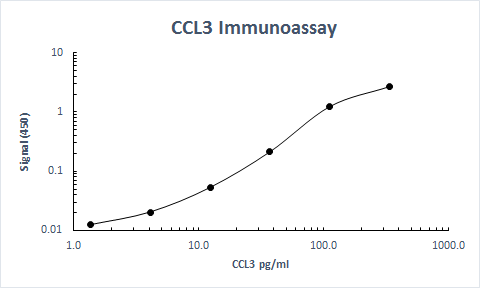
This antibody functions as an ELISA capture antibody when paired with Mouse Anti-Human CCL3/MIP‑1 alpha Monoclonal Antibody (Catalog # MAB9849).
This product is intended for assay development on various assay platforms requiring antibody pairs. We recommend the Human CCL3/MIP-1 alpha DuoSet ELISA Kit (Catalog # DY270) for convenient development of a sandwich ELISA or the Human CCL3/MIP-1 alpha Quantikine ELISA Kit (Catalog # DMA00) for a complete optimized ELISA.
Please Note: Optimal dilutions should be determined by each laboratory for each application. General Protocols are available in the Technical Information section on our website.
Scientific Data
View Larger
Chemotaxis Induced by CCL3/MIP‑1 alpha and Neutralization by Human CCL3/MIP‑1 alpha Antibody. Recombinant Human CCL3/MIP-1a (Catalog # 270-LD) chemoattracts the BaF3 mouse pro-B cell line transfected with human CCR5 in a dose-dependent manner (orange line). The amount of cells that migrated through to the lower chemotaxis chamber was measured by Resazurin (Catalog # AR002). Chemotaxis elicited by Recombinant Human CCL3/MIP-1a (0.1 µg/mL) is neutralized (green line) by increasing concentrations of Mouse Anti-Human CCL3/MIP-1a Monoclonal Antibody (Catalog # MAB670). The ND50 is typically 3-10 µg/mL.
Reconstitution Calculator
Preparation and Storage
- 12 months from date of receipt, -20 to -70 °C as supplied.
- 1 month, 2 to 8 °C under sterile conditions after reconstitution.
- 6 months, -20 to -70 °C under sterile conditions after reconstitution.
Background: CCL3/MIP-1 alpha
The macrophage inflammatory proteins -1 alpha and -1 beta were originally co-purified from medium conditioned by an LPS-stimulated murine macrophage cell line. Human MIP-1 alpha refers to the products of several independently cloned cDNAs, including LD78, pL78, pAT464, and GOS19. These cDNAs all code for the same human protein that is a homologue of the murine MIP-1 alpha. Mature MIP-1 alpha and MIP-1 beta in both human and mouse share approximately 70% homology at the amino acid level. The
MIP‑1 proteins are members of the beta (C-C) subfamily of chemokines.
Both MIP-1 alpha and MIP-1 beta are monocyte chemoattractants in vitro. Additionally, the MIP-1 proteins have been reported to have chemoattractant and adhesive effects on lymphocytes, with MIP-1 alpha and MIP-1 beta preferentially attracting CD8+ and CD4+ T cells, respectively. MIP-1 alpha has also been shown to attract B cells as well as eosinophils. MIP-1 proteins have been reported to have multiple effects on hematopoietic precursor cells and MIP-1 alpha has been identified as a stem cell inhibitory factor that can inhibit the proliferation of hematopoietic stem cells in vitro as well as in vivo. The functional receptor for MIP-1 alpha has been identified as CCR1 and CCR5.
Product Datasheets
Citations for Human CCL3/MIP-1 alpha Antibody
R&D Systems personnel manually curate a database that contains references using R&D Systems products. The data collected includes not only links to publications in PubMed, but also provides information about sample types, species, and experimental conditions.
6
Citations: Showing 1 - 6
Filter your results:
Filter by:
-
Lactoferrin Regulates an Axis Involving CD11b and CD49d Integrins and the Chemokines MIP-1 alpha and MCP-1 in GM-CSF-Treated Human Primary Eosinophils
Authors: Colleen S. Curran, Paul J. Bertics
Journal of Interferon & Cytokine Research
Species: Human
Sample Types: Cell Culture Supernates
Applications: ELISA Capture -
A multiplex immunoassay for human adipokine profiling.
Authors: Schipper HS, De Jager W, van Dijk ME, Meerding J, Zelissen PM, Adan RA, Prakken BJ, Kalkhoven E
Clin. Chem., 2010-06-08;56(0):1320.
Species: Human
Sample Types: Cell Culture Supernates
Applications: Luminex Development -
Changes in soluble factor-mediated CD8+ cell-derived antiviral activity in cynomolgus macaques infected with simian immunodeficiency virus SIVmac251: relationship to biological markers of progression.
Authors: Dioszeghy V, Benlhassan-Chahour K, Delache B, Dereuddre-Bosquet N, Aubenque C, Gras G, Le Grand R, Vaslin B
J. Virol., 2006-01-01;80(1):236-45.
Species: Primate - Macaca fascicularis (Crab-eating Monkey or Cynomolgus Macaque)
Sample Types: Cell Culture Supernates
Applications: ELISA Development -
Effect of cognate human CD4+ T cell and endothelial cell interactions upon chemokine production.
Authors: Tay SS, McCormack A, Rose ML
Transplantation, 2004-10-15;78(7):987-94.
Species: Human
Sample Types: Cell Culture Supernates
Applications: ELISA Development -
Virally stimulated plasmacytoid dendritic cells produce chemokines and induce migration of T and NK cells.
Authors: Megjugorac NJ, Young HA, Amrute SB, Olshalsky SL, Fitzgerald-Bocarsly P
J. Leukoc. Biol., 2004-01-23;75(3):504-14.
Species: Human
Sample Types:
Applications: Flow Cytometry -
Secretion of oncostatin M by infiltrating neutrophils: regulation of IL-6 and chemokine expression in human mesothelial cells.
Authors: Hurst SM, McLoughlin RM, Monslow J, Owens S, Morgan L, Fuller GM, Topley N, Jones SA
J. Immunol., 2002-11-01;169(9):5244-51.
Species: Human
Sample Types: Cell Culture Supernates
Applications: ELISA Development
FAQs
No product specific FAQs exist for this product, however you may
View all Antibody FAQsReviews for Human CCL3/MIP-1 alpha Antibody
Average Rating: 5 (Based on 2 Reviews)
Have you used Human CCL3/MIP-1 alpha Antibody?
Submit a review and receive an Amazon gift card.
$25/€18/£15/$25CAN/¥75 Yuan/¥2500 Yen for a review with an image
$10/€7/£6/$10 CAD/¥70 Yuan/¥1110 Yen for a review without an image
Filter by:
Used as a capture antibody in our NHP ELISA