
LRRC4 (Leucine rich repeat/LRR-containing protein 4), also called NGL-2 (netrin-G ligand-2) or NAG14 (nasopharyngeal carcinoma-associated gene 14) is a 55 kDa (predicted, unglycosylated) type I transmembrane protein that is a member of the NGL family of synaptic LRR adhesion molecules (1, 2). Human LRRC4 cDNA encodes 653 amino acids (aa) that include a 38 aa signal sequence, a 489 aa extracellular domain (ECD), a 21 aa transmembrane domain, and a 105 aa cytoplasmic domain. The ECD contains nine LRRs (aa 74‑288), a C2 type Ig like domain (aa 354‑440), and a Thr-rich segment (aa 455‑526). Within the ECD, human LRRC4 shares 98% aa identity with mouse and rat, 99% aa identity with canine and bovine, and 99.6% aa identity with equine LRRC4. It also shares 54‑55% aa identity with family members LRRC4C/NGL-1 and LRRC4B/NGL-3, but each recognizes different ligands (1). LRRC4 is predominantly expressed in the brain on neurons and astrocytes as a ligand for netrin-G2 on the dendritic surface of synaptic neurons (2-4). It is proposed to regulate the formation of excitatory synapses via recruitment of PSD-95 to the cytoplasmic domain after aggregation of LRRC4 at the surface (3, 5). It suppresses proliferation by downregulating cell signaling pathways, resulting in altered expression of cell cycle regulating proteins and delay at the late G1 phase (1, 2, 6-8). It is thus considered a tumor suppressor protein and is often downregulated in brain tumors, particularly gliomas (1, 2, 6). Forced expression of LRRC4 in tumor cells slows proliferation and promotes differentiation (1, 4, 9). Addition of soluble LRRC4 to cultured neurons reduces excitatory synapse formation (3).

Scientific images may be resized, cropped, or adjusted for brightness or contrast for presentation purposes. These updates are limited to presentation and do not affect the underlying scientific interpretation of the data. Where available, additional source data may be provided upon request.
Key Product Details
Species Reactivity
Applications
Label
Antibody Source
Product Specifications
Immunogen
Ala39-Lys527
Accession # Q9HBW1
Specificity
Clonality
Host
Isotype
Scientific Data Images for Human LRRC4 Antibody (701419)
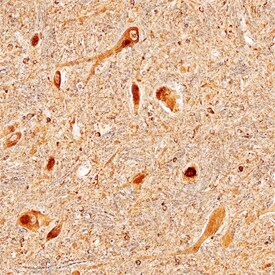
LRRC4 in Human Brain.
LRRC4 was detected in immersion fixed paraffin-embedded sections of human brain (medulla) using Mouse Anti-Human LRRC4 Monoclonal Antibody (Catalog # MAB49951) at 15 µg/mL overnight at 4 °C. Before incubation with the primary antibody, tissue was subjected to heat-induced epitope retrieval using Antigen Retrieval Reagent-Basic (Catalog # CTS013). Tissue was stained using the Anti-Mouse HRP-DAB Cell & Tissue Staining Kit (brown; Catalog # CTS002) and counterstained with hematoxylin (blue). Specific staining was localized to neuronal cell bodies, processes, and synaptic puncta. View our protocol for Chromogenic IHC Staining of Paraffin-embedded Tissue Sections.Applications for Human LRRC4 Antibody (701419)
Immunohistochemistry
Sample: Immersion fixed paraffin-embedded sections of human brain (medulla)
Formulation, Preparation, and Storage
Purification
Reconstitution
Sterile PBS to a final concentration of 0.5 mg/mL. For liquid material, refer to CoA for concentration.
Formulation
Shipping
Stability & Storage
- 12 months from date of receipt, -20 to -70 °C as supplied.
- 1 month, 2 to 8 °C under sterile conditions after reconstitution.
- 6 months, -20 to -70 °C under sterile conditions after reconstitution.
Calculators
Background: LRRC4
References
- Woo, J. et al. (2009) Mol. Cell. Neurosci. 42:1.
- Zhang, Q. et al. (2005) FEBS Lett. 579:3674.
- Kim, S. et al. (2006) Nat. Neurosci. 9:1294.
- Wu, M. et al. (2007) Acta Biochim Biophys Sin (Shanghai) 39:731.
- Nishimura-Akiyoshi, S. et al. (2007) Proc. Natl. Acad. Sci. USA 104:14801.
- Wu, M. et al. (2006) Mol. Biol. Cell 17:3534.
- Wu, M. et al. (2008) J. Cell. Biochem. 103:245.
- Wu, M. et al. (2008) J. Cell. Physiol. 214:65.
- Zhang, W. et al. (2008) Genes Brain Behav. 7:385.
Long Name
Alternate Names
Gene Symbol
UniProt
Additional LRRC4 Products
Product Documents for Human LRRC4 Antibody (701419)
Certificate of Analysis
To download a Certificate of Analysis, please enter a lot or batch number in the search box below.
Note: Certificate of Analysis not available for kit components.
Product Specific Notices for Human LRRC4 Antibody (701419)
For research use only
Related Research Areas
Customer Reviews for Human LRRC4 Antibody (701419)
There are currently no reviews for this product. Be the first to review Human LRRC4 Antibody (701419) and earn rewards!
Have you used Human LRRC4 Antibody (701419)?
Submit a review and receive an Amazon gift card!
$25/€18/£15/$25CAN/¥2500 for a review with an image
$10/€7/£6/$10CAN/¥1110 for a review without an image
Submit a review
Protocols
Find general support by application which include: protocols, troubleshooting, illustrated assays, videos and webinars.
- Antigen Retrieval Protocol (PIER)
- Antigen Retrieval for Frozen Sections Protocol
- Appropriate Fixation of IHC/ICC Samples
- Cellular Response to Hypoxia Protocols
- Chromogenic IHC Staining of Formalin-Fixed Paraffin-Embedded (FFPE) Tissue Protocol
- Chromogenic Immunohistochemistry Staining of Frozen Tissue
- ClariTSA™ Fluorophore Kits
- Detection & Visualization of Antibody Binding
- Fluorescent IHC Staining of Frozen Tissue Protocol
- Graphic Protocol for Heat-induced Epitope Retrieval
- Graphic Protocol for the Preparation and Fluorescent IHC Staining of Frozen Tissue Sections
- Graphic Protocol for the Preparation and Fluorescent IHC Staining of Paraffin-embedded Tissue Sections
- Graphic Protocol for the Preparation of Gelatin-coated Slides for Histological Tissue Sections
- IHC Sample Preparation (Frozen sections vs Paraffin)
- Immunofluorescent IHC Staining of Formalin-Fixed Paraffin-Embedded (FFPE) Tissue Protocol
- Immunohistochemistry (IHC) and Immunocytochemistry (ICC) Protocols
- Immunohistochemistry Frozen Troubleshooting
- Immunohistochemistry Paraffin Troubleshooting
- Preparing Samples for IHC/ICC Experiments
- Preventing Non-Specific Staining (Non-Specific Binding)
- Primary Antibody Selection & Optimization
- Protocol for Heat-Induced Epitope Retrieval (HIER)
- Protocol for Making a 4% Formaldehyde Solution in PBS
- Protocol for VisUCyte™ HRP Polymer Detection Reagent
- Protocol for the Preparation & Fixation of Cells on Coverslips
- Protocol for the Preparation and Chromogenic IHC Staining of Frozen Tissue Sections
- Protocol for the Preparation and Chromogenic IHC Staining of Frozen Tissue Sections - Graphic
- Protocol for the Preparation and Chromogenic IHC Staining of Paraffin-embedded Tissue Sections
- Protocol for the Preparation and Chromogenic IHC Staining of Paraffin-embedded Tissue Sections - Graphic
- Protocol for the Preparation and Fluorescent IHC Staining of Frozen Tissue Sections
- Protocol for the Preparation and Fluorescent IHC Staining of Paraffin-embedded Tissue Sections
- Protocol for the Preparation of Gelatin-coated Slides for Histological Tissue Sections
- TUNEL and Active Caspase-3 Detection by IHC/ICC Protocol
- The Importance of IHC/ICC Controls
- Troubleshooting Guide: Immunohistochemistry
- View all Protocols, Troubleshooting, Illustrated assays and Webinars