
The STAT family of transcription factors, first described as key mediators of interferon signal transduction, are now recognized as signaling factors downstream of many cytokines, growth factors, and hormones. At least seven STATs exist: STAT1, 2, 3, 4, 5a, 5b, and 6. They are responsible for an array of cellular activities including regulating growth, survival, differentiation, motility, and the immune response. They are characterized structurally by the presence of the Src homology 2 (SH2) domain, and a C-terminal tyrosine phosphorylation site. Upon ligand binding, they are recruited to the activated receptor, via their SH2 domains, to receptor-associated tyrosine kinases of the Janus kinase family (JAK). Once phosphorylated by JAK, STATS are free to hetero- or homo-dimerize, and translocate to the nucleus where they bind DNA to regulate gene transcription.

Key Product Details
Species Reactivity
Validated:
Human, Mouse, Rat
Cited:
Mouse, Rat
Applications
Validated:
Immunocytochemistry, Immunoprecipitation, Chromatin Immunoprecipitation (ChIP)
Cited:
Chromatin Immunoprecipitation (ChIP)
Label
Unconjugated
Antibody Source
Polyclonal Goat IgG
Loading...
Product Specifications
Immunogen
E. coli-derived recombinant mouse STAT3
Arg688-Met770
Accession # U06922
Arg688-Met770
Accession # U06922
Specificity
Detects human, mouse, and rat STAT3 from whole cell extracts.
Clonality
Polyclonal
Host
Goat
Isotype
IgG
Scientific Data Images for Human/Mouse/Rat STAT3 Antibody
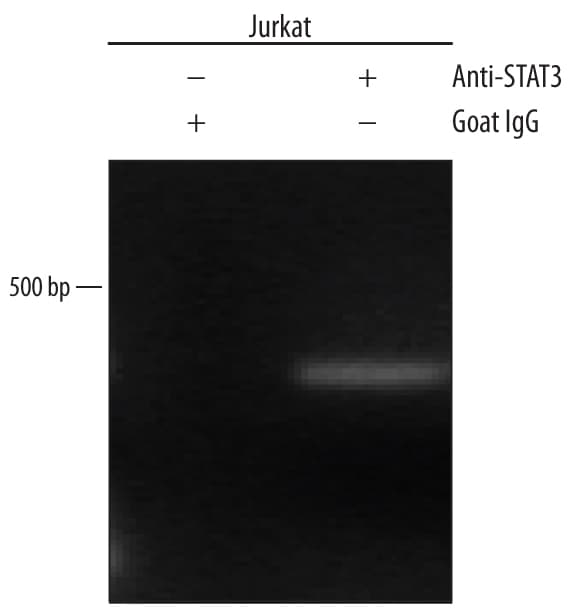
Detection of STAT3-regulated Genes by Chromatin Immunoprecipitation.
Jurkat human acute T cell leukemia cell line treated with 1000 U/mL Recombinant Human IFN-a Universal Type I (Catalog # 11200-1) for 1 hour was fixed using formaldehyde, resuspended in lysis buffer, and sonicated to shear chromatin. STAT3/DNA complexes were immunoprecipitated using 5 µg Goat Anti-Human/Mouse/Rat STAT3 Antigen Affinity-purified Polyclonal Antibody (Catalog # AF1799) or control antibody (Catalog # AB-108-C) for 15 minutes in an ultrasonic bath, followed by Biotinylated Anti-Goat IgG Secondary Antibody (Catalog # BAF109). Immunocomplexes were captured using 50 µL of MagCellect Streptavidin Ferrofluid (Catalog # MAG999) and DNA was purified using chelating resin solution. Thec-mycpromoter was detected by standard PCR.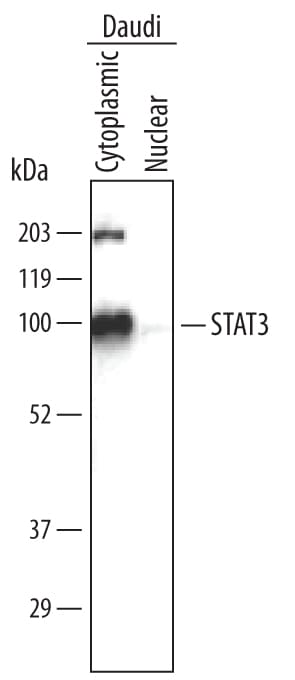
Immunoprecipitation of Human STAT3.
STAT3 was immunoprecipitated from 500 µg of Daudi human Burkitt's lymphoma cell line cytoplasmic and nuclear lystates following incubation with 2 µg Goat Anti-Human/Mouse/Rat STAT3 Antigen Affinity-purified Polyclonal Antibody (Catalog # AF1799) for overnight at 4 ºC. STAT3-antibody complexes were absorbed using Protein G agarose (Invitrogen). Immunoprecipitated STAT3 was detected by Western blot using 0.1 µg/mL Human STAT3 Monoclonal Antibody (Catalog # MAB1799). View our recommended buffer recipes for immunoprecipitation.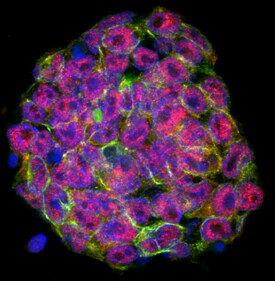
STAT3 in D3 Mouse Cell Line.
STAT3 was detected in immersion fixed D3 mouse embryonic stem cell line using Goat Anti-Human/Mouse/Rat STAT3 Antigen Affinity-purified Polyclonal Antibody (Catalog # AF1799) at 10 µg/mL for 3 hours at room temperature. Cells were stained using the NorthernLights™ 557-conjugated Anti-Goat IgG Secondary Antibody (red; Catalog # NL001). Tubulin was also detected using Tubulin Antibody (Catalog # NB600-506; Novus Biologicals) and stained using the NorthernLights™ 493-conjugated Anti-Rat IgG Secondary Antibody (green; Catalog # NL015). Cells were counterstained with DAPI (blue). Specific staining of STAT3 was localized to nuclei. View our protocol for Fluorescent ICC Staining of Stem Cells on Coverslips.Applications for Human/Mouse/Rat STAT3 Antibody
Application
Recommended Usage
Chromatin Immunoprecipitation (ChIP)
5 µg/5 x 106 cells
Sample: Human IFN‑ alpha treated Jurkat human acute T cell leukemia cell line chromatin, c-myc promoter detected by standard PCR.
Sample: Human IFN‑ alpha treated Jurkat human acute T cell leukemia cell line chromatin, c-myc promoter detected by standard PCR.
Immunocytochemistry
5-15 µg/mL
Sample: Immersion fixed mouse D3 embryonic stem cells
Sample: Immersion fixed mouse D3 embryonic stem cells
Immunoprecipitation
2 µg/500 µg cell lysate
Sample: Daudi human Burkitt's lymphoma cell line, see our available Western blot detection antibodies
Sample: Daudi human Burkitt's lymphoma cell line, see our available Western blot detection antibodies
Reviewed Applications
Read 1 review rated 5 using AF1799 in the following applications:
Formulation, Preparation, and Storage
Purification
Antigen Affinity-purified
Reconstitution
Reconstitute at 0.2 mg/mL in sterile PBS. For liquid material, refer to CoA for concentration.
Formulation
Lyophilized from a 0.2 μm filtered solution in PBS with Trehalose. *Small pack size (SP) is supplied either lyophilized or as a 0.2 µm filtered solution in PBS.
Shipping
Lyophilized product is shipped at ambient temperature. Liquid small pack size (-SP) is shipped with polar packs. Upon receipt, store immediately at the temperature recommended below.
Stability & Storage
Use a manual defrost freezer and avoid repeated freeze-thaw cycles.
- 12 months from date of receipt, -20 to -70 °C as supplied.
- 1 month, 2 to 8 °C under sterile conditions after reconstitution.
- 6 months, -20 to -70 °C under sterile conditions after reconstitution.
Calculators
Background: STAT3
Long Name
Signal Transducer and Activator of Transcription 3
Alternate Names
Acute-phase response factor, APRFMGC16063, DNA-binding protein APRF, FLJ20882, HIES, signal transducer and activator of transcription 3, signal transducer and activator of transcription 3 (acute-phase responsefactor)
Gene Symbol
STAT3
UniProt
Additional STAT3 Products
Product Documents for Human/Mouse/Rat STAT3 Antibody
Certificate of Analysis
To download a Certificate of Analysis, please enter a lot or batch number in the search box below.
Note: Certificate of Analysis not available for kit components.
Product Specific Notices for Human/Mouse/Rat STAT3 Antibody
For research use only
Citations for Human/Mouse/Rat STAT3 Antibody
 Powered by Bioz
Customer Reviews for Human/Mouse/Rat STAT3 Antibody (1)
5 out of 5
1 Customer Rating
Have you used Human/Mouse/Rat STAT3 Antibody?
Submit a review and receive an Amazon gift card!
$25/€18/£15/$25CAN/¥2500 Yen for a review with an image
$10/€7/£6/$10CAN/¥1110 Yen for a review without an image
Submit a review
Customer Images

Showing
1
-
1 of
1 review
Showing All
Filter By:
-
Application: ImmunoprecipitationSample Tested: IPS2 induced pluripotent stem cellsSpecies: HumanVerified Customer | Posted 01/17/2018

There are no reviews that match your criteria.
Protocols
Find general support by application which include: protocols, troubleshooting, illustrated assays, videos and webinars.
- Appropriate Fixation of IHC/ICC Samples
- Cellular Response to Hypoxia Protocols
- ChIP Protocol Video
- Chromatin Immunoprecipitation (ChIP) Protocol
- Chromatin Immunoprecipitation Protocol
- ClariTSA™ Fluorophore Kits
- Detection & Visualization of Antibody Binding
- ICC Cell Smear Protocol for Suspension Cells
- ICC Immunocytochemistry Protocol Videos
- ICC for Adherent Cells
- Immunocytochemistry (ICC) Protocol
- Immunocytochemistry Troubleshooting
- Immunofluorescence of Organoids Embedded in Cultrex Basement Membrane Extract
- Immunohistochemistry (IHC) and Immunocytochemistry (ICC) Protocols
- Immunoprecipitation Protocol
- Preparing Samples for IHC/ICC Experiments
- Preventing Non-Specific Staining (Non-Specific Binding)
- Primary Antibody Selection & Optimization
- Protocol for VisUCyte™ HRP Polymer Detection Reagent
- Protocol for the Fluorescent ICC Staining of Cell Smears - Graphic
- Protocol for the Fluorescent ICC Staining of Cultured Cells on Coverslips - Graphic
- Protocol for the Preparation and Fluorescent ICC Staining of Cells on Coverslips
- Protocol for the Preparation and Fluorescent ICC Staining of Non-adherent Cells
- Protocol for the Preparation and Fluorescent ICC Staining of Stem Cells on Coverslips
- Protocol for the Preparation of a Cell Smear for Non-adherent Cell ICC - Graphic
- TUNEL and Active Caspase-3 Detection by IHC/ICC Protocol
- The Importance of IHC/ICC Controls
- View all Protocols, Troubleshooting, Illustrated assays and Webinars
Loading...
Associated Pathways
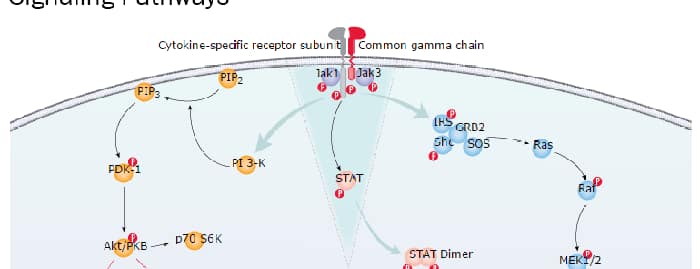 Embryonic and Induced Pluripotent Stem Cell Differentiation Pathways & Lineage-specific Markers
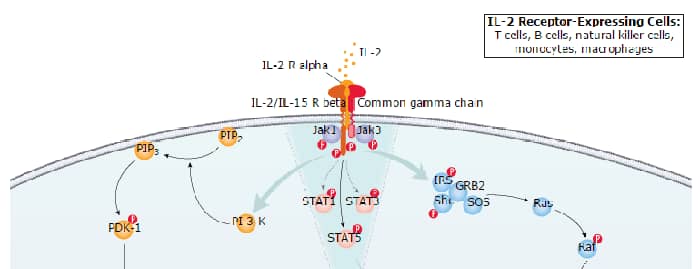
 IL-2 Signaling Pathways
 IL-7 Signaling Pathways
 IL-9 Signaling Pathways

IL-15 Signaling Pathways
 IL-21 Signaling Pathways
 IL-21 Signaling Pathways and their Primary Biological Effects in Different Immune Cell Types
 Jak/STAT Signaling Pathway
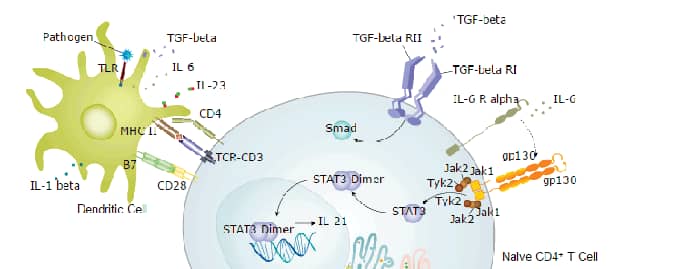
 Th1 Differentiation Pathway
 Th17 Differentiation Pathway
 VEGF - VEGF R2 Signaling Pathways

IL-21 Signaling Pathways
IL-21 Signaling Pathways and their Primary Biological Effects in Different Immune Cell Types
Jak/STAT Signaling Pathway
Th1 Differentiation Pathway
Th17 Differentiation Pathway
VEGF - VEGF R2 Signaling Pathways