

Scientific images may be resized, cropped, or adjusted for brightness or contrast for presentation purposes. These updates are limited to presentation and do not affect the underlying scientific interpretation of the data. Where available, additional source data may be provided upon request.
Key Product Details
Validated by
Species Reactivity
Validated:
Cited:
Applications
Validated:
Cited:
Label
Antibody Source
Product Specifications
Immunogen
Met1-Ser497
Accession # P98170
Specificity
Clonality
Host
Isotype
Scientific Data Images for XIAP Antibody (117320)
Detection of Human/Mouse XIAP by Western Blot.
Western blot shows lysates of WS-1 human fetal skin fibroblast cell line and L-929 mouse fibrosarcoma cell line. PVDF membrane was probed with 2 µg/mL Mouse Anti-Human/Mouse XIAP Monoclonal Antibody (Catalog # MAB822) followed by HRP-conjugated Anti-Mouse IgG Secondary Antibody (Catalog # HAF007). For additional reference, Recombinant Human XIAP Full Length (Catalog # 822-XF) and recombinant mouse XIAP (5 ng/lane) were included. A specific band for XIAP was detected at approximately 55 kDa (as indicated). This experiment was conducted under reducing conditions and using Immunoblot Buffer Group 6.
Western Blot Shows Human XIAP Specificity by Using Knockout Cell Line.
Western blot shows lysates of HeLa human cervical epithelial carcinoma parental cell line and XIAP knockout HeLa cell line (KO). PVDF membrane was probed with 2 µg/mL of Mouse Anti-Human/Mouse XIAP Monoclonal Antibody (Catalog # MAB822) followed by HRP-conjugated Anti-Mouse IgG Secondary Antibody (Catalog # HAF018). A specific band was detected for XIAP at approximately 52 kDa (as indicated) in the parental HeLa cell line, but is not detectable in knockout HeLa cell line. GAPDH (Catalog # MAB5718) is shown as a loading control. This experiment was conducted under reducing conditions and using Immunoblot Buffer Group 1.
Detection of Human XIAP by Western Blot
VP-16 had a more potent effect on LX-2 cells than normal hepatocytes.(a–c) Three cell lines were treated with 0–4 μM VP-16 for 72 h. (a) Cytotoxicity was measured using the CCK-8 assay. (b) Apoptotic cells were analyzed using flow cytometry. Annexin V-positive cells are displayed in the bar chart as a percentage of the untreated controls. (c) Apoptosis-regulating protein levels were analyzed by western blotting. beta -actin was used as a loading control. The data are presented as the mean ± SD of three independent experiments. *P < 0.05, ***P < 0.001. Image collected and cropped by CiteAb from the following publication (https://pubmed.ncbi.nlm.nih.gov/27680712), licensed under a CC-BY license. Not internally tested by R&D Systems.
Detection of Mouse XIAP by Western Blot
cIAP2 and XIAP regulate autophagosome fusion, but not cIAP1.a MEFs expressing mCherry-GFP-LC3b were transfected with siRNA against either cIAP1, cIAP2 or XIAP. Cells were analysed with the microscope and the number of mCherry+, and GFP + puncta/cell were calculated and the ratio of GFP + /mCherry + puncta is indicated. Shown are the means and the error bars represent the SEM of at least three independent experiments. Westerns show efficient knockdown of cIAP1 and XIAP expression. cIAP2 siRNA efficiency was determined by real time PCR as shown in the graph below the westerns. b Wild type and cIAP2−/− XIAP−/− dermal fibroblasts expressing mCherry-GFP-LC3b were treated analysed on the microscope and mCherry+, and GFP + puncta/cell were calculated. The ratio of GFP+/mCherry + puncta is indicated. c Wild type and cIAP2−/− XIAP−/− dermal fibroblasts were left in complete media (CM) or starved for 2 h in EBSS. Cells were lysed and proteins analysed by western blot for XIAP, LC3, and Actin. cIAP2−/− was confirmed by PCR due to lack of effective antibodies for mouse cIAP2 (see supplemental Fig. 2). d Immunofluoresence showing accumulation of LC3 in starved cIAP2−/− XIAP−/− dermal fibroblasts. Wild type and cIAP2−/− XIAP−/− dermal fibroblasts were incubated in complete media or starved in EBSS for 2 h, then fixed and stained for LC3 (green channel) and LAMP2 (red channel). Nuclei are stained blue with Hoechst. Shown in upper panels are overviews. Lower panels show zoomed in regions indicated in the upper panels Image collected and cropped by CiteAb from the following publication (https://pubmed.ncbi.nlm.nih.gov/29743550), licensed under a CC-BY license. Not internally tested by R&D Systems.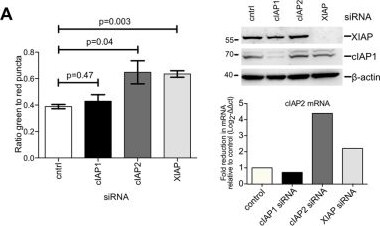
Detection of Mouse XIAP by Western Blot
cIAP2 and XIAP regulate autophagosome fusion, but not cIAP1.a MEFs expressing mCherry-GFP-LC3b were transfected with siRNA against either cIAP1, cIAP2 or XIAP. Cells were analysed with the microscope and the number of mCherry+, and GFP + puncta/cell were calculated and the ratio of GFP + /mCherry + puncta is indicated. Shown are the means and the error bars represent the SEM of at least three independent experiments. Westerns show efficient knockdown of cIAP1 and XIAP expression. cIAP2 siRNA efficiency was determined by real time PCR as shown in the graph below the westerns. b Wild type and cIAP2−/− XIAP−/− dermal fibroblasts expressing mCherry-GFP-LC3b were treated analysed on the microscope and mCherry+, and GFP + puncta/cell were calculated. The ratio of GFP+/mCherry + puncta is indicated. c Wild type and cIAP2−/− XIAP−/− dermal fibroblasts were left in complete media (CM) or starved for 2 h in EBSS. Cells were lysed and proteins analysed by western blot for XIAP, LC3, and Actin. cIAP2−/− was confirmed by PCR due to lack of effective antibodies for mouse cIAP2 (see supplemental Fig. 2). d Immunofluoresence showing accumulation of LC3 in starved cIAP2−/− XIAP−/− dermal fibroblasts. Wild type and cIAP2−/− XIAP−/− dermal fibroblasts were incubated in complete media or starved in EBSS for 2 h, then fixed and stained for LC3 (green channel) and LAMP2 (red channel). Nuclei are stained blue with Hoechst. Shown in upper panels are overviews. Lower panels show zoomed in regions indicated in the upper panels Image collected and cropped by CiteAb from the following publication (https://pubmed.ncbi.nlm.nih.gov/29743550), licensed under a CC-BY license. Not internally tested by R&D Systems.Applications for XIAP Antibody (117320)
Knockout Validated
Western Blot
Sample: WS-1 human fetal skin fibroblast cell line and L-929 mouse fibrosarcoma cell line
Reviewed Applications
Read 3 reviews rated 4 using MAB822 in the following applications:
Formulation, Preparation, and Storage
Purification
Reconstitution
Reconstitute at 0.5 mg/mL in sterile PBS. For liquid material, refer to CoA for concentration.
Formulation
Shipping
Stability & Storage
- 12 months from date of receipt, -20 to -70 °C as supplied.
- 1 month, 2 to 8 °C under sterile conditions after reconstitution.
- 6 months, -20 to -70 °C under sterile conditions after reconstitution.
Calculators
Background: XIAP
Long Name
Alternate Names
Gene Symbol
UniProt
Additional XIAP Products
Product Documents for XIAP Antibody (117320)
Certificate of Analysis
To download a Certificate of Analysis, please enter a lot or batch number in the search box below.
Note: Certificate of Analysis not available for kit components.
Product Specific Notices for XIAP Antibody (117320)
For research use only
Related Research Areas
Citations for XIAP Antibody (117320)
 Powered by Bioz
Customer Reviews for XIAP Antibody (117320) (3)
Have you used XIAP Antibody (117320)?
Submit a review and receive an Amazon gift card!
$25/€18/£15/$25CAN/¥2500 for a review with an image
$10/€7/£6/$10CAN/¥1110 for a review without an image
Submit a review
Customer Images

-
Application: MicroarraySample Tested: EDTA PlasmaSpecies: HumanVerified Customer | Posted 12/06/2019Antibody was printed on custom arrays and incubated with fluorescently labeled human EDTA plasma

-
Application: ELISASample Tested: PlasmaSpecies: HumanVerified Customer | Posted 11/10/2018
-
Application: Western BlotSample Tested: See PMID 20074295Species: HumanVerified Customer | Posted 02/25/2015
There are no reviews that match your criteria.
Protocols
Find general support by application which include: protocols, troubleshooting, illustrated assays, videos and webinars.
- Cellular Response to Hypoxia Protocols
- R&D Systems Quality Control Western Blot Protocol
- Troubleshooting Guide: Western Blot Figures
- Western Blot Conditions
- Western Blot Protocol
- Western Blot Protocol for Cell Lysates
- Western Blot Troubleshooting
- Western Blot Troubleshooting Guide
- View all Protocols, Troubleshooting, Illustrated assays and Webinars
Associated Pathways

