
Human Notch-2 is a 300 kDa type I transmembrane glycoprotein that is one of four human Notch homologues involved in developmental processes (1‑3). Although Notch proteins are structurally and functionally similar, deletion of either Notch-1 or Notch-2 is lethal, showing that not all functions overlap (4, 5). Mice with hypomorphic Notch-2 show defects in the development of kidney, heart and eyes (6). Notch-2 is up‑regulated in mature B cells and is critical for differentiation to splenic marginal zone B cells (7). Notch-2 is also preferentially expressed in choroid plexus epithelia and neuronal precursors (8, 9). Human Notch-2 is synthesized as a 2471 amino acid (aa) precursor that contains a 25 aa signal sequence, a 1652 aa extracellular domain (ECD), and a 794 aa transmembrane (TM) and cytoplasmic segment. The ECD contains 35 EGF-like repeats and three Lin-12/Notch repeats, while the cytoplasmic region shows six ankyrin repeats, a glutamine-rich domain and a PEST sequence. Binding of ligands, including Jagged and Delta-like molecules in humans, has been localized to the 11th and 12th EGF-like repeats of Notch (10). Notch receptors undergo post-translational furin-type proteolytic cleavage (11). This forms a heterodimer through the interaction of a hydrophobic area in the ligand‑binding extracellular region with the TM/cytoplasmic portion (11, 12). Upon ligand binding, additional sequential proteolysis by TNF-converting enzyme (ADAM‑17) and the presenilin-dependent gamma -secretase results in the release of the Notch intracellular domain (NICD) which translocates into the nucleus, activating transcription of Notch-responsive genes (13). Human Notch-2 ECD (aa 26‑530) shows 93%, 93%, 96% and 96% aa identity with the corresponding regions of mouse, rat, canine, and bovine Notch-2, respectively. This region also exhibits approximately 60% aa identity with human Notch-1 and Notch-3.
Human Notch-2 Intracellular Domain Antibody
R&D Systems | Catalog # AF3735

Scientific images may be resized, cropped, or adjusted for brightness or contrast for presentation purposes. These updates are limited to presentation and do not affect the underlying scientific interpretation of the data. Where available, additional source data may be provided upon request.
Key Product Details
Species Reactivity
Validated:
Cited:
Applications
Validated:
Cited:
Label
Antibody Source
Product Specifications
Immunogen
Asp2063-Pro2413
Accession # Q04721
Specificity
Clonality
Host
Isotype
Scientific Data Images for Human Notch-2 Intracellular Domain Antibody
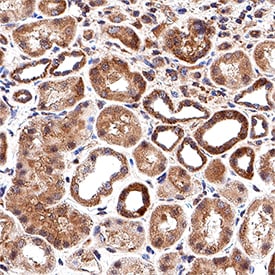
Detection of Notch‑2 in Human Kidney.
Notch‑2 was detected in immersion fixed paraffin-embedded sections of human kidney using Goat Anti-Human Notch‑2 Intracellular Domain Antigen Affinity-purified Polyclonal Antibody (Catalog # AF3735) at 5 µg/ml for 1 hour at room temperature followed by incubation with the Anti-Goat IgG VisUCyte™ HRP Polymer Antibody (Catalog # VC004) or the HRP-conjugated Anti-Goat IgG Secondary Antibody (Catalog # HAF017). Before incubation with the primary antibody, tissue was subjected to heat-induced epitope retrieval using VisUCyte Antigen Retrieval Reagent-Basic (Catalog # VCTS021). Tissue was stained using DAB (brown) and counterstained with hematoxylin (blue). Specific staining was localized to the cytoplasm and nucleus. View our protocol for Chromogenic IHC Staining of Paraffin-embedded Tissue Sections.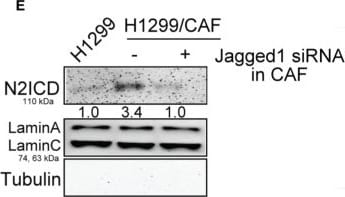
Detection of Notch-2 Intracellular Domain by Western Blot
Interaction of Notch2 and Jagged1 between CAFs and lung cancer cells. (A) Expression of Notches and their ligands in lung cancer cells and their CAFs, respectively. (B) Close interaction of Nocth2 and Jagged1 between H1299 cells and CAFs as determined by proximity ligation assay (PLA). H1299-GFP cells, CAFs (BioTracker 400 Blue cytoplasmic membrane dye), and H1299-GFP cells mixed with CAFs were committed to PLA analysis (red). (C) Increased NOTCH 2 intracellular domain (N2ICD) nuclear translocation in H1299 cells. Cells were collected and the nuclear and cytosol fractions were extracted using a commercial kit. Equal levels of protein were assessed by immunoblotting. (D) Inhibition of Jagged1 in CAFs reduced the VM formation of H1299 cells. Knockdown of Jagged 1 in CAFs reduced (E) N2ICD nuclear translocation, and (F) HEY1 upregulation driven by CAFs in H1299 cells. Knockdown of Notch2 in H1299 reduced (G) VM formation, (H) N2ICD nuclear translocation, and (I) HEY1 upregulation driven by CAFs. CAFs and H1299 cells were transfected with a control, Jagged1 (for CAFs), or Notch2 (for H1299 cells) siRNA for 24 h, then CAFs were mixed with H1299 cells. The HEY1 mRNA and nuclear N2ICD levels were detected using a quantitative reverse transcription polymerase chain reaction and immunoblotting, respectively. All results are representative of at least three independent experiments. Each value is the mean ± SD of three determinations; *P < 0.05. Image collected and cropped by CiteAb from the following open publication (https://pubmed.ncbi.nlm.nih.gov/34485133), licensed under a CC-BY license. Not internally tested by R&D Systems.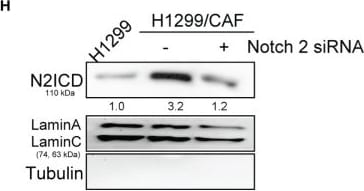
Detection of Notch-2 Intracellular Domain by Western Blot
Interaction of Notch2 and Jagged1 between CAFs and lung cancer cells. (A) Expression of Notches and their ligands in lung cancer cells and their CAFs, respectively. (B) Close interaction of Nocth2 and Jagged1 between H1299 cells and CAFs as determined by proximity ligation assay (PLA). H1299-GFP cells, CAFs (BioTracker 400 Blue cytoplasmic membrane dye), and H1299-GFP cells mixed with CAFs were committed to PLA analysis (red). (C) Increased NOTCH 2 intracellular domain (N2ICD) nuclear translocation in H1299 cells. Cells were collected and the nuclear and cytosol fractions were extracted using a commercial kit. Equal levels of protein were assessed by immunoblotting. (D) Inhibition of Jagged1 in CAFs reduced the VM formation of H1299 cells. Knockdown of Jagged 1 in CAFs reduced (E) N2ICD nuclear translocation, and (F) HEY1 upregulation driven by CAFs in H1299 cells. Knockdown of Notch2 in H1299 reduced (G) VM formation, (H) N2ICD nuclear translocation, and (I) HEY1 upregulation driven by CAFs. CAFs and H1299 cells were transfected with a control, Jagged1 (for CAFs), or Notch2 (for H1299 cells) siRNA for 24 h, then CAFs were mixed with H1299 cells. The HEY1 mRNA and nuclear N2ICD levels were detected using a quantitative reverse transcription polymerase chain reaction and immunoblotting, respectively. All results are representative of at least three independent experiments. Each value is the mean ± SD of three determinations; *P < 0.05. Image collected and cropped by CiteAb from the following open publication (https://pubmed.ncbi.nlm.nih.gov/34485133), licensed under a CC-BY license. Not internally tested by R&D Systems.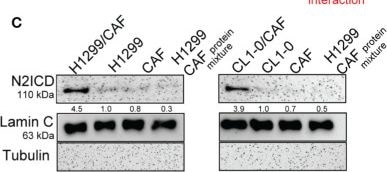
Detection of Notch-2 Intracellular Domain by Western Blot
Interaction of Notch2 and Jagged1 between CAFs and lung cancer cells. (A) Expression of Notches and their ligands in lung cancer cells and their CAFs, respectively. (B) Close interaction of Nocth2 and Jagged1 between H1299 cells and CAFs as determined by proximity ligation assay (PLA). H1299-GFP cells, CAFs (BioTracker 400 Blue cytoplasmic membrane dye), and H1299-GFP cells mixed with CAFs were committed to PLA analysis (red). (C) Increased NOTCH 2 intracellular domain (N2ICD) nuclear translocation in H1299 cells. Cells were collected and the nuclear and cytosol fractions were extracted using a commercial kit. Equal levels of protein were assessed by immunoblotting. (D) Inhibition of Jagged1 in CAFs reduced the VM formation of H1299 cells. Knockdown of Jagged 1 in CAFs reduced (E) N2ICD nuclear translocation, and (F) HEY1 upregulation driven by CAFs in H1299 cells. Knockdown of Notch2 in H1299 reduced (G) VM formation, (H) N2ICD nuclear translocation, and (I) HEY1 upregulation driven by CAFs. CAFs and H1299 cells were transfected with a control, Jagged1 (for CAFs), or Notch2 (for H1299 cells) siRNA for 24 h, then CAFs were mixed with H1299 cells. The HEY1 mRNA and nuclear N2ICD levels were detected using a quantitative reverse transcription polymerase chain reaction and immunoblotting, respectively. All results are representative of at least three independent experiments. Each value is the mean ± SD of three determinations; *P < 0.05. Image collected and cropped by CiteAb from the following open publication (https://pubmed.ncbi.nlm.nih.gov/34485133), licensed under a CC-BY license. Not internally tested by R&D Systems.Applications for Human Notch-2 Intracellular Domain Antibody
Immunohistochemistry
Sample: Immersion fixed paraffin-embedded sections of human kidney
Western Blot
Sample: Recombinant Human Notch‑2 Intracellular Domain
Formulation, Preparation, and Storage
Purification
Reconstitution
Reconstitute at 0.2 mg/mL in sterile PBS. For liquid material, refer to CoA for concentration.
Formulation
Shipping
Stability & Storage
- 12 months from date of receipt, -20 to -70 °C as supplied.
- 1 month, 2 to 8 °C under sterile conditions after reconstitution.
- 6 months, -20 to -70 °C under sterile conditions after reconstitution.
Calculators
Background: Notch-2
References
- Stifani, S. et al. (1992) Nat. Genet. 2:119.
- Dumortier, A. et al. (2005) Int. J. Hematol. 82:277.
- Yoon, K. and N. Gaiano (2005) Nat. Neurosci. 8:709.
- Hamada, Y. et al. (1999) Development 126:3415.
- Shimizu, K. et al. (2002) Biochem. Biophys. Res. Comm. 291:775.
- McCright, B. et al. (2001) Development 128:491.
- Saito, T. et al. (2003) Immunity 18:675.
- Irvin, D. K. et al. (2001) J. Comp. Neurol. 436:167.
- Solecki, D. J. et al. (2001) Neuron 31:557.
- Hambleton, S. et al. (2004) Structure 12:2173.
- Logeat, F. et al. (1998) Proc. Natl. Acad. Sci. USA 95:8108.
- Sanchez-Irizarry, C. et al. (2004) Mol. Cell. Biol. 24:9265.
- Mumm, J.S. and R. Kopan (2000) Dev. Biol. 228:151.
Alternate Names
Gene Symbol
UniProt
Additional Notch-2 Products
Product Documents for Human Notch-2 Intracellular Domain Antibody
Certificate of Analysis
To download a Certificate of Analysis, please enter a lot or batch number in the search box below.
Note: Certificate of Analysis not available for kit components.
Product Specific Notices for Human Notch-2 Intracellular Domain Antibody
For research use only
Related Research Areas
Citations for Human Notch-2 Intracellular Domain Antibody
 Powered by Bioz
Customer Reviews for Human Notch-2 Intracellular Domain Antibody
There are currently no reviews for this product. Be the first to review Human Notch-2 Intracellular Domain Antibody and earn rewards!
Have you used Human Notch-2 Intracellular Domain Antibody?
Submit a review and receive an Amazon gift card!
$25/€18/£15/$25CAN/¥2500 for a review with an image
$10/€7/£6/$10CAN/¥1110 for a review without an image
Submit a review
Protocols
Find general support by application which include: protocols, troubleshooting, illustrated assays, videos and webinars.
- Antigen Retrieval Protocol (PIER)
- Antigen Retrieval for Frozen Sections Protocol
- Appropriate Fixation of IHC/ICC Samples
- Cellular Response to Hypoxia Protocols
- Chromogenic IHC Staining of Formalin-Fixed Paraffin-Embedded (FFPE) Tissue Protocol
- Chromogenic Immunohistochemistry Staining of Frozen Tissue
- ClariTSA™ Fluorophore Kits
- Detection & Visualization of Antibody Binding
- Fluorescent IHC Staining of Frozen Tissue Protocol
- Graphic Protocol for Heat-induced Epitope Retrieval
- Graphic Protocol for the Preparation and Fluorescent IHC Staining of Frozen Tissue Sections
- Graphic Protocol for the Preparation and Fluorescent IHC Staining of Paraffin-embedded Tissue Sections
- Graphic Protocol for the Preparation of Gelatin-coated Slides for Histological Tissue Sections
- IHC Sample Preparation (Frozen sections vs Paraffin)
- Immunofluorescent IHC Staining of Formalin-Fixed Paraffin-Embedded (FFPE) Tissue Protocol
- Immunohistochemistry (IHC) and Immunocytochemistry (ICC) Protocols
- Immunohistochemistry Frozen Troubleshooting
- Immunohistochemistry Paraffin Troubleshooting
- Preparing Samples for IHC/ICC Experiments
- Preventing Non-Specific Staining (Non-Specific Binding)
- Primary Antibody Selection & Optimization
- Protocol for Heat-Induced Epitope Retrieval (HIER)
- Protocol for Making a 4% Formaldehyde Solution in PBS
- Protocol for VisUCyte™ HRP Polymer Detection Reagent
- Protocol for the Preparation & Fixation of Cells on Coverslips
- Protocol for the Preparation and Chromogenic IHC Staining of Frozen Tissue Sections
- Protocol for the Preparation and Chromogenic IHC Staining of Frozen Tissue Sections - Graphic
- Protocol for the Preparation and Chromogenic IHC Staining of Paraffin-embedded Tissue Sections
- Protocol for the Preparation and Chromogenic IHC Staining of Paraffin-embedded Tissue Sections - Graphic
- Protocol for the Preparation and Fluorescent IHC Staining of Frozen Tissue Sections
- Protocol for the Preparation and Fluorescent IHC Staining of Paraffin-embedded Tissue Sections
- Protocol for the Preparation of Gelatin-coated Slides for Histological Tissue Sections
- R&D Systems Quality Control Western Blot Protocol
- TUNEL and Active Caspase-3 Detection by IHC/ICC Protocol
- The Importance of IHC/ICC Controls
- Troubleshooting Guide: Immunohistochemistry
- Troubleshooting Guide: Western Blot Figures
- Western Blot Conditions
- Western Blot Protocol
- Western Blot Protocol for Cell Lysates
- Western Blot Troubleshooting
- Western Blot Troubleshooting Guide
- View all Protocols, Troubleshooting, Illustrated assays and Webinars


