
Osteopontin (OPN, previously also referred to as transformation-associated secreted phosphoprotein, bone sialoprotein I, 2ar, 2B7, early T lymphocyte activation 1 protein, minopotin, calcium oxalate crystal growth inhibitor protein), is a secreted, highly acidic, calcium-binding, RGD-containing, phosphorylated glycoprotein originally isolated from bone matrix (1). Subsequently, OPN has been found in kidney, placenta, blood vessels and various tumor tissues. Many cell types (including macrophages, osteoclasts, activated T-cells, fibroblasts, epithelial cells, vascular smooth muscle cells, and natural killer cells) can express OPN in response to activation by cytokines, growth factors or inflammatory mediators. Elevated expression of OPN has also been associated with numerous pathobiological conditions such as atherosclerotic plaques, renal tubulointerstitial fibrosis, granuloma formations in tuberculosis and silicosis, neointimal formation associated with balloon catheterization, metastasizing tumors, and cerebral ischemia. Human OPN cDNA encodes a 314 amino acid (aa) residue precursor protein with a 16 aa residue predicted signal peptide that is cleaved to yield a 298 aa residue mature protein with an integrin binding sequence (RGD), and N- and O-glycosylation sites. By alternative splicing, at least three human OPN isoforms exist. OPN has been shown to bind to different cell types through RGD-mediated interaction with the integrins alpha v beta 1, alpha v beta 3, alpha v beta 5, and non-RGD-mediated interaction with CD44 and the integrins alpha 8 beta 1 or alpha 9 beta 1. OPN exists both as a component of extracellular matrix and as a soluble molecule. Functionally, OPN is chemotactic for macrophages, smooth muscle cells, endothelial cells and glial cells. OPN has also been shown to inhibit nitric oxide production and cytotoxicity by activated macrophages. Human, mouse, rat, pig and bovine OPN share from approximately 40% - 80% amino acid sequence identity. Osteopontin is a substrate for proteolytic cleavage by thrombin, enterokinase, MMP-3 and MMP-7. The functions of OPN in a variety of cell types were shown to be modified as a result of proteolytic cleavage (2, 3).
Human Osteopontin/OPN Antibody (223112)
R&D Systems | Catalog # MAB14332


Scientific images may be resized, cropped, or adjusted for brightness or contrast for presentation purposes. These updates are limited to presentation and do not affect the underlying scientific interpretation of the data. Where available, additional source data may be provided upon request.
Key Product Details
Species Reactivity
Validated:
Cited:
Applications
Validated:
Cited:
Label
Antibody Source
Product Specifications
Immunogen
Ile17-Asn300
Accession # NP_000573.1
Specificity
Clonality
Host
Isotype
Scientific Data Images for Human Osteopontin/OPN Antibody (223112)
Human Osteopontin / OPN ELISA Standard Curve
Recombinant Human Osteopontin/OPN (Catalog # 1433-OP) was serially diluted and captured by Mouse Anti-Human Osteopontin/OPN Monoclonal Antibody (Catalog # MAB14332) coated on a Clear Polystyrene Microplate (Catalog # DY990). Goat Anti-Human Osteopontin/OPN Antigen Affinity-purified Polyclonal Antibody (Catalog # AF1433) was biotinylated and incubated with the protein captured on the plate. Detection of the standard curve was achieved by incubating Streptavidin-HRP (Catalog # DY998)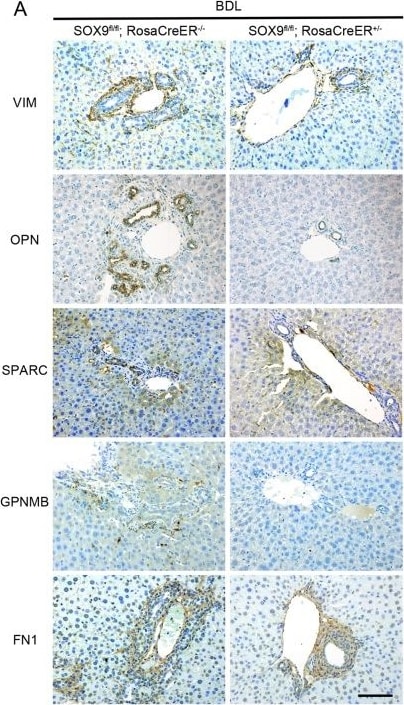
Detection of Osteopontin/OPN by Immunohistochemistry
Localization and quantification of SOX9-regulated proteins in fibrotic liver following Sox9-loss in mice with BDL-induced fibrosis. (A) Immunohistochemistry for VIM, OPN, SPARC, GPNMB and FN1 (brown) counterstained with toludine blue. Images shown for control (Sox9fl/fl; RosaCreER−/−) and Sox9-null (Sox9fl/fl; RosaCreER+/−) livers following CCl4 induced fibrosis. Scale bar 100 μm. (B) Quantification of surface area covered by individual protein staining in control (Sox9fl/fl; RosaCreER−/−) and Sox9-null (Sox9fl/fl; RosaCreER+/−) livers in (A). All experiments are n = 5. Data are shown as means ± s.e.m. ***p < 0.001. Image collected and cropped by CiteAb from the following open publication (https://pubmed.ncbi.nlm.nih.gov/30559459), licensed under a CC-BY license. Not internally tested by R&D Systems.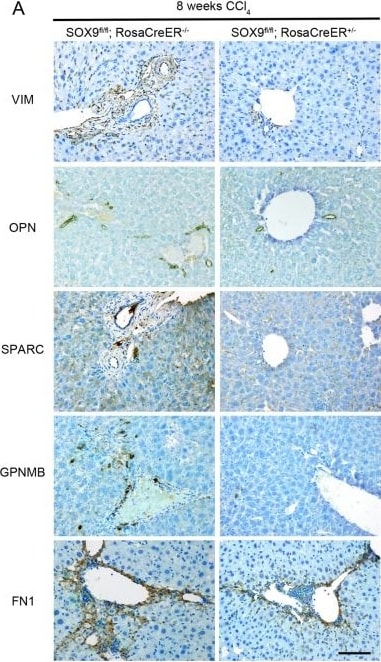
Detection of Osteopontin/OPN by Immunohistochemistry
Localization and quantification of SOX9-regulated proteins in fibrotic liver following Sox9-loss in mice with CCl4 induced fibrosis. (A) Immunohistochemistry for VIM, OPN, SPARC, GPNMB and FN1 (brown) counterstained with toludine blue. Images shown for control (Sox9fl/fl; RosaCreER−/−) and Sox9-null (Sox9fl/fl; RosaCreER+/−) livers following BDL induced fibrosis. Scale bar 100 μm. (B) Quantification of surface area covered by individual protein staining in control (Sox9fl/fl; RosaCreER−/−) and Sox9-null (Sox9fl/fl; RosaCreER+/−) livers in (A). All experiments are n = 5. Data are shown as means ± s.e.m. *p < 0.05. Image collected and cropped by CiteAb from the following open publication (https://pubmed.ncbi.nlm.nih.gov/30559459), licensed under a CC-BY license. Not internally tested by R&D Systems.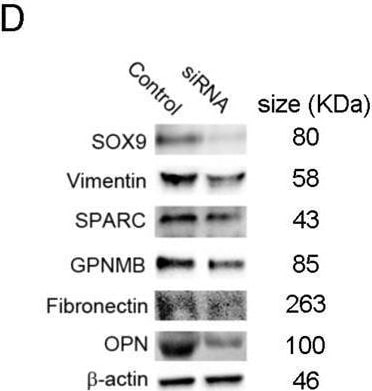
Detection of Osteopontin/OPN by Western Blot
Identification of a panel of Sox9-regulated genes in HSCs. (A) Comparative levels and representation of highly expressed factors after knockdown of Sox9 in activated rat HSCs (*in A signifies statistically significant change). Relative mRNA levels by qRT-PCR analysis and protein levels quantified by immunoblotting in rHSCs following Sox9 abrogation using siRNA (B) and (C), representative immunoblot shown in (D) or quiescent and activated rHSCs (E) and (F, representative immunoblot shown in (G). All experiments are n ≥3. Data are shown as means ± s.e.m. *p < 0.05, **p < 0.01, ***p < 0.001. Image collected and cropped by CiteAb from the following open publication (https://pubmed.ncbi.nlm.nih.gov/30559459), licensed under a CC-BY license. Not internally tested by R&D Systems.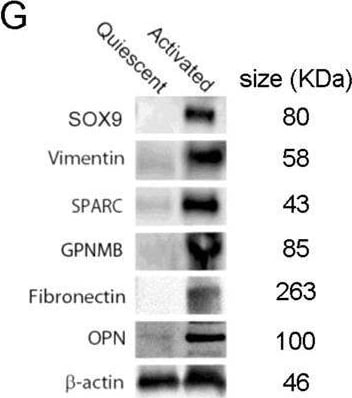
Detection of Osteopontin/OPN by Western Blot
Identification of a panel of Sox9-regulated genes in HSCs. (A) Comparative levels and representation of highly expressed factors after knockdown of Sox9 in activated rat HSCs (*in A signifies statistically significant change). Relative mRNA levels by qRT-PCR analysis and protein levels quantified by immunoblotting in rHSCs following Sox9 abrogation using siRNA (B) and (C), representative immunoblot shown in (D) or quiescent and activated rHSCs (E) and (F, representative immunoblot shown in (G). All experiments are n ≥3. Data are shown as means ± s.e.m. *p < 0.05, **p < 0.01, ***p < 0.001. Image collected and cropped by CiteAb from the following open publication (https://pubmed.ncbi.nlm.nih.gov/30559459), licensed under a CC-BY license. Not internally tested by R&D Systems.Applications for Human Osteopontin/OPN Antibody (223112)
ELISA
Formulation, Preparation, and Storage
Purification
Reconstitution
Reconstitute at 0.5 mg/mL in sterile PBS. For liquid material, refer to CoA for concentration.
Formulation
Shipping
Stability & Storage
- 12 months from date of receipt, -20 to -70 °C as supplied.
- 1 month, 2 to 8 °C under sterile conditions after reconstitution.
- 6 months, -20 to -70 °C under sterile conditions after reconstitution.
Calculators
Background: Osteopontin/OPN
References
- Ann. N.Y. Acad. Sci. (1995) 760, Apr. 21.
- Senger, D.R. et al. (1996) Biochim. Biophys. Acta. 1314:13.
- Agnihotri, R. et al. (2001) J. Biol. Chem. 276:28261.
Long Name
Alternate Names
Gene Symbol
UniProt
Additional Osteopontin/OPN Products
Product Documents for Human Osteopontin/OPN Antibody (223112)
Certificate of Analysis
To download a Certificate of Analysis, please enter a lot or batch number in the search box below.
Note: Certificate of Analysis not available for kit components.
Product Specific Notices for Human Osteopontin/OPN Antibody (223112)
For research use only
Citations for Human Osteopontin/OPN Antibody (223112)
 Powered by Bioz
Customer Reviews for Human Osteopontin/OPN Antibody (223112)
There are currently no reviews for this product. Be the first to review Human Osteopontin/OPN Antibody (223112) and earn rewards!
Have you used Human Osteopontin/OPN Antibody (223112)?
Submit a review and receive an Amazon gift card!
$25/€18/£15/$25CAN/¥2500 for a review with an image
$10/€7/£6/$10CAN/¥1110 for a review without an image
Submit a review
Protocols
Find general support by application which include: protocols, troubleshooting, illustrated assays, videos and webinars.
- ELISA Sample Preparation & Collection Guide
- ELISA Troubleshooting Guide
- How to Run an R&D Systems DuoSet ELISA
- How to Run an R&D Systems Quantikine ELISA
- How to Run an R&D Systems Quantikine™ QuicKit™ ELISA
- Quantikine HS ELISA Kit Assay Principle, Alkaline Phosphatase
- Quantikine HS ELISA Kit Principle, Streptavidin-HRP Polymer
- Sandwich ELISA (Colorimetric) – Biotin/Streptavidin Detection Protocol
- Sandwich ELISA (Colorimetric) – Direct Detection Protocol
- Troubleshooting Guide: ELISA
- View all Protocols, Troubleshooting, Illustrated assays and Webinars
Associated Pathways
