
Pax2 is a 40-45 kDa protein belonging to the small but developmentally important family of transcription regulators. Human Pax2 is a 416 amino acid (aa) residue protein with an N-terminal 128 aa DNA-binding paired box domain, a centrally-located octapeptide motif and a C-terminal truncated homeodomain. Based on the presence of the structural domains, Pax2 belongs to subgroup 2 in the Pax family. Pax2 is important for stem cell survival and lineage commitment during development. Pax2 is also expressed in various carcinomas where it seems to mediate anti-apoptotic functions. At least five splice isoforms of human Pax2 have been described within the region used as immunogen (shared by all isoforms). Human and mouse Pax2 share 98% aa sequence identity.

Scientific images may be resized, cropped, or adjusted for brightness or contrast for presentation purposes. These updates are limited to presentation and do not affect the underlying scientific interpretation of the data. Where available, additional source data may be provided upon request.
Key Product Details
Species Reactivity
Validated:
Cited:
Applications
Validated:
Cited:
Label
Antibody Source
Product Specifications
Immunogen
Asp229-Pro363
Accession # Q02962
Specificity
Clonality
Host
Isotype
Scientific Data Images for Human Pax2 Antibody
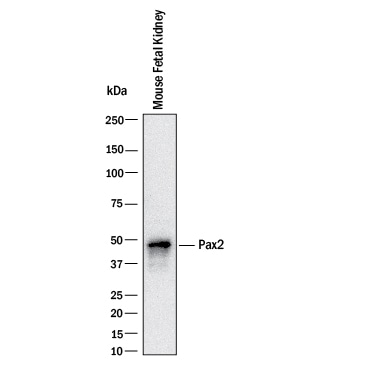
Detection of Mouse Pax2 by Western Blot.
Western blot shows lysates of mouse fetal kidney. PVDF Membrane was probed with 1 µg/mL of Goat Anti-Human Pax2 Antigen Affinity-purified Polyclonal Antibody (Catalog # AF3364) followed by HRP-conjugated Anti-Goat IgG Secondary Antibody (HAF017). A specific band was detected for Pax2 at approximately 47 kDa (as indicated). This experiment was conducted under reducing conditions and using Western Blot Buffer Group 1.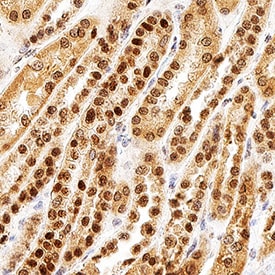
Pax2 in Human Kidney.
Pax2 was detected in immersion fixed paraffin-embedded sections of human kidney using Goat Anti-Human Pax2 Antigen Affinity-purified Polyclonal Antibody (Catalog # AF3364) at 1 µg/mL for 1 hour at room temperature followed by incubation with the Anti-Goat IgG VisUCyte™ HRP Polymer Antibody (VC004). Before incubation with the primary antibody, tissue was subjected to heat-induced epitope retrieval using Antigen Retrieval Reagent-Basic (CTS013). Tissue was stained using DAB (brown) and counterstained with hematoxylin (blue). Specific staining was localized to cell nuclei in convoluted tubules. Staining was performed using our protocol for IHC Staining with VisUCyte HRP Polymer Detection Reagents.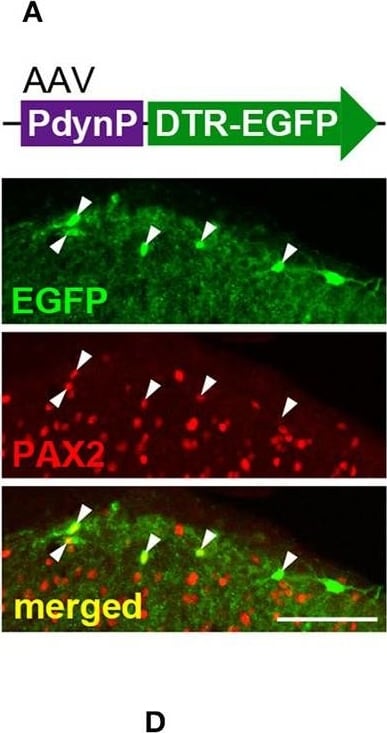
Detection of Rat Human Pax2 Antibody by Immunohistochemistry
Ablation of AAV-PdynP+ spinal dorsal horn (SDH) neurons does not affect behavioral responses evoked by the optical stimulation of A beta fibers, nociceptive mechanical force, and heat in rats. (A) Enhanced green fluorescent protein (EGFP) expression (green) in the L4 SDH at 4 weeks after intra-SDH microinjection of AAV-PdynP-DTR-EGFP (indicated by an upper schematic illustration). Colocalization of EGFP and PAX2 (red) in the SDH (indicated by arrowheads). Scale bar, 100 μm. The percentage of co-expressing neurons was quantified (n = 3 rats tested, 94 total EGFP+ cells quantified, and 339 total PAX2+ cells quantified). (B) Diphtheria toxin receptors (DTR) immunofluorescence in the SDH after administration of diphtheria toxin (DTX: 50 μg/kg, i.p., two injection 72 h apart) or PBS. Scale bar, 200 μm. (C) Immunohistochemical analysis and quantification of PAX2+ neurons in the superficial laminae of the ipsilateral and contralateral SDH at 4 weeks after DTX injection (n = 6 rats tested, PAX2+ neurons: 992 [ipsi] and 1574 [contra] cells quantified). Scale bar, 50 μm. ****P < 0.0001, Unpaired t-test. (D) Paw withdrawal behaviors by light (score), von Frey filaments (threshold), and heat (latency) at 4 weeks after DTX or PBS injection (n = 7–9 rats). Data shown as mean ± SEM. Image collected and cropped by CiteAb from the following publication (https://pubmed.ncbi.nlm.nih.gov/35813063), licensed under a CC-BY license. Not internally tested by R&D Systems.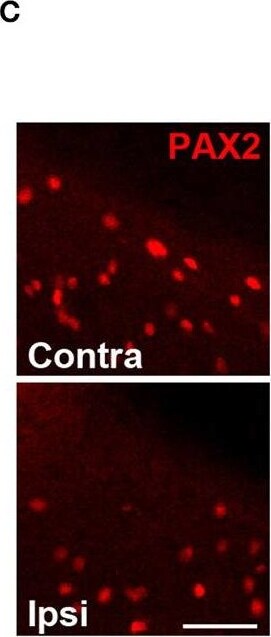
Detection of Rat Human Pax2 Antibody by Immunohistochemistry
Ablation of AAV-PdynP+ spinal dorsal horn (SDH) neurons does not affect behavioral responses evoked by the optical stimulation of A beta fibers, nociceptive mechanical force, and heat in rats. (A) Enhanced green fluorescent protein (EGFP) expression (green) in the L4 SDH at 4 weeks after intra-SDH microinjection of AAV-PdynP-DTR-EGFP (indicated by an upper schematic illustration). Colocalization of EGFP and PAX2 (red) in the SDH (indicated by arrowheads). Scale bar, 100 μm. The percentage of co-expressing neurons was quantified (n = 3 rats tested, 94 total EGFP+ cells quantified, and 339 total PAX2+ cells quantified). (B) Diphtheria toxin receptors (DTR) immunofluorescence in the SDH after administration of diphtheria toxin (DTX: 50 μg/kg, i.p., two injection 72 h apart) or PBS. Scale bar, 200 μm. (C) Immunohistochemical analysis and quantification of PAX2+ neurons in the superficial laminae of the ipsilateral and contralateral SDH at 4 weeks after DTX injection (n = 6 rats tested, PAX2+ neurons: 992 [ipsi] and 1574 [contra] cells quantified). Scale bar, 50 μm. ****P < 0.0001, Unpaired t-test. (D) Paw withdrawal behaviors by light (score), von Frey filaments (threshold), and heat (latency) at 4 weeks after DTX or PBS injection (n = 7–9 rats). Data shown as mean ± SEM. Image collected and cropped by CiteAb from the following publication (https://pubmed.ncbi.nlm.nih.gov/35813063), licensed under a CC-BY license. Not internally tested by R&D Systems.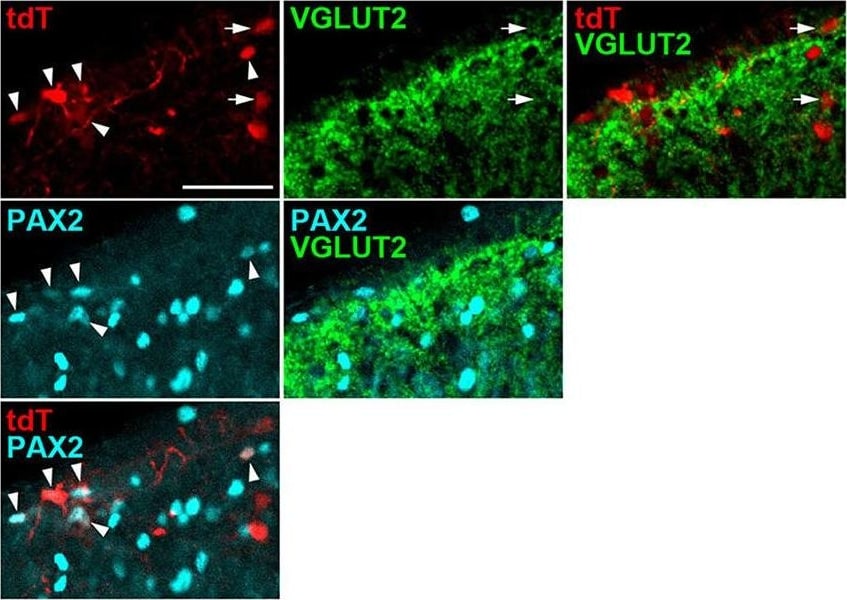
Detection of Rat Human Pax2 Antibody by Immunohistochemistry
AAV-PdynP injected into rat spinal dorsal horn (SDH) captures a subset of inhibitory neurons. (A) tdTomato (tdT) expression in the fourth lumbar (L4) SDH at 4 weeks after microinjection of AAV-PdynP-tdT. Schematic illustration indicates intra-SDH microinjection of the AAV vector. Scale bar, 200 μm. (B) Immunolabeling of tdT+ cells (red) with lamina-selective markers (green, NK1R; blue, IB4) in the L4 SDH. Scale bar, 200 μm. Quantification of the distribution of tdT+ cells (n = 3 rats tested, 272 total tdT+ cells quantified). (C) Immunofluorescence of prodynorphin (PDYN; green) in tdT+ SDH neurons (red). Scale bar, 200 μm (above), 20 μm (below). Arrowheads indicate tdT+ PDYN+ neurons. The percentage of tdT+ PDYN+ neurons per total tdT+ neurons was quantified (n = 4 rats tested, 1,281 total tdT+ cells quantified). (D) No colocalization of tdT (red) with NK1R (green). Scale bar, 50 μm. The percentage of co-expressing neurons was quantified (n = 3 rats tested, 187 total tdT+ cells quantified). (E) Firing patterns of tdT+ SDH neurons, and the percentage of neurons displaying each pattern. APs were evoked by current injection (80 pA). (F) Colocalization of tdT (red) with PAX2 (blue) and VGLUT2 (green) in the superficial laminae. Arrowheads and arrows indicate tdT+PAX2+ and tdT+VGLUT2+ neurons, respectively. Scale bar, 50 μm. The percentage of co-expressing neurons was quantified (n = 4 rats tested, 456 total tdT+ cells quantified). Data shown as mean ± SEM. Image collected and cropped by CiteAb from the following publication (https://pubmed.ncbi.nlm.nih.gov/35813063), licensed under a CC-BY license. Not internally tested by R&D Systems.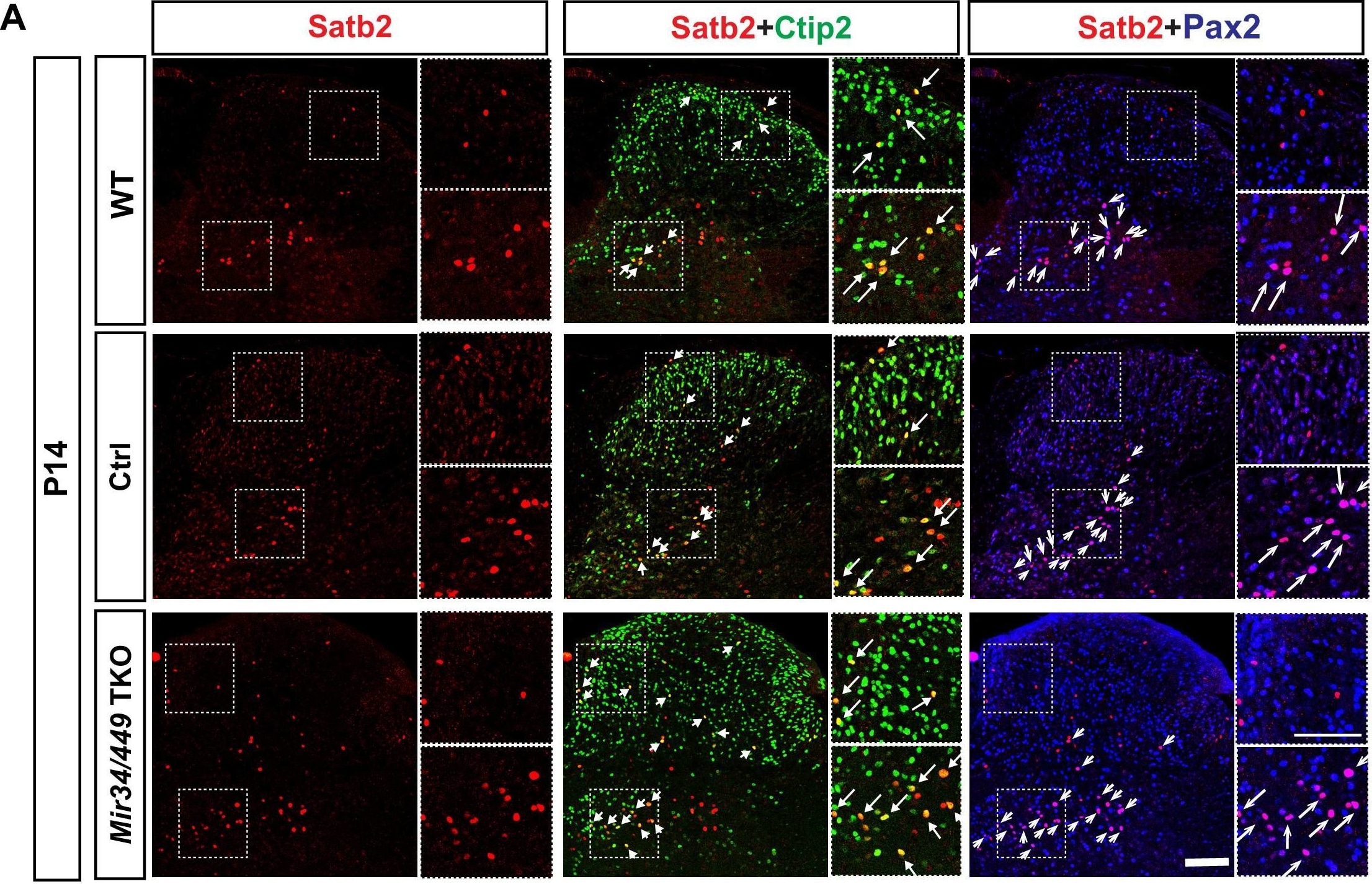
Detection of Mouse Pax2 by Immunohistochemistry
MiR34/449 tunes optimal Satb2 expression in the Ctip2 IN subpopulation.(A) Immunostaining for Satb2, Ctip2,&Pax2 in dorsal&intermediate spinal cord at P14. Note that Satb2on INs display two molecular identities, i.e., the Ctip2on or Pax2on subpopulations. Comparison with WT/Ctrl reveals an increase in the cell number of Satb2on;Ctip2on INs in the intermediate spinal cord of cervical/brachial sections upon MiR34/449 deletion. Boxed areas indicate higher magnification regions from the intermediate&dorsal regions of each image. Arrows highlight the presence of dual-labeled Satb2on;Ctip2on cells (yellow) or dual-labeled Satb2on;Pax2on cells (magenta) among the Satb2on population. (B–C) Quantifications of cell number from (A). (D) Quantifications of the Satb2on;Ctip2on&Satb2on;Pax2on subpopulations normalized against total Satb2on cell numbers&are shown as a %age. (E) Comparison of the spatial distribution of individual Satb2on;Ctip2on INs in the cervical/brachial spinal cord of indicated mice (Ctrl, grey; Mir34bc/449 DKO&Mir34/449 TKO, magenta). Frequency distributions along the medio-lateral (top)&dorso-ventral (right) axes represent non-linear regressions. (F) A contour density plot of Satb2on;Ctip2on INs indicates that Satb2on;Ctip2on INs are mainly located in the medial spinal cord of both MiR34/449 mutant&Ctrl mice. Contour lines represent density at the 30th–90th %iles. Data analyzed from more than 25 sections of at least five independent spinal cords in (E)&(F). (G) Schematic illustrating the increased number of Satb2on;Ctip2on INs in the MiR34/449 mutant spinal cord. Data are presented as mean ± SD. One-way ANOVA with Tukey’s multiple comparisons test. * denotes p<0.05; ‘NS’ denotes ‘not significant’. Scale bars represent 100 μm. Image collected&cropped by CiteAb from the following open publication (https://pubmed.ncbi.nlm.nih.gov/33787491), licensed under a CC-BY license. Not internally tested by R&D Systems.Applications for Human Pax2 Antibody
Immunohistochemistry
Sample: Immersion fixed paraffin-embedded sections of human kidney
Western Blot
Sample: Mouse fetal kidney
Reviewed Applications
Read 2 reviews rated 4 using AF3364 in the following applications:
Formulation, Preparation, and Storage
Purification
Reconstitution
Reconstitute at 0.2 mg/mL in sterile PBS. For liquid material, refer to CoA for concentration.
Formulation
Shipping
Stability & Storage
- 12 months from date of receipt, -20 to -70 °C as supplied.
- 1 month, 2 to 8 °C under sterile conditions after reconstitution.
- 6 months, -20 to -70 °C under sterile conditions after reconstitution.
Calculators
Background: Pax2
Long Name
Alternate Names
Gene Symbol
UniProt
Additional Pax2 Products
Product Documents for Human Pax2 Antibody
Certificate of Analysis
To download a Certificate of Analysis, please enter a lot or batch number in the search box below.
Note: Certificate of Analysis not available for kit components.
Product Specific Notices for Human Pax2 Antibody
For research use only
Related Research Areas
Citations for Human Pax2 Antibody
 Powered by Bioz
Customer Reviews for Human Pax2 Antibody (2)
Have you used Human Pax2 Antibody?
Submit a review and receive an Amazon gift card!
$25/€18/£15/$25CAN/¥2500 for a review with an image
$10/€7/£6/$10CAN/¥1110 for a review without an image
Submit a review
Customer Images
-
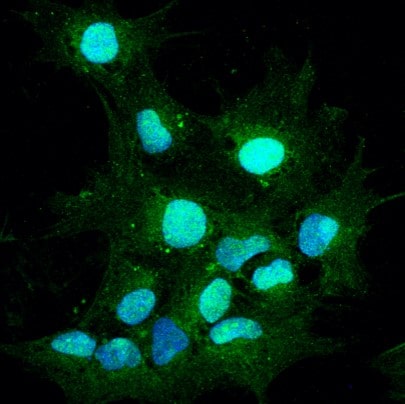
Application: Immunocytochemistry/ImmunofluorescenceSample Tested: iPS2 human induced pluripotent stem cellsSpecies: HumanVerified Customer | Posted 03/27/2024Green is PAX2. Blue is DAPI.

-
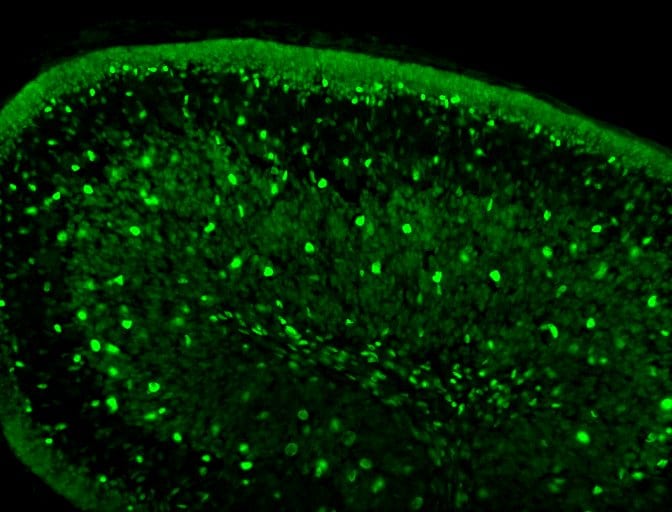
Application: ImmunohistochemistrySample Tested: Cerebellum tissueSpecies: MouseVerified Customer | Posted 07/22/2016P7 Mouse cerebellum. 20 um section.
There are no reviews that match your criteria.
Protocols
Find general support by application which include: protocols, troubleshooting, illustrated assays, videos and webinars.
- Antigen Retrieval Protocol (PIER)
- Antigen Retrieval for Frozen Sections Protocol
- Appropriate Fixation of IHC/ICC Samples
- Cellular Response to Hypoxia Protocols
- Chromogenic IHC Staining of Formalin-Fixed Paraffin-Embedded (FFPE) Tissue Protocol
- Chromogenic Immunohistochemistry Staining of Frozen Tissue
- ClariTSA™ Fluorophore Kits
- Detection & Visualization of Antibody Binding
- Fluorescent IHC Staining of Frozen Tissue Protocol
- Graphic Protocol for Heat-induced Epitope Retrieval
- Graphic Protocol for the Preparation and Fluorescent IHC Staining of Frozen Tissue Sections
- Graphic Protocol for the Preparation and Fluorescent IHC Staining of Paraffin-embedded Tissue Sections
- Graphic Protocol for the Preparation of Gelatin-coated Slides for Histological Tissue Sections
- IHC Sample Preparation (Frozen sections vs Paraffin)
- Immunofluorescent IHC Staining of Formalin-Fixed Paraffin-Embedded (FFPE) Tissue Protocol
- Immunohistochemistry (IHC) and Immunocytochemistry (ICC) Protocols
- Immunohistochemistry Frozen Troubleshooting
- Immunohistochemistry Paraffin Troubleshooting
- Preparing Samples for IHC/ICC Experiments
- Preventing Non-Specific Staining (Non-Specific Binding)
- Primary Antibody Selection & Optimization
- Protocol for Heat-Induced Epitope Retrieval (HIER)
- Protocol for Making a 4% Formaldehyde Solution in PBS
- Protocol for VisUCyte™ HRP Polymer Detection Reagent
- Protocol for the Preparation & Fixation of Cells on Coverslips
- Protocol for the Preparation and Chromogenic IHC Staining of Frozen Tissue Sections
- Protocol for the Preparation and Chromogenic IHC Staining of Frozen Tissue Sections - Graphic
- Protocol for the Preparation and Chromogenic IHC Staining of Paraffin-embedded Tissue Sections
- Protocol for the Preparation and Chromogenic IHC Staining of Paraffin-embedded Tissue Sections - Graphic
- Protocol for the Preparation and Fluorescent IHC Staining of Frozen Tissue Sections
- Protocol for the Preparation and Fluorescent IHC Staining of Paraffin-embedded Tissue Sections
- Protocol for the Preparation of Gelatin-coated Slides for Histological Tissue Sections
- R&D Systems Quality Control Western Blot Protocol
- TUNEL and Active Caspase-3 Detection by IHC/ICC Protocol
- The Importance of IHC/ICC Controls
- Troubleshooting Guide: Immunohistochemistry
- Troubleshooting Guide: Western Blot Figures
- Western Blot Conditions
- Western Blot Protocol
- Western Blot Protocol for Cell Lysates
- Western Blot Troubleshooting
- Western Blot Troubleshooting Guide
- View all Protocols, Troubleshooting, Illustrated assays and Webinars

