
Sphingomyelin phosphodiesterase, also known as acid sphingomyelinase and encoded by the SMPD1 gene, is a lysosomal phosphodiesterase which belongs to the acid sphingomyelinase family (1). SMPD1 catalyzes the hydrolysis of sphingomyelin to ceramide and phosphorylcholine. Ceramide, a bioactive lipid, has emerged as an important signaling molecule involved in a variety of cellular processes such as cell differentiation, apoptosis, and proliferation (2). Activation of SMPD1 occurs by the removal, chemical modification or dimerization of its C-terminal cysteine residue (3). Deficiencies of SMPD1 result in a lysosomal storage disorder referred to as Niemann-Pick disease (4). rhSMPD1 was expressed without the last three C-terminal residues, and is therefore constitutively active.

Scientific images may be resized, cropped, or adjusted for brightness or contrast for presentation purposes. These updates are limited to presentation and do not affect the underlying scientific interpretation of the data. Where available, additional source data may be provided upon request.
Key Product Details
Validated by
Species Reactivity
Validated:
Cited:
Applications
Validated:
Cited:
Label
Antibody Source
Product Specifications
Immunogen
His62-Pro628
Accession # NP_000534
Specificity
Clonality
Host
Isotype
Scientific Data Images for Human SMPD1 Antibody (563418)
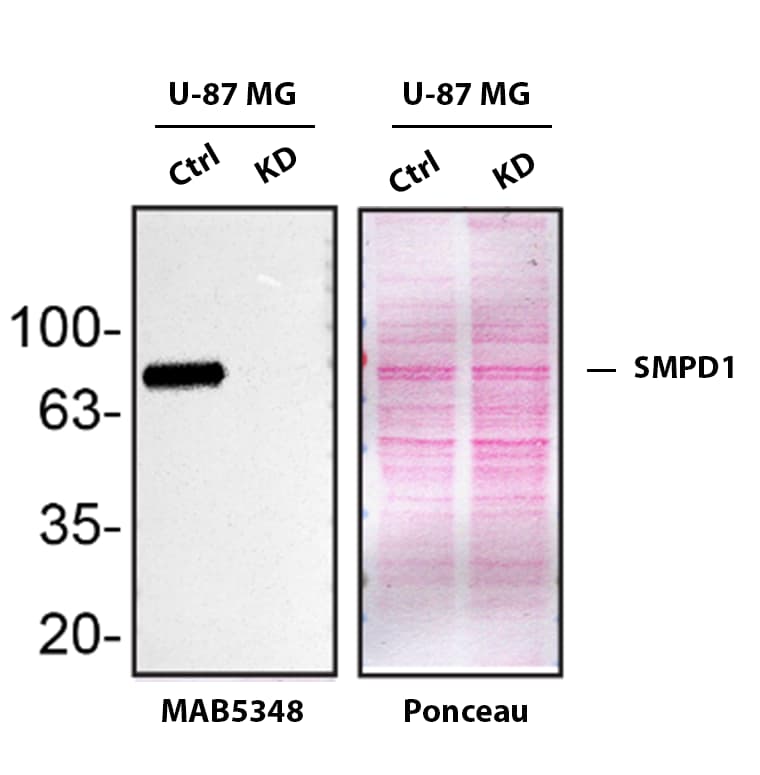
Western Blot Shows SMPD1 Specificity Using Knockdown Cell Line.
Western blot shows culture media of U‑87 MG human glioblastoma/astrocytoma parental cell line and SMPD1 knockdown U-87 MG cell line (KD). Nitrocellulose membrane was probed with Mouse Anti-Human SMPD1 Monoclonal Antibody (Catalog # MAB5348) followed by HRP-conjugated secondary antibody. A specific band was detected for SMPD1 at approximately 69.9 kDa (as indicated) in the parental U-87 MG cell line, but is significantly reduced in the knockdown U-87 MG cell line. Primary antibody concentration used: 2.5 µg/mL. The Ponceau stained transfer of the blot is shown. This experiment was conducted under reducing conditions. Image, protocol, and testing courtesy of YCharOS Inc. See ycharos.com for additional details.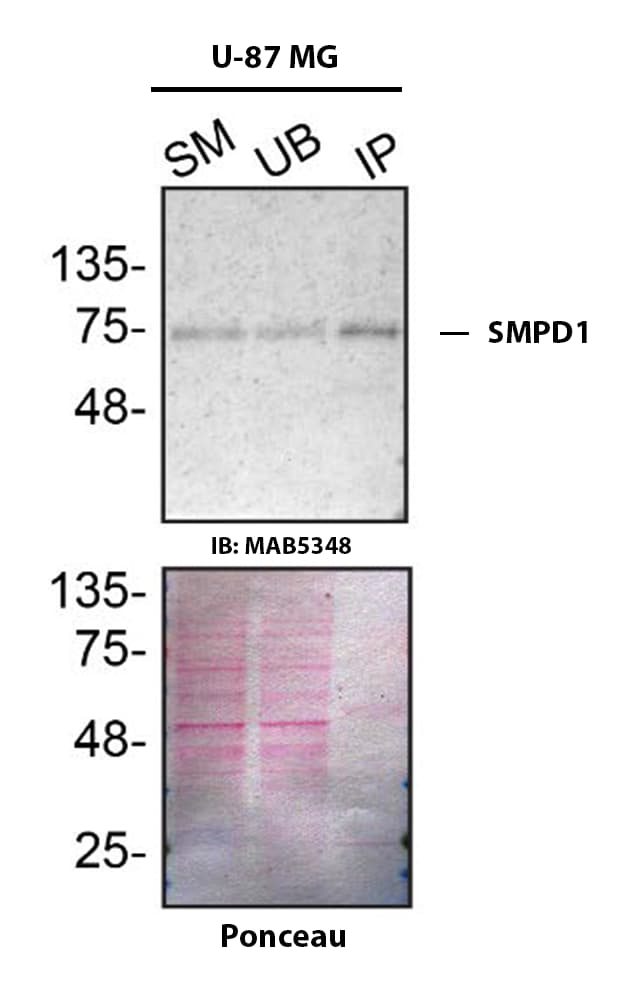
Detection of SMPD1 by Immunoprecipitation.
U‑87 MG human glioblastoma/astrocytoma cell line culture medium were prepared and immunoprecipitation was performed using 2.0 μg of Mouse Anti-Human SMPD1 Monoclonal Antibody (Catalog # MAB5348) pre-coupled to Dynabeads Protein G. Immunoprecipitated SMPD1 was detected in Western Blot with MAB5348 used at 1/500. The Ponceau stained transfer of the blot is shown. SM=4% starting material; UB=4% unbound fraction; IP=immunoprecipitate; HC=antibody heavy chain. Image, protocol and testing courtesy of YCharOS Inc. (ycharos.com).Applications for Human SMPD1 Antibody (563418)
Immunoprecipitation
Sample: Conditioned cell culture medium spiked with Recombinant Human SMPD1
(Catalog # 5348-PD), see our available Western blot detection antibodies.
Western Blot
Neutralization
Reviewed Applications
Read 1 review rated 5 using MAB5348 in the following applications:
Formulation, Preparation, and Storage
Purification
Reconstitution
Sterile PBS to a final concentration of 0.5 mg/mL. For liquid material, refer to CoA for concentration.
Formulation
Shipping
Stability & Storage
- 12 months from date of receipt, -20 to -70 °C as supplied.
- 1 month, 2 to 8 °C under sterile conditions after reconstitution.
- 6 months, -20 to -70 °C under sterile conditions after reconstitution.
Calculators
Background: SMPD1
References
- Schuchman, E.H. et al. (1991) J. Biol. Chem. 266:8531.
- Melendez, A.J. et al. (2008) Biochim. Biophys. Acta 1784:66.
- Qiu, H. et al. (2003) J. Biol. Chem. 278:32744.
- Smith, E.L. and Schuchman, E.H. (2008) FASEB J. 22:3419.
Long Name
Alternate Names
Gene Symbol
UniProt
Additional SMPD1 Products
Product Documents for Human SMPD1 Antibody (563418)
Certificate of Analysis
To download a Certificate of Analysis, please enter a lot or batch number in the search box below.
Note: Certificate of Analysis not available for kit components.
Product Specific Notices for Human SMPD1 Antibody (563418)
For research use only
Related Research Areas
Citations for Human SMPD1 Antibody (563418)
 Powered by Bioz
Customer Reviews for Human SMPD1 Antibody (563418) (1)
Have you used Human SMPD1 Antibody (563418)?
Submit a review and receive an Amazon gift card!
$25/€18/£15/$25CAN/¥2500 for a review with an image
$10/€7/£6/$10CAN/¥1110 for a review without an image
Submit a review
Customer Images
-
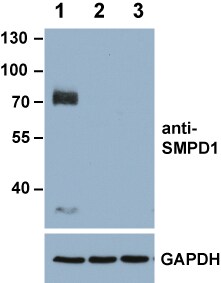
Application: Western BlotSample Tested: 143B osteosarcoma cellsSpecies: HumanVerified Customer | Posted 02/03/201730 micrograms of proteins per lane. Nitrocellulose membrane. 5% milk/PBS-Tween was used for blocking. Antibody dilution: 1:1000 in 1% milk/PBS-Tween. Lane 1=wild-type cells, lane 2 and 3 show two different knock-out clones obtained by CRISPR/Cas9 genome editing. A loading control (GAPDH) is also shown.

There are no reviews that match your criteria.
Protocols
Find general support by application which include: protocols, troubleshooting, illustrated assays, videos and webinars.
- Cellular Response to Hypoxia Protocols
- Immunoprecipitation Protocol
- R&D Systems Quality Control Western Blot Protocol
- Troubleshooting Guide: Western Blot Figures
- Western Blot Conditions
- Western Blot Protocol
- Western Blot Protocol for Cell Lysates
- Western Blot Troubleshooting
- Western Blot Troubleshooting Guide
- View all Protocols, Troubleshooting, Illustrated assays and Webinars