
Syntaxin 4 (STX4) is a widely expressed type IV transmembrane protein that is a member of the syntaxin family of t‑SNARE (target‑Soluble NSF [N‑ethylmaleimide‑sensitive factor] Attachment REceptor) membrane fusion proteins (1, 2). For membrane fusion, VAMPs (Vesicle‑Associated Membrane Proteins, also called Synaptotagmins) as v‑SNAREs on donor (vesicle) membranes interact with t‑SNAREs and SNAPs (Soluble NSF Attachment Proteins) on target (cell surface) membranes, with SM (Sec1/Munc18-like) accessory proteins acting as catalysts for fusion (2). Human Syntaxin 4 cDNA encodes 297 amino acids (aa) including basolateral targeting motif for epithelial cells (aa 24‑29), a coiled‑coil domain termed Habc (aa 43‑163), an S‑nitrosylation site which regulates fusion (aa 141), a hinge region, a t‑SNARE domain (aa 200‑262), and a C‑terminal transmembrane domain (aa 276‑296) (1‑4). Within aa 1‑183, human Syntaxin 4 shares 89% aa sequence homology with mouse and rat, and 94‑95% with canine, bovine, equine, porcine, feline and ovine Syntaxin 4. Among its known roles, Syntaxin 4 and SNAP‑23 or SNAP‑25 associate with VAMP‑2 for fusion of GLUT4‑containing vesicles with the plasma membrane in muscle and adipose cells (1, 5). It is required for exocytosis of insulin from pancreatic beta ‑cells (3, 6, 7). With SNAP23 and VAMP‑3, it allows endosome recycling to extend podosomes during macrophage migration (7‑9). It establishes polarization of epithelial cells, specifying basolateral sorting of proteins (4, 10). It mediates postsynaptic activity‑dependent exocytosis in neural cell dendritic spines (11). It is involved in exocytosis of ANP from cardiomyocytes (12). In FAS‑mediated apoptosis, it allows translocation of acid sphingomyelinase to the cell surface (13). Syntaxin 4 binds F‑actin and gelsolin, linking the plasma membrane with, or releasing it from, the actin cytoskeleton (6, 7).
Human Syntaxin 4 Antibody (884637)
R&D Systems | Catalog # MAB7894

Scientific images may be resized, cropped, or adjusted for brightness or contrast for presentation purposes. These updates are limited to presentation and do not affect the underlying scientific interpretation of the data. Where available, additional source data may be provided upon request.
Key Product Details
Validated by
Species Reactivity
Applications
Label
Antibody Source
Product Specifications
Immunogen
Met1-Glu183
Accession # Q12846
Specificity
Clonality
Host
Isotype
Scientific Data Images for Human Syntaxin 4 Antibody (884637)
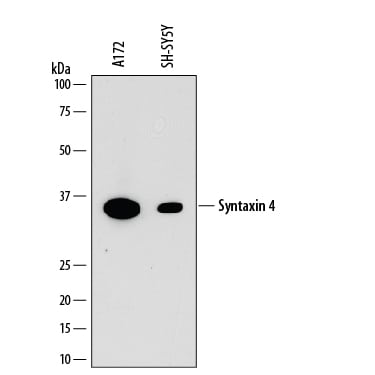
Detection of Human Syntaxin 4 by Western Blot.
Western blot shows lysates of A172 human glioblastoma cell line and SH-SY5Y human neuroblastoma cell line. PVDF membrane was probed with 0.25 µg/mL of Mouse Anti-Human Syntaxin 4 Monoclonal Antibody (Catalog # MAB7894) followed by HRP-conjugated Anti-Mouse IgG Secondary Antibody (HAF018). A specific band was detected for Syntaxin 4 at approximately 36 kDa (as indicated). This experiment was conducted under reducing conditions and using Immunoblot Buffer Group 1.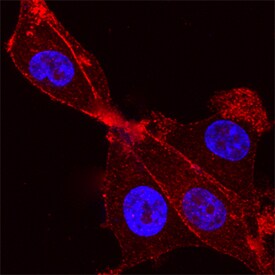
Syntaxin 4 in U‑87 MG Human Cell Line.
Syntaxin 4 was detected in immersion fixed U-87 MG human glioblastoma/astrocytoma cell line using Mouse Anti-Human Syntaxin 4 Monoclonal Antibody (Catalog # MAB7894) at 25 µg/mL for 3 hours at room temperature. Cells were stained using the NorthernLights™ 557-conjugated Anti-Mouse IgG Secondary Antibody (red; NL007) and counterstained with DAPI (blue). Specific staining was localized to plasma membranes and focal contacts. View our protocol for Fluorescent ICC Staining of Cells on Coverslips.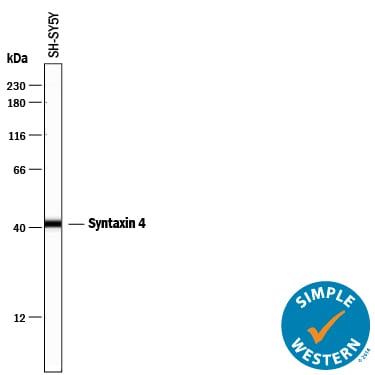
Detection of Human Syntaxin 4 by Simple WesternTM.
Simple Western lane view shows lysates of SH‑SY5Y human neuroblastoma cell line, loaded at 0.5 mg/mL. A specific band was detected for Syntaxin 4 at approximately 42 kDa (as indicated) using 2.5 µg/mL of Mouse Anti-Human Syntaxin 4 Monoclonal Antibody (Catalog # MAB7894). This experiment was conducted under reducing conditions and using the 12-230 kDa separation system.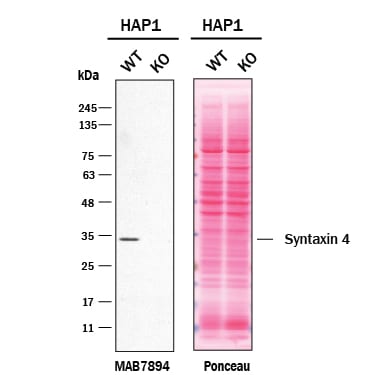
Western Blot Shows Human Syntaxin 4 Specificity Using Knockout Cell Line.
Western blot shows lysates of HAP1 human near-haploid cell line and Syntaxin 4 knockout HAP1 cell line (KO). Nitrocellulose membrane was probed with 0.25 µg/mL of Mouse Anti-Human Syntaxin 4 Monoclonal Antibody (Catalog # MAB7894) followed by HRP-conjugated Anti-Mouse IgG Secondary Antibody. A specific band was detected for Syntaxin 4 at approximately 34 kDa (as indicated) in the parental HAP1 cell line, but is not detectable in knockout HAP1 cell line. The Ponceau stained transfer of the blot is shown. This experiment was conducted under reducing conditions. Image, protocol, and testing courtesy of YCharOS Inc. See ycharos.com for additional details.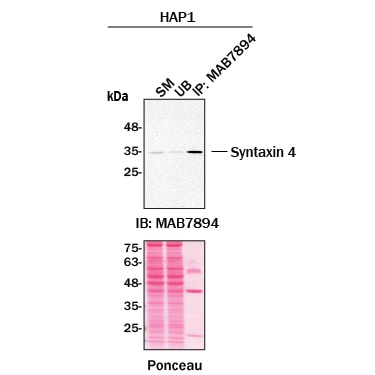
Detection of Syntaxin-4 by Immunoprecipitation.
Immunoprecipitation was performed on cell lysate of HAP1 human near-haploid cell line using 2.0 μg of Mouse Anti-Human Syntaxin-4 Monoclonal Antibody (Catalog # MAB7894) pre-coupled to protein G or protein A beads. Immunoprecipitated Syntaxin-4 was detected with an Anti-Human Syntaxin-4 Monoclonal Antibody (Catalog # MAB7894) The Ponceau stained transfers of each blot are shown. SM=10% starting material; UB=10% unbound fraction; IP=immunoprecipitated. Image, protocol, and testing courtesy of YCharOS Inc. (ycharos.com).Applications for Human Syntaxin 4 Antibody (884637)
Immunocytochemistry
Sample: Immersion fixed U‑87 MG human glioblastoma/astrocytoma cell line
Immunoprecipitation
Sample: Cell lysate of HAP1 human near-haploid cell line.
Knockout Validated
Simple Western
Sample: SH‑SY5Y human neuroblastoma cell line
Western Blot
Sample: A172 human glioblastoma cell line and SH‑SY5Y human neuroblastoma cell line
Formulation, Preparation, and Storage
Purification
Reconstitution
Reconstitute at 0.5 mg/mL in sterile PBS. For liquid material, refer to CoA for concentration.
Formulation
Shipping
Stability & Storage
- 12 months from date of receipt, -20 to -70 °C as supplied.
- 1 month, 2 to 8 °C under sterile conditions after reconstitution.
- 6 months, -20 to -70 °C under sterile conditions after reconstitution.
Calculators
Background: Syntaxin 4
References
- Jagadish, M.N. et al. (1996) Biochem. J. 317:945.
- Sudhof, T.C. and J.E. Rothman 2009 Science 323:474.
- Wiseman, D.A. et al. (2011) J. Biol. Chem. 286:16344.
- Reales, E. et al. (2011) PLoS One 6:e21181.
- Vicogne, J. et al. (2006) Proc. Natl. Acad. Sci. USA 103:14761.
- Jewell, J.L. et al. (2008) J. Biol. Chem. 283:10716.
- Kalwat, M.A. et al. (2012) Mol. Endocrinol. 26:128.
- Veale, K.J. et al. (2010) Commun. Integr. Biol. 4:44.
- Veale, K.J. et al. (2010) Exp. Cell Res. 317:1817.
- Low, S.H. et al. (2006) Mol. Biol. Cell 17:977.
- Kennedy, M.J. et al. (2010) Cell 141:524.
- Ferlito, M. et al. (2010) J. Mol. Cardiol. 49:791.
- Perotta, C. et al. (2010) J. Biol. Chem. 285:40240.
Alternate Names
Gene Symbol
UniProt
Additional Syntaxin 4 Products
Product Documents for Human Syntaxin 4 Antibody (884637)
Certificate of Analysis
To download a Certificate of Analysis, please enter a lot or batch number in the search box below.
Note: Certificate of Analysis not available for kit components.
Product Specific Notices for Human Syntaxin 4 Antibody (884637)
For research use only
Related Research Areas
Citations for Human Syntaxin 4 Antibody (884637)
 Powered by Bioz
Customer Reviews for Human Syntaxin 4 Antibody (884637)
There are currently no reviews for this product. Be the first to review Human Syntaxin 4 Antibody (884637) and earn rewards!
Have you used Human Syntaxin 4 Antibody (884637)?
Submit a review and receive an Amazon gift card!
$25/€18/£15/$25CAN/¥2500 for a review with an image
$10/€7/£6/$10CAN/¥1110 for a review without an image
Submit a review
Protocols
Find general support by application which include: protocols, troubleshooting, illustrated assays, videos and webinars.
- Appropriate Fixation of IHC/ICC Samples
- Cellular Response to Hypoxia Protocols
- ClariTSA™ Fluorophore Kits
- Detection & Visualization of Antibody Binding
- ICC Cell Smear Protocol for Suspension Cells
- ICC Immunocytochemistry Protocol Videos
- ICC for Adherent Cells
- Immunocytochemistry (ICC) Protocol
- Immunocytochemistry Troubleshooting
- Immunofluorescence of Organoids Embedded in Cultrex Basement Membrane Extract
- Immunohistochemistry (IHC) and Immunocytochemistry (ICC) Protocols
- Immunoprecipitation Protocol
- Preparing Samples for IHC/ICC Experiments
- Preventing Non-Specific Staining (Non-Specific Binding)
- Primary Antibody Selection & Optimization
- Protocol for VisUCyte™ HRP Polymer Detection Reagent
- Protocol for the Fluorescent ICC Staining of Cell Smears - Graphic
- Protocol for the Fluorescent ICC Staining of Cultured Cells on Coverslips - Graphic
- Protocol for the Preparation and Fluorescent ICC Staining of Cells on Coverslips
- Protocol for the Preparation and Fluorescent ICC Staining of Non-adherent Cells
- Protocol for the Preparation and Fluorescent ICC Staining of Stem Cells on Coverslips
- Protocol for the Preparation of a Cell Smear for Non-adherent Cell ICC - Graphic
- R&D Systems Quality Control Western Blot Protocol
- TUNEL and Active Caspase-3 Detection by IHC/ICC Protocol
- The Importance of IHC/ICC Controls
- Troubleshooting Guide: Western Blot Figures
- Western Blot Conditions
- Western Blot Protocol
- Western Blot Protocol for Cell Lysates
- Western Blot Troubleshooting
- Western Blot Troubleshooting Guide
- View all Protocols, Troubleshooting, Illustrated assays and Webinars