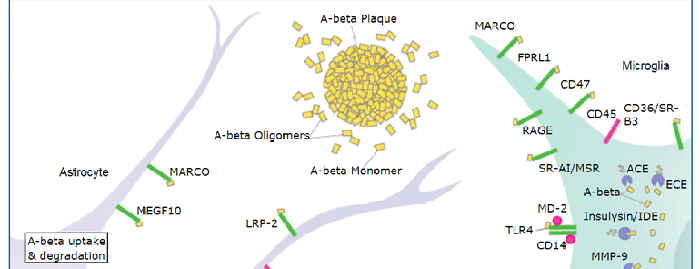
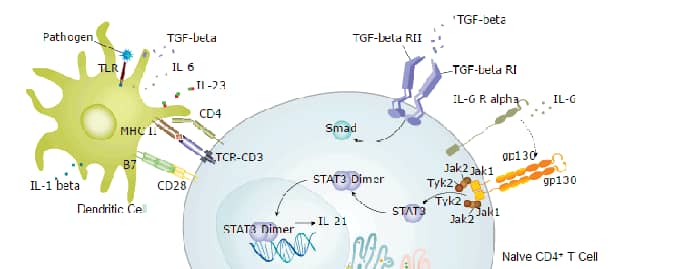
TLR4 is a 100 kDa type I transmembrane glycoprotein that belongs to the mammalian Toll-Like Receptor family of pathogen pattern recognition molecules. MD-2, also known as ESOP-1, is a 25 kDa secreted protein that is required for TLR4-mediated responses to bacterial lipopolysaccharide (LPS) (1-3). The human TLR4 cDNA encodes an 839 amino acid (aa) precursor that contains a 23 aa signal sequence, a 608 aa extracellular domain (ECD), a 21 aa transmembrane segment, and a 187 aa cytoplasmic domain. TLR4 contains 21 leucine rich repeats in its ECD and one cytoplasmic Toll/IL-1 receptor (TIR) domain (4). The ECD of human TLR4 shares approximately 25% aa sequence identity with other TLRs and 60-74% aa sequence identity with bovine, equine, feline, mouse, rat, and porcine TLR4. The human MD‑2 cDNA encodes a 160 aa precursor with an 18 aa signal sequence (5). Human MD-2 shares 20% aa sequence identity with MD-1 and 62-64% aa sequence identity with bovine, mouse, and rat MD-2. MD-2 associates with TLR4 on monocytes, macrophages, dendritic cells, and B cells (5-7). MD-2 expression is required for cell surface localization of TLR4 and for optimal LPS-induced TLR4 signaling (7, 8). MD-2 also forms soluble disulfide-linked homo-oligomers which can interact with TLR4 (6). Through a domain separate from its TLR4-binding domain, MD-2 extracts LPS from circulating CD14-LPS complexes and carries the LPS into a ternary complex with TLR4 (9-11). The interaction of MD-2/LPS with TLR4 induces receptor oligomerization and the triggering of an inflammatory response (12). Increased levels of plasma MD-2 in septic shock patients sensitizes MD-2 non-expressing epithelial cells to LPS and promotes widespread tissue inflammation (13).
Human TLR4 Antibody (285227)
R&D Systems | Catalog # MAB1478

Scientific images may be resized, cropped, or adjusted for brightness or contrast for presentation purposes. These updates are limited to presentation and do not affect the underlying scientific interpretation of the data. Where available, additional source data may be provided upon request.
Key Product Details
Species Reactivity
Validated:
Cited:
Applications
Validated:
Cited:
Label
Antibody Source
Product Specifications
Immunogen
Glu24-Lys631
Accession # O00206
Specificity
Clonality
Host
Isotype
Scientific Data Images for Human TLR4 Antibody (285227)
Detection of TLR4 by Western Blot
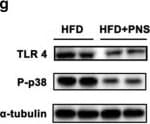
PNS attenuated fibrosis associated with TLR 4 pathway in HFD-fed mice but not ob/ob mice. a Representative Sirius Red staining examination in liver sections of ob/ob and HFD mice treated with PNS or vehicle (Scale bars, × 50 μm). b, d The mRNA expression of fibrosis genes, including Collegen I, Collegen IV and alpha -SMA in HFD and ob/ob mice treated with PNS or vehicle. c, e The mRNA levels of inflammatory gens (TNF-alpha, IL-6 and CD14) in HFD and ob/ob mice treated with PNS or vehicle. f Immunofluorescence staining of alpha -SMA protein (red) staining in HFD and ob/ob mice treated with PNS or vehicle (Scale bars, × 20 μm). g–j The expression of TLR4 and phosphorylated p-38 proteins in HFD and ob/ob mice were evaluated by the western blotting analysis Image collected and cropped by CiteAb from the following open publication (https://pubmed.ncbi.nlm.nih.gov/33656663), licensed under a CC-BY license. Not internally tested by R&D Systems.Applications for Human TLR4 Antibody (285227)
Western Blot
Sample: Recombinant Human TLR4/MD‑2 Complex (Catalog # 3146-TM)
Formulation, Preparation, and Storage
Purification
Reconstitution
Reconstitute at 0.5 mg/mL in sterile PBS. For liquid material, refer to CoA for concentration.
Formulation
Shipping
Stability & Storage
- 12 months from date of receipt, -20 to -70 °C as supplied.
- 1 month, 2 to 8 °C under sterile conditions after reconstitution.
- 6 months, -20 to -70 °C under sterile conditions after reconstitution.
Calculators
Background: TLR4
References
- Gangloff, M. and N.J. Gay (2004) Trends Biochem. Sci. 29:294.
- Palsson-McDermott, E.M. and L.A. O’Neill (2004) Immunology 113:153.
- Miyake, K. (2004) Semin. Immunol. 16:11.
- Medzhitov, R. et al. (1997) Nature 388:394.
- Shimazu, R. et al. (1999) J. Exp. Med. 189:1777.
- Visintin, A. et al. (2001) Proc. Natl. Acad. Sci. USA 98:12156.
- Akashi, S. et al. (2000) J. Immunol. 164:3471.
- Nagai, Y. et al. (2002) Nat. Immunol. 3:667.
- Re, F. and J.L. Strominger (2003) J. Immunol. 171:5272.
- Kennedy, M.N. et al. (2004) J. Biol. Chem. 279:34698.
- Gioannini, T.L. et al. (2004) Proc. Natl. Acad. Sci. USA 101:4186.
- Saitoh, S. et al. (2004) J. Endotoxin Res. 10:257.
- Pugin, J. et al. (2004) Blood 104:4071.
Long Name
Alternate Names
Gene Symbol
UniProt
Additional TLR4 Products
Product Documents for Human TLR4 Antibody (285227)
Certificate of Analysis
To download a Certificate of Analysis, please enter a lot or batch number in the search box below.
Note: Certificate of Analysis not available for kit components.
Product Specific Notices for Human TLR4 Antibody (285227)
For research use only
Citations for Human TLR4 Antibody (285227)
 Powered by Bioz
Customer Reviews for Human TLR4 Antibody (285227)
There are currently no reviews for this product. Be the first to review Human TLR4 Antibody (285227) and earn rewards!
Have you used Human TLR4 Antibody (285227)?
Submit a review and receive an Amazon gift card!
$25/€18/£15/$25CAN/¥2500 for a review with an image
$10/€7/£6/$10CAN/¥1110 for a review without an image
Submit a review
Protocols
Find general support by application which include: protocols, troubleshooting, illustrated assays, videos and webinars.
- Cellular Response to Hypoxia Protocols
- R&D Systems Quality Control Western Blot Protocol
- Troubleshooting Guide: Western Blot Figures
- Western Blot Conditions
- Western Blot Protocol
- Western Blot Protocol for Cell Lysates
- Western Blot Troubleshooting
- Western Blot Troubleshooting Guide
- View all Protocols, Troubleshooting, Illustrated assays and Webinars