
ULBPs activate multiple signaling pathways in primary NK cells, resulting in the production of cytokines and chemokines. Binding of ULBPs ligands to NKG2D induces calcium mobilization and activation of the JAK2, STAT5, ERK and PI3K kinase/Akt signal transduction pathway. The name ULBP derives from the original identification of three proteins, ULBP-1, -2, and -3, as ligands for the human cytomegalovirus glycoprotein UL16; they were designated UL16 binding proteins (ULBP). The genes for ULBPs reside in a cluster of ten related genes, six of which encode potentially functional glycoproteins. ULBP-2 has also been described under the names RaeT1H (retinoic acid early transcript), NKG2DL2, and ALCAN-alpha. ULBP-5 also known as RaeT1G and ULBP-6 also known as RaeT1L. These proteins are distantly related to MHC class I proteins, but they possess only the alpha 1 and alpha 2 Ig-like domains, and they have no capacity to bind peptide or interact with
beta 2‑microglobulin. Some family members, including ULBP-2, are anchored to the membrane via a GPI-linkage, whereas others have transmembrane domains. Engagement of NKG2D results in the activation of cytolytic activity and/or cytokine production by these effector cells. The ULBPs are expressed on some tumor cells and have been implicated in tumor surveillance. Over aa 26-217, ULBP-2 shares 92% and 95% aa sequence identity with the human ULBP-5 and ULBP-6, respectively.
Human ULBP-2/5/6 Antibody
R&D Systems | Catalog # AF1298


Scientific images may be resized, cropped, or adjusted for brightness or contrast for presentation purposes. These updates are limited to presentation and do not affect the underlying scientific interpretation of the data. Where available, additional source data may be provided upon request.
Key Product Details
Validated by
Species Reactivity
Validated:
Cited:
Applications
Validated:
Cited:
Label
Antibody Source
Product Specifications
Immunogen
Gly26-Ser217
Accession # Q9BZM5
Specificity
Clonality
Host
Isotype
Endotoxin Level
Scientific Data Images for Human ULBP-2/5/6 Antibody
ULBP‑2/5/6 in Human Colon Cancer Tissue.
ULBP-2/5/6 was detected in immersion fixed paraffin-embedded sections of human colon cancer tissue using 10 µg/mL Goat Anti-Human ULBP-2/5/6 Antigen Affinity-purified Polyclonal Antibody (Catalog # AF1298) overnight at 4 °C. Before incubation with the primary antibody tissue was subjected to heat-induced epitope retrieval using Antigen Retrieval Reagent-Basic (CTS013). Tissue was stained with the Anti-Goat HRP-DAB Cell & Tissue Staining Kit (brown; CTS008) and counterstained with hematoxylin (blue). View our protocol for Chromogenic IHC Staining of Paraffin-embedded Tissue Sections.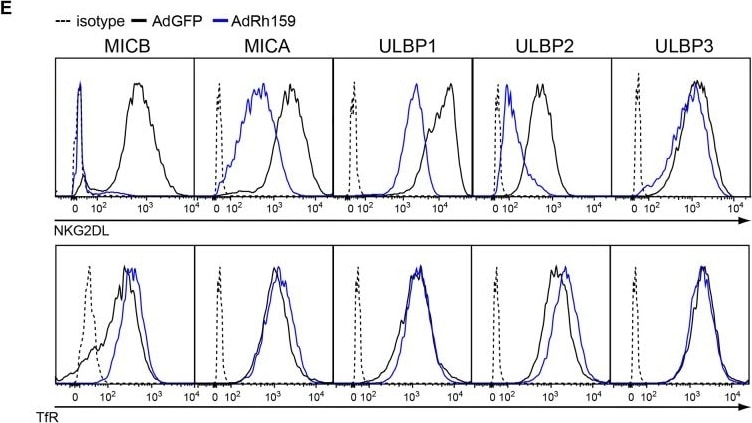
Detection of Human ULBP-2/5/6 by Flow Cytometry
Rh159 interferes with intracellular transport of NKG2DL.A) Association with Rh159 prevents intracellular transport of MICB. U373-MICB cells were transduced with adenovectors (MOI = 80) expressing either GFP (AdGFP) or FLAG-tagged Rh159 (AdRh159FL) under control of tetracycline-dependent transactivator provided by co-transduced AdtTA (MOI = 20). At 24 hpi cells were metabolically labeled for 30 min with [35S]cysteine + [35S]methionine. Upon chasing the label for the indicated times (h), cells were lysed and MICB was immunoprecipitated with anti–MICB mAb. Precipitates were either digested with EndoH (+) or mock treated (-) followed by SDS-PAGE and autoradiography. (S) indicates EndoH-deglycosylated proteins. B) Rh159 co-immunoprecipitates with MICB. U373-ULBP3 (ULBP3, left panel) or U373-MICB (MICB, right panel) cells were lysed at 48 h post-transduction with AdRh159FL (Rh159) or an adenovector expressing FLAG-tagged SVV ORF 61 (SVV61) used as a negative control. MICB and ULBP3 were immunoprecipitated with anti–MICB and anti-ULBP3 mouse and goat mAbs, respectively, then immunoblotted with mouse anti-FLAG mAb. The mouse IgG heavy chain (55kDa) is indicated (HC). Input lanes were loaded with 10% total lysate used in immunoprecipitation and immunoblotted with mAbs for FLAG and GAPDH. The results shown are representative of two independent experiments. C) Rh159 reduces steady state levels of MICB. U373-MICB cells were lysed at 48 h post-transduction with the indicated Ad-vectors. Lysates were digested with EndoH (+) or mock treated (-) then immunoblotted with mAbs for MICB, FLAG or GAPDH. Note that both MICB and Rh159 are EndoH sensitive consistent with ER localization. The results shown are representative of two independent experiments. D-E) Rh159 reduces surface expression of MICA, MICB, ULBP1 and ULBP2 but not ULBP3. U373-NKG2DL cells were transduced with AdRh159FL or AdGFP as in A) but for 48 h. Cells were then lysed and immunoblotted with mAbs for FLAG and GAPDH (D),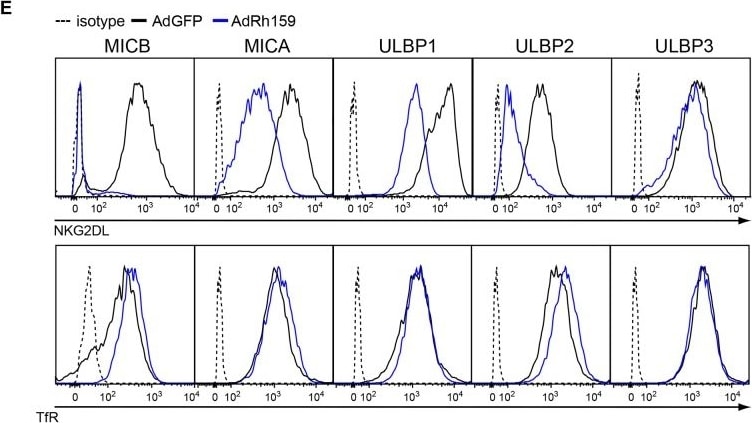
Detection of Human ULBP-2/5/6 by Flow Cytometry
Rh159 interferes with intracellular transport of NKG2DL.A) Association with Rh159 prevents intracellular transport of MICB. U373-MICB cells were transduced with adenovectors (MOI = 80) expressing either GFP (AdGFP) or FLAG-tagged Rh159 (AdRh159FL) under control of tetracycline-dependent transactivator provided by co-transduced AdtTA (MOI = 20). At 24 hpi cells were metabolically labeled for 30 min with [35S]cysteine + [35S]methionine. Upon chasing the label for the indicated times (h), cells were lysed and MICB was immunoprecipitated with anti–MICB mAb. Precipitates were either digested with EndoH (+) or mock treated (-) followed by SDS-PAGE and autoradiography. (S) indicates EndoH-deglycosylated proteins. B) Rh159 co-immunoprecipitates with MICB. U373-ULBP3 (ULBP3, left panel) or U373-MICB (MICB, right panel) cells were lysed at 48 h post-transduction with AdRh159FL (Rh159) or an adenovector expressing FLAG-tagged SVV ORF 61 (SVV61) used as a negative control. MICB and ULBP3 were immunoprecipitated with anti–MICB and anti-ULBP3 mouse and goat mAbs, respectively, then immunoblotted with mouse anti-FLAG mAb. The mouse IgG heavy chain (55kDa) is indicated (HC). Input lanes were loaded with 10% total lysate used in immunoprecipitation and immunoblotted with mAbs for FLAG and GAPDH. The results shown are representative of two independent experiments. C) Rh159 reduces steady state levels of MICB. U373-MICB cells were lysed at 48 h post-transduction with the indicated Ad-vectors. Lysates were digested with EndoH (+) or mock treated (-) then immunoblotted with mAbs for MICB, FLAG or GAPDH. Note that both MICB and Rh159 are EndoH sensitive consistent with ER localization. The results shown are representative of two independent experiments. D-E) Rh159 reduces surface expression of MICA, MICB, ULBP1 and ULBP2 but not ULBP3. U373-NKG2DL cells were transduced with AdRh159FL or AdGFP as in A) but for 48 h. Cells were then lysed and immunoblotted with mAbs for FLAG and GAPDH (D),Applications for Human ULBP-2/5/6 Antibody
Blockade of Receptor-ligand Interaction
Immunohistochemistry
Sample: Immersion fixed paraffin-embedded sections of human colon cancer tissue subjected to Antigen Retrieval Reagent-Basic (Catalog # CTS013)
Western Blot
Sample: Recombinant Human ULBP‑2 Fc Chimera (Catalog # 1298-UL), Recombinant Human ULBP-5 (Catalog # 7149-UL), and Recombinant Human RAET1L/ULBP-6 (Catalog # 7485‑UL)
Formulation, Preparation, and Storage
Purification
Reconstitution
Reconstitute at 0.2 mg/mL in sterile PBS. For liquid material, refer to CoA for concentration.
Formulation
Shipping
Stability & Storage
- 12 months from date of receipt, -20 to -70 °C as supplied.
- 1 month, 2 to 8 °C under sterile conditions after reconstitution.
- 6 months, -20 to -70 °C under sterile conditions after reconstitution.
Calculators
Background: ULBP-2/5/6
References
- Cosman, D. et al. (2001) Immunity 14:123.
- Kubin, M. et al. (2001) Eur. J. Immunol. 31:1428.
- Sutherland, C. et al. (2002) J. Immunol. 168:671.
- Steinle, A. et al. (2001) Immunogenetics 53:279.
- Sutherland, C. et al. (2001) Immunol. Rev. 181:185.
- Pende, D. et al. (2002) Cancer Res. 62:6178.
- Radosavljevic, M. et al. (2002) Genomics 79:114.
- NKG2D and its Ligands (2002) www.RnDSystems.com.
Long Name
Alternate Names
UniProt
Additional ULBP-2/5/6 Products
Product Documents for Human ULBP-2/5/6 Antibody
Certificate of Analysis
To download a Certificate of Analysis, please enter a lot or batch number in the search box below.
Note: Certificate of Analysis not available for kit components.
Product Specific Notices for Human ULBP-2/5/6 Antibody
For research use only
Related Research Areas
Citations for Human ULBP-2/5/6 Antibody
 Powered by Bioz
Customer Reviews for Human ULBP-2/5/6 Antibody
There are currently no reviews for this product. Be the first to review Human ULBP-2/5/6 Antibody and earn rewards!
Have you used Human ULBP-2/5/6 Antibody?
Submit a review and receive an Amazon gift card!
$25/€18/£15/$25CAN/¥2500 for a review with an image
$10/€7/£6/$10CAN/¥1110 for a review without an image
Submit a review
Protocols
Find general support by application which include: protocols, troubleshooting, illustrated assays, videos and webinars.
- Antigen Retrieval Protocol (PIER)
- Antigen Retrieval for Frozen Sections Protocol
- Appropriate Fixation of IHC/ICC Samples
- Cellular Response to Hypoxia Protocols
- Chromogenic IHC Staining of Formalin-Fixed Paraffin-Embedded (FFPE) Tissue Protocol
- Chromogenic Immunohistochemistry Staining of Frozen Tissue
- ClariTSA™ Fluorophore Kits
- Detection & Visualization of Antibody Binding
- Fluorescent IHC Staining of Frozen Tissue Protocol
- Graphic Protocol for Heat-induced Epitope Retrieval
- Graphic Protocol for the Preparation and Fluorescent IHC Staining of Frozen Tissue Sections
- Graphic Protocol for the Preparation and Fluorescent IHC Staining of Paraffin-embedded Tissue Sections
- Graphic Protocol for the Preparation of Gelatin-coated Slides for Histological Tissue Sections
- IHC Sample Preparation (Frozen sections vs Paraffin)
- Immunofluorescent IHC Staining of Formalin-Fixed Paraffin-Embedded (FFPE) Tissue Protocol
- Immunohistochemistry (IHC) and Immunocytochemistry (ICC) Protocols
- Immunohistochemistry Frozen Troubleshooting
- Immunohistochemistry Paraffin Troubleshooting
- Preparing Samples for IHC/ICC Experiments
- Preventing Non-Specific Staining (Non-Specific Binding)
- Primary Antibody Selection & Optimization
- Protocol for Heat-Induced Epitope Retrieval (HIER)
- Protocol for Making a 4% Formaldehyde Solution in PBS
- Protocol for VisUCyte™ HRP Polymer Detection Reagent
- Protocol for the Preparation & Fixation of Cells on Coverslips
- Protocol for the Preparation and Chromogenic IHC Staining of Frozen Tissue Sections
- Protocol for the Preparation and Chromogenic IHC Staining of Frozen Tissue Sections - Graphic
- Protocol for the Preparation and Chromogenic IHC Staining of Paraffin-embedded Tissue Sections
- Protocol for the Preparation and Chromogenic IHC Staining of Paraffin-embedded Tissue Sections - Graphic
- Protocol for the Preparation and Fluorescent IHC Staining of Frozen Tissue Sections
- Protocol for the Preparation and Fluorescent IHC Staining of Paraffin-embedded Tissue Sections
- Protocol for the Preparation of Gelatin-coated Slides for Histological Tissue Sections
- R&D Systems Quality Control Western Blot Protocol
- TUNEL and Active Caspase-3 Detection by IHC/ICC Protocol
- The Importance of IHC/ICC Controls
- Troubleshooting Guide: Immunohistochemistry
- Troubleshooting Guide: Western Blot Figures
- Western Blot Conditions
- Western Blot Protocol
- Western Blot Protocol for Cell Lysates
- Western Blot Troubleshooting
- Western Blot Troubleshooting Guide
- View all Protocols, Troubleshooting, Illustrated assays and Webinars