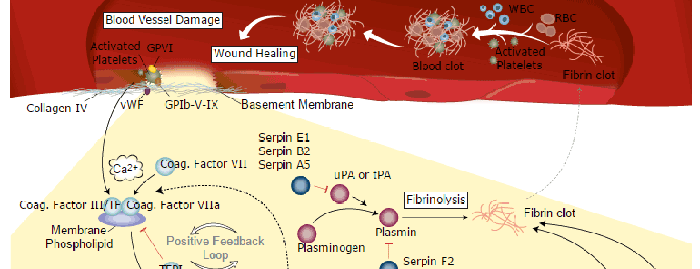
von Willebrand Factor (vWF) is a large, multimeric glycoprotein made by endothelial cells and megakaryocytes. The pre-pro-vWF protein contains 2813 amino acids (aa), which consists of 22 aa signal peptide, 741 aa propeptide, and mature vWF monomer of 2050 aa (1-4). The pro-vWF undergoes dimerization in the endoplasmic reticulum (ER) through C-terminal “cysteine-knot” (CK) domain. The pro-vWF dimmers are transported to Golgi and form multimers by forming disulfide bond in amino-terminal region of the mature form. The proteolytic processing of pro-region also occurs in Golgi. The matured vWF is stored in Weibel-Pallade bodies in endothelial cells and granules in megakaryocytes and platelets. The unusually-large vWF (ulvWF) multimers released from cells are very efficient in binding to platelets to form thrombus. The population of these highly active ulvWF multimers is controlled by a specific protease, ADAMTS13, which cleaves between residues Tyr1605 and Met1606 in the A2 domain of vWF. In the plasma, vWF appears as a series of large and intermediate multimers with molecular masses from several thousand to 500 kDa. vWF also performs hemostatic functions (3-5). In a high shear-stressed environment, vWF undergoes conformational change to expose a binding site for glycoprotein Ib alpha. As a result, vWF facilitates aggregation of platelets. In addition to platelet binding, vWF binds coagulation factor VIII to increase the lifetime of FVIII in plasma. The purified rhvWF-A2 contains the A2 domain of vWF.

Scientific images may be resized, cropped, or adjusted for brightness or contrast for presentation purposes. These updates are limited to presentation and do not affect the underlying scientific interpretation of the data. Where available, additional source data may be provided upon request.
Key Product Details
Species Reactivity
Applications
Label
Antibody Source
Product Specifications
Immunogen
Asp1498-Val1665
Accession # P04275
Specificity
Clonality
Host
Isotype
Scientific Data Images for Human vWF-A2 Antibody (1072103)
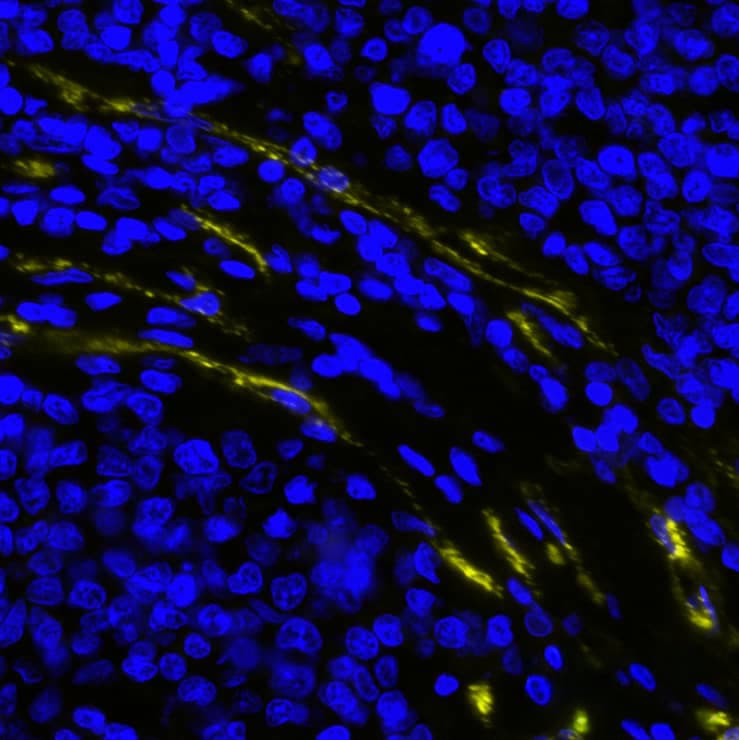
VWF in Human Non-Hodgkins Lymphoma via seqIF™ staining on COMET™
VWF was detected in immersion fixed paraffin-embedded sections of human non-Hodgkin's Lymphoma using Mouse Anti-Human VWF, Monoclonal Antibody (Catalog #MAB11543) at 1ug/mL at 37° Celsius for 4 minutes. Before incubation with the primary antibody, tissue underwent an all-in-one dewaxing and antigen retrieval preprocessing using PreTreatment Module (PT Module) and Dewax and HIER Buffer H (pH 9; Epredia Catalog # TA-999-DHBH). Tissue was stained using the Alexa Fluor™ 647 Goat anti-Mouse IgG Secondary Antibody at 1:200 at 37 ° Celsius for 2 minutes. (Yellow; Lunaphore Catalog # DR647MS) and counterstained with DAPI (blue; Lunaphore Catalog # DR100). Specific staining was localized to the cytoplasm of endothelial cells. Protocol available in COMET™ Panel Builder.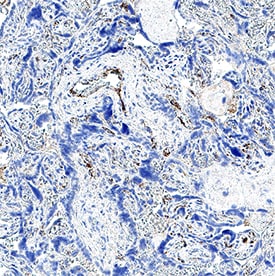
Detection of vWF‑A2 in Human Placenta.
vWF‑A2 was detected in immersion fixed paraffin-embedded sections of human placenta using Mouse Anti-Human vWF‑A2 Monoclonal Antibody (Catalog # MAB11543) at 25 µg/ml for 1 hour at room temperature followed by incubation with the Anti-Mouse IgG VisUCyte™ HRP Polymer Antibody (Catalog # VC001) or the HRP-conjugated Anti-Mouse IgG Secondary Antibody (Catalog # HAF007). Before incubation with the primary antibody, tissue was subjected to heat-induced epitope retrieval using VisUCyte Antigen Retrieval Reagent-Basic (Catalog # VCTS021). Tissue was stained using DAB (brown) and counterstained with hematoxylin (blue). Specific staining was localized to the cytoplasm of endothelial cells. View our protocol for Chromogenic IHC Staining of Paraffin-embedded Tissue Sections.Applications for Human vWF-A2 Antibody (1072103)
COMET
Immunohistochemistry
Sample: Immersion fixed paraffin-embedded sections of human placenta
Multiplex Immunofluorescence
Sample: Immersion fixed paraffin-embedded sections of human non-Hodgkin's Lymphoma
Formulation, Preparation, and Storage
Purification
Reconstitution
Reconstitute lyophilized material at 0.2mg/ml in sterile PBS. For liquid material, refer to CoA for concentration.
Formulation
Shipping
Stability & Storage
- 12 months from date of receipt, -20 to -70 °C as supplied.
- 1 month, 2 to 8 °C under sterile conditions after reconstitution.
- 6 months, -20 to -70 °C under sterile conditions after reconstitution.
Calculators
Background: vWF-A2
References
- Sadler, J.E. (1998) Annu. Rev. Biochem. 67:395.
- Ruggeri, Z.M. (2003) Cur. Opin. Hemat. 10:142.
- Michiels, J.J. et al. (2006) Clin. Appl. Thromb. Hemost. 12:397.
- Groot, E. et al. (2007) Cur. Opin. Hemat. 14:284.
- Lenting, P.J. et al. (2007) J. Thromb. Haemos. 5:1353.
Long Name
Alternate Names
Gene Symbol
UniProt
Additional vWF-A2 Products
Product Documents for Human vWF-A2 Antibody (1072103)
Certificate of Analysis
To download a Certificate of Analysis, please enter a lot or batch number in the search box below.
Note: Certificate of Analysis not available for kit components.
Product Specific Notices for Human vWF-A2 Antibody (1072103)
For research use only
Related Research Areas
Customer Reviews for Human vWF-A2 Antibody (1072103)
There are currently no reviews for this product. Be the first to review Human vWF-A2 Antibody (1072103) and earn rewards!
Have you used Human vWF-A2 Antibody (1072103)?
Submit a review and receive an Amazon gift card!
$25/€18/£15/$25CAN/¥2500 for a review with an image
$10/€7/£6/$10CAN/¥1110 for a review without an image
Submit a review
Protocols
Find general support by application which include: protocols, troubleshooting, illustrated assays, videos and webinars.
- Antigen Retrieval Protocol (PIER)
- Antigen Retrieval for Frozen Sections Protocol
- Appropriate Fixation of IHC/ICC Samples
- Cellular Response to Hypoxia Protocols
- Chromogenic IHC Staining of Formalin-Fixed Paraffin-Embedded (FFPE) Tissue Protocol
- Chromogenic Immunohistochemistry Staining of Frozen Tissue
- ClariTSA™ Fluorophore Kits
- Detection & Visualization of Antibody Binding
- Fluorescent IHC Staining of Frozen Tissue Protocol
- Graphic Protocol for Heat-induced Epitope Retrieval
- Graphic Protocol for the Preparation and Fluorescent IHC Staining of Frozen Tissue Sections
- Graphic Protocol for the Preparation and Fluorescent IHC Staining of Paraffin-embedded Tissue Sections
- Graphic Protocol for the Preparation of Gelatin-coated Slides for Histological Tissue Sections
- IHC Sample Preparation (Frozen sections vs Paraffin)
- Immunofluorescent IHC Staining of Formalin-Fixed Paraffin-Embedded (FFPE) Tissue Protocol
- Immunohistochemistry (IHC) and Immunocytochemistry (ICC) Protocols
- Immunohistochemistry Frozen Troubleshooting
- Immunohistochemistry Paraffin Troubleshooting
- Preparing Samples for IHC/ICC Experiments
- Preventing Non-Specific Staining (Non-Specific Binding)
- Primary Antibody Selection & Optimization
- Protocol for Heat-Induced Epitope Retrieval (HIER)
- Protocol for Making a 4% Formaldehyde Solution in PBS
- Protocol for VisUCyte™ HRP Polymer Detection Reagent
- Protocol for the Preparation & Fixation of Cells on Coverslips
- Protocol for the Preparation and Chromogenic IHC Staining of Frozen Tissue Sections
- Protocol for the Preparation and Chromogenic IHC Staining of Frozen Tissue Sections - Graphic
- Protocol for the Preparation and Chromogenic IHC Staining of Paraffin-embedded Tissue Sections
- Protocol for the Preparation and Chromogenic IHC Staining of Paraffin-embedded Tissue Sections - Graphic
- Protocol for the Preparation and Fluorescent IHC Staining of Frozen Tissue Sections
- Protocol for the Preparation and Fluorescent IHC Staining of Paraffin-embedded Tissue Sections
- Protocol for the Preparation of Gelatin-coated Slides for Histological Tissue Sections
- TUNEL and Active Caspase-3 Detection by IHC/ICC Protocol
- The Importance of IHC/ICC Controls
- Troubleshooting Guide: Immunohistochemistry
- View all Protocols, Troubleshooting, Illustrated assays and Webinars
Associated Pathways