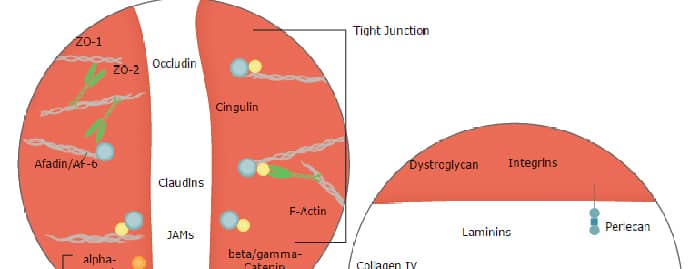
The family of junctional adhesion molecules (JAM), comprising at least three members, are type I transmembrane receptors belonging to the immunoglobulin (Ig) superfamily (1, 2). These proteins are localized in the tight junctions between endothelial or epithelial cells. Some family members are also found on blood leukocytes and platelets. Mouse JAM-A is predominantly expressed at intercellular junctions of both epithelial cells and endothelial cells (3). It is also expressed on circulating megakaryocytes. Mouse JAM-A cDNA predicts a 300 amino acid (aa) residue precursor protein with a putative 23 aa signal peptide, a 215 aa extracellular region containing two Ig-like V-subset domains, a 17 aa transmembrane domain and a 45 aa cytoplasmic domain. The human and mouse protein share approximately 67% aa sequence homology. Mouse JAM-A also shares approximately 35% aa sequence homology with mouse JAM-B or JAM-C. JAM-A exhibits homotypic interactions to regulate tight junction assembly and modulate paracellular permeability (1‑3). The human JAM-A homotypic interation also mediates platelet aggregation and adhesion to endothelial cells and may play a role in thrombosis (4). JAM-A is involved in leukocyte adhesion and transmigration through the endothelium (3, 5). JAM-A has also been shown to bind reovirus attachment protein sigma-1 to permit reovirus infection and signal virus-induced apoptosis (6).
Mouse JAM-A Antibody
R&D Systems | Catalog # AF1077


Scientific images may be resized, cropped, or adjusted for brightness or contrast for presentation purposes. These updates are limited to presentation and do not affect the underlying scientific interpretation of the data. Where available, additional source data may be provided upon request.
Key Product Details
Species Reactivity
Validated:
Cited:
Applications
Validated:
Cited:
Label
Antibody Source
Product Specifications
Immunogen
Lys27-Ala242
Accession # O88792
Specificity
Clonality
Host
Isotype
Scientific Data Images for Mouse JAM-A Antibody
Mouse JAM-A ELISA Standard Curve
Recombinant Mouse JAM‑A Fc Chimera (Catalog # 1077-JM) was serially diluted and captured by Goat Anti-Mouse JAM‑A Antigen Affinity-purified Polyclonal Antibody (Catalog # AF1077) coated on a Clear Polystyrene Microplate (Catalog # DY990). Goat Anti-Mouse JAM‑A Antigen Affinity-purified Polyclonal Antibody (Catalog # AF1077) was biotinylated and incubated with the protein captured on the plate. Detection of the standard curve was achieved by incubating Streptavidin-HRP (Catalog # DY998)
Mouse JAM-A ELISA Standard Curve
Recombinant Mouse JAM‑A Fc Chimera (Catalog # 1077-JM) was serially diluted and captured by Goat Anti-Mouse JAM‑A Antigen Affinity-purified Polyclonal Antibody (Catalog # AF1077) coated on a Clear Polystyrene Microplate (Catalog # DY990). Goat Anti-Mouse JAM‑A Antigen Affinity-purified Polyclonal Antibody (Catalog # AF1077) was biotinylated and incubated with the protein captured on the plate. Detection of the standard curve was achieved by incubating Streptavidin-HRP (Catalog # DY998)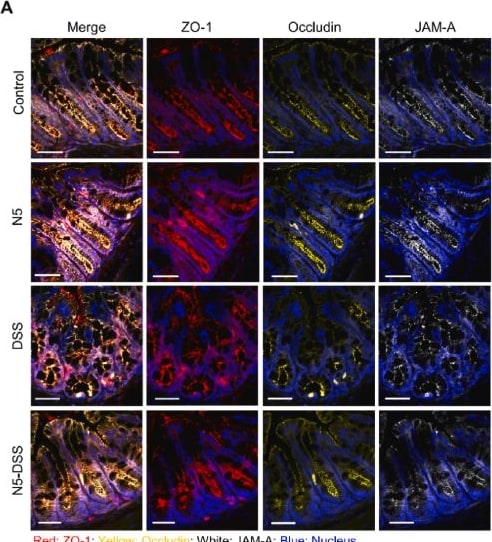
Detection of JAM-A by Immunohistochemistry
Lactobacillus johnsonii N5 improves the intestinal barrier tight junction protein and HSP70 expressions in dextran sulfate sodium-induced colitis. (A) Representative images of colonic tissue sections stained with antibodies specific for ZO-1 (red), occludin (yellow), and JAM-A (white). Sections were counterstained with Nucleus (blue). Scale bars = 50 μm. (B to D) The expression of ZO-1, occludin, and JAM-A was quantified as mean fluorescence intensity (MFI). (E) Representative images of colonic tissue sections stained with anti-HSP70 (green) antibody. Sections were counterstained with Nucleus (blue). Scale bars = 50 μm. (F) Analysis and quantification of HSP70 expression, n = 6 mice per group (duplicate slides per mouse). Control, mice were fed a commercial chow diet and received vehicle treatment; DSS, mice were given 2.5% of dextran sulfate sodium in drinking water for 7 consecutive days; N5, mice were administered L. johnsonii N5 daily for 7 days; N5-DSS, mice were administered L. johnsonii N5 daily for 14 days starting 7 days prior to DSS-treatment. ZO-1 = zonula occludens protein 1; JAM-A = junctional adhesion molecule A; MFI = mean fluorescence intensity; HSP70 = heat shock proteins 70. Data are presented as mean ± SEM, ∗P < 0.05, ∗∗P < 0.01, ∗∗∗P < 0.001, using ANOVA with Tukey's post hoc test. Image collected and cropped by CiteAb from the following open publication (https://pubmed.ncbi.nlm.nih.gov/38033603), licensed under a CC-BY license. Not internally tested by R&D Systems.Applications for Mouse JAM-A Antibody
Immunohistochemistry
Sample: Perfusion fixed frozen sections of mouse small intestine
Western Blot
Sample: Recombinant Mouse JAM-A Fc Chimera (Catalog # 1077-JM)
Mouse JAM-A Sandwich Immunoassay
Formulation, Preparation, and Storage
Purification
Reconstitution
Reconstitute at 0.2 mg/mL in sterile PBS. For liquid material, refer to CoA for concentration.
Formulation
Shipping
Stability & Storage
- 12 months from date of receipt, -20 to -70 °C as supplied.
- 1 month, 2 to 8 °C under sterile conditions after reconstitution.
- 6 months, -20 to -70 °C under sterile conditions after reconstitution.
Calculators
Background: JAM-A
References
- Chavakis, T. et al. (2003) Thromb. Haemost. 89:13.
- Aurand-Lions, M. et al. (2001) Blood 98:3699.
- Martin-Padura, I. et al. (1998) J. Cell Biol. 142:117.
- Babinska, A. et al. (2002) Thromb. Haemost. 88:842.
- Del Maschio, A. et al. (1999) J. Exp. Med. 190:1351.
- Barton, E. S. et al. (2001) Cell 104:441.
Long Name
Alternate Names
Gene Symbol
UniProt
Additional JAM-A Products
Product Documents for Mouse JAM-A Antibody
Certificate of Analysis
To download a Certificate of Analysis, please enter a lot or batch number in the search box below.
Note: Certificate of Analysis not available for kit components.
Product Specific Notices for Mouse JAM-A Antibody
For research use only
Citations for Mouse JAM-A Antibody
 Powered by Bioz
Customer Reviews for Mouse JAM-A Antibody
There are currently no reviews for this product. Be the first to review Mouse JAM-A Antibody and earn rewards!
Have you used Mouse JAM-A Antibody?
Submit a review and receive an Amazon gift card!
$25/€18/£15/$25CAN/¥2500 for a review with an image
$10/€7/£6/$10CAN/¥1110 for a review without an image
Submit a review
Protocols
Find general support by application which include: protocols, troubleshooting, illustrated assays, videos and webinars.
- Antigen Retrieval Protocol (PIER)
- Antigen Retrieval for Frozen Sections Protocol
- Appropriate Fixation of IHC/ICC Samples
- Cellular Response to Hypoxia Protocols
- Chromogenic IHC Staining of Formalin-Fixed Paraffin-Embedded (FFPE) Tissue Protocol
- Chromogenic Immunohistochemistry Staining of Frozen Tissue
- ClariTSA™ Fluorophore Kits
- Detection & Visualization of Antibody Binding
- Fluorescent IHC Staining of Frozen Tissue Protocol
- Graphic Protocol for Heat-induced Epitope Retrieval
- Graphic Protocol for the Preparation and Fluorescent IHC Staining of Frozen Tissue Sections
- Graphic Protocol for the Preparation and Fluorescent IHC Staining of Paraffin-embedded Tissue Sections
- Graphic Protocol for the Preparation of Gelatin-coated Slides for Histological Tissue Sections
- IHC Sample Preparation (Frozen sections vs Paraffin)
- Immunofluorescent IHC Staining of Formalin-Fixed Paraffin-Embedded (FFPE) Tissue Protocol
- Immunohistochemistry (IHC) and Immunocytochemistry (ICC) Protocols
- Immunohistochemistry Frozen Troubleshooting
- Immunohistochemistry Paraffin Troubleshooting
- Preparing Samples for IHC/ICC Experiments
- Preventing Non-Specific Staining (Non-Specific Binding)
- Primary Antibody Selection & Optimization
- Protocol for Heat-Induced Epitope Retrieval (HIER)
- Protocol for Making a 4% Formaldehyde Solution in PBS
- Protocol for VisUCyte™ HRP Polymer Detection Reagent
- Protocol for the Preparation & Fixation of Cells on Coverslips
- Protocol for the Preparation and Chromogenic IHC Staining of Frozen Tissue Sections
- Protocol for the Preparation and Chromogenic IHC Staining of Frozen Tissue Sections - Graphic
- Protocol for the Preparation and Chromogenic IHC Staining of Paraffin-embedded Tissue Sections
- Protocol for the Preparation and Chromogenic IHC Staining of Paraffin-embedded Tissue Sections - Graphic
- Protocol for the Preparation and Fluorescent IHC Staining of Frozen Tissue Sections
- Protocol for the Preparation and Fluorescent IHC Staining of Paraffin-embedded Tissue Sections
- Protocol for the Preparation of Gelatin-coated Slides for Histological Tissue Sections
- R&D Systems Quality Control Western Blot Protocol
- TUNEL and Active Caspase-3 Detection by IHC/ICC Protocol
- The Importance of IHC/ICC Controls
- Troubleshooting Guide: Immunohistochemistry
- Troubleshooting Guide: Western Blot Figures
- Western Blot Conditions
- Western Blot Protocol
- Western Blot Protocol for Cell Lysates
- Western Blot Troubleshooting
- Western Blot Troubleshooting Guide
- View all Protocols, Troubleshooting, Illustrated assays and Webinars
Associated Pathways