
N-Acetylcysteine
Tocris Bioscience | Catalog # 7874


Key Product Details
Description
Product Description
N-Acetylcysteine is a cell-permeable antioxidant and a precursor of reduced glutathione (GSH) (Cat. No. 5219), with anti-inflammatory, mucolytic, and antiviral activities. N-Acetylcysteine can be used in organoid culture media for non-small cell lung and colorectal cancer organoids, expansion media for mouse/human liver and pancreas 3D organoids and LWRN media for colonic 3D organoids from human biopsies. It is a component of S7 medium in the optimized protocol for generation of functional stem cell-derived islets (SC-islets). N-Acetylcysteine can be orally administered.Scientific Data Images for N-Acetylcysteine
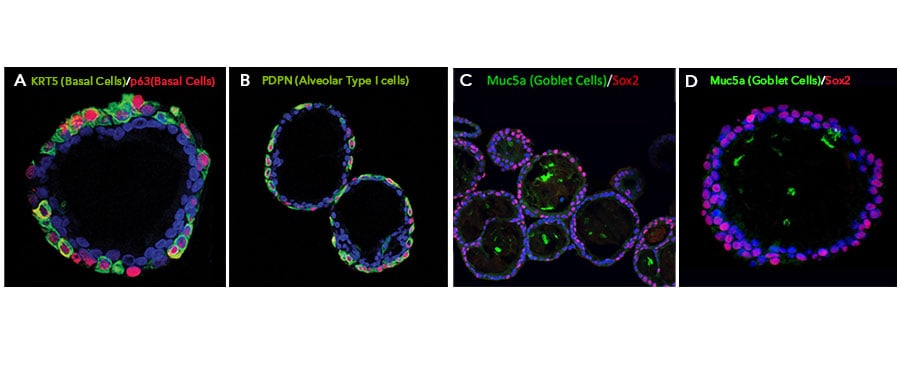
Application of N-Acetylcysteine in Culture and Characterization of Adult Stem Cell-derived Lung Organoids.
Adult stem cells isolated from human lung biopsy tissue were embedded and then cultured for 20-60 days in lung organoid expansion medium, which includes N-Acetylcysteine, Y-27632 dihydrochloride (Catalog # 1254), HEPES (Catalog # 3173), A 83-01 (Catalog # 2939), SB 202190 (Catalog # 1264), Nicotinamide (Catalog # 4106), along with other reagents used in the human lung organoid culture protocol. Lung organoids were able to differentiate and exhibit markers for various lung cell types. Lung organoids were stained with (A) anti-Cytokeratin 5 (KRT5) (green) and with anti-p63/TP73L (Catalog # AF1916; red) to visualize basal cells, (B) Anti-Podoplanin (PDPN) (Novus Biologicals, Catalog # NB600-1015; green) to visualize alveolar type I cells and anti- p63/TP73L (Catalog # AF1916; red) to visualize basal cells, (C, D) Anti-MUC5AC (Novus Biologicals, Catalog # NBP2-15196; green) to visualize Goblet cells and anti-SOX2 (Catalog # MAB2018; red). All samples were counterstained with DAPI (Catalog # 5748; blue).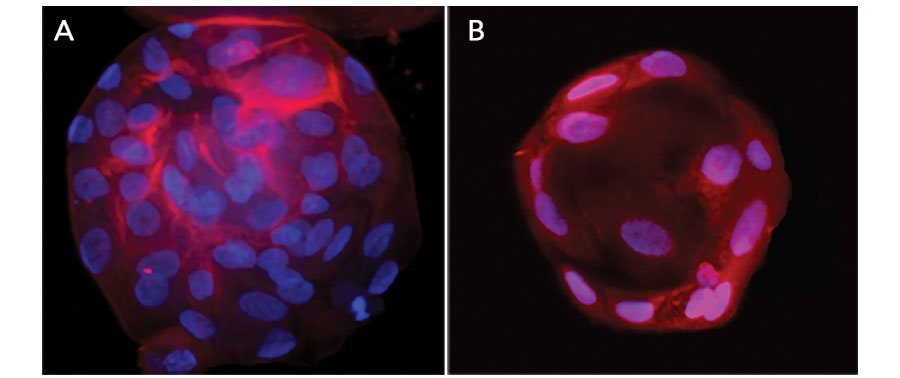
Application of N-Acetylcysteine in Culture and Characterization of Adult Stem Cell-derived Liver Organoids.
Adult stem cell-derived liver organoids were cultured using N-Acetylcysteine, Y-27632 dihydrochloride (Catalog # 1254), HEPES (Catalog # 3173), A 83-01 (Catalog # 2939), Forskolin (Catalog # 1099), along with other reagents used in the human liver organoid culture protocol. After 3 days, liver organoid expansion medium was added for 7-10 days, followed by liver organoid differentiation medium, which includes N-Acetylcysteine, HEPES (Catalog # 3173), Nicotinamide (Catalog # 4106), A 83-01 (Catalog # 2939), along with other reagents. Differentiated human liver organoids were stained using a (A) Human Serum Albumin Antibody (Catalog # MAB1455; red) and a (B) Human HNF-3beta /FoxA2 Antibody (Catalog # AF2400; red) and counterstained with DAPI (Catalog # 5748; blue).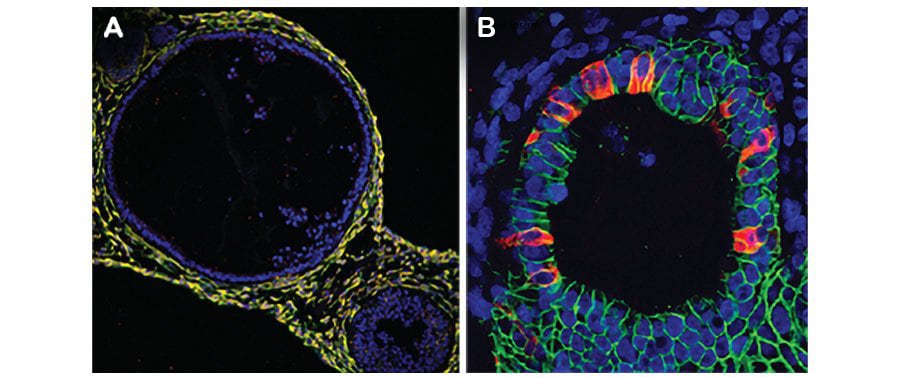
Application of N-Acetylcysteine in Culture and Characterization of iPSC-derived Human Intestinal Organoids.
iPSC-derived human intestinal organoids were cultured using N-Acetylcysteine, Y-27632 dihydrochloride (Catalog # 1254), SB 202190 (Catalog # 1264), A 83-01 (Catalog # 2939), Nicotinamide (Catalog # 4106), along with other reagents used in the human intestinal organoid culture protocol. (A) Human intestinal organoids were stained using a Human/Mouse/Rat Vimentin Antibody (Catalog # MAB2105; green) and a Human/Mouse Desmin Antibody (Catalog # AF3844; red) to visualize myofibroblast cells and counterstained with DAPI (Catalog # 5748; blue). (B) Human intestinal organoids were stained using a Human/Mouse E-Cadherin Antibody (Catalog # AF748; green), a Human MUC2 Antibody (Novus Biologicals, Catalog # NBP2-44431; red) and counterstained with DAPI (Catalog # 5748; blue).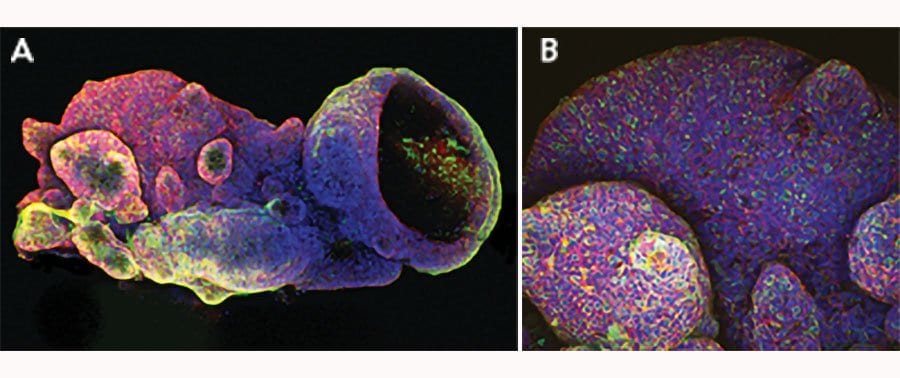
Application of N-Acetylcysteine in Culture and Characterization of Adult Stem Cell-derived Human Descending Colon Organoids.
Adult stem cells isolated from human descending colon were embedded and then cultured for 30 days in intestinal organoid culture medium, which includes N-Acetylcysteine, Y-27632 dihydrochloride (Catalog # 1254), SB 202190 (Catalog # 1264), A 83-01 (Catalog # 2939), Nicotinamide (Catalog # 4106), along with other reagents used in the human intestinal organoid culture protocol. (A) Organoids were fixed and stained with Anti-MUC2 (Novus Biologicals; Catalog # NBP2-44431; green) to visualize intestinal goblet cells and counterstained for E-Cadherin (Catalog # AF3844; red) and DAPI (Catalog # 5748; blue). (B) Organoids were fixed and stained with Human Chromogranin A Antibody(Catalog # MAB90981; green) to visualize enteroendocrine cells and counterstained for E-Cadherin (Catalog # AF3844; red) and DAPI (Catalog # 5748; blue).
Product Specifications for N-Acetylcysteine
Molecular Weight
Formula
Storage
Purity
Chemical Name
CAS Number
PubChem ID
InChI Key
SMILES
The technical data provided above is for guidance only. For batch specific data refer to the Certificate of Analysis.
Solubility
| Solvent | Max Conc. mg/mL | Max Conc. mM | |
|---|---|---|---|
| Solubility | |||
| water | 8.16 | 50 | |
| DMSO | 8.16 | 50 |
Preparing Stock Solutions for N-Acetylcysteine
The following data is based on the product molecular weight 163.20.
Batch specific molecular weights may vary from batch to batch due to the degree of hydration, which all affect the solvent volumes required to prepare stock solutions.
| Concentration / Solvent Volume / Mass | 1 mg | 5 mg | 10 mg |
|---|---|---|---|
| 0.5 mM | 12.25 mL | 61.27 mL | 122.55 mL |
| 2.5 mM | 2.45 mL | 12.25 mL | 24.51 mL |
| 5 mM | 1.23 mL | 6.13 mL | 12.25 mL |
| 25 mM | 0.25 mL | 1.23 mL | 2.45 mL |
Calculators
Background References
References are publications that support the biological activity of the product. See our Citations tab to view 64 publications citing the usage of this product.
- Moiseeva Senescence atlas reveals an aged-like inflamed niche that blunts muscle regeneration. Nature 2023 PMID: 36544018
- Balboa Functional, metabolic and transcriptional maturation of human pancreatic islets derived from stem cells. Nat.Biotechnol. 2022 PMID: 35241836
- Cattaneo Tumor organoid-T-cell coculture systems. Nat.Protoc. 2019 PMID: 31853056
- Broutier Culture and establishment of self-renewing human and mouse adult liver and pancreas 3D organoids and their genetic manipulation. Nat.Protoc. 2016 PMID: 27560176
- Geiler N-acetyl-L-cysteine (NAC) inhibits virus replication and expression of pro-inflammatory molecules in A549 cells infected with highly pathogenic H5N1 influenza A virus. Biochem.Pharmacol. 2009 PMID: 19732754
Product Documents for N-Acetylcysteine
Certificate of Analysis
To download a Certificate of Analysis, please enter a lot or batch number in the search box below.
Product Specific Notices for N-Acetylcysteine
For research use only
Citations for N-Acetylcysteine
 Powered by Bioz
Customer Reviews for N-Acetylcysteine (1)
Have you used N-Acetylcysteine?
Submit a review and receive an Amazon gift card!
$25/€18/£15/$25CAN/¥2500 for a review with an image
$10/€7/£6/$10CAN/¥1110 for a review without an image
Submit a review
Customer Images
-
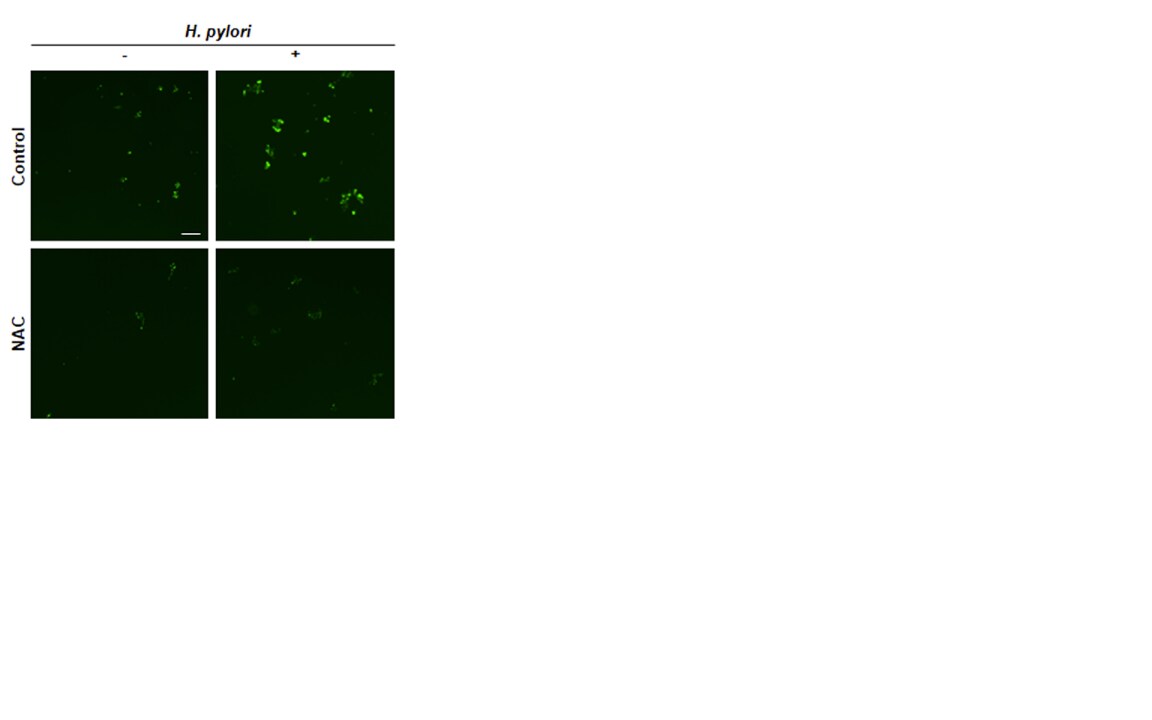
Species: HumanAssay Type: In VitroCell Line/Tissue: Gastric cancer cells (AGS)Verified Customer | Posted 08/18/2025NAC is water soluble. Made a 1000x stock solution and add it directly to the culture medium.NAC was used to inhibit ROS overproduction by Helicobacter pylori (H. pylori) injection in gastric cancer cells AGS. The use of ROS quencher NAC was to investigate the involvement of H.pylori-induced ROS overproduction in epithelial-mesenchymal transition of gastric cancer cells AGS.

There are no reviews that match your criteria.