
Galectins comprise a family of multifunctional carbohydrate-binding proteins with specificity for N‑acetyl-lactosamine-containing glycoproteins. At least 14 mammalian Galectins share structural similarities in their carbohydrate recognition domains (CRD), forming three groups: prototype (one CRD), tandem-repeat (two CRDs), and chimeric (one CRD, unique N‑terminus) (1, 2). Full length Galectin-9 is a widely expressed 39 kDa tandem-repeat Galectin that contains two CRDs connected by a linker region (3). Progressive deletion within the linker region generates a 36 kDa isoform, also known as Ecalectin or UAT, as well as a 35 kDa isoform (4). This recombinant protein corresponds to the Ecalectin isoform of human Galectin-9 and shares 70% and 73% aa sequence identity with the corresponding regions of mouse and rat Galectin-9, respectively. Galectin-9 exhibits a wide range of activities. All three isoforms function as eosinophil chemoattractants (5, 6). This activity is destroyed by thrombin-mediated cleavage within the linker region of the long isoform, although the Ecalectin isoform is resistant to thrombin (7). Galectin-9 binds to carbohydrate moieties of IgE, thereby preventing immune complex formation, mast cell degranulation, and asthmatic and cutaneous anaphylaxis reactions (8). Independent of its lectin properties, Galectin-9 induces the maturation of dendritic cells which promote Th1 polarization (9). Galectin-9 induces cellular apoptosis in part by direct binding to TIM-3 (10, 11). Its interaction with TIM-3 inhibits Th1 cell and CD8+ cytotoxic T cell responses and also promotes regulatory T cell differentiation and activity (11, 12). Galectin-9 suppresses tumor cell metastasis by interfering with the associations between hyaluronic acid and CD44 and between VCAM-1 and Integrin alpha 4 beta 1 (13). The Ecalectin isoform (UAT; urate transporter) can also be expressed as an integral membrane protein and mediate the cellular efflux of urate (14).
Human Galectin-9 Antibody (1005401)
R&D Systems | Catalog # MAB2045

Scientific images may be resized, cropped, or adjusted for brightness or contrast for presentation purposes. These updates are limited to presentation and do not affect the underlying scientific interpretation of the data. Where available, additional source data may be provided upon request.
Key Product Details
Species Reactivity
Applications
Label
Antibody Source
Product Specifications
Immunogen
Ala2-Thr323
Accession # O00182
Specificity
Clonality
Host
Isotype
Scientific Data Images for Human Galectin-9 Antibody (1005401)
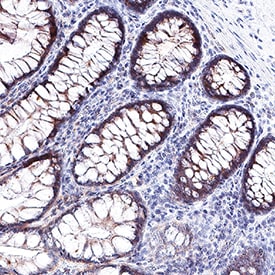
Galectin‑9 in Human Colon.
Galectin-9 was detected in immersion fixed paraffin-embedded sections of human colon using Mouse Anti-Human Galectin-9 Monoclonal Antibody (Catalog # MAB2045) at 0.5 µg/mL for 1 hour at room temperature followed by incubation with the Anti-Mouse IgG VisUCyte™ HRP Polymer Antibody (Catalog # VC001). Before incubation with the primary antibody, tissue was subjected to heat-induced epitope retrieval using Antigen Retrieval Reagent-Basic (Catalog # CTS013). Tissue was stained using DAB (brown) and counterstained with hematoxylin (blue). Specific staining was localized to cytoplasm in glandular epithelial cells. View our protocol for IHC Staining with VisUCyte HRP Polymer Detection Reagents.Applications for Human Galectin-9 Antibody (1005401)
Immunohistochemistry
Sample: Immersion fixed paraffin-embedded sections of human colon
Formulation, Preparation, and Storage
Purification
Reconstitution
Reconstitute at 0.5 mg/mL in sterile PBS. For liquid material, refer to CoA for concentration.
Formulation
Shipping
Stability & Storage
- 12 months from date of receipt, -20 to -70 °C as supplied.
- 1 month, 2 to 8 °C under sterile conditions after reconstitution.
- 6 months, -20 to -70 °C under sterile conditions after reconstitution.
Calculators
Background: Galectin-9
References
- Yang, R-Y. et al. (2008) Expert Rev. Mol. Med. 10:e17.
- Elola, M. T. et al. (2007) Cell. Mol. Life Sci. 64:1679.
- Tureci, O. et al. (1997) J. Biol. Chem. 272:6416.
- Chabot, S. et al. (2002) Glycobiology 12:111.
- Matsumoto, R. et al. (2002) J. Immunol. 168:1961.
- Sato, M. et al. (2002) Glycobiology 12:191.
- Nishi, N. et al. (2006) Glycobiology 16:15C.
- Niki, T. et al. (2009) J. Biol. Chem. 284:32344.
- Dai, S.-Y. et al. (2005) J. Immunol. 175:2974.
- Seki, M. et al. (2007) Arthritis Rheum. 56:3968.
- Zhu, C. et al. (2005) Nat. Immunol. 6:1245.
- Sehrawat, S. et al. (2010) PloS Pathogens 6:e1000882.
- Nobumoto, A. et al. (2008) Glycobiology 18:735.
- Leal-Pinto, E. et al. (2002) Am. J. Physiol. Renal Physiol. 283:F150.
Alternate Names
Gene Symbol
UniProt
Additional Galectin-9 Products
Product Documents for Human Galectin-9 Antibody (1005401)
Certificate of Analysis
To download a Certificate of Analysis, please enter a lot or batch number in the search box below.
Note: Certificate of Analysis not available for kit components.
Product Specific Notices for Human Galectin-9 Antibody (1005401)
For research use only
Related Research Areas
Customer Reviews for Human Galectin-9 Antibody (1005401)
There are currently no reviews for this product. Be the first to review Human Galectin-9 Antibody (1005401) and earn rewards!
Have you used Human Galectin-9 Antibody (1005401)?
Submit a review and receive an Amazon gift card!
$25/€18/£15/$25CAN/¥2500 for a review with an image
$10/€7/£6/$10CAN/¥1110 for a review without an image
Submit a review
Protocols
Find general support by application which include: protocols, troubleshooting, illustrated assays, videos and webinars.
- Antigen Retrieval Protocol (PIER)
- Antigen Retrieval for Frozen Sections Protocol
- Appropriate Fixation of IHC/ICC Samples
- Cellular Response to Hypoxia Protocols
- Chromogenic IHC Staining of Formalin-Fixed Paraffin-Embedded (FFPE) Tissue Protocol
- Chromogenic Immunohistochemistry Staining of Frozen Tissue
- ClariTSA™ Fluorophore Kits
- Detection & Visualization of Antibody Binding
- Fluorescent IHC Staining of Frozen Tissue Protocol
- Graphic Protocol for Heat-induced Epitope Retrieval
- Graphic Protocol for the Preparation and Fluorescent IHC Staining of Frozen Tissue Sections
- Graphic Protocol for the Preparation and Fluorescent IHC Staining of Paraffin-embedded Tissue Sections
- Graphic Protocol for the Preparation of Gelatin-coated Slides for Histological Tissue Sections
- IHC Sample Preparation (Frozen sections vs Paraffin)
- Immunofluorescent IHC Staining of Formalin-Fixed Paraffin-Embedded (FFPE) Tissue Protocol
- Immunohistochemistry (IHC) and Immunocytochemistry (ICC) Protocols
- Immunohistochemistry Frozen Troubleshooting
- Immunohistochemistry Paraffin Troubleshooting
- Preparing Samples for IHC/ICC Experiments
- Preventing Non-Specific Staining (Non-Specific Binding)
- Primary Antibody Selection & Optimization
- Protocol for Heat-Induced Epitope Retrieval (HIER)
- Protocol for Making a 4% Formaldehyde Solution in PBS
- Protocol for VisUCyte™ HRP Polymer Detection Reagent
- Protocol for the Preparation & Fixation of Cells on Coverslips
- Protocol for the Preparation and Chromogenic IHC Staining of Frozen Tissue Sections
- Protocol for the Preparation and Chromogenic IHC Staining of Frozen Tissue Sections - Graphic
- Protocol for the Preparation and Chromogenic IHC Staining of Paraffin-embedded Tissue Sections
- Protocol for the Preparation and Chromogenic IHC Staining of Paraffin-embedded Tissue Sections - Graphic
- Protocol for the Preparation and Fluorescent IHC Staining of Frozen Tissue Sections
- Protocol for the Preparation and Fluorescent IHC Staining of Paraffin-embedded Tissue Sections
- Protocol for the Preparation of Gelatin-coated Slides for Histological Tissue Sections
- TUNEL and Active Caspase-3 Detection by IHC/ICC Protocol
- The Importance of IHC/ICC Controls
- Troubleshooting Guide: Immunohistochemistry
- View all Protocols, Troubleshooting, Illustrated assays and Webinars