Key Product Details

Validated by

Biological Validation

Species Reactivity

Validated:

Human

Cited:

Human, Mouse, Rat, Primate - Chlorocebus pygerythrus (Vervet Monkey), Transgenic Mouse

Applications

Validated:

Immunohistochemistry, Western Blot, ELISA Capture (Matched Antibody Pair), Neutralization

Cited:

Immunohistochemistry, Immunohistochemistry-Paraffin, Western Blot, Neutralization, Flow Cytometry, Immunocytochemistry, Cell Culture, ELISA Capture, IF/IHC

Label

Unconjugated

Antibody Source

Polyclonal Goat IgG
Loading...

Product Specifications

Immunogen

S. frugiperda insect ovarian cell line Sf 21-derived recombinant human HB-EGF (R&D Systems, Catalog # 259-HE)
Asp63-Leu148
Accession # Q99075

Specificity

Detects human HB-EGF in ELISAs and Western blots. In direct ELISAs, less than 1% cross reactivity with recombinant mouse HB-EGF is observed. In sandwich immunoassays, less than 0.1% cross-reactivity with recombinant human (rh) Amphiregulin, rhBetacellulin, rhEpiregulin, and recombinant mouse Epigen is observed.

Clonality

Polyclonal

Host

Goat

Isotype

IgG

Endotoxin Level

<0.10 EU per 1 μg of the antibody by the LAL method.

Scientific Data Images for Human HB‑EGF Antibody

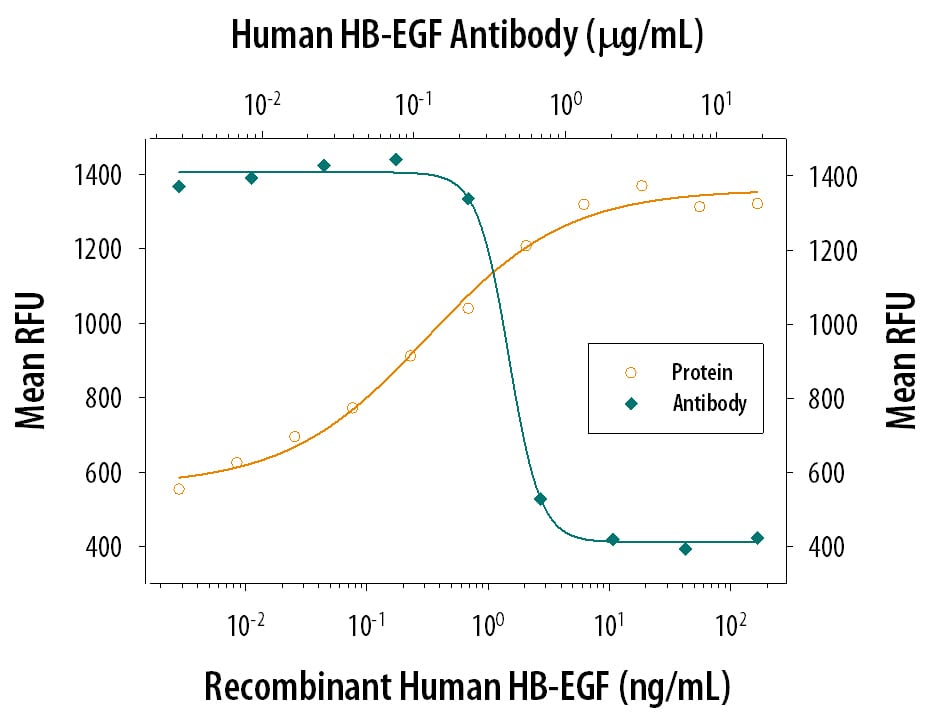
Cell Proliferation Induced by HB‑EGF and Neutralization by Human HB‑EGF Antibody.

Cell Proliferation Induced by HB‑EGF and Neutralization by Human HB‑EGF Antibody.

Recombinant Human HB-EGF (Catalog # 259-HE) stimulates proliferation in the Balb/3T3 mouse embryonic fibroblast cell line in a dose-dependent manner (orange line). Proliferation elicited by Recombinant Human HB-EGF (20 ng/mL) is neutralized (green line) by increasing concentrations of Human HB-EGF Antigen Affinity-purified Polyclonal Antibody (Catalog # AF-259-NA). The ND50 is typically 0.1-0.6 µg/mL.
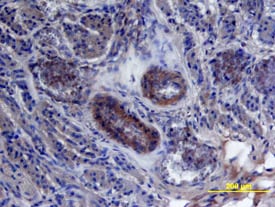
HB-EGF antibody in Human Placenta by Immunohistochemistry (IHC-P).

HB-EGF in Human Placenta.

HB-EGF was detected in immersion fixed paraffin-embedded sections of human placenta using 15 µg/mL Human HB-EGF Antigen Affinity-purified Polyclonal Antibody (Catalog # AF‑259‑NA) overnight at 4 °C. Tissue was stained with the Anti-Goat HRP-DAB Cell & Tissue Staining Kit (brown; Catalog # CTS008) and counterstained with hematoxylin (blue). View our protocol for Chromogenic IHC Staining of Paraffin-embedded Tissue Sections.
HB-EGF antibody in Human Placenta by Immunohistochemistry (IHC-P).

HB-EGF in Human Placenta.

HB-EGF was detected in immersion fixed paraffin-embedded sections of human placenta using Human HB-EGF Antigen Affinity-purified Polyclonal Antibody (Catalog # AF-259-NA) at 15 µg/mL overnight at 4 °C. Tissue was stained using the Anti-Goat HRP-DAB Cell & Tissue Staining Kit (brown; Catalog # CTS008) and counterstained with hematoxylin (blue). View our protocol for Chromogenic IHC Staining of Paraffin-embedded Tissue Sections.
Detection of Mouse HB-EGF by Western Blot

Detection of Mouse HB-EGF by Western Blot

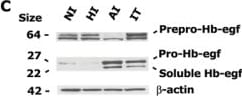
Dynamic expression and processing of Tgf-alpha and Hb-egf during multistep pancreatic neuroendocrine tumorigenesis (PNET). (A) Relative expression of Egf family members in cDNAs prepared from total RNA extracts of successive stages of neoplastic progression (NI = normal islets; HI = hyperplastic islets; AI = angiogenic islets; IT = islet tumors). Levels of mRNAs are expressed as a percentage of the mGus control mRNA. (B) Western blot analysis of the various forms of Tgf-alpha polypeptides in total protein extracts from successive stages of disease progression. (C) Analogous Western blot analysis of the various forms of Hb-egf polypeptides in total protein extracts from the successive disease stages. Image collected and cropped by CiteAb from the following publication (https://pubmed.ncbi.nlm.nih.gov/20975924), licensed under a CC-BY license. Not internally tested by R&D Systems.
Detection of Human HB-EGF by Western Blot

Detection of Human HB-EGF by Western Blot

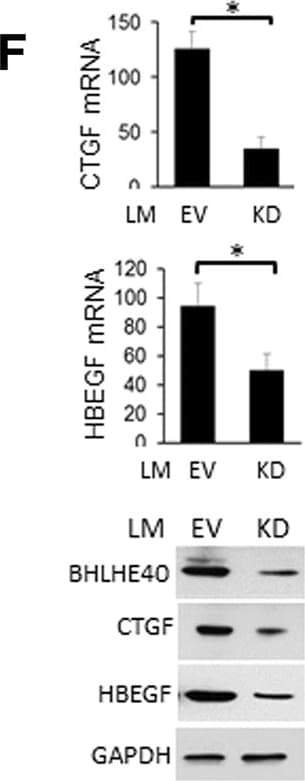
BHLHE40-knockdown reduced hypoxia-induced expression of a panel of cytokines and growth factors. a Heatmaps of cytokines and growth factors whose hypoxia-induced expression (1% O2 at 6 h or 48 h, fold-change ≥ 1.5 in two independent experiments) was diminished by BHLHE40-knockdown (KD) in LM cells. The gene expression levels were determined using the Illumina Human HT-12 expression BeadChips. Normalized (quantile normalization) hybridization signals were log2 transformed and standardized by genes across experiment conditions to generate the heatmap. b Heatmaps of a subset of genes list in a whose expression was affected by BHLHE40-KD in LM cells exposed to hypoxia combined with low (1 mM) glucose (1%O2/LG, 4 h). The gene expression levels were determined using the Affymetrix Human Gene 1.0 ST array. c Heatmaps of hypoxia-induced genes whose expression was not significantly affected by BHLHE40-KD in LM cells as determined by the Illumina Human HT-12 expression BeadChips. d Expression of luciferase reporters driven by hypoxia-responsive elements of ITGA6 or LDHA was not affected by BHLHE40 knockout (KO) by CRISPR/Cas9 editing in MDA-MB-231 cells, in the absence or presence of exogenous HIF1A. Luciferase activities were normalized to co-transfected CMV-beta -galactosidase and presented as mean ± SD (n = 6). e Expression of genes in control LM empty vector (EV) and LM BHLHE40-KD cells exposed to 1%O2/LG (4 h). mRNA expression levels were determined by qPCR, normalized to RPL13A, and presented as mean ± SD (n = 6). *p <  0.05 (n = 6, 1%O2/LG vs. untreated control), **p <  0.05 (n = 6, KD vs. EV), one-way ANOVA followed by Tukey’s post-hoc tests. f mRNA and protein expression levels of HBEGF and CTGF in primary xenograft tumors, determined by qPCR and immunoblotting, respectively. *p <  0.05 (n = 6, KD vs. EV), Student’s t test. Representative immunoblotting images of three tumors of KD or EV cells are presented Image collected and cropped by CiteAb from the following publication (https://pubmed.ncbi.nlm.nih.gov/30285805), licensed under a CC-BY license. Not internally tested by R&D Systems.
Detection of Mouse HB-EGF by Western Blot

Detection of Mouse HB-EGF by Western Blot

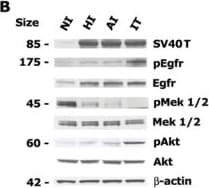
Egfr activity contributes to RT2 tumor growth and angiogenic switching. (A) Relative expression quantified by real-time quantitative PCR of Erbb family members in cDNAs derived from total RNA extracts of successive stages of pancreatic neuroendocrine tumorigenesis from RIP1-Tag2 (RT2) transgenic mice (NI = normal islets; HI = hyperplastic islets; AI = angiogenic islets; IT = islet tumors). Levels of mRNAs are expressed as a percentage of the mGus control mRNA. (B) Western blot analysis of protein extracts from successive stages of RT2-derived lesions. (C) Western blot analysis of protein extracts from RT2-derived tumors 4 h after treatment with a vehicle solution or erlotinib (80 mg/kg). (D-F) Comparison of the average tumor burden of RT2 mice treated daily with a control solution (vehicle) or with (D) gefitinib (80 mg/kg), (E) CI-1033 (80 mg/kg), both from 11.5 to 14.5 weeks of age, or with (F) erlotinib (80 mg/kg), from 12 to 16 weeks of age with an additional vehicle-treated time point at 14 weeks. (G) Comparison of the average number of hemorrhagic angiogenic islets per pancreas of RT2 mice treated daily with a vehicle solution or with erlotinib (80 mg/kg) or CI-1033 (80 mg/kg) from 6 to 9 weeks of age. (N = number of animals per treatment group). *P < 0.01. Image collected and cropped by CiteAb from the following publication (https://pubmed.ncbi.nlm.nih.gov/20975924), licensed under a CC-BY license. Not internally tested by R&D Systems.
Detection of Mouse HB-EGF by Western Blot

Detection of Mouse HB-EGF by Western Blot

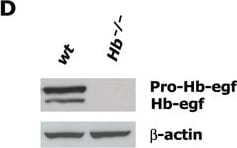
Hb-egf contributes to the angiogenic switch and neovascularization of PNET tumors. (A) Comparison of the average number of hemorrhagic angiogenic islets in wild-type (wt) and Hb-egf mutant (Hb) 9-week-old RT2 mice. (B-C) Comparison of the average (B) tumor burden or (C) tumor number in wild-type and Hb-egf mutant 14-week-old RT2 mice. (D) Western blot analysis of Hb-egf protein expression in total protein extracts from pools of 5 wild-type or 5 Hb-egf mutant tumors. (E-F) Average percentage of (E) dividing tumor cells (phospho-histone H3 positive) or (F) apoptotic cells (TdT-mediated dUTP-biotin nick end-labeling [TUNEL] positive) in wild-type or Hb-egf mutant tumors at 14 weeks of age. (G) Average vessel density (ratio of Meca-32 stained area to total section area) in wild-type or Hb-egf mutant tumors at 14 weeks of age. (H-I) Representative micrographs of (H) wild-type or (I) Hb-egf mutant RT2 tumors stained with Meca-32 (red) and DAPI (blue) (200x); panels are representative of 20 wild-type and 18 Hb-egf RT2 tumors dissected from at least 5 independent mice of each genotype. (N = number of independent mice [A-C] or tumor fields [E-G] analyzed per genotype; 1-2 fields per tumor.) *P < 0.001. **P < 0.01. ***P < 0.05. Image collected and cropped by CiteAb from the following open publication (https://pubmed.ncbi.nlm.nih.gov/20975924), licensed under a CC-BY license. Not internally tested by R&D Systems.

Applications for Human HB‑EGF Antibody

Application
Recommended Usage

Immunohistochemistry

5-15 µg/mL
Sample: Immersion fixed paraffin-embedded sections of human placenta

Western Blot

0.1 µg/mL
Sample: Recombinant Human HB-EGF (Catalog # 259-HE)

Neutralization

Measured by its ability to neutralize HB‑EGF-induced proliferation in the Balb/3T3 mouse embryonic fibroblast cell line. Rubin, J.S. et al. (1991) PNAS 88:415. The Neutralization Dose (ND50) is typically 0.1-0.6 µg/mL in the presence of 20 ng/mL Recombinant Human HB‑EGF.

Human HB-EGF Sandwich Immunoassay

ELISA Capture (Matched Antibody Pair)
Recommended Concentration: 0.2-0.8 µg/mL
Use in combination with these reagents:
  • Detection Reagent: Human HB‑EGF Biotinylated Antibody (Catalog # BAF259)
  • Standard: Recombinant Human HB-EGF Protein (Catalog # 259-HE)
Please Note: Optimal dilutions of this antibody should be experimentally determined.

Reviewed Applications

Read 1 review rated 4 using AF-259-NA in the following applications:

Formulation, Preparation, and Storage

Purification

Antigen Affinity-purified

Reconstitution

Reconstitute at 0.2 mg/mL in sterile PBS. For liquid material, refer to CoA for concentration.


Loading...

Formulation

Lyophilized from a 0.2 μm filtered solution in PBS with Trehalose. *Small pack size (SP) is supplied either lyophilized or as a 0.2 µm filtered solution in PBS.

Shipping

Lyophilized product is shipped at ambient temperature. Liquid small pack size (-SP) is shipped with polar packs. Upon receipt, store immediately at the temperature recommended below.

Stability & Storage

Use a manual defrost freezer and avoid repeated freeze-thaw cycles.
  • 12 months from date of receipt, -20 to -70 °C as supplied.
  • 1 month, 2 to 8 °C under sterile conditions after reconstitution.
  • 6 months, -20 to -70 °C under sterile conditions after reconstitution.

Calculators

The reconstitution calculator allows you to quickly calculate the volume of a reagent to reconstitute your vial. Simply enter the mass of reagent and the target concentration and the calculator will determine the rest.

=
÷

Background: HB-EGF

HB-EGF was originally purified based on its heparin-binding property and mitogenic activity on BALB-3T3 fibroblasts from the conditioned medium of the human U-937 histiocytic lymphoma cell line. The natural protein has an apparent molecular mass of 19-23 kDa and exists in multiple forms as a result of heterogenous O-glycosylation and/or N-terminal truncation. In addition to fibroblasts, HB-EGF is also a potent mitogen for keratinocytes and smooth muscle cells but not for capillary endothelial cells. HB-EGF is produced in monocytes and macrophages. In addition, transcription of HB-EGF can be induced in vascular endothelial cells as well as aortic smooth muscle cells (SMC), suggesting that HB-EGF may have an important role in the pathogenesis of atherosclerosis.

HB-EGF is a member of the EGF family of mitogens which also include transforming growth factor-alpha (TGF-alpha ), amphiregulin (AR), rat schwanoma-derived growth factor (SDGF), vaccinia growth factor (VGF), and the various ligands for the Her2/ErbB2/neu receptor. All these cytokines are derived from transmembrane precursors that contain one or several EGF structural units in their extracellular domain. Many of these transmembrane precursors are biologically active and seem to play a role in juxtacrine stimulation of adjacent cells. The cDNA for HB-EGF encodes a 204 amino acid residue transmembrane protein that is proteolytically cleaved to generate the soluble HB-EGF. Like EGF, TGF-alpha, and AR; HB-EGF binds to the EGF receptor and activates the receptor tyrosine kinase. HB-EGF is reported to be a more potent SMC mitogen than EGF. It has been suggested that the differential activities found for HB-EGF compared to EGF may be mediated by the heparin-binding properties of HB-EGF. A diphtheria toxin receptor that mediates the endocytosis of the bound toxin has been cloned and found to be identical to the transmembrane HB-EGF precursor.

Long Name

Heparin Binding EGF-like Growth Factor

Alternate Names

Dtr, Dts, HBEGF, Hegfl

Entrez Gene IDs

1839 (Human); 15200 (Mouse)

Gene Symbol

HBEGF

UniProt

Additional HB-EGF Products

Product Documents for Human HB‑EGF Antibody

Certificate of Analysis

To download a Certificate of Analysis, please enter a lot or batch number in the search box below.

Note: Certificate of Analysis not available for kit components.

Product Specific Notices for Human HB‑EGF Antibody

For research use only

Related Research Areas

Citations for Human HB‑EGF Antibody

Customer Reviews for Human HB‑EGF Antibody (1)

4 out of 5
1 Customer Rating
5 Stars
0%
4 Stars
100%
3 Stars
0%
2 Stars
0%
1 Stars
0%

Have you used Human HB‑EGF Antibody?

Submit a review and receive an Amazon gift card!

$25/€18/£15/$25CAN/¥2500 Yen for a review with an image

$10/€7/£6/$10CAN/¥1110 Yen for a review without an image

Submit a review
Amazon Gift Card

Customer Images


Showing  1 - 1 of 1 review Showing All
Filter By:
  • Human HB-EGF Antibody
    Name: Tamar Licht
    Application: Immunocytochemistry/Immunofluorescence
    Sample Tested: Adult brain
    Species: Mouse- transgenic inducible DTR
    Verified Customer | Posted 11/30/2017
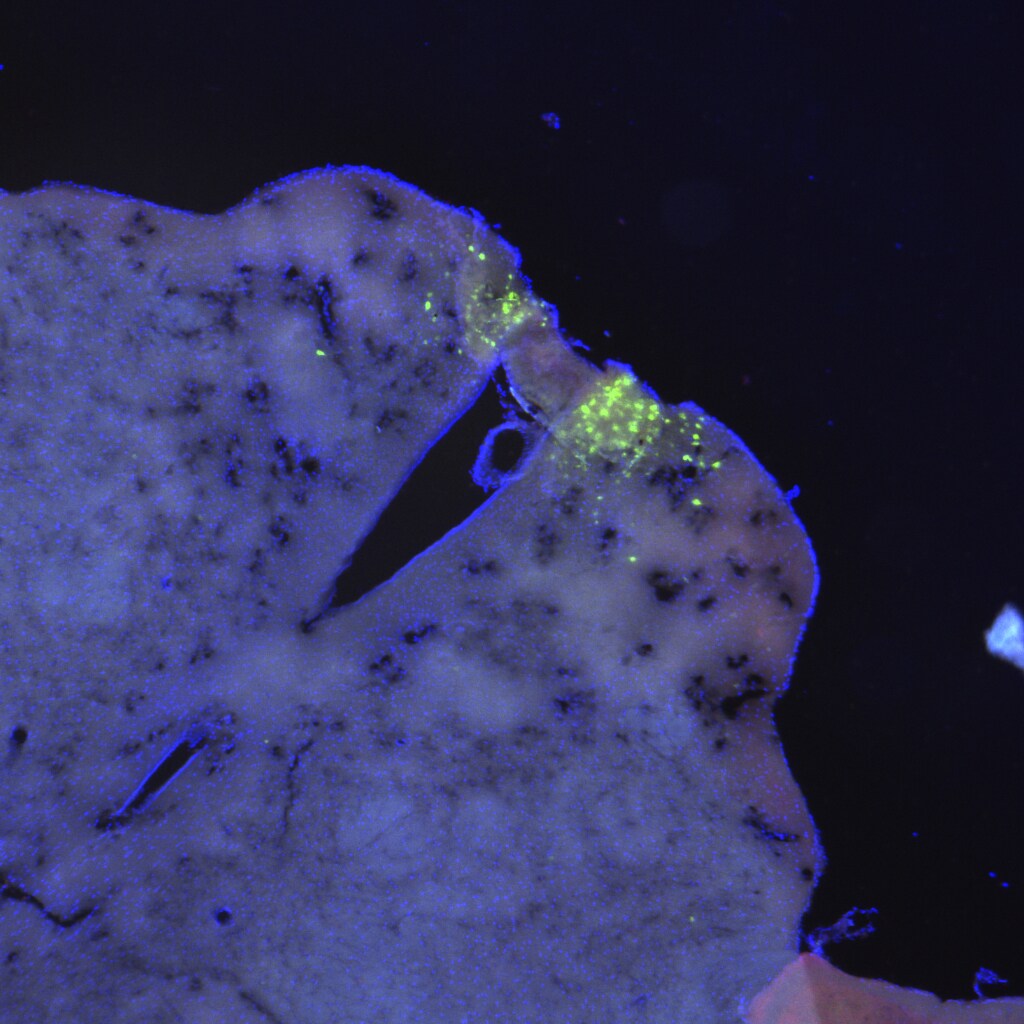
    Perfect to detect expression of transgenic human diphtheria toxin receptor in mouse. Here I show POMC-Cre line crossed to iDTR line. Mouse hypothalamus is presented. HB-EFG in green.
    Human HB‑EGF Antibody AF-259-NA

There are no reviews that match your criteria.

Showing  1 - 1 of 1 review Showing All

Protocols

Find general support by application which include: protocols, troubleshooting, illustrated assays, videos and webinars.

FAQs

No product specific FAQs exist for this product.

View all FAQs for Antibodies