Key Product Details

Species Reactivity

Human

Applications

ELISA

Label

Unconjugated

Antibody Source

Monoclonal Mouse IgG2B Clone # 1004603
Loading...

Product Specifications

Immunogen

E. coli-derived human IL-21
Gln32-Ser162
Accession # Q9HBE4.3

Specificity

Detects human IL-21 in direct ELISAs.

Clonality

Monoclonal

Host

Mouse

Isotype

IgG2B

Applications for Human IL‑21 Antibody

Application
Recommended Usage

ELISA

This antibody functions as an ELISA capture antibody when paired with Mouse Anti-Human IL‑21 Monoclonal Antibody (Catalog # MAB15002).

This product is intended for assay development on various assay platforms requiring antibody pairs.

Formulation, Preparation, and Storage

Purification

Protein A or G purified from hybridoma culture supernatant

Reconstitution

Reconstitute at 0.5 mg/mL in sterile PBS. For liquid material, refer to CoA for concentration.


Loading...

Formulation

Lyophilized from a 0.2 μm filtered solution in PBS with Trehalose. *Small pack size (SP) is supplied either lyophilized or as a 0.2 µm filtered solution in PBS.

Shipping

Lyophilized product is shipped at ambient temperature. Liquid small pack size (-SP) is shipped with polar packs. Upon receipt, store immediately at the temperature recommended below.

Stability & Storage

Use a manual defrost freezer and avoid repeated freeze-thaw cycles.
  • 12 months from date of receipt, -20 to -70 °C as supplied.
  • 1 month, 2 to 8 °C under sterile conditions after reconstitution.
  • 6 months, -20 to -70 °C under sterile conditions after reconstitution.

Calculators

The reconstitution calculator allows you to quickly calculate the volume of a reagent to reconstitute your vial. Simply enter the mass of reagent and the target concentration and the calculator will determine the rest.

=
÷

Background: IL-21

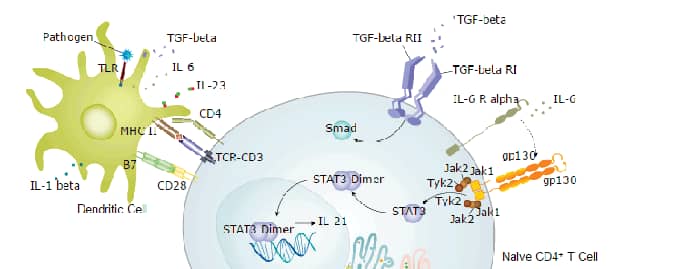
IL-21 (Interleukin-21) is a potent cytokine regulating many cell types of the immune system. IL-21 is produced by activated T follicular helper cells (Tfh), Th17 cells, and NKT cells (2-6). Tfh-derived IL-21 plays an important role in the development of humoral immunity through its autocrine effects on the Tfh cell and paracrine effects on immunoglobulin affinity maturation, plasma cell differentiation, and B cell memory responses (4, 8, 9). IL-21 protein regulates several aspects of T cell function. It co-stimulates the activation, proliferation, and survival of CD8+ T cells and NKT cells and promotes Th17 cell polarization (3, 5, 6, 11, 12). IL-21 blocks the generation of regulatory T cells and their suppressive effects on CD4+ T cells (13, 14). In addition to its role in T cell biology, IL-21 also plays a critical role in B cell activation, proliferation, differentiation, and apoptosis (2). It is also required for the migration of dendritic cells to draining lymph nodes (10). And IL-21 suppresses cutaneous hypersensitivity reactions by limiting allergen-specific IgE production and mast cell degranulation (16). In the autoimmune disease Systemic lupus erythematosus (SLE), a link between IL-21 and SLE disease susceptibility and progression was recently reported (19).

IL-21 protein exerts its biological effects through a heterodimeric receptor complex of gamma c and the IL-21-specific IL-21 R (2, 7). IL-21 is an approximately 14 kDa four-helix-bundle member of the family of cytokines that utilize the common gamma chain (gamma c) as a receptor subunit. gamma c is also a subunit of the receptors for IL-2, IL-4, IL-7, IL-9, and IL-15 (1). IL-21 R engagement enhances the cytolytic activity and IFN-gamma production of activated NK cells but limits the expansion of resting NK cells (15). Dysregulation of the IL-21/IL-21 R system contributes to the development of multiple immunological disorders (1, 17). The 133 amino acid (aa) mature human IL-21 protein shares 63% and 61% aa sequence identity with mouse and rat IL-21 protein, respectively. Alternative splicing generates an additional isoform with a substitution of the C-terminal 16 amino acids (18).

References

  1. Tangye, S.G. (2015) Curr. Opin. Immunol. 34:107.
  2. Parrish-Novak, et al. (2000) Nature 408:57.
  3. Coquet, J.M. et al. (2007) J. Immunol. 178:2827.
  4. Vogelzang, A. et al. (2008) Immunity 29:127.
  5. Korn, T. et al. (2007) Nature 448:484.
  6. Nurieva, R. et al. (2007) Nature 448:480.
  7. Asao, H. et al. (2001) J. Immunol. 167:1.
  8. Zotos, D. et al. (2010) J. Exp. Med. 207:365.
  9. Rankin, A.L. et al. (2011) J. Immunol. 186:667.
  10. Jin, H. et al. (2009) J. Clin. Invest. 119:47.
  11. Frohlich, A. et al. (2009) Science 324:1576.
  12. Yi, J.S. et al. (2009) Science 324:1572.
  13. Peluso, I. et al. (2007) J. Immunol. 178:732.
  14. Bucher, C. et al. (2009) Blood 114:5375.
  15. Kasaian, M.T. et al. (2002) Immunity 16:559.
  16. Tamagawa-Mineoka, R. et al. (2011) J. Invest. Dermatol. 131:1513.
  17. Ma, J. et al. (2011) Cytokine 56:133.
  18. Rahman, M. et al. (2007) FEBS Lett. 581:4001.
  19. Wang, et al. (2018) Nature Commun. 9: 1758.

Long Name

Interleukin 21

Alternate Names

CVID11, IL21, Za11

Entrez Gene IDs

59067 (Human); 60505 (Mouse); 365769 (Rat); 442935 (Canine); 100344172 (Rabbit)

Gene Symbol

IL21

UniProt

Additional IL-21 Products

Product Documents for Human IL‑21 Antibody

Certificate of Analysis

To download a Certificate of Analysis, please enter a lot or batch number in the search box below.

Note: Certificate of Analysis not available for kit components.

Product Specific Notices for Human IL‑21 Antibody

For research use only

Customer Reviews for Human IL‑21 Antibody

There are currently no reviews for this product. Be the first to review Human IL‑21 Antibody and earn rewards!

Have you used Human IL‑21 Antibody?

Submit a review and receive an Amazon gift card!

$25/€18/£15/$25CAN/¥2500 Yen for a review with an image

$10/€7/£6/$10CAN/¥1110 Yen for a review without an image

Submit a review
Amazon Gift Card

FAQs

No product specific FAQs exist for this product.

View all FAQs for Antibodies