Key Product Details

Validated by

Biological Validation

Species Reactivity

Validated:

Human

Cited:

Human, Mouse, Rat

Applications

Validated:

Knockout Validated, Immunohistochemistry, Western Blot, Simple Western, Immunoprecipitation

Cited:

Immunohistochemistry, Western Blot, Neutralization, Immunocytochemistry, Immunoprecipitation, Functional Assay, Electron Microscopy

Label

Unconjugated

Antibody Source

Polyclonal Goat IgG
Loading...

Product Specifications

Immunogen

E. coli-derived recombinant human Midkine
Lys23-Asp143
Accession # P21741

Specificity

Detects human Midkine in direct ELISAs and Western blots. In direct ELISAs, approximately 10% cross-reactivity with recombinant mouse Midkine is observed, and less than 1% cross-reactivity with recombinant human Pleiotrophin is observed.

Clonality

Polyclonal

Host

Goat

Isotype

IgG

Scientific Data Images for Human Midkine Antibody

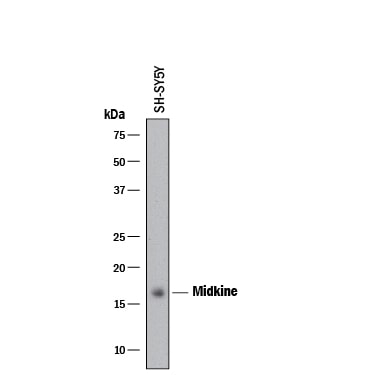
Detection of Human Midkine antibody by Western Blot.

Detection of Human Midkine by Western Blot.

Western blot shows lysates of SH-SY5Y human neuroblastoma cell line. PVDF membrane was probed with 2 µg/mL of Goat Anti-Human Midkine Antigen Affinity-purified Polyclonal Antibody (Catalog # AF-258-PB) followed by HRP-conjugated Anti-Goat IgG Secondary Antibody (HAF017). A specific band was detected for Midkine at approximately 17 kDa (as indicated). This experiment was conducted under reducing conditions and using Immunoblot Buffer Group 1.

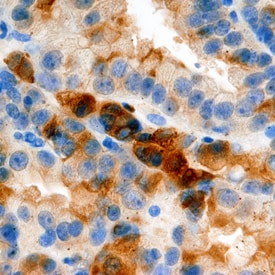
Midkine antibody in Human Prostate by Immunohistochemistry (IHC-P).

Midkine in Human Prostate.

Midkine was detected in immersion fixed paraffin-embedded sections of human prostate using Goat Anti-Human Midkine Antigen Affinity-purified Polyclonal Antibody (Catalog # AF-258-PB) at 10 µg/mL overnight at 4 °C. Before incubation with the primary antibody, tissue was subjected to heat-induced epitope retrieval using Antigen Retrieval Reagent-Basic (CTS013). Tissue was stained using the Anti-Goat HRP-DAB Cell & Tissue Staining Kit (brown CTS008) and counterstained with hematoxylin (blue). Specific staining was localized to stromal cell cytoplasm. View our protocol for Chromogenic IHC Staining of Paraffin-embedded Tissue Sections.

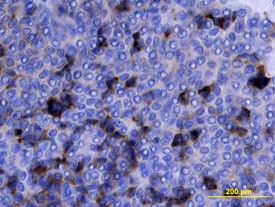
Midkine antibody in Human Ovarian Array by Immunohistochemistry (IHC-P).

Midkine in Human Ovarian Array.

Midkine was detected in immersion fixed paraffin-embedded sections of human ovarian array using Goat Anti-Human Midkine Antigen Affinity-purified Polyclonal Antibody (Catalog # AF-258-PB) at 10 µg/mL overnight at 4 °C. Tissue was stained using the Anti-Goat HRP-DAB Cell & Tissue Staining Kit (brown; CTS008) and counterstained with hematoxylin (blue). View our protocol for Chromogenic IHC Staining of Paraffin-embedded Tissue Sections.

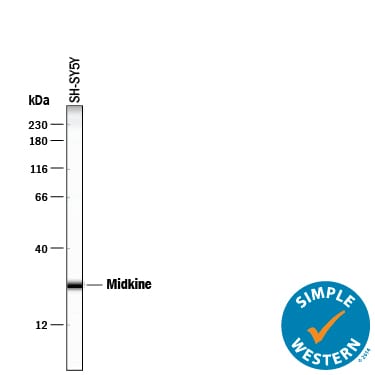
Detection of Human Midkine antibody by Simple WesternTM.

Detection of Human Midkine by Simple WesternTM.

Simple Western lane view shows lysates of SH-SY5Y human neuroblastoma cell line, loaded at 0.2 mg/mL. A specific band was detected for Midkine at approximately 26 kDa (as indicated) using 100 µg/mL of Goat Anti-Human Midkine Antigen Affinity-purified Polyclonal Antibody (Catalog # AF-258-PB) followed by 1:50 dilution of HRP-conjugated Anti-Goat IgG Secondary Antibody (HAF109). This experiment was conducted under reducing conditions and using the 12-230 kDa separation system.

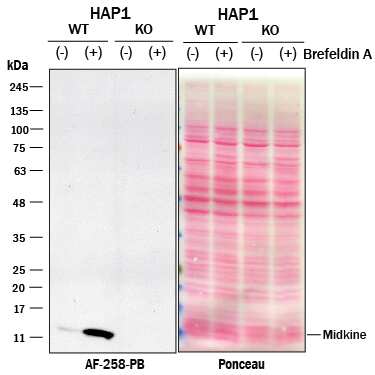
Western Blot Shows Human Midkine Specificity Using Knockout Cell Line.

Western blot shows lysates of HAP1 human near-haploid cell line untreated (-) or treated (+) with 3.0 ug/ml Brefeldin A for 18 hr and Midkine knockout HAP1 cell line (KO). Nitrocellulose membrane was probed with 2 µg/mL of Goat Anti-Human Midkine Antigen Affinity-purified Polyclonal Antibody (Catalog # AF-258-PB) followed by HRP-conjugated Anti-Goat IgG Secondary Antibody. A specific band was detected for Midkine at approximately 11 kDa (as indicated) in the parental HAP1 cell line, but is not detectable in knockout HAP1 cell line. The Ponceau stained transfer of the blot is shown. This experiment was conducted under reducing conditions. Image, protocol, and testing courtesy of YCharOS Inc. See ycharos.com for additional details.

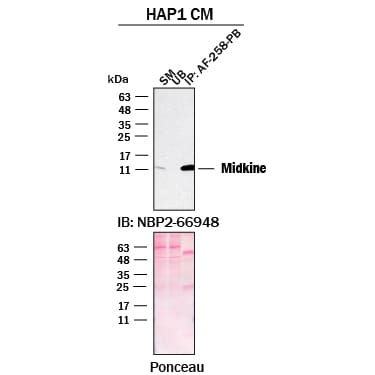
Detection of Midkine by Immunoprecipitation.

Immunoprecipitation was performed on concentrated culture media of HAP1 human near-haploid cell line using 2.0 μg of Mouse Anti-Human Midkine Monoclonal Antibody (Catalog # AF-258-PB) pre-coupled to protein G or protein A beads. Immunoprecipitated Midkine was detected with Rabbit Anti-Human Midkine Monoclonal Antibody (NBP2-66948 ) at 1/500. The Ponceau stained transfers of each blot are shown. SM=10% starting material; UB=10% unbound fraction; IP=immunoprecipitated. Image, protocol, and testing courtesy of YCharOS Inc. (ycharos.com).

Applications for Human Midkine Antibody

Application
Recommended Usage

Immunohistochemistry

5-15 µg/mL
Sample: Immersion fixed paraffin-embedded sections of human ovarian array and human prostate

Immunoprecipitation

1 µg/mL
Sample:  Conditioned cell culture medium from HAP1 human near-haploid cell line

Knockout Validated

Midkine is specifically detected in the parental HAP1 cell line, but is not detectable in knockout HAP1 cell line. 

Simple Western

100 µg/mL
Sample: SH‑SY5Y human neuroblastoma cell line

Western Blot

2 µg/mL
Sample: SH‑SY5Y human neuroblastoma cell line

Reviewed Applications

Read 1 review rated 4 using AF-258-PB in the following applications:

Formulation, Preparation, and Storage

Purification

Antigen Affinity-purified

Reconstitution

Reconstitute at 0.2 mg/mL in sterile PBS. For liquid material, refer to CoA for concentration.


Loading...

Formulation

Lyophilized from a 0.2 μm filtered solution in PBS with Trehalose. *Small pack size (SP) is supplied either lyophilized or as a 0.2 µm filtered solution in PBS.

Shipping

Lyophilized product is shipped at ambient temperature. Liquid small pack size (-SP) is shipped with polar packs. Upon receipt, store immediately at the temperature recommended below.

Stability & Storage

Use a manual defrost freezer and avoid repeated freeze-thaw cycles.
  • 12 months from date of receipt, -20 to -70 °C as supplied.
  • 1 month, 2 to 8 °C under sterile conditions after reconstitution.
  • 6 months, -20 to -70 °C under sterile conditions after reconstitution.

Calculators

The reconstitution calculator allows you to quickly calculate the volume of a reagent to reconstitute your vial. Simply enter the mass of reagent and the target concentration and the calculator will determine the rest.

=
÷

Background: Midkine

Midkine (MK) is a 15 kDa heparin-binding molecule originally cloned during a search for genes preferentially transcribed during retinoic acid (RA)-induced differentiation. Midkine belongs to a family of neurotrophic and developmentally-regulated heparin-binding molecules consisting of midkine, pleiotrophin (PTN/HBNF/OSF-1/HNGF-8) and the avian midkine homolog, RI-HB (for retinoic acid-inducible heparin-binding protein).

Midkine is a highly basic, nonglycosylated polypeptide that contains five intrachain disulfide bonds. The predicted molecular weight is approximately 13.3 kDa, based on a mature peptide length of 118 amino acid residues in the mouse and 121 amino acid residues in the human. Across species, MK shows 87% identity between the human and murine proteins. Between family members, human MK is approximately 50% identical to human PTN, with conservation of all 10 cysteines. Initial structure-function studies indicate that the C-terminal half of MK contains the principal heparin-binding site plus the molecule’s antigenicity and neurite-promoting sequences; while both the C- and N-termini are necessary for the molecule’s neurotrophic effects. Cells known to produce MK include endothelial cells, fetal astrocytes, renal proximal tubule epithelial cells and Wilms’ (kidney) tumor cells. MK has also been identified in the senile plaques of patients with Alzheimer’s disease. The pattern of expression of midkine during development strongly suggests a role for this factor both in epithelial-mesenchymal interactions and in development of the nervous system.

References

  1. Bohlen, P. and I. Kovesdi (1991) Prog. Growth Factor Res. 3:143.
  2. Muramatsu, T. (1993) Int. J. Dev. Biol. 37:183.

Alternate Names

ARAP, MDK, MEK, MK1, NEGF2

Entrez Gene IDs

4192 (Human); 17242 (Mouse)

Gene Symbol

MDK

UniProt

Additional Midkine Products

Product Documents for Human Midkine Antibody

Certificate of Analysis

To download a Certificate of Analysis, please enter a lot or batch number in the search box below.

Note: Certificate of Analysis not available for kit components.

Product Specific Notices for Human Midkine Antibody

For research use only

Citations for Human Midkine Antibody

Customer Reviews for Human Midkine Antibody (1)

4 out of 5
1 Customer Rating
5 Stars
0%
4 Stars
100%
3 Stars
0%
2 Stars
0%
1 Stars
0%

Have you used Human Midkine Antibody?

Submit a review and receive an Amazon gift card!

$25/€18/£15/$25CAN/¥2500 Yen for a review with an image

$10/€7/£6/$10CAN/¥1110 Yen for a review without an image

Submit a review
Amazon Gift Card

Customer Images


Showing  1 - 1 of 1 review Showing All
Filter By:
  • Human Midkine Antibody
    Name: Anonymous
    Application: ELISA
    Sample Tested: Serum and Plasma
    Species: Human
    Verified Customer | Posted 06/19/2019
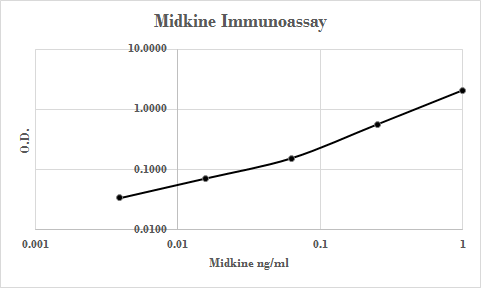
    AF258 was used with MAB2581 as a matched pair in an Midkine LBA.
    Human Midkine Antibody AF-258-PB

There are no reviews that match your criteria.

Showing  1 - 1 of 1 review Showing All

Protocols

Find general support by application which include: protocols, troubleshooting, illustrated assays, videos and webinars.

FAQs

No product specific FAQs exist for this product.

View all FAQs for Antibodies