
Stem Cell Growth Factor (SCGF) is a secreted sulfated glycoprotein that belongs to the C-type lectin superfamily (CLEC11a) and is expressed primarily in hematopoietic tissues. It functions as a growth factor for primitive hematopoietic progenitor cells. SCGF-beta is a truncated variant of SCGF-alpha that has aa 78 amino acid deletion and lacks a functional calcium-dependent carbohydrate-recognition domain.
Human SCGF/CLEC11a Antibody (239029)
R&D Systems | Catalog # MAB1904


Scientific images may be resized, cropped, or adjusted for brightness or contrast for presentation purposes. These updates are limited to presentation and do not affect the underlying scientific interpretation of the data. Where available, additional source data may be provided upon request.
Key Product Details
Validated by
Biological Validation
Species Reactivity
Validated:
Human
Cited:
Human
Applications
Validated:
Immunohistochemistry, Western Blot, Immunocytochemistry
Cited:
Immunohistochemistry-Paraffin, Western Blot, Neutralization
Label
Unconjugated
Antibody Source
Monoclonal Mouse IgG2A Clone # 239029
Loading...
Product Specifications
Immunogen
E. coli-derived recombinant human SCGF/CLEC11a
Gly19-Phe245
Accession # BAA21499
Gly19-Phe245
Accession # BAA21499
Specificity
Detects human SCGF/CLEC11a in direct ELISAs and Western blots. In direct ELISAs and Western blots,
approximately 50% cross-reactivity with recombinant mouse SCGF-beta is observed.
Clonality
Monoclonal
Host
Mouse
Isotype
IgG2A
Scientific Data Images for Human SCGF/CLEC11a Antibody (239029)
SCGF/CLEC11a in Human Spleen.
SCGF/CLEC11a was detected in immersion fixed paraffin-embedded sections of human spleen using 25 µg/mL Mouse Anti-Human SCGF/CLEC11a Monoclonal Antibody (Catalog # MAB1904) overnight at 4 °C. Tissue was stained with the Anti-Mouse HRP-DAB Cell & Tissue Staining Kit (brown; Catalog # CTS002) and counterstained with hematoxylin (blue). View our protocol for Fluorescent ICC Staining of Cells on Coverslips.
SCGF/CLEC11a in THP-1 Human Cell Line.
SCGF/CLEC11a was detected in immersion fixed IFN gamma activated THP-1 human acute monocytic leukemia cell line using 10 µg/mL Mouse Anti-Human SCGF/CLEC11a Monoclonal Antibody (Catalog # MAB1904) for 3 hours at room temperature. Cells were stained with the NorthernLights™ 557-conjugated Anti-Mouse IgG Secondary Antibody (red; Catalog # NL007) and counter-stained with DAPI (blue). View our protocol for Chromogenic IHC Staining of Paraffin-embedded Tissue Sections.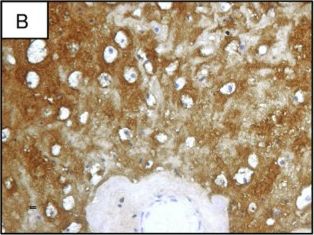
Detection of Human SCGF/CLEC11a by Immunohistochemistry
Immunohistochemistry of SCGF expression in GIST samples. A) Hematoxylin-eosin section of one representative slide from GIST 5. B) SCGF staining; strong SCGF positivity, consistent with western blotting, was restricted to the stroma compartment. C) CD117 staining; cells retained weak cytoplasmic KIT reactivity. The rare viable tumoral cells present in the responding area were SCGF-negative in the cytoplasm and the nucleus. D) Hematoxylin-eosin section of one representative slide from GIST 2. Highly cellulated areas indicating the absence of pathological response are visible. Only two areas showing rare tumoral cells are present. E) CD117 staining; all cellulated areas exhibit strong KIT expression not observed in the acellulated areas mostly composed of stroma. F) SCGF staining; strong SCGF expression is restricted to the non-cellulated areas, in contrast to CD117 staining. Image collected and cropped by CiteAb from the following publication (https://translational-medicine.biomedcentral.com/articles/10.1186/1479-…), licensed under a CC-BY license. Not internally tested by R&D Systems.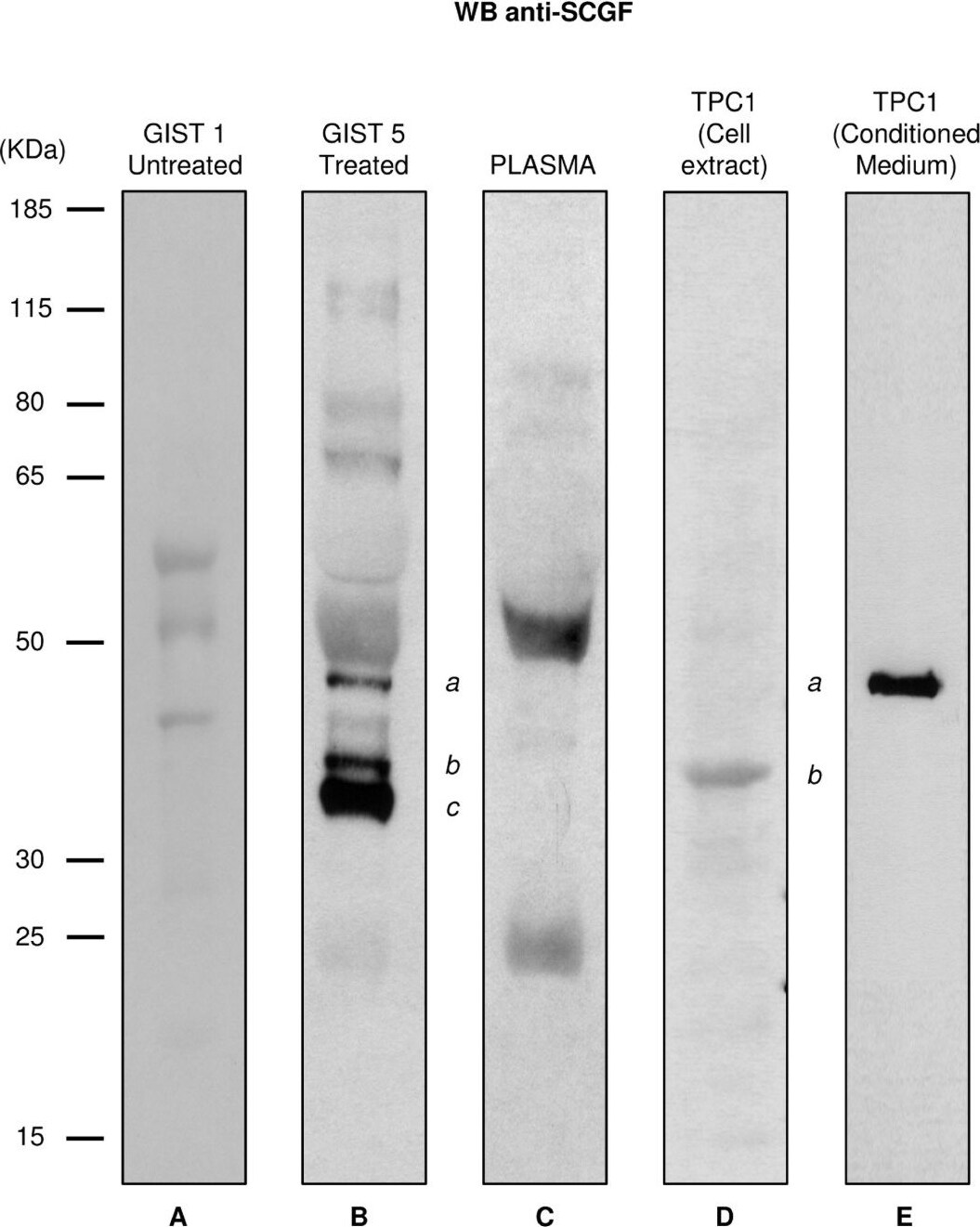
Detection of Human SCGF/CLEC11a by Western Blot
Western blotting of SCGF expression. Western blotting with anti SCGF-alpha /-beta antibody of tumor tissue samples from the untreated GIST 1 patient (lane A), the SCGF-positive GIST 5 patient (lane B), a pool of plasma samples from healthy subjects (lane C), and the cell extract (lane D) and conditioned medium (lane E) from the TPC1 cell line. (a) indicates the mature and secreted form of SCGF-alpha detected in the GIST 5 sample (lane B) and in the TPC1 conditioned medium (lane E); (b) indicates the immature and cytoplasmatic form of SCGF-alpha detected in the GIST 5 sample (lane B; corresponding to band 8 in Figure 1A) and in the TPC1 cell extract (lane D); (c) points out the quantitatively most relevant form, exclusively present in the GIST 5 sample, corresponding to band 9 in Figure 1A. Image collected and cropped by CiteAb from the following publication (https://translational-medicine.biomedcentral.com/articles/10.1186/1479-…), licensed under a CC-BY license. Not internally tested by R&D Systems.
Detection of Human SCGF/CLEC11a by Western Blot
Analysis of an independent set of imatinib-treated GIST samples. A) Comparative analysis of tumoral areas from of GIST 6, 7 and 8, which resulted non-responding or responding to imatinib treatment. Panels 1-5, 6-10 and 11-15 refer to GISTs 6, 7 and 8 respectively. Panels 1, 6 and 11 represent non-responding areas; panels 2, 7 and 12 responding areas; panels 3, 8 and 13 show the inset areas of panels 2, 7, and 12. Arrows and arrowheads indicate inflammatory macrophages and lymphocytes, respectively, and asterisks residual tumor cells. Panels 4, 9 and 14 show the protein lysates prepared from adjacent tumor areas were separated onto SDS gels and stained with Coomassie-blu. Lane NR indicates the non-responding area and lane R indicates the responding area. Panels 5, 10 and 15 show NR and R protein lysates were probed with anti-SCGF and anti-actin antibodies, respectively. Note that in panels 5, 10 and 15 arrows refer to the actin band that is detected as a non-specific background band in anti-SCGF blot. As expected, due to the higher cellularity we observe a more intense actin band in NR samples than in R samples. B) Western blotting of SCGF expression in GIST 9-16 samples. GIST 9-13 represent protein lysates from non-responder GIST samples and GIST 14-16 protein lysates from responder samples. C corresponds to GIST 6 protein lysate. Samples were probed with both anti-SCGF and anti-actin antibodies. Arrow indicates actin band and asterisks SCGF band. In non-responder samples anti-SCGF detected exclusively the actin band. Image collected and cropped by CiteAb from the following publication (https://translational-medicine.biomedcentral.com/articles/10.1186/1479-…), licensed under a CC-BY license. Not internally tested by R&D Systems.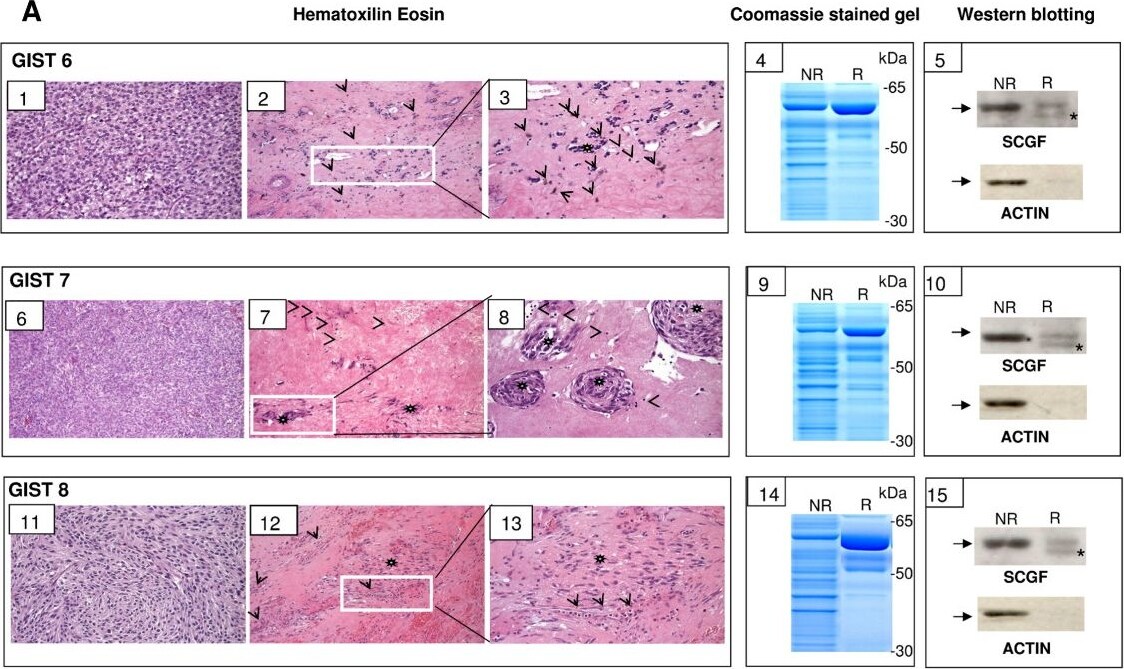
Detection of Human SCGF/CLEC11a by Western Blot
Analysis of an independent set of imatinib-treated GIST samples. A) Comparative analysis of tumoral areas from of GIST 6, 7 and 8, which resulted non-responding or responding to imatinib treatment. Panels 1-5, 6-10 and 11-15 refer to GISTs 6, 7 and 8 respectively. Panels 1, 6 and 11 represent non-responding areas; panels 2, 7 and 12 responding areas; panels 3, 8 and 13 show the inset areas of panels 2, 7, and 12. Arrows and arrowheads indicate inflammatory macrophages and lymphocytes, respectively, and asterisks residual tumor cells. Panels 4, 9 and 14 show the protein lysates prepared from adjacent tumor areas were separated onto SDS gels and stained with Coomassie-blu. Lane NR indicates the non-responding area and lane R indicates the responding area. Panels 5, 10 and 15 show NR and R protein lysates were probed with anti-SCGF and anti-actin antibodies, respectively. Note that in panels 5, 10 and 15 arrows refer to the actin band that is detected as a non-specific background band in anti-SCGF blot. As expected, due to the higher cellularity we observe a more intense actin band in NR samples than in R samples. B) Western blotting of SCGF expression in GIST 9-16 samples. GIST 9-13 represent protein lysates from non-responder GIST samples and GIST 14-16 protein lysates from responder samples. C corresponds to GIST 6 protein lysate. Samples were probed with both anti-SCGF and anti-actin antibodies. Arrow indicates actin band and asterisks SCGF band. In non-responder samples anti-SCGF detected exclusively the actin band. Image collected and cropped by CiteAb from the following publication (https://translational-medicine.biomedcentral.com/articles/10.1186/1479-…), licensed under a CC-BY license. Not internally tested by R&D Systems.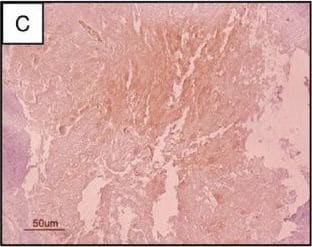
Detection of Human SCGF/CLEC11a by Immunohistochemistry
Immunohistochemistry of CD68 and SCGF in GIST 5 and GIST 2. A) Hematoxilin-eosin section of one representative slide from GIST 5. B) CD68 staining; CD68 positive macrophages are scattered through the section. C) SCGF staining; SCGF positivity was observed in the corresponding stromal area. D) Hematoxylin-eosin section of one representative slide from GIST 2. E) CD68 staining; a diffuse infiltration of CD68-positive macrophages is visible in this area. F) SCGF staining; SCGF positivity was observed in the corresponding stromal counterpart. Image collected and cropped by CiteAb from the following publication (https://translational-medicine.biomedcentral.com/articles/10.1186/1479-…), licensed under a CC-BY license. Not internally tested by R&D Systems.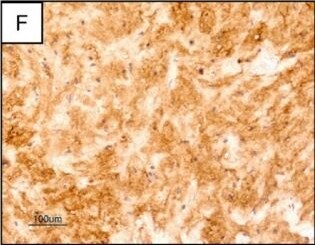
Detection of Human SCGF/CLEC11a by Immunohistochemistry
Immunohistochemistry of CD68 and SCGF in GIST 5 and GIST 2. A) Hematoxilin-eosin section of one representative slide from GIST 5. B) CD68 staining; CD68 positive macrophages are scattered through the section. C) SCGF staining; SCGF positivity was observed in the corresponding stromal area. D) Hematoxylin-eosin section of one representative slide from GIST 2. E) CD68 staining; a diffuse infiltration of CD68-positive macrophages is visible in this area. F) SCGF staining; SCGF positivity was observed in the corresponding stromal counterpart. Image collected and cropped by CiteAb from the following publication (https://translational-medicine.biomedcentral.com/articles/10.1186/1479-…), licensed under a CC-BY license. Not internally tested by R&D Systems.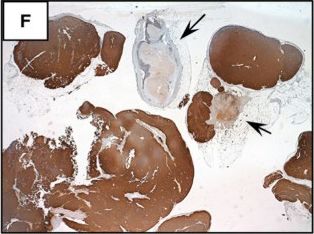
Detection of Human SCGF/CLEC11a by Immunohistochemistry
Immunohistochemistry of SCGF expression in GIST samples. A) Hematoxylin-eosin section of one representative slide from GIST 5. B) SCGF staining; strong SCGF positivity, consistent with western blotting, was restricted to the stroma compartment. C) CD117 staining; cells retained weak cytoplasmic KIT reactivity. The rare viable tumoral cells present in the responding area were SCGF-negative in the cytoplasm and the nucleus. D) Hematoxylin-eosin section of one representative slide from GIST 2. Highly cellulated areas indicating the absence of pathological response are visible. Only two areas showing rare tumoral cells are present. E) CD117 staining; all cellulated areas exhibit strong KIT expression not observed in the acellulated areas mostly composed of stroma. F) SCGF staining; strong SCGF expression is restricted to the non-cellulated areas, in contrast to CD117 staining. Image collected and cropped by CiteAb from the following publication (https://translational-medicine.biomedcentral.com/articles/10.1186/1479-…), licensed under a CC-BY license. Not internally tested by R&D Systems.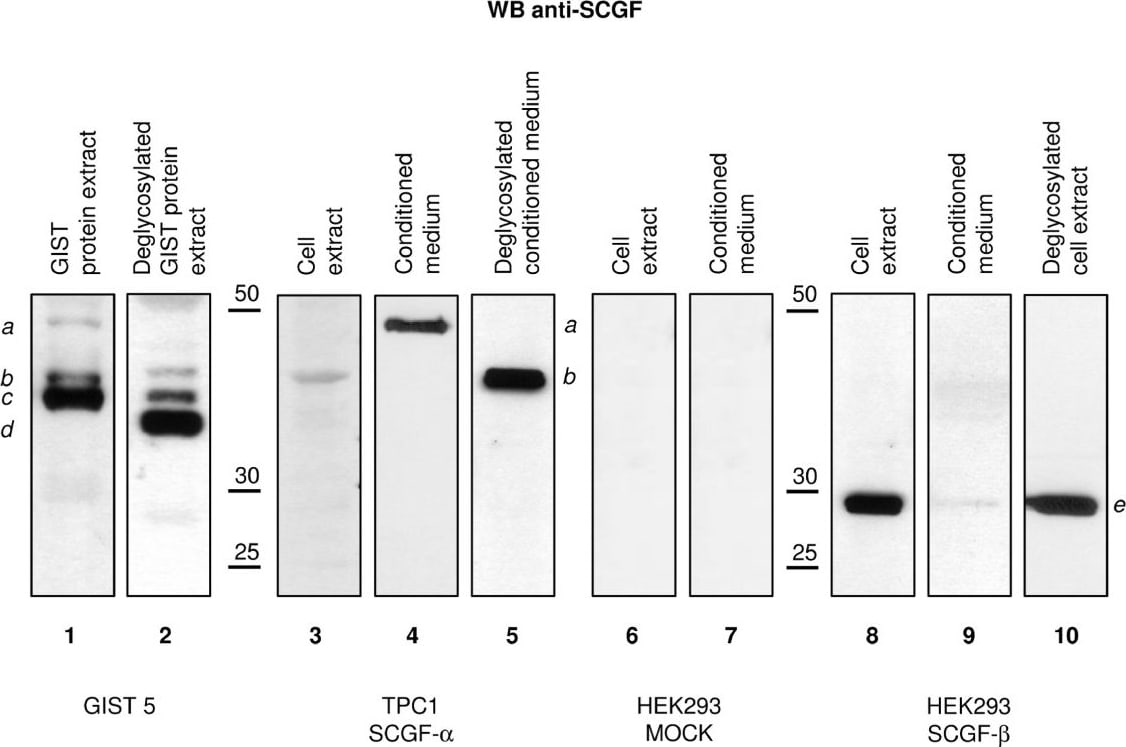
Detection of Human SCGF/CLEC11a by Western Blot
Western blotting of SCGF after deglycosylation. Western blotting with anti-SCGF-alpha /-beta antibody. Lanes 1 and 2 compare SCGF patterns in the untreated (lane 1) and the deglycosylated (lane 2) protein extract of the GIST 5 sample. Lanes 3-5 contain a comparison of the cytoplasmatic (lane 3) and the secreted (lane 4) SCGF-alpha forms and the untreated (lane 4) and the deglycosylated secreted (lane 5) SCGF-alpha forms in the TPC1 cell line. Lanes 6 and 7 depict the expression of SCGF-alpha and -beta in the cell extract and conditioned medium of a mock HEK293 cell line (negative control). Lanes 8-10 reflect SCGF-beta expression in the cell extract (lane 8) and conditioned medium (lane 9) of the transfected HEK293 cell line; lanes 8 and 10 show the untreated and the deglycosylated SCGF-beta forms in the transfected HEK293 cell line extract. The mature and secreted forms of SCGF-alpha detected in the GIST 5 sample (lane 1) and the TPC1 conditioned medium (lane 4) are indicated by (a); (b) indicates an immature, cytoplasmatic, unglycosylated form of SCGF-alpha in the untreated (lane 1) and deglycosylated (lane 2) GIST 5 samples, and in the cell extract (lane 3) and conditioned medium of the TPC1 cell line after deglycosylation (lane 5); the form indicated by (c) was exclusively detected in the GIST 5 sample, was the quantitatively most relevant form in the untreated sample (lane 1), and was observed after deglycosylation (lane 2); (d) indicates the form exclusively detected and quantitatively most relevant in the deglycosylated GIST 5 sample (lane 2), corresponding to the protein backbone of SCGF-alpha (~36 kDa); (e) indicates the form detected in the untreated (lane 8) and deglycosylated (lane 10) cell extract of the transfected HEK293 cell line, corresponding to the primary structure of SCGF-beta (~27 kDa). Image collected and cropped by CiteAb from the following publication (https://translational-medicine.biomedcentral.com/articles/10.1186/1479-…), licensed under a CC-BY license. Not internally test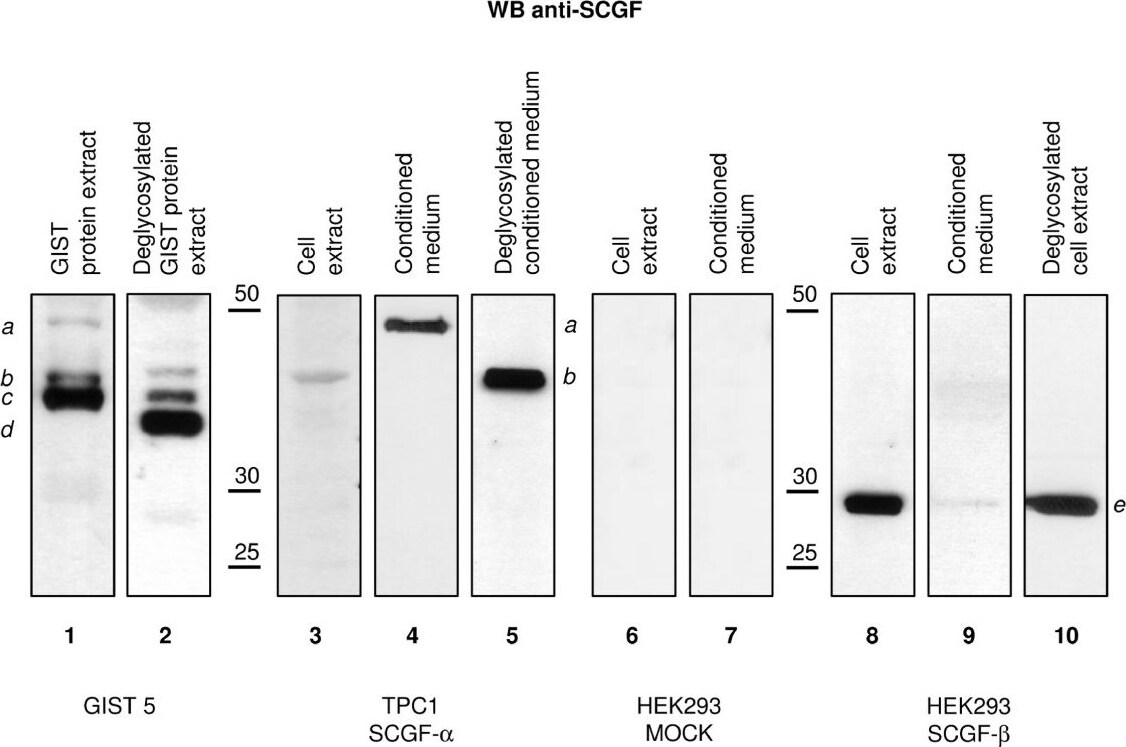
Detection of Human Human SCGF/CLEC11a Antibody by Western Blot
Western blotting of SCGF after deglycosylation. Western blotting with anti-SCGF-alpha /-beta antibody. Lanes 1 and 2 compare SCGF patterns in the untreated (lane 1) and the deglycosylated (lane 2) protein extract of the GIST 5 sample. Lanes 3-5 contain a comparison of the cytoplasmatic (lane 3) and the secreted (lane 4) SCGF-alpha forms and the untreated (lane 4) and the deglycosylated secreted (lane 5) SCGF-alpha forms in the TPC1 cell line. Lanes 6 and 7 depict the expression of SCGF-alpha and -beta in the cell extract and conditioned medium of a mock HEK293 cell line (negative control). Lanes 8-10 reflect SCGF-beta expression in the cell extract (lane 8) and conditioned medium (lane 9) of the transfected HEK293 cell line; lanes 8 and 10 show the untreated and the deglycosylated SCGF-beta forms in the transfected HEK293 cell line extract. The mature and secreted forms of SCGF-alpha detected in the GIST 5 sample (lane 1) and the TPC1 conditioned medium (lane 4) are indicated by (a); (b) indicates an immature, cytoplasmatic, unglycosylated form of SCGF-alpha in the untreated (lane 1) and deglycosylated (lane 2) GIST 5 samples, and in the cell extract (lane 3) and conditioned medium of the TPC1 cell line after deglycosylation (lane 5); the form indicated by (c) was exclusively detected in the GIST 5 sample, was the quantitatively most relevant form in the untreated sample (lane 1), and was observed after deglycosylation (lane 2); (d) indicates the form exclusively detected and quantitatively most relevant in the deglycosylated GIST 5 sample (lane 2), corresponding to the protein backbone of SCGF-alpha (~36 kDa); (e) indicates the form detected in the untreated (lane 8) and deglycosylated (lane 10) cell extract of the transfected HEK293 cell line, corresponding to the primary structure of SCGF-beta (~27 kDa). Image collected and cropped by CiteAb from the following publication (https://pubmed.ncbi.nlm.nih.gov/21943129), licensed under a CC-BY license. Not internally tested by R&D Systems.
Detection of Human Human SCGF/CLEC11a Antibody by Western Blot
Analysis of an independent set of imatinib-treated GIST samples. A) Comparative analysis of tumoral areas from of GIST 6, 7 and 8, which resulted non-responding or responding to imatinib treatment. Panels 1-5, 6-10 and 11-15 refer to GISTs 6, 7 and 8 respectively. Panels 1, 6 and 11 represent non-responding areas; panels 2, 7 and 12 responding areas; panels 3, 8 and 13 show the inset areas of panels 2, 7, and 12. Arrows and arrowheads indicate inflammatory macrophages and lymphocytes, respectively, and asterisks residual tumor cells. Panels 4, 9 and 14 show the protein lysates prepared from adjacent tumor areas were separated onto SDS gels and stained with Coomassie-blu. Lane NR indicates the non-responding area and lane R indicates the responding area. Panels 5, 10 and 15 show NR and R protein lysates were probed with anti-SCGF and anti-actin antibodies, respectively. Note that in panels 5, 10 and 15 arrows refer to the actin band that is detected as a non-specific background band in anti-SCGF blot. As expected, due to the higher cellularity we observe a more intense actin band in NR samples than in R samples. B) Western blotting of SCGF expression in GIST 9-16 samples. GIST 9-13 represent protein lysates from non-responder GIST samples and GIST 14-16 protein lysates from responder samples. C corresponds to GIST 6 protein lysate. Samples were probed with both anti-SCGF and anti-actin antibodies. Arrow indicates actin band and asterisks SCGF band. In non-responder samples anti-SCGF detected exclusively the actin band. Image collected and cropped by CiteAb from the following publication (https://pubmed.ncbi.nlm.nih.gov/21943129), licensed under a CC-BY license. Not internally tested by R&D Systems.Applications for Human SCGF/CLEC11a Antibody (239029)
Application
Recommended Usage
Immunocytochemistry
8-25 µg/mL
Sample: Immersion fixed IFN gamma activated THP-1 human acute monocytic leukemia cell line
Sample: Immersion fixed IFN gamma activated THP-1 human acute monocytic leukemia cell line
Immunohistochemistry
8-25 µg/mL
Sample: Immersion fixed paraffin-embedded sections of human spleen
Sample: Immersion fixed paraffin-embedded sections of human spleen
Western Blot
1 µg/mL
Sample: Recombinant Human SCGF/CLEC11a
Sample: Recombinant Human SCGF/CLEC11a
Formulation, Preparation, and Storage
Purification
Protein A or G purified from hybridoma culture supernatant
Reconstitution
Reconstitute at 0.5 mg/mL in sterile PBS. For liquid material, refer to CoA for concentration.
Loading...
Formulation
Lyophilized from a 0.2 μm filtered solution in PBS with Trehalose. *Small pack size (SP) is supplied either lyophilized or as a 0.2 µm filtered solution in PBS.
Shipping
Lyophilized product is shipped at ambient temperature. Liquid small pack size (-SP) is shipped with polar packs. Upon receipt, store immediately at the temperature recommended below.
Stability & Storage
Use a manual defrost freezer and avoid repeated freeze-thaw cycles.
- 12 months from date of receipt, -20 to -70 °C as supplied.
- 1 month, 2 to 8 °C under sterile conditions after reconstitution.
- 6 months, -20 to -70 °C under sterile conditions after reconstitution.
Calculators
Background: SCGF/CLEC11a
Long Name
Stem Cell Growth Factor/C-type Lectin Domain Family 11, Member A
Alternate Names
CLEC11a, CLECSF3, LSLCL
Gene Symbol
CLEC11A
UniProt
Additional SCGF/CLEC11a Products
Product Documents for Human SCGF/CLEC11a Antibody (239029)
Certificate of Analysis
To download a Certificate of Analysis, please enter a lot or batch number in the search box below.
Note: Certificate of Analysis not available for kit components.
Product Specific Notices for Human SCGF/CLEC11a Antibody (239029)
For research use only
Related Research Areas
Citations for Human SCGF/CLEC11a Antibody (239029)
 Powered by Bioz
Customer Reviews for Human SCGF/CLEC11a Antibody (239029)
There are currently no reviews for this product. Be the first to review Human SCGF/CLEC11a Antibody (239029) and earn rewards!
Have you used Human SCGF/CLEC11a Antibody (239029)?
Submit a review and receive an Amazon gift card!
$25/€18/£15/$25CAN/¥2500 for a review with an image
$10/€7/£6/$10CAN/¥1110 for a review without an image
Submit a review
Protocols
Find general support by application which include: protocols, troubleshooting, illustrated assays, videos and webinars.
- Antigen Retrieval Protocol (PIER)
- Antigen Retrieval for Frozen Sections Protocol
- Appropriate Fixation of IHC/ICC Samples
- Cellular Response to Hypoxia Protocols
- Chromogenic IHC Staining of Formalin-Fixed Paraffin-Embedded (FFPE) Tissue Protocol
- Chromogenic Immunohistochemistry Staining of Frozen Tissue
- ClariTSA™ Fluorophore Kits
- Detection & Visualization of Antibody Binding
- Fluorescent IHC Staining of Frozen Tissue Protocol
- Graphic Protocol for Heat-induced Epitope Retrieval
- Graphic Protocol for the Preparation and Fluorescent IHC Staining of Frozen Tissue Sections
- Graphic Protocol for the Preparation and Fluorescent IHC Staining of Paraffin-embedded Tissue Sections
- Graphic Protocol for the Preparation of Gelatin-coated Slides for Histological Tissue Sections
- ICC Cell Smear Protocol for Suspension Cells
- ICC Immunocytochemistry Protocol Videos
- ICC for Adherent Cells
- IHC Sample Preparation (Frozen sections vs Paraffin)
- Immunocytochemistry (ICC) Protocol
- Immunocytochemistry Troubleshooting
- Immunofluorescence of Organoids Embedded in Cultrex Basement Membrane Extract
- Immunofluorescent IHC Staining of Formalin-Fixed Paraffin-Embedded (FFPE) Tissue Protocol
- Immunohistochemistry (IHC) and Immunocytochemistry (ICC) Protocols
- Immunohistochemistry Frozen Troubleshooting
- Immunohistochemistry Paraffin Troubleshooting
- Preparing Samples for IHC/ICC Experiments
- Preventing Non-Specific Staining (Non-Specific Binding)
- Primary Antibody Selection & Optimization
- Protocol for Heat-Induced Epitope Retrieval (HIER)
- Protocol for Making a 4% Formaldehyde Solution in PBS
- Protocol for VisUCyte™ HRP Polymer Detection Reagent
- Protocol for the Fluorescent ICC Staining of Cell Smears - Graphic
- Protocol for the Fluorescent ICC Staining of Cultured Cells on Coverslips - Graphic
- Protocol for the Preparation & Fixation of Cells on Coverslips
- Protocol for the Preparation and Chromogenic IHC Staining of Frozen Tissue Sections
- Protocol for the Preparation and Chromogenic IHC Staining of Frozen Tissue Sections - Graphic
- Protocol for the Preparation and Chromogenic IHC Staining of Paraffin-embedded Tissue Sections
- Protocol for the Preparation and Chromogenic IHC Staining of Paraffin-embedded Tissue Sections - Graphic
- Protocol for the Preparation and Fluorescent ICC Staining of Cells on Coverslips
- Protocol for the Preparation and Fluorescent ICC Staining of Non-adherent Cells
- Protocol for the Preparation and Fluorescent ICC Staining of Stem Cells on Coverslips
- Protocol for the Preparation and Fluorescent IHC Staining of Frozen Tissue Sections
- Protocol for the Preparation and Fluorescent IHC Staining of Paraffin-embedded Tissue Sections
- Protocol for the Preparation of Gelatin-coated Slides for Histological Tissue Sections
- Protocol for the Preparation of a Cell Smear for Non-adherent Cell ICC - Graphic
- R&D Systems Quality Control Western Blot Protocol
- TUNEL and Active Caspase-3 Detection by IHC/ICC Protocol
- The Importance of IHC/ICC Controls
- Troubleshooting Guide: Immunohistochemistry
- Troubleshooting Guide: Western Blot Figures
- Western Blot Conditions
- Western Blot Protocol
- Western Blot Protocol for Cell Lysates
- Western Blot Troubleshooting
- Western Blot Troubleshooting Guide
- View all Protocols, Troubleshooting, Illustrated assays and Webinars
Loading...