Mouse TNF-alpha Antibody (MP6-XT22)
R&D Systems | Catalog # MAB4101

Scientific images may be resized, cropped, or adjusted for brightness or contrast for presentation purposes. These updates are limited to presentation and do not affect the underlying scientific interpretation of the data. Where available, additional source data may be provided upon request.
Key Product Details
Validated by
Species Reactivity
Validated:
Cited:
Applications
Validated:
Cited:
Label
Antibody Source
Product Specifications
Immunogen
Specificity
Clonality
Host
Isotype
Endotoxin Level
Scientific Data Images for Mouse TNF-alpha Antibody (MP6-XT22)
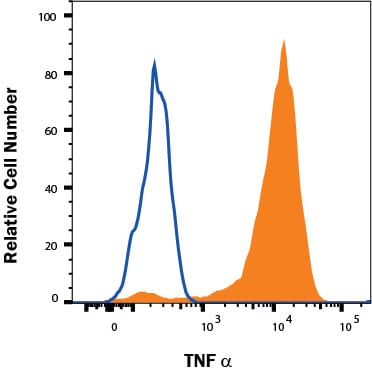
Detection of TNF-alpha in Raw264 Mouse Cell Line by Flow Cytometry.
Raw264 mouse macrophage cell line treated with 1 μg/mL LPS overnight was stained with Rat Anti-Mouse TNF-alpha Monoclonal Antibody (Catalog # MAB4101, filled histogram) or isotype control antibody (MAB005, open histogram) followed by Anti-Rat IgG CFS-conjugated Secondary Antibody (F0104). To facilitate intracellular staining, cells were fixed and permeabilized with FlowX FoxP3/Transcription Factor Fixation & Perm Kit (FC012). Staining was performed using our Staining Intracellular Molecules protocol.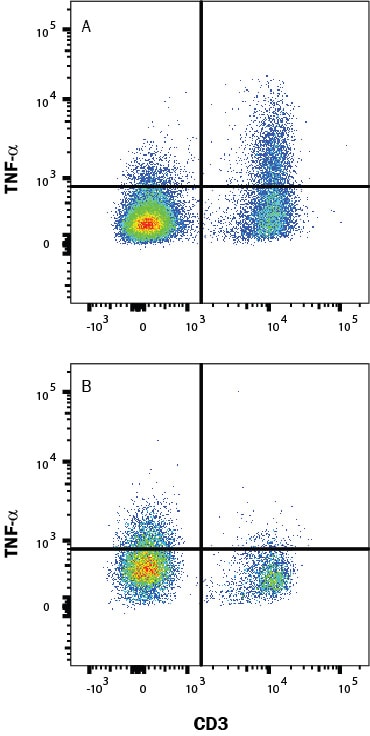
Detection of TNF-alpha in Mouse Splenocytes by Flow Cytometry.
Mouse splenocytes (A) treated with PMA (50 ng/mL), Ca2+ Ionomycin (200 ng/mL) and Brefeldin A (5 μg/mL) for 4 hours or (B) untreated, were stained with Rat Anti-Mouse TNF-alpha Monoclonal Antibody (Catalog # MAB4101) followed by Anti-Rat IgG PE-conjugated Secondary Antibody (F0105B) and Rat anti-Mouse CD3 APC-conjugated Monoclonal Antibody (FAB4841A). Quadrant markers were set based on isotype control antibody (MAB005). To facilitate intracellular staining, cells were fixed with Flow Cytometry Fixation Buffer (FC004) and permeabilized with Flow Cytometry Permeabilization/Wash Buffer I (FC005). Staining was performed using our protocol for Staining Intracellular Molecules.
Cytotoxicity Induced by TNF‑ alpha and Neutralization by Mouse TNF‑ alpha Antibody.
Recombinant Mouse TNF-a (Catalog # 410-MT) induces cytotoxicity in the the L-929 mouse fibroblast cell line in a dose-dependent manner (orange line). Cytotoxicity elicited by Recombinant Mouse TNF-a (0.25 ng/mL) is neutralized (green line) by increasing concentrations of Mouse TNF-a Monoclonal Antibody (Catalog # MAB4101). The ND50 is typically 0.15-0.75 µg/mL in the presence of the metabolic inhibitor actinomycin D (1 µg/mL).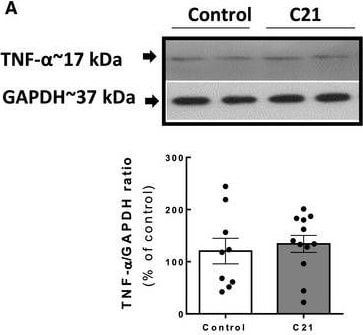
Detection of Mouse TNF-alpha by Western Blot
Parameters of inflammation/nitrosative stress are unaltered in adipose tissue after chronic administration of compound 21. (A) and (B) Levels of TNF‐ alpha determined by WB and IHC. (C) and (D) levels of nitrotyrosine determined by WB and IHC. Quantification of specific bands was performed with Gel‐Pro Analyzer software. (C) For nitrotyrosine quantification, the intensity of the most predominant bands in the WB (of unknown identity), with MWs of 53 and 65 kDa, respectively, were quantified in each sample. Bar graphs are the means ± SE. (B) and (D) Positive TNF‐ alpha and nitrotyrosine staining as detected by immunohistochemistry was quantified using Image‐Pro Plus software. Data were analyzed by unpaired two‐tailed Student's t test. C21, n = 9 per group, control, n = 12 per group for TNF‐ alpha quantification. For nitrotyrosine quantification by Western blotting: C21, n = 6 per group; control, n = 6 per group and by immunohistochemistry: C21, n = 9 per group; control, n = 9 per group. WB, western blotting. Image collected and cropped by CiteAb from the following publication (https://pubmed.ncbi.nlm.nih.gov/30156060), licensed under a CC-BY license. Not internally tested by R&D Systems.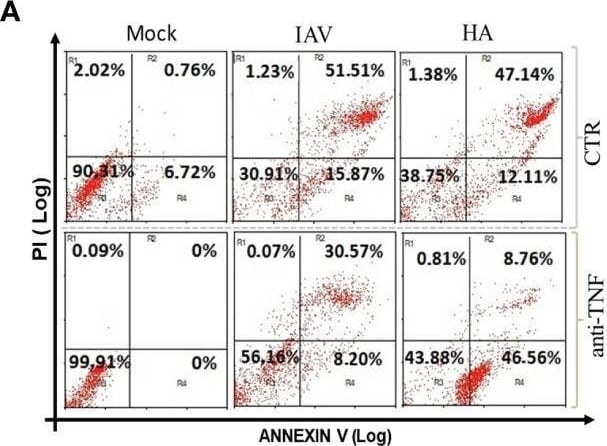
Detection of Mouse TNF-alpha by Flow Cytometry
IAV- and HA-induced inflammatory programmed cell death is dependent on TNF. Macrophage cultures were pretreated with 1 ng/mL anti-TNF-alpha antibody and then infected with IAV (MOI of 0.25) or exposed to 10 ng/mL viral HA for 24 h. Cell death analysis was performed by flow cytometry analysis of annexin V/PI-positive cells (A, B). Assessment of cell viability through the measurement of LDH release in the supernatant of BMDMs (C). (D) The expression of p-RIPK1 was detected in BMDMs by Western blotting. beta -actin levels were used as a control for protein loading. (E) Graphs of band densitometry obtained after loading normalization and expressed as fold change over mock untreated control. (F) Levels of nitrite were measured by the Griess method in the supernatant of BMDM cultures after 24 h of stimulus. The levels of (G) IL-6 and (H) IL-10 were measured by ELISA in the supernatant of BMDM cultures after 24 h of stimulation. Data are presented as the mean ± SEM of 5 independent experiments *P < 0.05 versus untreated control group (MOCK); #P < 0.05 versus respective untreated infected/stimulated group. (I) Model of A/HA-triggered necroptosis. IAV/HA triggered necroptosis by a loop of events involving TLR4, TNF-alpha, and RIPK1, leading to exacerbation of inflammation. Images were created with BioRender.com. Image collected and cropped by CiteAb from the following open publication (https://pubmed.ncbi.nlm.nih.gov/36875528), licensed under a CC-BY license. Not internally tested by R&D Systems.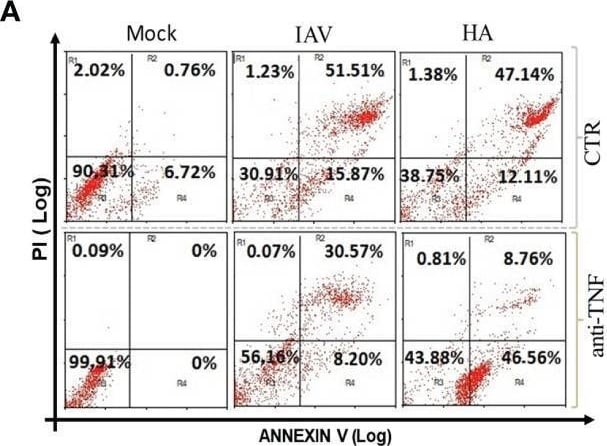
Detection of Mouse TNF-alpha by Flow Cytometry
IAV- and HA-induced inflammatory programmed cell death is dependent on TNF. Macrophage cultures were pretreated with 1 ng/mL anti-TNF-alpha antibody and then infected with IAV (MOI of 0.25) or exposed to 10 ng/mL viral HA for 24 h. Cell death analysis was performed by flow cytometry analysis of annexin V/PI-positive cells (A, B). Assessment of cell viability through the measurement of LDH release in the supernatant of BMDMs (C). (D) The expression of p-RIPK1 was detected in BMDMs by Western blotting. beta -actin levels were used as a control for protein loading. (E) Graphs of band densitometry obtained after loading normalization and expressed as fold change over mock untreated control. (F) Levels of nitrite were measured by the Griess method in the supernatant of BMDM cultures after 24 h of stimulus. The levels of (G) IL-6 and (H) IL-10 were measured by ELISA in the supernatant of BMDM cultures after 24 h of stimulation. Data are presented as the mean ± SEM of 5 independent experiments *P < 0.05 versus untreated control group (MOCK); #P < 0.05 versus respective untreated infected/stimulated group. (I) Model of A/HA-triggered necroptosis. IAV/HA triggered necroptosis by a loop of events involving TLR4, TNF-alpha, and RIPK1, leading to exacerbation of inflammation. Images were created with BioRender.com. Image collected and cropped by CiteAb from the following open publication (https://pubmed.ncbi.nlm.nih.gov/36875528), licensed under a CC-BY license. Not internally tested by R&D Systems.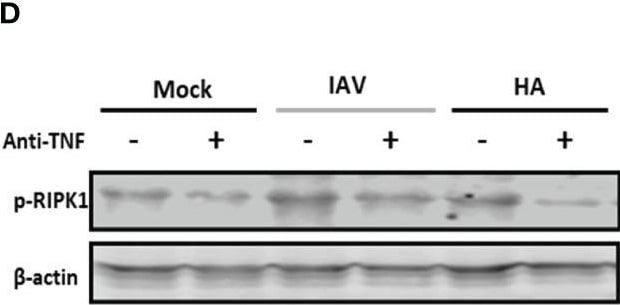
Detection of Mouse TNF-alpha by Western Blot
IAV- and HA-induced inflammatory programmed cell death is dependent on TNF. Macrophage cultures were pretreated with 1 ng/mL anti-TNF-alpha antibody and then infected with IAV (MOI of 0.25) or exposed to 10 ng/mL viral HA for 24 h. Cell death analysis was performed by flow cytometry analysis of annexin V/PI-positive cells (A, B). Assessment of cell viability through the measurement of LDH release in the supernatant of BMDMs (C). (D) The expression of p-RIPK1 was detected in BMDMs by Western blotting. beta -actin levels were used as a control for protein loading. (E) Graphs of band densitometry obtained after loading normalization and expressed as fold change over mock untreated control. (F) Levels of nitrite were measured by the Griess method in the supernatant of BMDM cultures after 24 h of stimulus. The levels of (G) IL-6 and (H) IL-10 were measured by ELISA in the supernatant of BMDM cultures after 24 h of stimulation. Data are presented as the mean ± SEM of 5 independent experiments *P < 0.05 versus untreated control group (MOCK); #P < 0.05 versus respective untreated infected/stimulated group. (I) Model of A/HA-triggered necroptosis. IAV/HA triggered necroptosis by a loop of events involving TLR4, TNF-alpha, and RIPK1, leading to exacerbation of inflammation. Images were created with BioRender.com. Image collected and cropped by CiteAb from the following open publication (https://pubmed.ncbi.nlm.nih.gov/36875528), licensed under a CC-BY license. Not internally tested by R&D Systems.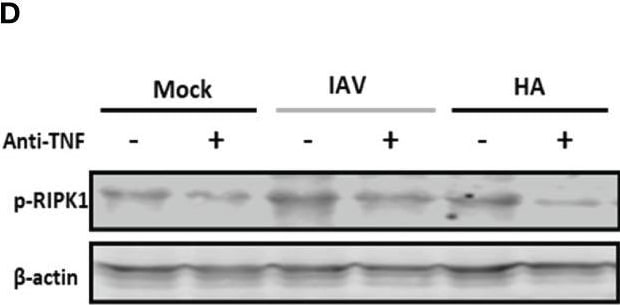
Detection of Mouse TNF-alpha by Western Blot
IAV- and HA-induced inflammatory programmed cell death is dependent on TNF. Macrophage cultures were pretreated with 1 ng/mL anti-TNF-alpha antibody and then infected with IAV (MOI of 0.25) or exposed to 10 ng/mL viral HA for 24 h. Cell death analysis was performed by flow cytometry analysis of annexin V/PI-positive cells (A, B). Assessment of cell viability through the measurement of LDH release in the supernatant of BMDMs (C). (D) The expression of p-RIPK1 was detected in BMDMs by Western blotting. beta -actin levels were used as a control for protein loading. (E) Graphs of band densitometry obtained after loading normalization and expressed as fold change over mock untreated control. (F) Levels of nitrite were measured by the Griess method in the supernatant of BMDM cultures after 24 h of stimulus. The levels of (G) IL-6 and (H) IL-10 were measured by ELISA in the supernatant of BMDM cultures after 24 h of stimulation. Data are presented as the mean ± SEM of 5 independent experiments *P < 0.05 versus untreated control group (MOCK); #P < 0.05 versus respective untreated infected/stimulated group. (I) Model of A/HA-triggered necroptosis. IAV/HA triggered necroptosis by a loop of events involving TLR4, TNF-alpha, and RIPK1, leading to exacerbation of inflammation. Images were created with BioRender.com. Image collected and cropped by CiteAb from the following open publication (https://pubmed.ncbi.nlm.nih.gov/36875528), licensed under a CC-BY license. Not internally tested by R&D Systems.Applications for Mouse TNF-alpha Antibody (MP6-XT22)
Intracellular Staining by Flow Cytometry
Sample: Raw264 cells treated with LPS, fixed and permeabilized with FlowX FoxP3/Transcription Factor Fixation & Perm Kit (Catalog # FC012) and mouse splenocytes treated with PMA and Ca2+ Ionomycin
Neutralization
Flow Cytometry Panel Builder
Bio-Techne Knows Flow Cytometry
Save time and reduce costly mistakes by quickly finding compatible reagents using the Panel Builder Tool.
Advanced Features
- Spectra Viewer - Custom analysis of spectra from multiple fluorochromes
- Spillover Popups - Visualize the spectra of individual fluorochromes
- Antigen Density Selector - Match fluorochrome brightness with antigen density

Formulation, Preparation, and Storage
Purification
Reconstitution
Reconstitute at 0.5 mg/mL in sterile PBS. For liquid material, refer to CoA for concentration.
Formulation
Shipping
Stability & Storage
- 12 months from date of receipt, -20 to -70 °C as supplied.
- 1 month, 2 to 8 °C under sterile conditions after reconstitution.
- 6 months, -20 to -70 °C under sterile conditions after reconstitution.
Calculators
Background: TNF-alpha
Long Name
Alternate Names
Entrez Gene IDs
Gene Symbol
Additional TNF-alpha Products
Product Documents for Mouse TNF-alpha Antibody (MP6-XT22)
Certificate of Analysis
To download a Certificate of Analysis, please enter a lot or batch number in the search box below.
Note: Certificate of Analysis not available for kit components.
Product Specific Notices for Mouse TNF-alpha Antibody (MP6-XT22)
For research use only
Related Research Areas
Citations for Mouse TNF-alpha Antibody (MP6-XT22)
 Powered by Bioz
Customer Reviews for Mouse TNF-alpha Antibody (MP6-XT22)
There are currently no reviews for this product. Be the first to review Mouse TNF-alpha Antibody (MP6-XT22) and earn rewards!
Have you used Mouse TNF-alpha Antibody (MP6-XT22)?
Submit a review and receive an Amazon gift card!
$25/€18/£15/$25CAN/¥2500 for a review with an image
$10/€7/£6/$10CAN/¥1110 for a review without an image
Submit a review
Protocols
Find general support by application which include: protocols, troubleshooting, illustrated assays, videos and webinars.
- 7-Amino Actinomycin D (7-AAD) Cell Viability Flow Cytometry Protocol
- Extracellular Membrane Flow Cytometry Protocol
- Flow Cytometry Protocol for Cell Surface Markers
- Flow Cytometry Protocol for Staining Membrane Associated Proteins
- Flow Cytometry Staining Protocols
- Flow Cytometry Troubleshooting Guide
- Intracellular Flow Cytometry Protocol Using Alcohol (Methanol)
- Intracellular Flow Cytometry Protocol Using Detergents
- Intracellular Nuclear Staining Flow Cytometry Protocol Using Detergents
- Intracellular Staining Flow Cytometry Protocol Using Alcohol Permeabilization
- Intracellular Staining Flow Cytometry Protocol Using Detergents to Permeabilize Cells
- Propidium Iodide Cell Viability Flow Cytometry Protocol
- Protocol for Liperfluo
- Protocol for the Characterization of Human Th22 Cells
- Protocol for the Characterization of Human Th9 Cells
- Protocol: Annexin V and PI Staining by Flow Cytometry
- Protocol: Annexin V and PI Staining for Apoptosis by Flow Cytometry
- Troubleshooting Guide: Fluorokine Flow Cytometry Kits
- View all Protocols, Troubleshooting, Illustrated assays and Webinars
Associated Pathways