
Mouse lymphotactin (Lptn) and its human homologue (also named human SCM-1 and ATAC) belong to the C or gamma subfamily of chemokines. The C chemokines lack two (the 1st and 3rd) of the four invariant cysteine residues normally found in the CC and CXC chemokines and have an extended carboxy terminus. Mouse lymphotactin encodes a 114 amino acid residue precursor protein with a 21 amino acid residue predicted signal peptide. The expression of lymphotactin is restricted to activated mouse pro-T cells and to activated, class I MHC restricted T cells. The gene for lymphotactin has been mapped to chromosome 1 in both human and mouse.
Mouse XCL1/Lymphotactin Antibody
R&D Systems | Catalog # AF486


Scientific images may be resized, cropped, or adjusted for brightness or contrast for presentation purposes. These updates are limited to presentation and do not affect the underlying scientific interpretation of the data. Where available, additional source data may be provided upon request.
Key Product Details
Species Reactivity
Validated:
Mouse
Cited:
Mouse
Applications
Validated:
Immunohistochemistry, Western Blot, Neutralization
Cited:
Immunohistochemistry, Neutralization, Flow Cytometry, ELISA Development, In vivo assay
Label
Unconjugated
Antibody Source
Polyclonal Goat IgG
Loading...
Product Specifications
Immunogen
E. coli-derived recombinant mouse XCL1/Lymphotactin
Specificity
Detects XCL1/Lymphotactin in direct ELISAs and Western blots. In direct ELISAs, less than 5% cross-reactivity with recombinant human (rh) GRO alpha, rhGRO beta, rhGRO gamma, and recombinant mouse MCP-5 is observed.
Clonality
Polyclonal
Host
Goat
Isotype
IgG
Endotoxin Level
<0.10 EU per 1 μg of the antibody by the LAL method.
Scientific Data Images for Mouse XCL1/Lymphotactin Antibody
Chemotaxis Induced by XCL1/Lymphotactin and Neutralization by Mouse XCL1/Lymphotactin Antibody.
Recombinant Mouse XCL1/Lymphotactin (Catalog # 486-LT) chemoattracts the BaF3 mouse pro-B cell line transfected with human XCR1 in a dose-dependent manner (orange line). The amount of cells that migrated through to the lower chemotaxis chamber was measured by Resazurin. Chemotaxis elicited by Recombinant Mouse XCL1/Lymphotactin (0.15 µg/mL) is neutralized (green line) by increasing concentrations of Goat Anti-Mouse XCL1/ Lymphotactin Antigen Affinity-purified Polyclonal Antibody (Catalog # AF486). The ND50 is typically 5-15 µg/mL.
Mouse XCL1 / Lymphotactin ELISA Standard Curve
Recombinant Mouse XCL1/Lymphotactin (Catalog # 486-LT) was serially diluted and captured by Rat Anti-Mouse XCL1/Lymphotactin Monoclonal Antibody (Catalog # MAB486) coated on a Clear Polystyrene Microplate (Catalog # DY990). Goat Anti-Mouse XCL1/Lymphotactin Antigen Affinity-purified Polyclonal Antibody (Catalog # AF486) was biotinylated and incubated with the protein captured on the plate. Detection of the standard curve was achieved by incubating Streptavidin-HRP (Catalog # DY998)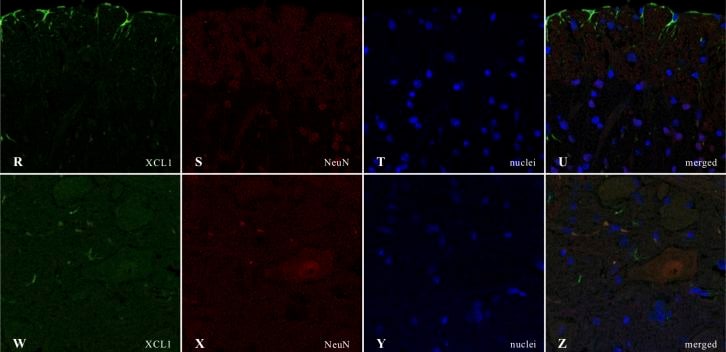
Detection of XCL1/Lymphotactin by Immunohistochemistry
Immunofluorescence analysis of chemokine-C-motif ligand 1 (XCL1) localization in the lumbar (L4 to L6) spinal cord 7 days after chronic constriction injury (CCI) of the sciatic nerve in mice. Dorsal (A–D, I–L, R–U) and ventral (E–H, M–P, W–Z) parts of lumbar spinal cord (a,b,c) were shown as an approximate fragments of selected images. Representative immunofluorescence images from colocalization analysis performed on spinal cord, paraffin-embedded 7 μM microtome slices: XCL1 (green: A, E, I, M, R, W) with astroglia marker glial fibrillary acidic protein; (GFAP, red: B, F); microglia marker ionized calcium-binding adaptor molecule 1; (IBA1, red: J, N); and with neuronal marker neuronal nucleus; (NeuN, red: S, X), Nuclei are in blue (C, G, K, O, T, Y). High magnification, three-dimensional image rendering shows XCL1 localization inside GFAP-positive cells (yellow: D, H). Scale bars: 50 μm (a, b, c), 500 μm (A–Z). Image collected and cropped by CiteAb from the following open publication (https://pubmed.ncbi.nlm.nih.gov/36618360), licensed under a CC-BY license. Not internally tested by R&D Systems.Applications for Mouse XCL1/Lymphotactin Antibody
Application
Recommended Usage
Immunohistochemistry
5-15 µg/mL
Sample: Perfusion fixed frozen sections of mouse small intestine (Peyer's patch) and thymus
Sample: Perfusion fixed frozen sections of mouse small intestine (Peyer's patch) and thymus
Western Blot
0.1 µg/mL
Sample: Recombinant Mouse XCL1/Lymphotactin (Catalog # 486-LT)
Sample: Recombinant Mouse XCL1/Lymphotactin (Catalog # 486-LT)
Neutralization
Measured by its ability to neutralize XCL1/Lymphotactin-induced chemotaxis in the BaF3 mouse pro‑B cell line transfected with human XCR1. The Neutralization Dose (ND50) is typically 5-15 µg/mL in the presence of 0.15 µg/mL Recombinant Mouse XCL1/Lymphotactin.
Formulation, Preparation, and Storage
Purification
Antigen Affinity-purified
Reconstitution
Reconstitute at 0.2 mg/mL in sterile PBS. For liquid material, refer to CoA for concentration.
Loading...
Formulation
Lyophilized from a 0.2 μm filtered solution in PBS with Trehalose. *Small pack size (SP) is supplied either lyophilized or as a 0.2 µm filtered solution in PBS.
Shipping
Lyophilized product is shipped at ambient temperature. Liquid small pack size (-SP) is shipped with polar packs. Upon receipt, store immediately at the temperature recommended below.
Stability & Storage
Use a manual defrost freezer and avoid repeated freeze-thaw cycles.
- 12 months from date of receipt, -20 to -70 °C as supplied.
- 1 month, 2 to 8 °C under sterile conditions after reconstitution.
- 6 months, -20 to -70 °C under sterile conditions after reconstitution.
Calculators
Background: XCL1/Lymphotactin
References
- Kelner, G. et al. (1994) Science 266:1395.
- Hedrick, J.A. et al. (1997) J. Immunol. 158:1533.
Long Name
Chemokine [C Motif] Ligand 1
Alternate Names
ATAC, Lymphotactin, SCM-1 alpha
Gene Symbol
XCL1
Additional XCL1/Lymphotactin Products
Product Documents for Mouse XCL1/Lymphotactin Antibody
Certificate of Analysis
To download a Certificate of Analysis, please enter a lot or batch number in the search box below.
Note: Certificate of Analysis not available for kit components.
Product Specific Notices for Mouse XCL1/Lymphotactin Antibody
For research use only
Related Research Areas
Citations for Mouse XCL1/Lymphotactin Antibody
 Powered by Bioz
Customer Reviews for Mouse XCL1/Lymphotactin Antibody
There are currently no reviews for this product. Be the first to review Mouse XCL1/Lymphotactin Antibody and earn rewards!
Have you used Mouse XCL1/Lymphotactin Antibody?
Submit a review and receive an Amazon gift card!
$25/€18/£15/$25CAN/¥2500 for a review with an image
$10/€7/£6/$10CAN/¥1110 for a review without an image
Submit a review
Protocols
Find general support by application which include: protocols, troubleshooting, illustrated assays, videos and webinars.
- Antigen Retrieval Protocol (PIER)
- Antigen Retrieval for Frozen Sections Protocol
- Appropriate Fixation of IHC/ICC Samples
- Cellular Response to Hypoxia Protocols
- Chromogenic IHC Staining of Formalin-Fixed Paraffin-Embedded (FFPE) Tissue Protocol
- Chromogenic Immunohistochemistry Staining of Frozen Tissue
- ClariTSA™ Fluorophore Kits
- Detection & Visualization of Antibody Binding
- Fluorescent IHC Staining of Frozen Tissue Protocol
- Graphic Protocol for Heat-induced Epitope Retrieval
- Graphic Protocol for the Preparation and Fluorescent IHC Staining of Frozen Tissue Sections
- Graphic Protocol for the Preparation and Fluorescent IHC Staining of Paraffin-embedded Tissue Sections
- Graphic Protocol for the Preparation of Gelatin-coated Slides for Histological Tissue Sections
- IHC Sample Preparation (Frozen sections vs Paraffin)
- Immunofluorescent IHC Staining of Formalin-Fixed Paraffin-Embedded (FFPE) Tissue Protocol
- Immunohistochemistry (IHC) and Immunocytochemistry (ICC) Protocols
- Immunohistochemistry Frozen Troubleshooting
- Immunohistochemistry Paraffin Troubleshooting
- Preparing Samples for IHC/ICC Experiments
- Preventing Non-Specific Staining (Non-Specific Binding)
- Primary Antibody Selection & Optimization
- Protocol for Heat-Induced Epitope Retrieval (HIER)
- Protocol for Making a 4% Formaldehyde Solution in PBS
- Protocol for VisUCyte™ HRP Polymer Detection Reagent
- Protocol for the Preparation & Fixation of Cells on Coverslips
- Protocol for the Preparation and Chromogenic IHC Staining of Frozen Tissue Sections
- Protocol for the Preparation and Chromogenic IHC Staining of Frozen Tissue Sections - Graphic
- Protocol for the Preparation and Chromogenic IHC Staining of Paraffin-embedded Tissue Sections
- Protocol for the Preparation and Chromogenic IHC Staining of Paraffin-embedded Tissue Sections - Graphic
- Protocol for the Preparation and Fluorescent IHC Staining of Frozen Tissue Sections
- Protocol for the Preparation and Fluorescent IHC Staining of Paraffin-embedded Tissue Sections
- Protocol for the Preparation of Gelatin-coated Slides for Histological Tissue Sections
- R&D Systems Quality Control Western Blot Protocol
- TUNEL and Active Caspase-3 Detection by IHC/ICC Protocol
- The Importance of IHC/ICC Controls
- Troubleshooting Guide: Immunohistochemistry
- Troubleshooting Guide: Western Blot Figures
- Western Blot Conditions
- Western Blot Protocol
- Western Blot Protocol for Cell Lysates
- Western Blot Troubleshooting
- Western Blot Troubleshooting Guide
- View all Protocols, Troubleshooting, Illustrated assays and Webinars
Loading...
Associated Pathways
