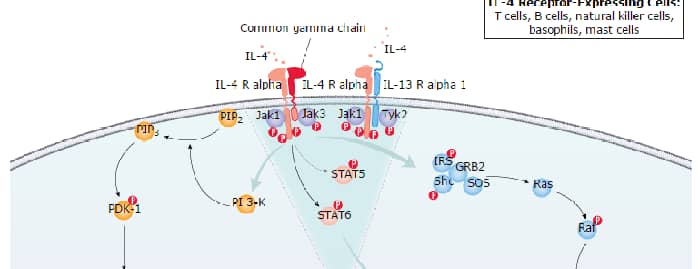
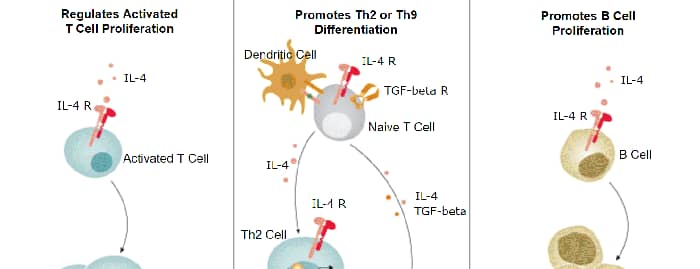
Interleukin-4 (IL-4), also known as B cell-stimulatory factor-1, is a monomeric, approximately 13‑18 kDa Th2 cytokine that shows pleiotropic effects during immune responses (1 ‑ 3). It is a glycosylated polypeptide that contains three intrachain disulfide bridges and adopts a bundled four alpha -helix structure (4). Porcine IL-4 is synthesized with a 24 amino acid (aa) signal sequence. Mature porcine IL-4 shares 78%, 59%, 41%, and 41% aa sequence identity with bovine, human, mouse, and rat IL-4, respectively. Human IL-4 is active on porcine vascular endothelial cells (5). IL-4 exerts its effects through two receptor complexes (6, 7). The type I receptor, which is expressed on hematopoietic cells, is a heterodimer of the ligand binding IL-4 R alpha and the common gamma chain (a shared subunit of the receptors for IL‑2, ‑7, ‑9, ‑15, and -21). The type II receptor on nonhematopoietic cells consists of IL-4 R alpha and IL-13 R alpha 1. The type II receptor also transduces IL-13 mediated signals. IL‑4 is primarily expressed by Th2-biased CD4+ T cells, mast cells, basophils, and eosinophils (1, 2). It promotes cell proliferation, survival, and immunoglobulin class switch to IgE in B cells, acquisition of the Th2 phenotype by naïve CD4+ T cells, priming and chemotaxis of mast cells, eosinophils, and basophils, and the proliferation and activation of epithelial cells (8, 11). IL-4 plays a dominant role in the development of allergic inflammation and asthma (10, 12).


Key Product Details
Species Reactivity
Porcine
Applications
Neutralization
Label
Unconjugated
Antibody Source
Monoclonal Mouse IgG1 Clone # 286120
Loading...
Product Specifications
Immunogen
E. coli-derived recombinant porcine IL-4
His25-Cys133
Accession # Q04745
His25-Cys133
Accession # Q04745
Specificity
Detects porcine IL-4 in Western blots. In Western blots, 100% cross-reactivity with recombinant mouse IL-4 is observed, 15% with recombinant rat IL-4 is observed, and no cross-reactivity with recombinant bovine IL-4, recombinant canine IL-4, recombinant cotton rat IL-4, recombinant equine IL-4, recombinant feline IL-4, recombinant human IL-4, or recombinant human IL-13 is observed.
Clonality
Monoclonal
Host
Mouse
Isotype
IgG1
Endotoxin Level
<0.10 EU per 1 μg of the antibody by the LAL method.
Scientific Data Images for Porcine IL-4 Antibody (286120)
Cell Proliferation Induced by IL‑4 and Neutralization by Porcine IL‑4 Antibody.
Recombinant Porcine IL-4 (Catalog # 654-P4) stimulates proliferation in the TF-1 human erythroleukemic cell line in a dose-dependent manner (orange line). Proliferation elicited by Recombinant Porcine IL-4 (30 ng/mL) is neutralized (green line) by increasing concen-trations of Mouse Anti-Porcine IL-4 Monoclonal Antibody (Catalog # MAB6542). The ND50 is typically 0.3-1.2 µg/mL.Applications for Porcine IL-4 Antibody (286120)
Application
Recommended Usage
Neutralization
Measured by its ability to neutralize IL‑4-induced proliferation in the TF‑1 human erythroleukemic cell line. Kitamura, T. et al. (1989) J. Cell Physiol. 140:323. The Neutralization Dose (ND50) is typically 0.3-1.2 µg/mL in the presence of 30 ng/mL Recombinant Porcine IL‑4.
Formulation, Preparation, and Storage
Purification
Protein A or G purified from hybridoma culture supernatant
Reconstitution
Reconstitute at 0.5 mg/mL in sterile PBS. For liquid material, refer to CoA for concentration.
Loading...
Formulation
Lyophilized from a 0.2 μm filtered solution in PBS with Trehalose. *Small pack size (SP) is supplied either lyophilized or as a 0.2 µm filtered solution in PBS.
Shipping
Lyophilized product is shipped at ambient temperature. Liquid small pack size (-SP) is shipped with polar packs. Upon receipt, store immediately at the temperature recommended below.
Stability & Storage
Use a manual defrost freezer and avoid repeated freeze-thaw cycles.
- 12 months from date of receipt, -20 to -70 °C as supplied.
- 1 month, 2 to 8 °C under sterile conditions after reconstitution.
- 6 months, -20 to -70 °C under sterile conditions after reconstitution.
Calculators
Background: IL-4
References
- Benczik, M. and S.L. Gaffen (2004) Immunol. Invest. 33:109.
- Chomarat, P. and J. Banchereau (1998) Int. Rev. Immunol. 17:1.
- Bailey, M. et al. (1993) Biochim. Biophys. Acta 1171:328.
- Redfield, C. et al. (1991) Biochemistry 30:11029.
- Stocker, C.J. et al. (2000) J. Immunol. 164:3309.
- Mueller, T.D. et al. (2002) Biochim. Biophys. Acta 1592:237.
- Nelms, K. et al. (1999) Annu. Rev. Immunol. 17:701.
- Paludan, S.R. (1998) Scand. J. Immunol. 48:459.
- Corthay, A. (2006) Scand. J. Immunol. 64:93.
- Ryan, J.J. et al. (2007) Crit. Rev. Immunol. 27:15.
- Grone, A. (2002) Vet. Immunol. Immunopathol. 88:1.
- Rosenberg, H.F. et al. (2007) J. Allergy Clin. Immunol. 119:1303.
Long Name
Interleukin 4
Alternate Names
BCDF, BCGF-1, BCGF1, BSF-1, BSF1, IL4, IL4E12
Entrez Gene IDs
Gene Symbol
IL4
UniProt
Additional IL-4 Products
Product Documents for Porcine IL-4 Antibody (286120)
Certificate of Analysis
To download a Certificate of Analysis, please enter a lot or batch number in the search box below.
Note: Certificate of Analysis not available for kit components.
Product Specific Notices for Porcine IL-4 Antibody (286120)
For research use only
Related Research Areas
Customer Reviews for Porcine IL-4 Antibody (286120)
There are currently no reviews for this product. Be the first to review Porcine IL-4 Antibody (286120) and earn rewards!
Have you used Porcine IL-4 Antibody (286120)?
Submit a review and receive an Amazon gift card!
$25/€18/£15/$25CAN/¥2500 for a review with an image
$10/€7/£6/$10CAN/¥1110 for a review without an image
Submit a review
Loading...
Associated Pathways