
Caspase Cleavage and Activation in Apoptosis
Table of Contents
Introduction to Caspase Cleavage | Caspase Products | Caspase Regulator Products | IAP Products | Additional Resources
Caspases
Caspases are a family of cysteine proteases found in the cytosol that act as the primary mediators of apoptosis. Based on their role in apoptosis or inflammation, caspases are subdivided into apoptotic initiator caspases (Caspase-2, -8, -9, -10), apoptotic effector (executioner) caspases (Caspase-3, -6, -7), and inflammatory initiator caspases (Caspase-1, -4, -5, -11, 12L).

All caspases are synthesized as inactive zymogens containing a variable length pro-domain followed by a large and small subunit. Cleavage of caspases occurs at specific asparagine (Asn) residues located after the pro-domain and in between the large and small subunits, and leads to the formation of active heterotetramers.
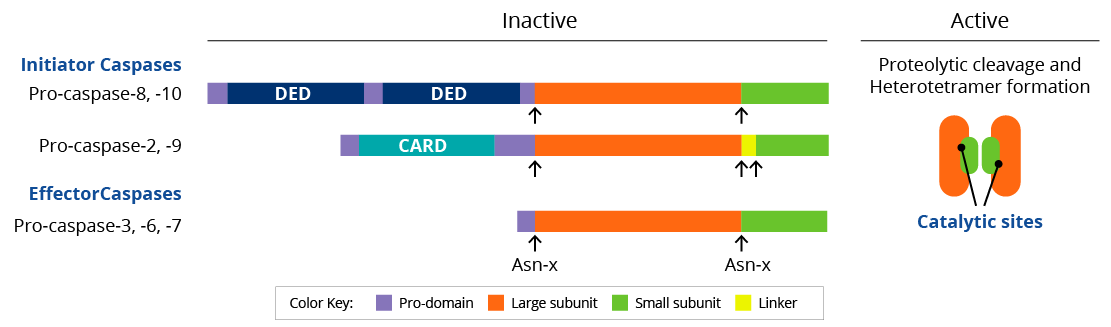
Intrinsic or extrinsic death signals trigger the autocatalytic activation of apoptotic initiator caspases upon binding to dedicated protein complexes. Once activated, initiator caspases cleave the pro-forms of executioner caspases to activate them, which in turn are responsible for the proteolytic processing of various cellular proteins.
Caspase activity is regulated by many molecules including APAF-1, ARC, FLIP, and members of the inhibitor of apoptosis protein (IAP) family such as NAIP/BIRC1, cIAP-1/BIRC2, cIAP-2/BIRC3, XIAP/BIRC4, Survivin/BIRC5, and Livin/BIRC7. Explore the role of caspases in apoptosis with our Caspase Inhibitors.
Caspase Regulators - Products by Molecule
Inhibitors of Apoptosis (IAPs) - Products by Molecule
| cIAP (pan) | cIAP-1/HIAP-2 | cIAP-2/HIAP-1 | IAP Inhibitors | Livin | NAIP |
| Survivin | XIAP |
Additional Resources
- Caspase Activation & Apoptosis Poster
- Apoptosis Signaling Pathway
- The Caspase-1 Inflammasome & its Role in Autoinflammatory Diseases
- Mini-review: Caspases
- Mini-review: Apoptosis II: Beyond Cytochrome c, the Other Mitochondrial Proteins
- Apoptosis: Caspase Pathways
- Novel Caspase-8 Roles Revealed by Knockouts