
Glutamate (Ionotropic) Receptors
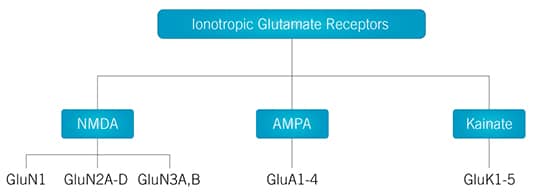
NMDA, AMPA and Kainate receptors are members of the ionotropic class of glutamate receptors. This heterogeneous group of ion channels exist as cation-selective tetramers formed by homo- and hetero-oligomeric assembly of subunits. Common structural features include an extracellular N'-terminal, three transmembrane domains, a channel lining re-entrant 'p-loop' and an intracellular C'-terminal.
Glutamate (Ionotropic) Receptor Targets
AMPA Receptors (AMPA Receptors) | Kainate Receptors (Kainate Receptors) | NMDA Receptors (NMDA Receptors) |
Related Targets
Caged Glutamate Compounds | Miscellaneous Glutamate |
Glutamate Transporters (EAAT) | Non-selective Ionotropic Glutamate |
Glutamate (Metabotropic) Receptors |
Ionotropic glutamate receptors represent the major excitatory neurotransmitter pathway in the brain and consequently, they are essential for normal CNS function. However, they are also implicated in numerous pathologies including Alzheimer's disease, stroke, schizophrenia, Parkinson's disease, motor neuron disease and depression.
Huntington's Disease Research Product Guide

This product guide provides a background to Huntington's disease research and lists around 100 products for the study of:
- Somatic Instability
- Proteolysis and Inclusion Bodies
- Transcriptional Dysregulation
- Mitochondrial Dysfunction
- Nuclear-Cytoplasmic Transport Interference
- Excitotoxicity
- Stem Cells
Parkinson's Disease Poster
Parkinson's disease (PD) causes chronic disability and is the second most common neurodegenerative condition. This poster outlines the neurobiology of the disease, as well as highlighting current therapeutic treatments for symptomatic PD, and emerging therapeutic strategies to delay PD onset and progression.