Equine IL-2 Antibody Summary
Ala21-Thr149 (Cys141Ser)
Accession # NP_001078902.1
Applications
Equine IL-2 Sandwich Immunoassay
Please Note: Optimal dilutions should be determined by each laboratory for each application. General Protocols are available in the Technical Information section on our website.
Scientific Data
View Larger
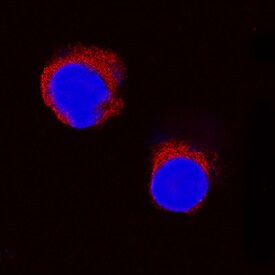
IL‑2 in Equine PBMCs. IL-2 was detected in immersion fixed equine peripheral blood mononuclear cells (PBMCs) using Goat Anti-Equine IL-2 Antigen Affinity-purified Polyclonal Antibody (Catalog # AF1613) at 15 µg/mL for 3 hours at room temperature. Cells were stained using the NorthernLights™ 557-conjugated Anti-Goat IgG Secondary Antibody (red; Catalog # NL001) and counterstained with DAPI (blue). Specific staining was localized to cytoplasm. View our protocol for Fluorescent ICC Staining of Non-adherent Cells.
Reconstitution Calculator
Preparation and Storage
- 12 months from date of receipt, -20 to -70 °C as supplied.
- 1 month, 2 to 8 °C under sterile conditions after reconstitution.
- 6 months, -20 to -70 °C under sterile conditions after reconstitution.
Background: IL-2
Interleukin 2 was initially identified as a T cell growth factor that is produced by T cells following activation by mitogens or antigens (1). IL-2 has since been found to also stimulate the growth and differentiation of B cells, natural killer (NK) cells, lymphocyte activated killer (LAK) cells, monocytes/macrophages and oligodendrocytes (2).
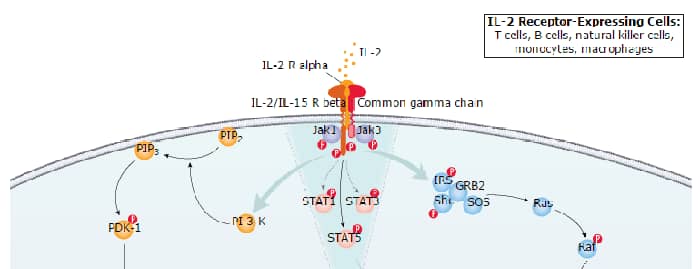
The biological activity of IL-2 is mediated by the binding of IL-2 to cell surface receptor complexes. The functional high-affinity receptor that mediate IL-2 signals is composed of three polypeptide chains, the IL-2 receptor alpha, beta and gamma subunits (3). IL-2 also signals via the intermediate affinity receptor complex of the beta and gamma subunits (4). In T cells, the beta and gamma subunits are shared with the IL-15 receptor complex (5). The gamma subunit of the IL-2 receptor complex has also been shown to be a subunit of the receptor complexes of IL-4, IL-7, IL-9 and IL-21 (6).
At the amino acid sequence level, equine IL-2 shares 72%, 70%, 56% and 54% sequence similarities with human, porcine, rat and mouse IL-2, respectively. It has been reported that equine IL-2 augmented proliferation in equine peripheral blood mononuclear cells, but has no effect on mouse CTLL-2 cells (7).

- Morgan, D.A. et al. (1976) Science 193:1007.
- Smith, K.A. et al. (1988) Science 240:1169.
- Taniguchi, T. and Y. Minami (1993) Cell 73:5.
- Giri, J. et al. (1994) EMBO J. 13:2822.
- Waldmann, T. et al. (1998) Int. Rev. Immunol. 16:205.
- Nelson, B.H. and D.M. Willeford (1998) Adv. Immunol. 70:1.
- E.V. Vandergrift and D.W. Horohov (1993) Vet. Immunol. Immunopathol. 39:395.
Product Datasheets
FAQs
No product specific FAQs exist for this product, however you may
View all Antibody FAQsReviews for Equine IL-2 Antibody
There are currently no reviews for this product. Be the first to review Equine IL-2 Antibody and earn rewards!
Have you used Equine IL-2 Antibody?
Submit a review and receive an Amazon gift card.
$25/€18/£15/$25CAN/¥75 Yuan/¥2500 Yen for a review with an image
$10/€7/£6/$10 CAD/¥70 Yuan/¥1110 Yen for a review without an image