
Focal adhesion kinase 1 (FAK), also known as FAK1 and PTK2, is a ubiquitously expressed non-receptor protein tyrosine kinase that is concentrated in focal adhesions. This cellular localization is directed by a C-terminal 125 amino acid "Focal Adhesion Targeting" (FAT) sequence. FAK plays an important role in migration, cell spreading, differentiation and apoptosis. It associates with several different signaling proteins, such as Src-family PTKs, p130Cas, Shc, Grb2, PI 3-kinase, and Paxillin. These associations enable FAK to function within a network of integrin-stimulated signaling pathways, leading to the activation of targets such as the ERK and JNK mitogen-activated protein kinase pathways. Increased expression and/or activity of FAK in various cancers has been correlated with enhanced proliferation, migration and invasiveness of human tumor cells.
Human FAK Antibody (495919)
R&D Systems | Catalog # MAB4467


Scientific images may be resized, cropped, or adjusted for brightness or contrast for presentation purposes. These updates are limited to presentation and do not affect the underlying scientific interpretation of the data. Where available, additional source data may be provided upon request.
Key Product Details
Validated by
Species Reactivity
Validated:
Cited:
Applications
Validated:
Cited:
Label
Antibody Source
Product Specifications
Immunogen
Asp213-Thr412
Accession # Q05397
Specificity
Clonality
Host
Isotype
Scientific Data Images for Human FAK Antibody (495919)
Detection of Human FAK by Western Blot.
Western blot shows lysates of MCF-7 human breast cancer cell line, A549 human lung carcinoma cell line, Huh-7 human hepatoma cell line, and HUVEC human umbilical vein endothelial cells. PVDF membrane was probed with 2 µg/mL of Human FAK Monoclonal Antibody (Catalog # MAB4467) followed by HRP-conjugated Anti-Mouse IgG Secondary Antibody (HAF007). A specific band was detected for FAK at approximately 125 kDa (as indicated). This experiment was conducted under reducing conditions and using Immunoblot Buffer Group 3.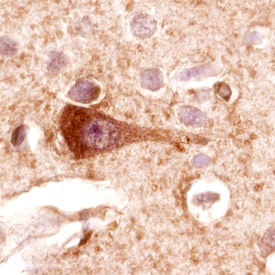
FAK in Human Brain.
FAK was detected in immersion fixed paraffin-embedded sections of human brain (hippocampus) using Human FAK Monoclonal Antibody (Catalog # MAB4467) at 25 µg/mL overnight at 4 °C. Tissue was stained using the Anti-Mouse HRP-DAB Cell & Tissue Staining Kit (brown; Catalog # CTS002) and counterstained with hematoxylin (blue). View our protocol for Chromogenic IHC Staining of Paraffin-embedded Tissue Sections.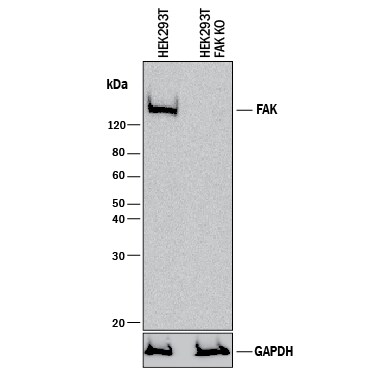
Western Blot Shows Human FAK Specificity by Using Knockout Cell Line.
Western blot shows lysates of HEK293T human embryonic kidney parental cell line and FAK knockout HEK293T cell line (KO). PVDF membrane was probed with 2 µg/mL of Mouse Anti-Human FAK Monoclonal Antibody (Catalog # MAB4467) followed by HRP-conjugated Anti-Mouse IgG Secondary Antibody (HAF018). A specific band was detected for FAK at approximately 135 kDa (as indicated) in the parental HEK293T cell line, but is not detectable in knockout HEK293T cell line. GAPDH (MAB5718) is shown as a loading control. This experiment was conducted under reducing conditions and using Immunoblot Buffer Group 1.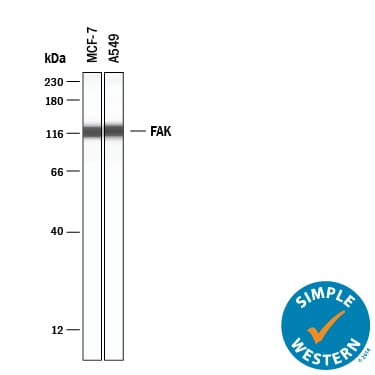
Detection of Human FAK by Simple WesternTM.
Simple Western lane view shows lysates of MCF‑7 human breast cancer cell line and A549 human lung carcinoma cell line, loaded at 0.2 mg/mL. A specific band was detected for FAK at approximately 120 kDa (as indicated) using 20 µg/mL of Mouse Anti-Human FAK Monoclonal Antibody (Catalog # MAB4467). This experiment was conducted under reducing conditions and using the 12-230 kDa separation system.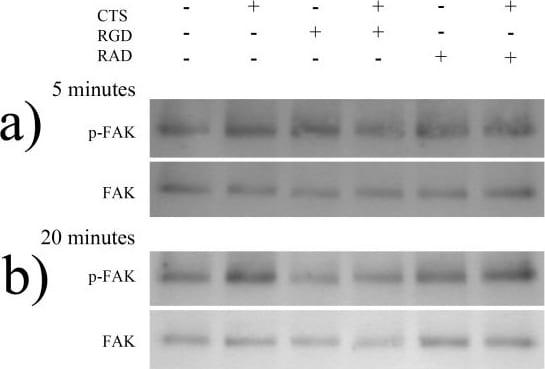
Detection of Human FAK by Western Blot
Phosphorylation of FAK following treatment of AF cells derived from non-degenerate IVDs with 1.0 Hz CTS, with and without pre-treatment with RGD or RAD peptides.AF cells derived from non-degenerate IVDs (n = 4) were treated+/− RGD (50 µg/ml) or RAD (50 µg/ml) peptides, and mechanically stimulated (10% CTS, 1.0 Hz frequency) in serum-free media and total protein extracted at timepoints of 5 and 20 minutes. Mechanically stimulated and unstimulated,+/− RGD or RAD peptides, non-degenerate protein samples (5 µg/well) exposed to A) 5 minutes and B) 20 minutes of CTS, were separated using 10% SDS-PAGE and probed using primary antibodies against phosphorylated FAK. Blots were then stripped using a stripping buffer, re-blocked and probed using an antibody against total FAK protein. C) The density of bands were quantified using a Syngene imaging system and the ratio of phosphorylated: total FAK protein normalised to timepoint controls and plotted as % change. *denotes a significant change (p≤0.05) between treatment groups. Image collected and cropped by CiteAb from the following open publication (https://pubmed.ncbi.nlm.nih.gov/24039840), licensed under a CC-BY license. Not internally tested by R&D Systems.Applications for Human FAK Antibody (495919)
Immunohistochemistry
Sample: Immersion fixed paraffin-embedded sections of human brain (hippocampus)
Knockout Validated
Simple Western
Sample: MCF-7 human breast cancer cell line and A549 human lung carcinoma cell line,
Western Blot
Sample: MCF-7 human breast cancer cell line, A549 human lung carcinoma cell line, Huh-7 human hepatoma cell line, and HUVEC human umbilical vein endothelial cells
Formulation, Preparation, and Storage
Purification
Reconstitution
Reconstitute at 0.5 mg/mL in sterile PBS. For liquid material, refer to CoA for concentration.
Formulation
Shipping
Stability & Storage
- 12 months from date of receipt, -20 to -70 °C as supplied.
- 1 month, 2 to 8 °C under sterile conditions after reconstitution.
- 6 months, -20 to -70 °C under sterile conditions after reconstitution.
Calculators
Background: FAK
Long Name
Alternate Names
Gene Symbol
UniProt
Additional FAK Products
Product Documents for Human FAK Antibody (495919)
Certificate of Analysis
To download a Certificate of Analysis, please enter a lot or batch number in the search box below.
Note: Certificate of Analysis not available for kit components.
Product Specific Notices for Human FAK Antibody (495919)
For research use only
Related Research Areas
Citations for Human FAK Antibody (495919)
 Powered by Bioz
Customer Reviews for Human FAK Antibody (495919)
There are currently no reviews for this product. Be the first to review Human FAK Antibody (495919) and earn rewards!
Have you used Human FAK Antibody (495919)?
Submit a review and receive an Amazon gift card!
$25/€18/£15/$25CAN/¥2500 for a review with an image
$10/€7/£6/$10CAN/¥1110 for a review without an image
Submit a review
Protocols
Find general support by application which include: protocols, troubleshooting, illustrated assays, videos and webinars.
- Antigen Retrieval Protocol (PIER)
- Antigen Retrieval for Frozen Sections Protocol
- Appropriate Fixation of IHC/ICC Samples
- Cellular Response to Hypoxia Protocols
- Chromogenic IHC Staining of Formalin-Fixed Paraffin-Embedded (FFPE) Tissue Protocol
- Chromogenic Immunohistochemistry Staining of Frozen Tissue
- ClariTSA™ Fluorophore Kits
- Detection & Visualization of Antibody Binding
- Fluorescent IHC Staining of Frozen Tissue Protocol
- Graphic Protocol for Heat-induced Epitope Retrieval
- Graphic Protocol for the Preparation and Fluorescent IHC Staining of Frozen Tissue Sections
- Graphic Protocol for the Preparation and Fluorescent IHC Staining of Paraffin-embedded Tissue Sections
- Graphic Protocol for the Preparation of Gelatin-coated Slides for Histological Tissue Sections
- IHC Sample Preparation (Frozen sections vs Paraffin)
- Immunofluorescent IHC Staining of Formalin-Fixed Paraffin-Embedded (FFPE) Tissue Protocol
- Immunohistochemistry (IHC) and Immunocytochemistry (ICC) Protocols
- Immunohistochemistry Frozen Troubleshooting
- Immunohistochemistry Paraffin Troubleshooting
- Preparing Samples for IHC/ICC Experiments
- Preventing Non-Specific Staining (Non-Specific Binding)
- Primary Antibody Selection & Optimization
- Protocol for Heat-Induced Epitope Retrieval (HIER)
- Protocol for Making a 4% Formaldehyde Solution in PBS
- Protocol for VisUCyte™ HRP Polymer Detection Reagent
- Protocol for the Preparation & Fixation of Cells on Coverslips
- Protocol for the Preparation and Chromogenic IHC Staining of Frozen Tissue Sections
- Protocol for the Preparation and Chromogenic IHC Staining of Frozen Tissue Sections - Graphic
- Protocol for the Preparation and Chromogenic IHC Staining of Paraffin-embedded Tissue Sections
- Protocol for the Preparation and Chromogenic IHC Staining of Paraffin-embedded Tissue Sections - Graphic
- Protocol for the Preparation and Fluorescent IHC Staining of Frozen Tissue Sections
- Protocol for the Preparation and Fluorescent IHC Staining of Paraffin-embedded Tissue Sections
- Protocol for the Preparation of Gelatin-coated Slides for Histological Tissue Sections
- R&D Systems Quality Control Western Blot Protocol
- TUNEL and Active Caspase-3 Detection by IHC/ICC Protocol
- The Importance of IHC/ICC Controls
- Troubleshooting Guide: Immunohistochemistry
- Troubleshooting Guide: Western Blot Figures
- Western Blot Conditions
- Western Blot Protocol
- Western Blot Protocol for Cell Lysates
- Western Blot Troubleshooting
- Western Blot Troubleshooting Guide
- View all Protocols, Troubleshooting, Illustrated assays and Webinars
Associated Pathways
