
Interleukin 15 receptor alpha (IL-15 R alpha ) is a high affinity receptor that specifically binds IL-15 with high affinity and associates as a heterotrimer with the IL-2 receptors beta and gamma subunits to initiate signal transduction. IL-15 R alpha is expressed on a wide variety of T cells and B cells as well as non-lymphoid cells.
IL‑15 R alpha is a 58-60 kDa protein that shares structural similarities to the IL-2 R alpha protein. IL-15 R alpha and IL-2 R alpha genes also share similar intron-exon organization and are closely linked on human chromosome 10p14-p15. Human IL-15 R alpha shares 45% amino acid (aa) homology with the mouse form of the receptor. Eight isoforms of
IL‑15 R alpha mRNA have been identified resulting from alternative splicing events involving different exons. The exclusion of exon 2 results in an IL-15 R alpha isoform that does not bind IL-15. Human IL-15 R alpha DE3 cDNA encodes a 267 amino acid (aa) protein that contains a 30 aa signal sequence, a 175 aa extracellular region containing one N-linked glycosylation site, a 21 aa transmembrane domain, and a 41 aa cytoplasmic tail. Signaling of IL-15 can occur in one of three ways; through the heterotrimeric complex of IL-15 R alpha, IL-2 R beta, and IL-2 R gamma c, through the heterodimeric complex of IL-2 receptors beta and gamma common, through a novel 60-65 kDa IL-15 RX subunit found on mast cells. The binding of IL-15 to IL-15 R alpha has been reported to antagonize the TNF-alpha -mediated apoptosis in fibroblasts by competing with TNF RI for TRAF2 binding.


Scientific images may be resized, cropped, or adjusted for brightness or contrast for presentation purposes. These updates are limited to presentation and do not affect the underlying scientific interpretation of the data. Where available, additional source data may be provided upon request.
Key Product Details
Species Reactivity
Validated:
Cited:
Applications
Validated:
Cited:
Label
Antibody Source
Product Specifications
Immunogen
IL‑15 R alpha
Ile31-Thr172
Accession # EAW86418
Specificity
Clonality
Host
Isotype
Endotoxin Level
Scientific Data Images for Human IL-15R alpha Antibody
IL‑15 R alpha in HDLM‑2 Human Cell Line.
IL-15 Ra was detected in immersion fixed HDLM-2 human Hodgkin's lymphoma cell line using Goat Anti-Human IL-15 Ra Antigen Affinity-purified Polyclonal Antibody (Catalog # AF247) at 1.7 µg/mL for 3 hours at room temperature. Cells were stained using the NorthernLights™ 557-conjugated Anti-Goat IgG Secondary Antibody (red; Catalog # NL001) and counterstained with DAPI (blue). Specific staining was localized to cytoplasm. View our protocol for Fluorescent ICC Staining of Non-adherent Cells.
IL‑15 R alpha in Human Prostate Cancer Tissue.
IL‑15 Ra was detected in immersion fixed paraffin-embedded sections of human prostate cancer tissue using 15 µg/mL Goat Anti-Human IL‑15 Ra Antigen Affinity-purified Polyclonal Antibody (Catalog # AF247) overnight at 4 °C. Tissue was stained with the Anti-Goat HRP-DAB Cell & Tissue Staining Kit (brown; Catalog # CTS008) and counterstained with hematoxylin (blue). View our protocol for Chromogenic IHC Staining of Paraffin-embedded Tissue Sections.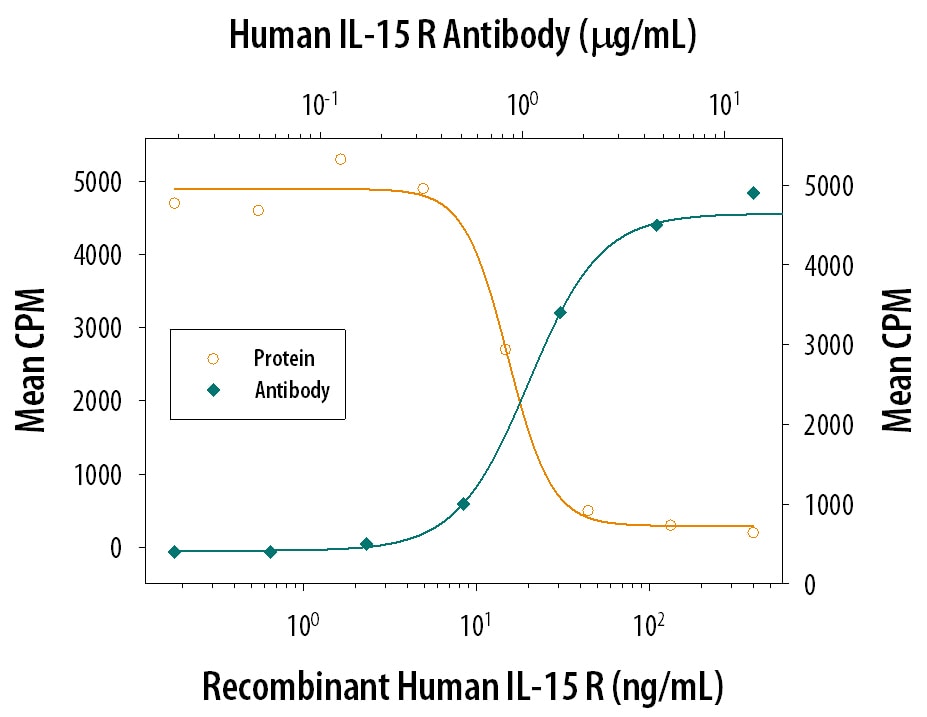
IL‑15 R alpha Inhibition of IL‑15-dependent Cell Proliferation and Neutralization by Human IL‑15 R alpha Antibody.
Recombinant Human IL-15 Ra Fc Chimera (Catalog # 147-IR) inhibits Recombinant Human IL-15 (Catalog # 247-IL) induced proliferation in the CTLL-2 mouse cytotoxic T cell line in a dose-dependent manner (orange line). Inhibition of Recombinant Human IL-15 (2 ng/mL) activity elicited by Recombinant Human IL-15 Ra Fc Chimera (30 ng/mL) is neutralized (green line) by increasing concentrations of Goat Anti-Human IL-15 Ra Antigen Affinity-purified Polyclonal Antibody (Catalog # AF247). The ND50 is typically 1-4 µg/mL.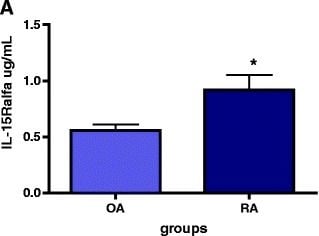
Detection of Human IL-15R alpha by ELISA
Measured levels of sIL-15Ralpha, IL-15, IL-6 and TNFalpha in synovial fluids from RA and OA patients. Cytokine concentration of IL-15Ralpha (A), IL-15 (B), TNFalpha (C) and IL-6 (D) were measured in in duplicate SF samples from RA (n = 30) and OA (n = 30) by ELISA. Box plot represents media ± SD. Differences between two groups were performed by Mann–Whitney U test for nonparametric data. Image collected and cropped by CiteAb from the following open publication (https://pubmed.ncbi.nlm.nih.gov/25879761), licensed under a CC-BY license. Not internally tested by R&D Systems.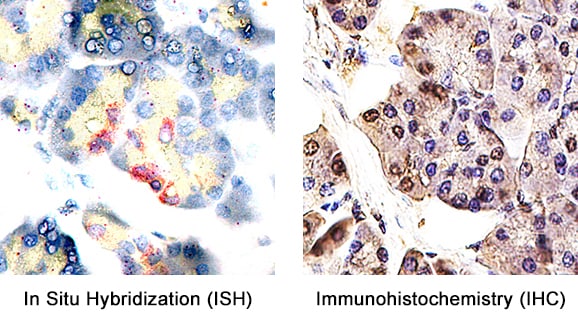
Detection of IL-15R alpha in Human Pancreas.
Formalin-fixed paraffin-embedded tissue sections of human pancreas were probed for IL15Ra mRNA (ACD RNAScope Probe, catalog #532368; Fast Red chromogen, ACD catalog # 322750). Adjacent tissue section was processed for immunohistochemistry using goat anti-human IL15Ra polyclonal antibody (R&D Systems catalog # AF247) at 3ug/mL with overnight incubation at 4 degrees Celsius followed by incubation with anti-goat IgG VisUCyte HRP Polymer Antibody (Catalog # VC004) and DAB chromogen (yellow-brown). Tissue was counterstained with hematoxylin (blue). Specific staining was localized to exocrine glands.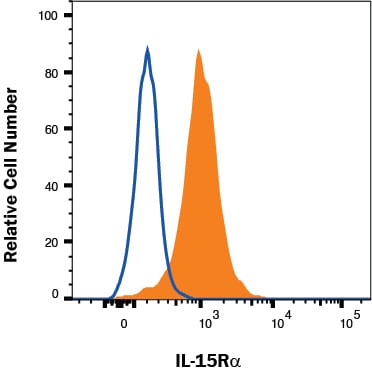
Detection of IL-15R alpha in human monocytes treated with LPS(100ng/mL) and IFNg(10ng/mL) for 24h by Flow Cytometry
Human monocytes treated with LPS(100ng/mL) and IFNg(10ng/mL) for 24h (filled histogram) or resting human monocytes (open histogram) were stained with Goat Anti-Human IL-15R alpha Antigen Affinity-purified Polyclonal Antibody (Catalog # AF247) followed by Allophycocyanin-conjugated Anti-Goat IgG Secondary Antibody (Catalog # F0108). View our protocol for Staining Membrane-associated Proteins.Applications for Human IL-15R alpha Antibody
CyTOF-ready
Dual RNAscope ISH-IHC Compatible
Sample: Immersion fixed paraffin-embedded sections of human pancreas
Flow Cytometry
Sample: Human monocytes treated with LPS and IFNg
Immunocytochemistry
Sample: Immersion fixed human Hodgkin's lymphoma cell line
Immunohistochemistry
Sample: Immersion fixed paraffin-embedded sections of human prostate cancer tissue
Western Blot
Sample: Recombinant Human IL‑15 R alpha Fc Chimera (Catalog # 147-IR)
Neutralization
Reviewed Applications
Read 2 reviews rated 4 using AF247 in the following applications:
Flow Cytometry Panel Builder
Bio-Techne Knows Flow Cytometry
Save time and reduce costly mistakes by quickly finding compatible reagents using the Panel Builder Tool.
Advanced Features
- Spectra Viewer - Custom analysis of spectra from multiple fluorochromes
- Spillover Popups - Visualize the spectra of individual fluorochromes
- Antigen Density Selector - Match fluorochrome brightness with antigen density

Formulation, Preparation, and Storage
Purification
Reconstitution
Reconstitute at 0.2 mg/mL in sterile PBS. For liquid material, refer to CoA for concentration.
Formulation
Shipping
Stability & Storage
- 12 months from date of receipt, -20 to -70 °C as supplied.
- 1 month, 2 to 8 °C under sterile conditions after reconstitution.
- 6 months, -20 to -70 °C under sterile conditions after reconstitution.
Calculators
Background: IL-15R alpha
References
- Anderson, D.M. et al. (1995) J. Biol. Chem. 270:29862.
- Bulfone-Paus, S. et al. (1999) FASEB 13:1575.
- Waldemann, T.A. and Y. Tagaya (1999) Ann. Rev. Immunol. 17:19.
- Dubois, S. et al. (1999) J. Biol. Chem. 274:26978.
Long Name
Alternate Names
Gene Symbol
UniProt
Additional IL-15R alpha Products
Product Documents for Human IL-15R alpha Antibody
Certificate of Analysis
To download a Certificate of Analysis, please enter a lot or batch number in the search box below.
Note: Certificate of Analysis not available for kit components.
Product Specific Notices for Human IL-15R alpha Antibody
For research use only
Citations for Human IL-15R alpha Antibody
 Powered by Bioz
Customer Reviews for Human IL-15R alpha Antibody (2)
Have you used Human IL-15R alpha Antibody?
Submit a review and receive an Amazon gift card!
$25/€18/£15/$25CAN/¥2500 for a review with an image
$10/€7/£6/$10CAN/¥1110 for a review without an image
Submit a review
Customer Images
-
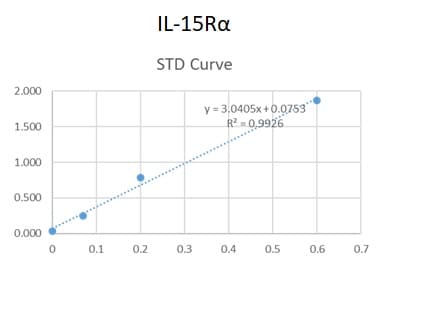
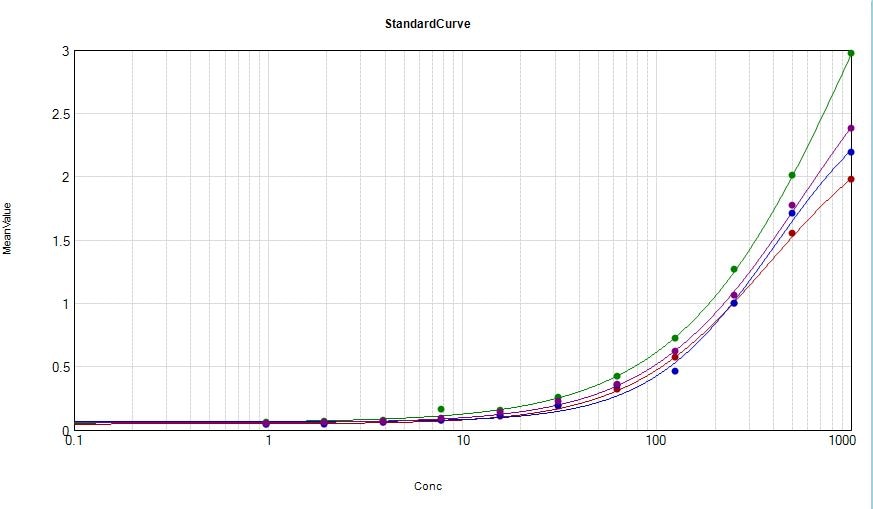
Application: ELISASample Tested: Serum and PlasmaSpecies: HumanVerified Customer | Posted 06/09/2020We used this antibody in an in-house ELISA along with mAb and protein standard (147-IR-100) to quantify IL-15R alpha in human serum and plasma. This combination could not detect IL-15R alpha in our samples but generated a good standard curve.

-
Application: ELISASample Tested: SerumSpecies: HumanVerified Customer | Posted 05/01/2020Ab was used as capture antibody in human serum ELISA
There are no reviews that match your criteria.
Protocols
Find general support by application which include: protocols, troubleshooting, illustrated assays, videos and webinars.
- 7-Amino Actinomycin D (7-AAD) Cell Viability Flow Cytometry Protocol
- Antigen Retrieval Protocol (PIER)
- Antigen Retrieval for Frozen Sections Protocol
- Appropriate Fixation of IHC/ICC Samples
- Cellular Response to Hypoxia Protocols
- Chromogenic IHC Staining of Formalin-Fixed Paraffin-Embedded (FFPE) Tissue Protocol
- Chromogenic Immunohistochemistry Staining of Frozen Tissue
- ClariTSA™ Fluorophore Kits
- Detection & Visualization of Antibody Binding
- Extracellular Membrane Flow Cytometry Protocol
- Flow Cytometry Protocol for Cell Surface Markers
- Flow Cytometry Protocol for Staining Membrane Associated Proteins
- Flow Cytometry Staining Protocols
- Flow Cytometry Troubleshooting Guide
- Fluorescent IHC Staining of Frozen Tissue Protocol
- Graphic Protocol for Heat-induced Epitope Retrieval
- Graphic Protocol for the Preparation and Fluorescent IHC Staining of Frozen Tissue Sections
- Graphic Protocol for the Preparation and Fluorescent IHC Staining of Paraffin-embedded Tissue Sections
- Graphic Protocol for the Preparation of Gelatin-coated Slides for Histological Tissue Sections
- ICC Cell Smear Protocol for Suspension Cells
- ICC Immunocytochemistry Protocol Videos
- ICC for Adherent Cells
- IHC Sample Preparation (Frozen sections vs Paraffin)
- ISH-IHC Protocol for Chromogenic Detection on Formalin Fixed Paraffin Embedded (FFPE) Tissue
- Immunocytochemistry (ICC) Protocol
- Immunocytochemistry Troubleshooting
- Immunofluorescence of Organoids Embedded in Cultrex Basement Membrane Extract
- Immunofluorescent IHC Staining of Formalin-Fixed Paraffin-Embedded (FFPE) Tissue Protocol
- Immunohistochemistry (IHC) and Immunocytochemistry (ICC) Protocols
- Immunohistochemistry Frozen Troubleshooting
- Immunohistochemistry Paraffin Troubleshooting
- Intracellular Flow Cytometry Protocol Using Alcohol (Methanol)
- Intracellular Flow Cytometry Protocol Using Detergents
- Intracellular Nuclear Staining Flow Cytometry Protocol Using Detergents
- Intracellular Staining Flow Cytometry Protocol Using Alcohol Permeabilization
- Intracellular Staining Flow Cytometry Protocol Using Detergents to Permeabilize Cells
- Preparing Samples for IHC/ICC Experiments
- Preventing Non-Specific Staining (Non-Specific Binding)
- Primary Antibody Selection & Optimization
- Propidium Iodide Cell Viability Flow Cytometry Protocol
- Protocol for Heat-Induced Epitope Retrieval (HIER)
- Protocol for Liperfluo
- Protocol for Making a 4% Formaldehyde Solution in PBS
- Protocol for VisUCyte™ HRP Polymer Detection Reagent
- Protocol for the Characterization of Human Th22 Cells
- Protocol for the Characterization of Human Th9 Cells
- Protocol for the Fluorescent ICC Staining of Cell Smears - Graphic
- Protocol for the Fluorescent ICC Staining of Cultured Cells on Coverslips - Graphic
- Protocol for the Preparation & Fixation of Cells on Coverslips
- Protocol for the Preparation and Chromogenic IHC Staining of Frozen Tissue Sections
- Protocol for the Preparation and Chromogenic IHC Staining of Frozen Tissue Sections - Graphic
- Protocol for the Preparation and Chromogenic IHC Staining of Paraffin-embedded Tissue Sections
- Protocol for the Preparation and Chromogenic IHC Staining of Paraffin-embedded Tissue Sections - Graphic
- Protocol for the Preparation and Fluorescent ICC Staining of Cells on Coverslips
- Protocol for the Preparation and Fluorescent ICC Staining of Non-adherent Cells
- Protocol for the Preparation and Fluorescent ICC Staining of Stem Cells on Coverslips
- Protocol for the Preparation and Fluorescent IHC Staining of Frozen Tissue Sections
- Protocol for the Preparation and Fluorescent IHC Staining of Paraffin-embedded Tissue Sections
- Protocol for the Preparation of Gelatin-coated Slides for Histological Tissue Sections
- Protocol for the Preparation of a Cell Smear for Non-adherent Cell ICC - Graphic
- Protocol: Annexin V and PI Staining by Flow Cytometry
- Protocol: Annexin V and PI Staining for Apoptosis by Flow Cytometry
- R&D Systems Quality Control Western Blot Protocol
- TUNEL and Active Caspase-3 Detection by IHC/ICC Protocol
- The Importance of IHC/ICC Controls
- Troubleshooting Guide: Fluorokine Flow Cytometry Kits
- Troubleshooting Guide: Immunohistochemistry
- Troubleshooting Guide: Western Blot Figures
- Western Blot Conditions
- Western Blot Protocol
- Western Blot Protocol for Cell Lysates
- Western Blot Troubleshooting
- Western Blot Troubleshooting Guide
- View all Protocols, Troubleshooting, Illustrated assays and Webinars


