

Scientific images may be resized, cropped, or adjusted for brightness or contrast for presentation purposes. These updates are limited to presentation and do not affect the underlying scientific interpretation of the data. Where available, additional source data may be provided upon request.
Key Product Details
Species Reactivity
Validated:
Human
Cited:
Human, Mouse
Applications
Validated:
Immunohistochemistry, Western Blot, Neutralization, Dual RNAscope ISH-IHC Compatible, Simple Western, Immunoprecipitation
Cited:
Immunohistochemistry, Western Blot, Neutralization, ELISA Development
Label
Unconjugated
Antibody Source
Polyclonal Goat IgG
Loading...
Product Specifications
Immunogen
Mouse myeloma cell line NS0-derived recombinant human MMP‑7
Leu18-Lys267
Accession # P09237
Leu18-Lys267
Accession # P09237
Specificity
Detects human MMP-7 in direct ELISAs. In direct ELISAs, approximately 50% cross-reactivity with recombinant mouse MMP-7 is observed, and less than 1% cross-reactivity with recombinant human (rh) MMP‑8 and rhMMP-12 is observed.
Clonality
Polyclonal
Host
Goat
Isotype
IgG
Scientific Data Images for Human MMP-7 Antibody
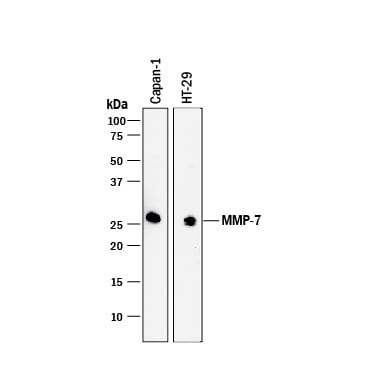
Detection of Human MMP‑7 by Western Blot.
Western blot shows lysates of Capan-1 human pancreatic adenocarcinoma cell line and HT-29 human colon adenocarcinoma cell line. PVDF membrane was probed with 1 µg/mL of Goat Anti-Human MMP-7 Antigen Affinity-purified Polyclonal Antibody (Catalog # AF907) followed by HRP-conjugated Anti-Goat IgG Secondary Antibody (HAF017). A specific band was detected for MMP-7 at approximately 28 kDa (as indicated). This experiment was conducted under reducing conditions and using Immunoblot Buffer Group 1.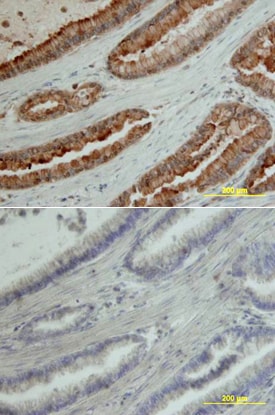
MMP‑7 in Human Pancreas.
MMP-7 was detected in immersion fixed paraffin-embedded sections of human pancreas array using Goat Anti-Human MMP-7 Antigen Affinity-purified Polyclonal Antibody (Catalog # AF907) at 10 µg/mL overnight at 4 °C. Tissue was stained using the Anti-Goat HRP-DAB Cell & Tissue Staining Kit (brown; Catalog # CTS008) and counterstained with hematoxylin (blue). Lower panel shows a lack of labeling if primary antibodies are omitted and tissue is stained only with secondary antibody followed by incubation with detection reagents. View our protocol for Chromogenic IHC Staining of Paraffin-embedded Tissue Sections.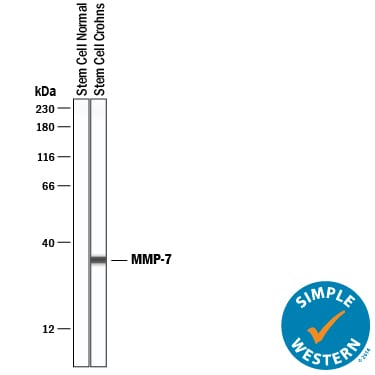
Detection of Human MMP‑7 by Simple WesternTM.
Simple Western lane view shows lysates of normal stem cells (negative control) and Crohn's stem cells, loaded at 0.2 mg/mL. A specific band was detected for MMP-7 at approximately 10 kDa (as indicated) using 10 µg/mL of Goat Anti-Human MMP-7 Antigen Affinity-purified Polyclonal Antibody (Catalog # AF907) followed by 1:50 dilution of HRP-conjugated Anti-Goat IgG Secondary Antibody (HAF109). This experiment was conducted under reducing conditions and using the 12-230 kDa separation system.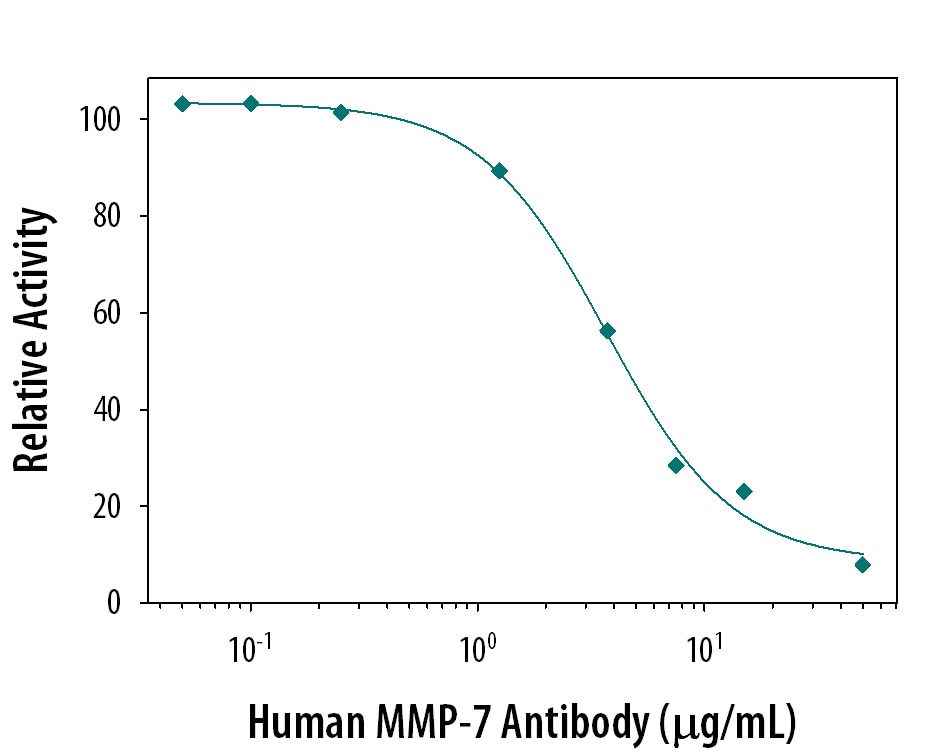
Neutralization of MMP‑7 Activity by Human MMP‑7 Antibody.
The cleavage of Mca-PLGL-Dpa-AR-NH2(10 µM, Catalog # ES001) by Recombinant Human MMP-7 (0.2 µg/mL, Catalog # 907-MP) is measured after preincubation with increasing concentrations of Goat Anti-Human MMP-7 Antigen Affinity-purified Polyclonal Antibody (Catalog # AF907). The ND50 is typically 2 µg/mL.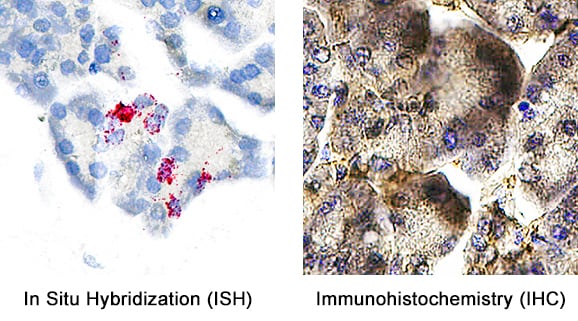
Detection of MMP‑7 in Human Pancreas.
Formalin-fixed paraffin-embedded tissue sections of human pancreas were probed for MMP7 mRNA (ACD RNAScope Probe, catalog #488408; Fast Red chromogen, ACD catalog # 322750). Adjacent tissue section was processed for immunohistochemistry using goat anti-human MMP7 polyclonal antibody (R&D Systems catalog # AF907) at 3ug/mL with overnight incubation at 4 degrees Celsius followed by incubation with anti-goat IgG VisUCyte HRP Polymer Antibody (Catalog # VC004) and DAB chromogen (yellow-brown). Tissue was counterstained with hematoxylin (blue). Specific staining was localized to exocrine glands.
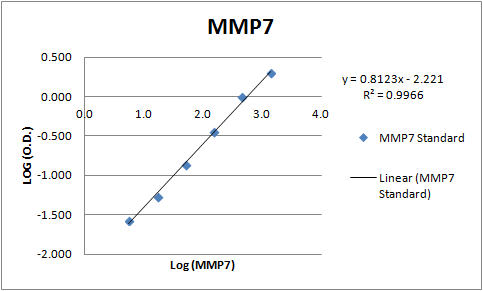
Human Total MMP-7 ELISA Standard Curve
Recombinant Human MMP‑7 (Catalog # 907-MP) was serially diluted and captured by Mouse Anti-Human/Primate MMP‑7 Monoclonal Antibody (Catalog # MAB9072) coated on a Clear Polystyrene Microplate (Catalog # DY990). Goat Anti-Human MMP‑7 Antigen Affinity-purified Polyclonal Antibody (Catalog # AF907) was biotinylated and incubated with the protein captured on the plate. Detection of the standard curve was achieved by incubating Streptavidin-HRP (Catalog # DY998)Applications for Human MMP-7 Antibody
Application
Recommended Usage
Dual RNAscope ISH-IHC Compatible
5-15 µg/mL
Sample: Immersion fixed paraffin-embedded sections of human pancreas
Sample: Immersion fixed paraffin-embedded sections of human pancreas
Immunohistochemistry
5-15 µg/mL
Sample: Immersion fixed paraffin-embedded sections of human pancreas subjected to Antigen Retrieval Reagent-Basic (Catalog # CTS013)
Sample: Immersion fixed paraffin-embedded sections of human pancreas subjected to Antigen Retrieval Reagent-Basic (Catalog # CTS013)
Immunoprecipitation
25 µg/mL
Sample: Conditioned cell culture medium spiked with Recombinant Human MMP‑7 (Catalog # 907‑MP), see our available Western blot detection antibodies
Sample: Conditioned cell culture medium spiked with Recombinant Human MMP‑7 (Catalog # 907‑MP), see our available Western blot detection antibodies
Simple Western
10 µg/mL
Sample: Crohn's stem cells
Sample: Crohn's stem cells
Western Blot
1 µg/mL
Sample: Capan‑1 human pancreatic adenocarcinoma cell line and HT‑29 human colon adenocarcinoma cell line
Sample: Capan‑1 human pancreatic adenocarcinoma cell line and HT‑29 human colon adenocarcinoma cell line
Neutralization
Measured by its ability to neutralize Recombinant Human MMP‑7 (0.2 µg/mL, Catalog # 907-MP) cleavage of the fluorogenic peptide substrate Mca-PLGL-Dpa-AR-NH2 (10 µM, Catalog # ES001). The Neutralization Dose (ND50) is typically 2 µg/mL.
Reviewed Applications
Read 1 review rated 4 using AF907 in the following applications:
Formulation, Preparation, and Storage
Purification
Antigen Affinity-purified
Reconstitution
Reconstitute at 0.2 mg/mL in sterile PBS. For liquid material, refer to CoA for concentration.
Loading...
Formulation
Lyophilized from a 0.2 μm filtered solution in PBS with Trehalose. See Certificate of Analysis for details.<br/>*Small pack size (-SP) is supplied either lyophilized or as a 0.2 µm filtered solution in PBS.
Shipping
Lyophilized product is shipped at ambient temperature. Liquid small pack size (-SP) is shipped with polar packs. Upon receipt, store immediately at the temperature recommended below.
Stability & Storage
Use a manual defrost freezer and avoid repeated freeze-thaw cycles.
- 12 months from date of receipt, -20 to -70 °C as supplied.
- 1 month, 2 to 8 °C under sterile conditions after reconstitution.
- 6 months, -20 to -70 °C under sterile conditions after reconstitution.
Calculators
Background: MMP-7
alpha ‑defensin activation in innate host defense, releases tumor necrosis factor‑ alpha in a model of herniated disc resorption, and cleaves FasL to generate a soluble form in a model of prostate involution. Structurally, MMP-7 is the smallest of the MMPs and consists of two domains: a pro-domain that is cleaved upon activation and a catalytic domain containing the zinc-binding site.
Long Name
Matrix Metalloproteinase 7
Alternate Names
Matrilysin, MMP7
Gene Symbol
MMP7
UniProt
Additional MMP-7 Products
Product Documents for Human MMP-7 Antibody
Certificate of Analysis
To download a Certificate of Analysis, please enter a lot or batch number in the search box below.
Note: Certificate of Analysis not available for kit components.
Product Specific Notices for Human MMP-7 Antibody
For research use only
Related Research Areas
Citations for Human MMP-7 Antibody
 Powered by Bioz
Customer Reviews for Human MMP-7 Antibody (1)
4 out of 5
1 Customer Rating
Have you used Human MMP-7 Antibody?
Submit a review and receive an Amazon gift card!
$25/€18/£15/$25CAN/¥2500 for a review with an image
$10/€7/£6/$10CAN/¥1110 for a review without an image
Submit a review
Customer Images
Showing
1
-
1 of
1 review
Showing All
Filter By:
-
Application: ELISASample Tested: Serum and PlasmaSpecies: HumanVerified Customer | Posted 11/09/2017This antibody was used to build an ELISA to measure MMP-7 in human plasma samples. The antibody worked as a matched pair with itself. i.e. is served as both the capture and detection molecule.

There are no reviews that match your criteria.
Protocols
Find general support by application which include: protocols, troubleshooting, illustrated assays, videos and webinars.
- Antigen Retrieval Protocol (PIER)
- Antigen Retrieval for Frozen Sections Protocol
- Appropriate Fixation of IHC/ICC Samples
- Cellular Response to Hypoxia Protocols
- Chromogenic IHC Staining of Formalin-Fixed Paraffin-Embedded (FFPE) Tissue Protocol
- Chromogenic Immunohistochemistry Staining of Frozen Tissue
- ClariTSA™ Fluorophore Kits
- Detection & Visualization of Antibody Binding
- Fluorescent IHC Staining of Frozen Tissue Protocol
- Graphic Protocol for Heat-induced Epitope Retrieval
- Graphic Protocol for the Preparation and Fluorescent IHC Staining of Frozen Tissue Sections
- Graphic Protocol for the Preparation and Fluorescent IHC Staining of Paraffin-embedded Tissue Sections
- Graphic Protocol for the Preparation of Gelatin-coated Slides for Histological Tissue Sections
- IHC Sample Preparation (Frozen sections vs Paraffin)
- ISH-IHC Protocol for Chromogenic Detection on Formalin Fixed Paraffin Embedded (FFPE) Tissue
- Immunofluorescent IHC Staining of Formalin-Fixed Paraffin-Embedded (FFPE) Tissue Protocol
- Immunohistochemistry (IHC) and Immunocytochemistry (ICC) Protocols
- Immunohistochemistry Frozen Troubleshooting
- Immunohistochemistry Paraffin Troubleshooting
- Immunoprecipitation Protocol
- Preparing Samples for IHC/ICC Experiments
- Preventing Non-Specific Staining (Non-Specific Binding)
- Primary Antibody Selection & Optimization
- Protocol for Heat-Induced Epitope Retrieval (HIER)
- Protocol for Making a 4% Formaldehyde Solution in PBS
- Protocol for VisUCyte™ HRP Polymer Detection Reagent
- Protocol for the Preparation & Fixation of Cells on Coverslips
- Protocol for the Preparation and Chromogenic IHC Staining of Frozen Tissue Sections
- Protocol for the Preparation and Chromogenic IHC Staining of Frozen Tissue Sections - Graphic
- Protocol for the Preparation and Chromogenic IHC Staining of Paraffin-embedded Tissue Sections
- Protocol for the Preparation and Chromogenic IHC Staining of Paraffin-embedded Tissue Sections - Graphic
- Protocol for the Preparation and Fluorescent IHC Staining of Frozen Tissue Sections
- Protocol for the Preparation and Fluorescent IHC Staining of Paraffin-embedded Tissue Sections
- Protocol for the Preparation of Gelatin-coated Slides for Histological Tissue Sections
- R&D Systems Quality Control Western Blot Protocol
- TUNEL and Active Caspase-3 Detection by IHC/ICC Protocol
- The Importance of IHC/ICC Controls
- Troubleshooting Guide: Immunohistochemistry
- Troubleshooting Guide: Western Blot Figures
- Western Blot Conditions
- Western Blot Protocol
- Western Blot Protocol for Cell Lysates
- Western Blot Troubleshooting
- Western Blot Troubleshooting Guide
- View all Protocols, Troubleshooting, Illustrated assays and Webinars
Loading...