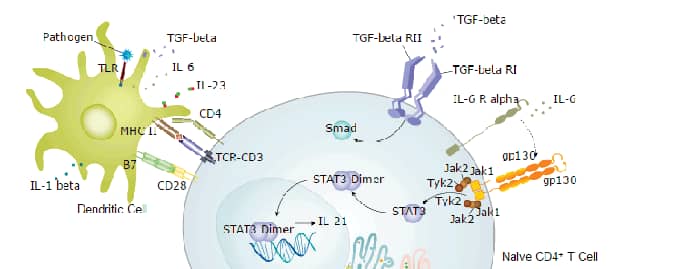
Human toll-like receptor (TLR) family includes ten members that activate the innate immune response via an ability to recognize molecular structures found in a variety of microbial pathogens (1‑3). All TLR family members are type I transmembrane proteins with a large number of extracellular leucine-rich repeats (LRRs) and a cytoplasmic Toll/IL-1 receptor (TIR) domain. Human TLR2 is synthesized as a 784 amino acid (aa) precursor (2) that contains a signal sequence (aa 1-18), an extracellular domain (aa 19-588) with approximately 20 LRRs, a transmembrane segment (aa 589-609), and a cytoplasmic TIR domain (aa 610-784). The receptor is expressed on a number of cell types including monocytes, dendritic cells, neutrophils, B cells endothelial cells, and hepatocytes (1, 2, 4). TLR2 functions as part of a heterodimeric complex with either TLR1 or TLR6, and possibly other co-receptors (1). These complexes recognize lipoproteins and glycolipids from gram-positive and gram-negative bacteria as well as mycoplasma and yeast. TLR2/TLR1 heterodimers bind triacylated lipopeptides, while the TLR2/TLR6 heterodimer preferentially recognizes diacylated lipopeptides (5). Upon ligand recognition, TLR2 delivers an activating signal via the associated adapter molecules, MyD88 and TIRAP (1, 6). TLR2 signaling results in dendritic cell maturation characterized by increased surface expression of class II MHC and the T cell costimulators, CD80 and CD86 (1, 2). Activation via TLR2 also results in production of a number of pro-inflammatory cytokines including TNF-alpha, IL-2, IL-6, IL-12, and MIP-2 (1-3).

Scientific images may be resized, cropped, or adjusted for brightness or contrast for presentation purposes. These updates are limited to presentation and do not affect the underlying scientific interpretation of the data. Where available, additional source data may be provided upon request.
Key Product Details
Species Reactivity
Validated:
Cited:
Applications
Validated:
Cited:
Label
Antibody Source
Product Specifications
Immunogen
Accession # O60603
Specificity
Clonality
Host
Isotype
Endotoxin Level
Scientific Data Images for Human TLR2 Antibody (383936)
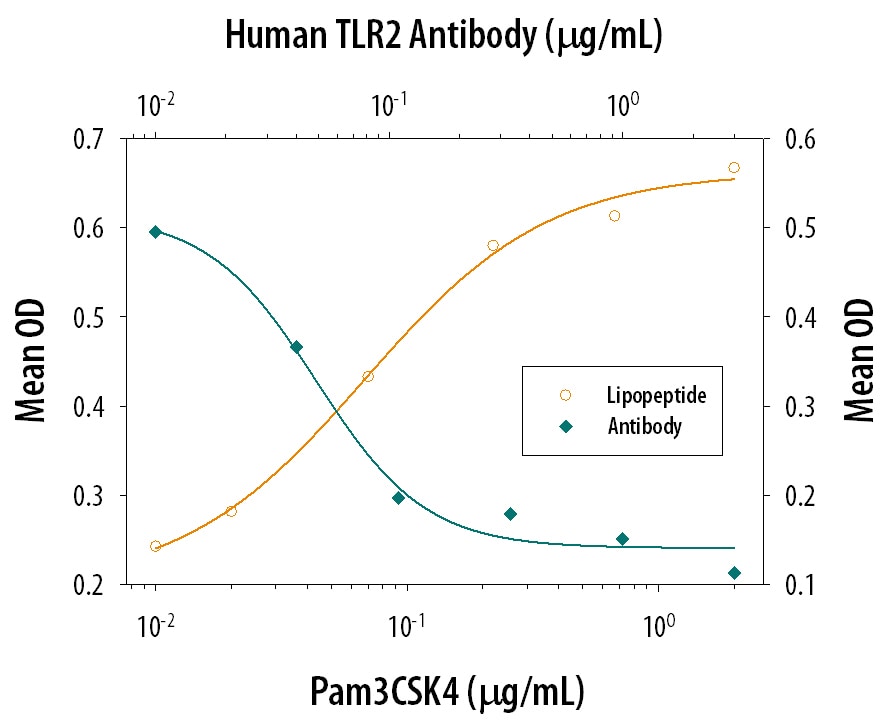
IL‑8 Secretion Induced by Pam3CSK4and Neutralization by Human TLR2 Antibody.
The synthetic tripalmitoylated lipopeptide Pam3CSK4stimulates IL-8 secretion in the HEK293 human embryonic kidney cell line transfected with human TLR2, in a dose-dependent manner (orange line), as measured by the Human CXCL8/IL-8 Quantikine ELISA Kit (Catalog # D8000C). IL-8 secretion elicited by Pam3CSK4(0.5 µg/mL) is neutralized (green line) by increasing concentrations of Mouse Anti-Human TLR2 Monoclonal Antibody (Catalog # MAB2616). The ND50 is typically 0.03-0.15 µg/mL.
Detection of TLR2 in Human Monocytes by Flow Cytometry.
Human whole blood monocytes were stained with Mouse Anti-Human TLR2 Monoclonal Antibody (Catalog # MAB2616, filled histogram) or isotype control antibody (Catalog # MAB0041, open histogram), followed by Phycoerythrin-conjugated Anti-Mouse IgG F(ab')2Secondary Antibody (Catalog # F0102B).Applications for Human TLR2 Antibody (383936)
CyTOF-ready
Flow Cytometry
Sample: Human whole blood monocytes
Neutralization
Reviewed Applications
Read 3 reviews rated 4.7 using MAB2616 in the following applications:
Flow Cytometry Panel Builder
Bio-Techne Knows Flow Cytometry
Save time and reduce costly mistakes by quickly finding compatible reagents using the Panel Builder Tool.
Advanced Features
- Spectra Viewer - Custom analysis of spectra from multiple fluorochromes
- Spillover Popups - Visualize the spectra of individual fluorochromes
- Antigen Density Selector - Match fluorochrome brightness with antigen density

Formulation, Preparation, and Storage
Purification
Reconstitution
Reconstitute at 0.5 mg/mL in sterile PBS. For liquid material, refer to CoA for concentration.
Formulation
Shipping
Stability & Storage
- 12 months from date of receipt, -20 to -70 °C as supplied.
- 1 month, 2 to 8 °C under sterile conditions after reconstitution.
- 6 months, -20 to -70 °C under sterile conditions after reconstitution.
Calculators
Background: TLR2
References
- Wetzler, L. (2003) Vaccine 21:S2/55.
- Kirschning, C. and R. Schumann (2002) Curr. Top. microbiol. Immunol. 270:121.
- Netea, M. et al. (2004) J. Leukoc. Biol. 75:749.
- Flo, T. et al. (2001) J. Leukoc. Biol. 69:474.
- Akira, S. (2003) Curr. Opin. Immunol. 15:5.
- Yamamoto, M. et al. (2002) Nature 420:324.
Long Name
Alternate Names
Gene Symbol
UniProt
Additional TLR2 Products
Product Documents for Human TLR2 Antibody (383936)
Certificate of Analysis
To download a Certificate of Analysis, please enter a lot or batch number in the search box below.
Note: Certificate of Analysis not available for kit components.
Product Specific Notices for Human TLR2 Antibody (383936)
For research use only
Citations for Human TLR2 Antibody (383936)
 Powered by Bioz
Customer Reviews for Human TLR2 Antibody (383936) (3)
Have you used Human TLR2 Antibody (383936)?
Submit a review and receive an Amazon gift card!
$25/€18/£15/$25CAN/¥2500 for a review with an image
$10/€7/£6/$10CAN/¥1110 for a review without an image
Submit a review
Customer Images

-
Application: MicroarraySample Tested: EDTA PlasmaSpecies: HumanVerified Customer | Posted 12/13/2019Antibody was printed on custom arrays and incubated with fluorescently labeled human EDTA plasma

-
Application: MicroarraysSample Tested: EDTA PlasmaSpecies: HumanVerified Customer | Posted 03/11/2019
-
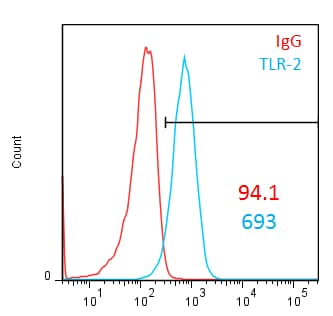
Application: Flow CytometrySample Tested: KF6 human keratinocytes and THP-1 human acute monocytic leukemia cell lineSpecies: HumanVerified Customer | Posted 04/26/2016
There are no reviews that match your criteria.
Protocols
Find general support by application which include: protocols, troubleshooting, illustrated assays, videos and webinars.
- 7-Amino Actinomycin D (7-AAD) Cell Viability Flow Cytometry Protocol
- Extracellular Membrane Flow Cytometry Protocol
- Flow Cytometry Protocol for Cell Surface Markers
- Flow Cytometry Protocol for Staining Membrane Associated Proteins
- Flow Cytometry Staining Protocols
- Flow Cytometry Troubleshooting Guide
- Intracellular Flow Cytometry Protocol Using Alcohol (Methanol)
- Intracellular Flow Cytometry Protocol Using Detergents
- Intracellular Nuclear Staining Flow Cytometry Protocol Using Detergents
- Intracellular Staining Flow Cytometry Protocol Using Alcohol Permeabilization
- Intracellular Staining Flow Cytometry Protocol Using Detergents to Permeabilize Cells
- Propidium Iodide Cell Viability Flow Cytometry Protocol
- Protocol for Liperfluo
- Protocol for the Characterization of Human Th22 Cells
- Protocol for the Characterization of Human Th9 Cells
- Protocol: Annexin V and PI Staining by Flow Cytometry
- Protocol: Annexin V and PI Staining for Apoptosis by Flow Cytometry
- Troubleshooting Guide: Fluorokine Flow Cytometry Kits
- View all Protocols, Troubleshooting, Illustrated assays and Webinars