
Adiponectin, also known as Acrp30, is an adipocyte-derived protein with wide ranging paracrine and endocrine effects on metabolism and inflammation. It promotes adipocyte differentiation, fatty acid catabolism, and insulin sensitivity, and is negatively correlated with obesity, type 2 diabetes, and atherogenesis. In this context, adiponectin is an anti-inflammatory agent, but it exerts pro-inflammatory effects in nonmetabolic disorders such as rheumatoid arthritis and inflammatory bowel disease (1-3). Adiponectin interacts with the receptors AdipoR1 and AdipoR2, calreticulin, and Cadherin-13/T-Cadherin, as well as with several growth factors (4-7). Mature mouse adiponectin consists of a 66 amino acid (aa) N-terminal collagenous region and a 137 aa C-terminal C1q-like globular domain which can be cleaved by a leukocyte-derived elastase (8-10). Mature mouse adiponectin shares 83% and 91% amino acid (aa) sequence identity with human and rat adiponectin, respectively. Adiponectin associates into trimers that may assemble into medium molecular weight (MMW) hexamers and then into >300 kDa high molecular weight (HMW) oligomers (11-13). The glycosylation of four hydroxylated lysine residues in the collagenous domain is required for the intracellular formation of HMW complexes (14). The various multimeric forms of adiponectin exhibit distinct tissue specific and gender specific profiles and activities (13, 15).
Mouse Adiponectin/Acrp30 Antibody
R&D Systems | Catalog # AF1119

Scientific images may be resized, cropped, or adjusted for brightness or contrast for presentation purposes. These updates are limited to presentation and do not affect the underlying scientific interpretation of the data. Where available, additional source data may be provided upon request.
Key Product Details
Validated by
Species Reactivity
Validated:
Cited:
Applications
Validated:
Cited:
Label
Antibody Source
Product Specifications
Immunogen
Glu18-Asn247
Accession # Q60994
Specificity
Clonality
Host
Isotype
Scientific Data Images for Mouse Adiponectin/Acrp30 Antibody
Adiponectin/Acrp30 in ST-2 mouse bone marrow-derived stromal cell line differentiated to adipocytes.
Adiponectin/Acrp30 was detected in immersion fixed ST-2 mouse bone marrow-derived stromal cell line differentiated to adipocytes using Goat Anti-Mouse Adiponectin/Acrp30 Antigen Affinity-purified Polyclonal Antibody (Catalog # AF1119) at 10 µg/mL for 3 hours at room temperature. Cells were stained using the NorthernLights™ 557-conjugated Anti-Goat IgG Secondary Antibody (red; NL001) and counter-stained with DAPI (blue). Specific staining was localized to cell surfaces and cytoplasm. View our protocol for Fluorescent ICC Staining of Cells on Coverslips.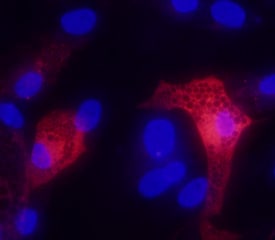
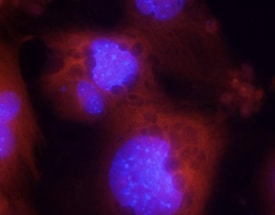
Adiponectin/Acrp30 in human mesenchymal stem cells differentiated to adipocytes.
Adiponectin/Acrp30 was detected in immersion fixed human mesenchymal stem cells differentiated to adipocytes using Goat Anti-Mouse Adiponectin/Acrp30 Antigen Affinity-purified Polyclonal Antibody (Catalog # AF1119) at 10 µg/mL for 3 hours at room temperature. Cells were stained using the NorthernLights™ 557-conjugated Anti-Goat IgG Secondary Antibody (red; NL001) and counterstained with DAPI (blue). Specific staining was localized to cell surfaces and cytoplasm. View our protocol for Fluorescent ICC Staining of Cells on Coverslips.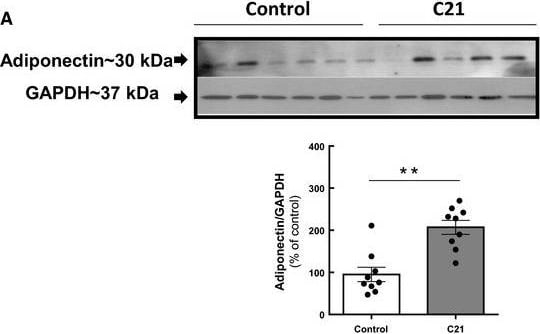
Detection of Mouse Adiponectin/Acrp30 by Western Blot
Chronic administration of compound 21 increases the abundance of adiponectin and UCP‐1 in adipose tissue. (A) and (C) Abundance of adiponectin and UCP‐1 in adipose tissue as determined by western blotting. (B) and (D) Levels of adiponectin and UCP‐1 as determined by immunohistochemistry. Quantification of specific bands was performed with Gel‐Pro Analyzer software. (A) and (C) Scatter dot plots show individual values and superimposed bar graphs represent the means ± S.E. (B) and (D) Positive adiponectin and UCP‐1 staining was quantified using Image‐Pro Plus 4.5 software. Data were analyzed by unpaired two‐tailed Student's t test, where **P < 0.01 when compared with saline‐treated control mice. For adiponectin, (C21, n = 9 per group; control, n = 9 per group). For UCP‐1, (C21, n = 9 per group, control, n = 10 per group). Image collected and cropped by CiteAb from the following open publication (https://pubmed.ncbi.nlm.nih.gov/30156060), licensed under a CC-BY license. Not internally tested by R&D Systems.
Detection of Mouse Adiponectin/Acrp30 by Western Blot
HIF-1 activation-induced T-cadherin upregulation increased adiponectin accumulation and EV production. (A) Western blot analysis of total cell lysates. UV-F2 cells cultured in DMEM containing 5% serum from adiponectin knockout mice were treated with or without high molecular weight adiponectin (HMW-APN) (10 μg/mL) and roxadustat (Roxa) (50 μM) for 48 h (n = 3 for each group). (B) Western blot analysis of EVs isolated from cell culture medium by differential ultracentrifugation. UV-F2 cells cultured in FBS-free Advanced DMEM were treated with or without HMW-APN (20 μg/mL) and roxadustat (50 μM) for 48 h (n = 3 for each group). Alix, TSG101, and syntenin were evaluated as EV markers. (C) Western blot analysis of total cell lysates. UV-F2 cells transfected control (Cont) or T-cadherin (T-cad) siRNA were cultured in DMEM containing 5% serum from adiponectin knockout mice with or without HMW-APN (20 μg/mL) and roxadustat (50 μM) for 48 h (n = 3 for each group). (D) Western blot analysis of EVs isolated from cell culture medium. UV-F2 cells transfected Cont or T-cad siRNA were cultured in FBS-free Advanced DMEM with or without HMW-APN (20 μg/mL) and roxadustat (50 μM) for 48 h (n = 3). Data are means ± SEMs. *p < 0.05, **p < 0.01, and ***p < 0.001 (Tukey–Kramer test). Image collected and cropped by CiteAb from the following open publication (https://www.nature.com/articles/s41598-024-51935-6), licensed under a CC-BY license. Not internally tested by R&D Systems.Applications for Mouse Adiponectin/Acrp30 Antibody
Immunocytochemistry
Sample: Immersion fixed human mesenchymal stem cells differentiated to adipocytes and immersion fixed ST-2 mouse bone marrow-derived stromal cell line differentiated to adipocytes using Human/Mouse StemXVivo Osteogenic/Adipogenic Base Media (Catalog # CCM007) and Human/Mouse StemXVivo Adipogenic Supplement (Catalog # CCM011)
Western Blot
Sample: Recombinant Mouse Adiponectin/Acrp30 (Catalog # 5095-AC)
Reviewed Applications
Read 2 reviews rated 4.5 using AF1119 in the following applications:
Formulation, Preparation, and Storage
Purification
Reconstitution
Reconstitute at 0.2 mg/mL in sterile PBS. For liquid material, refer to CoA for concentration.
Formulation
Shipping
Stability & Storage
- 12 months from date of receipt, -20 to -70 °C as supplied.
- 1 month, 2 to 8 °C under sterile conditions after reconstitution.
- 6 months, -20 to -70 °C under sterile conditions after reconstitution.
Calculators
Background: Adiponectin/Acrp30
References
- Lara-Castro, C. et al. (2007) Curr. Opin. Lipidol. 18:263.
- Tilg, H. and A.R. Moschen (2006) Nat. Rev. Immunol. 6:772.
- Fantuzzi, G. (2008) J. Allergy Clin. Immunol. 121:326.
- Yamauchi, T. et al. (2007) Nat. Med. 13:332.
- Takemura, Y. et al. (2007) J. Clin. Invest. 117:375.
- Hug, C. et al. (2004) Proc. Natl. Acad. Sci. USA 101:10308.
- Wang, Y. et al. (2005) J. Biol. Chem. 280:18341.
- Scherer, P.E. et al. (1995) J. Biol. Chem. 270:26746.
- Hu, E. et al. (1996) J. Biol. Chem. 271:10697.
- Waki, H. et al. (2005) Endocrinology 146:790.
- Waki, H. et al. (2003) J. Biol. Chem. 278:40352.
- Tsao, T.S. et al. (2003) J. Biol. Chem. 278:50810.
- Wang, Y. et al. (2008) Biochem. J. 409:623.
- Wang, H. et al. (2006) J. Biol. Chem. 281:16391.
- Pajvani, U.B. et al. (2003) J. Biol. Chem. 278:9073.
Alternate Names
Gene Symbol
UniProt
Additional Adiponectin/Acrp30 Products
Product Documents for Mouse Adiponectin/Acrp30 Antibody
Certificate of Analysis
To download a Certificate of Analysis, please enter a lot or batch number in the search box below.
Note: Certificate of Analysis not available for kit components.
Product Specific Notices for Mouse Adiponectin/Acrp30 Antibody
For research use only
Related Research Areas
Citations for Mouse Adiponectin/Acrp30 Antibody
 Powered by Bioz
Customer Reviews for Mouse Adiponectin/Acrp30 Antibody (2)
Have you used Mouse Adiponectin/Acrp30 Antibody?
Submit a review and receive an Amazon gift card!
$25/€18/£15/$25CAN/¥2500 for a review with an image
$10/€7/£6/$10CAN/¥1110 for a review without an image
Submit a review
-
Verified Customer | Posted 04/26/2017
-
Application: Western BlotSample Tested: See PMID 23824191Species: MouseVerified Customer | Posted 01/05/2015
There are no reviews that match your criteria.
Protocols
Find general support by application which include: protocols, troubleshooting, illustrated assays, videos and webinars.
- Appropriate Fixation of IHC/ICC Samples
- Cellular Response to Hypoxia Protocols
- ClariTSA™ Fluorophore Kits
- Detection & Visualization of Antibody Binding
- ICC Cell Smear Protocol for Suspension Cells
- ICC Immunocytochemistry Protocol Videos
- ICC for Adherent Cells
- Immunocytochemistry (ICC) Protocol
- Immunocytochemistry Troubleshooting
- Immunofluorescence of Organoids Embedded in Cultrex Basement Membrane Extract
- Immunohistochemistry (IHC) and Immunocytochemistry (ICC) Protocols
- Preparing Samples for IHC/ICC Experiments
- Preventing Non-Specific Staining (Non-Specific Binding)
- Primary Antibody Selection & Optimization
- Protocol for VisUCyte™ HRP Polymer Detection Reagent
- Protocol for the Fluorescent ICC Staining of Cell Smears - Graphic
- Protocol for the Fluorescent ICC Staining of Cultured Cells on Coverslips - Graphic
- Protocol for the Preparation and Fluorescent ICC Staining of Cells on Coverslips
- Protocol for the Preparation and Fluorescent ICC Staining of Non-adherent Cells
- Protocol for the Preparation and Fluorescent ICC Staining of Stem Cells on Coverslips
- Protocol for the Preparation of a Cell Smear for Non-adherent Cell ICC - Graphic
- R&D Systems Quality Control Western Blot Protocol
- TUNEL and Active Caspase-3 Detection by IHC/ICC Protocol
- The Importance of IHC/ICC Controls
- Troubleshooting Guide: Western Blot Figures
- Western Blot Conditions
- Western Blot Protocol
- Western Blot Protocol for Cell Lysates
- Western Blot Troubleshooting
- Western Blot Troubleshooting Guide
- View all Protocols, Troubleshooting, Illustrated assays and Webinars
Associated Pathways

