Tumor necrosis factor alpha (TNF-alpha ), also known as cachectin and TNFSF2, is the prototypic ligand of the TNF superfamily. It is a pleiotropic molecule that plays a central role in inflammation, apoptosis, and immune system development. TNF-alpha is produced by a wide variety of immune and epithelial cell types (1, 2). Porcine TNF-alpha consisits of a 35 amino acid (aa) cytoplasmic domain, a 21 aa transmembrane segment, and a 176 aa extracellular domain (ECD) (3). Within the ECD, porcine TNF-alpha shares 69% - 86% aa sequence identity with bovine, canine, cotton rat, equine, feline, human, mouse, rat, and rhesus TNF-alpha. The 26 kDa type 2 transmembrane protein is assembled intracellularly to form a noncovalently linked homotrimer (4). Ligation of this complex induces reverse signaling that promotes lymphocyte costimulation but diminishes monocyte responsiveness (5). Cleavage of membrane bound TNF-alpha by TACE/ADAM17 releases a 55 kDa soluble trimeric form of TNF-alpha (6, 7). TNF-alpha trimers bind the ubiquitous TNF RI and the hematopoietic cell-restricted TNF RII, both of which are also expressed as homotrimers (1, 8). TNF-alpha regulates lymphoid tissue development through control of apoptosis (2). It also promotes inflammatory responses by inducing the activation of vascular endothelial cells and macrophages (2). TNF-alpha is a key cytokine in the development of several inflammatory disorders (9). It contributes to the development of type 2 diabetes through its effects on insulin resistance and fatty acid metabolism (10, 11).
Porcine TNF-alpha Antibody (103304)
R&D Systems | Catalog # MAB6902


Scientific images may be resized, cropped, or adjusted for brightness or contrast for presentation purposes. These updates are limited to presentation and do not affect the underlying scientific interpretation of the data. Where available, additional source data may be provided upon request.
Key Product Details
Species Reactivity
Validated:
Cited:
Applications
Validated:
Cited:
Label
Antibody Source
Product Specifications
Immunogen
Arg78-Leu232
Accession # P23563
Specificity
Clonality
Host
Isotype
Scientific Data Images for Porcine TNF-alpha Antibody (103304)
Porcine TNF-alpha ELISA Standard Curve
Recombinant Porcine TNF‑ alpha (Catalog # 690-PT) was serially diluted and captured by Mouse Anti-Porcine TNF‑ alpha Monoclonal Antibody (Catalog # MAB6902) coated on a Clear Polystyrene Microplate (Catalog # DY990). Mouse Anti-Porcine TNF‑ alpha Monoclonal Antibody (Catalog # MAB6903) was biotinylated and incubated with the protein captured on the plate. Detection of the standard curve was achieved by incubating Streptavidin-HRP (Catalog # DY998)Applications for Porcine TNF-alpha Antibody (103304)
Porcine TNF-alpha Sandwich Immunoassay
Reviewed Applications
Read 1 review rated 5 using MAB6902 in the following applications:
Formulation, Preparation, and Storage
Purification
Reconstitution
Reconstitute at 0.5 mg/mL in sterile PBS. For liquid material, refer to CoA for concentration.
Formulation
Shipping
Stability & Storage
- 12 months from date of receipt, -20 to -70 °C as supplied.
- 1 month, 2 to 8 °C under sterile conditions after reconstitution.
- 6 months, -20 to -70 °C under sterile conditions after reconstitution.
Calculators
Background: TNF-alpha
References
- Idriss, H.T. and J.H. Naismith (2000) Microsc. Res. Tech. 50:184.
- Hehlgans, T. and K. Pfeffer (2005) Immunology 115:1.
- Pauli, U. et al. (1989) Gene 81:185.
- Tang, P. et al. (1996) Biochemistry 35:8216.
- Eissner G. et al. (2004) Cytokine Growth Factor Rev. 15:353.
- Black, R.A. et al. (1997) Nature 385:729.
- Moss, M.L. et al. (1997) Nature 385:733.
- Loetscher, H. et al. (1991) J. Biol. Chem. 266:18324.
- Clark, I.A. (2007) Cytokine Growth Factor Rev. 18:335.
- Romanatto, T. et al. (2007) Peptides 28:1050.
- Hector, J. et al. (2007) Horm. Metab. Res. 39:250.
Long Name
Alternate Names
Entrez Gene IDs
Gene Symbol
UniProt
Additional TNF-alpha Products
Product Documents for Porcine TNF-alpha Antibody (103304)
Certificate of Analysis
To download a Certificate of Analysis, please enter a lot or batch number in the search box below.
Note: Certificate of Analysis not available for kit components.
Product Specific Notices for Porcine TNF-alpha Antibody (103304)
For research use only
Related Research Areas
Citations for Porcine TNF-alpha Antibody (103304)
 Powered by Bioz
Customer Reviews for Porcine TNF-alpha Antibody (103304) (1)
Have you used Porcine TNF-alpha Antibody (103304)?
Submit a review and receive an Amazon gift card!
$25/€18/£15/$25CAN/¥2500 for a review with an image
$10/€7/£6/$10CAN/¥1110 for a review without an image
Submit a review
Customer Images
-
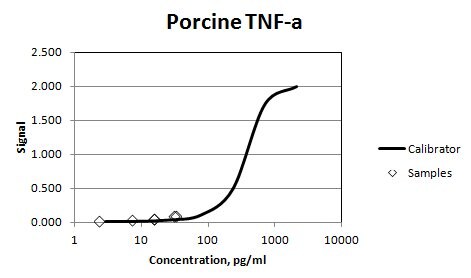
Application: ELISASample Tested: Porcine Serum and Serum and PlasmaSpecies: PorcineVerified Customer | Posted 11/08/2017The antibody MAB6902 was used as the capture antibody paired withe detection antibody BAM6903 in a sandwich assay for Porcine TNFa. The calibrator was 690-PT. The assay had a sensitivity of 2 pg/ml.

There are no reviews that match your criteria.
Associated Pathways