
Thioredoxins (Trxs) are a group of small ubiquitous proteins in all living cells that are key regulators of cellular redox balance (1, 2). The mammalian Trx family has three members. The Trx-1, which is a secreted and cellular protein, the mitochondria-specific Trx-2, and the Trx-like cytosolic protein p32TrxL (3‑5). The active site of mammalian Trxs contains two cysteines in the conserved sequence -Y-C-G-P-C-K-. In Trx-1 the conserved cysteine residues are in positions 32 and 35, respectively. Trxs exist either in a reduced or in an oxidized state when the two cysteines at the active site form an intramolecular disulfide bridge. NADPH and the flavoprotein thioredoxin reductase can convert the oxidized Trx into the reduced Trx. Trx-1 is the only extracellular occurring thioredoxin, and is secreted by lymphocytes, hepatocytes, fibroblasts, and several tumor cells. Plasma concentrations of Trx-1 are up to 6 nM (6). In cells, Trx-1 is localized predominantly in the cytoplasm. Small amounts have been detected in the nucleus and in association with the outside surface of the cells. Expression of Trx-1 is increased under various stress conditions such as hypoxia, elevated hydrogen peroxide concentrations, photochemical oxidative stress, and viral and bacterial infections. Biological functions of Trx-1 include growth factor activity, antioxidant properties, a cofactor that provides reducing equivalents, and transcriptional regulation (1, 2). The synovial tissue of rheumatoid arthritis patients produces increased levels of Trx-1 under oxidative stress conditions, and a correlation exists between the plasma levels of Trx-1 and the severity of the disease, making Trx-1 a biomarker for this pathological condition (7, 8).

Scientific images may be resized, cropped, or adjusted for brightness or contrast for presentation purposes. These updates are limited to presentation and do not affect the underlying scientific interpretation of the data. Where available, additional source data may be provided upon request.
Key Product Details
Species Reactivity
Applications
Label
Antibody Source
Product Specifications
Immunogen
Val2-Val105
Accession # P10599
Specificity
Clonality
Host
Isotype
Scientific Data Images for Thioredoxin-1 Antibody (763651)
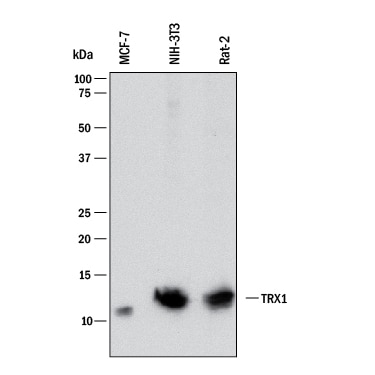
Detection of Human, Mouse, and Rat Thioredoxin‑1 by Western Blot.
Western blot shows lysates of MCF-7 human breast cancer cell line, NIH-3T3 mouse embryonic fibroblast cell line, and Rat-2 rat embryonic fibroblast cell line. PVDF membrane was probed with 2 µg/mL of Mouse Anti-Human/Mouse/Rat Thioredoxin-1 Monoclonal Antibody (Catalog # MAB19701) followed by HRP-conjugated Anti-Mouse IgG Secondary Antibody (Catalog # HAF018). A specific band was detected for Thioredoxin-1 at approximately 12 kDa (as indicated). This experiment was conducted under reducing conditions and using Immunoblot Buffer Group 1.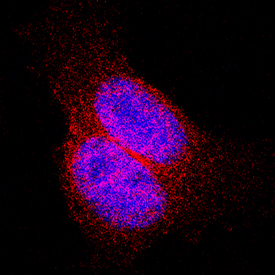
Thioredoxin‑1 in HeLa Human Cell Line.
Thioredoxin-1 was detected in immersion fixed HeLa human cervical epithelial carcinoma cell line using Mouse Anti-Human/Mouse/Rat Thioredoxin-1 Monoclonal Antibody (Catalog # MAB19701) at 8 µg/mL for 3 hours at room temperature. Cells were stained using the NorthernLights™ 557-conjugated Anti-Mouse IgG Secondary Antibody (red; Catalog # NL007) and counterstained with DAPI (blue). Specific staining was localized to cytoplasm. View our protocol for Fluorescent ICC Staining of Cells on Coverslips.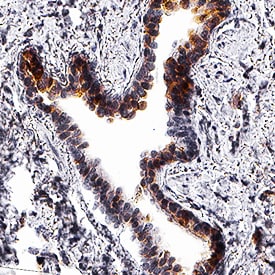
Thioredoxin‑1 in Human Lung.
Thioredoxin-1 was detected in immersion fixed paraffin-embedded sections of human lung using Mouse Anti-Human/Mouse/Rat Thioredoxin-1 Monoclonal Antibody (Catalog # MAB19701) at 5 µg/mL for 1 hour at room temperature followed by incubation with the Anti-Mouse IgG VisUCyte™ HRP Polymer Antibody (Catalog # VC001). Before incubation with the primary antibody, tissue was subjected to heat-induced epitope retrieval using Antigen Retrieval Reagent-Basic (Catalog # CTS013). Tissue was stained using DAB (brown) and counterstained with hematoxylin (blue). Specific staining was localized to cytoplasm in alveolar cells. View our protocol for IHC Staining with VisUCyte HRP Polymer Detection Reagents.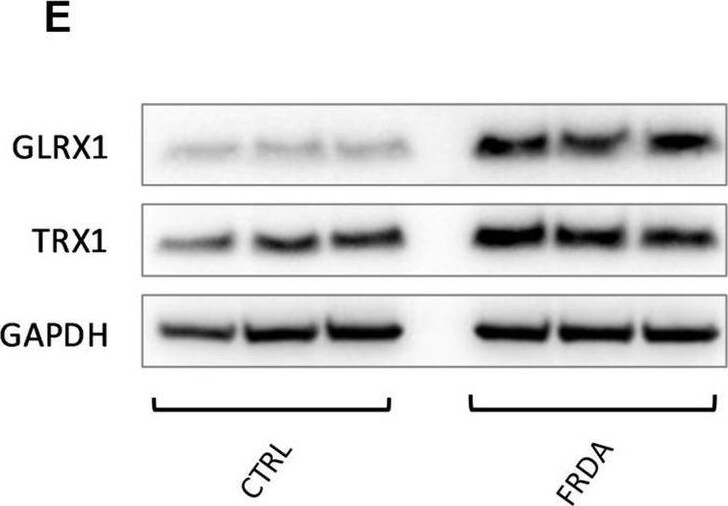
Detection of Thioredoxin-1 by Western Blot
mRNA (A,B) and protein (C,D) levels of TRX1 and GLRX1 in n.3 FRDA fibroblasts and n.3 control subjects, as determined by qRT-PCR and Western blot analysis, respectively. (E) Representative Western blot of TRX1, GLRX1, and GAPDH (as loading control). Data are expressed as mean ± SEM. Statistical significance was determined by Student’s t test and defined as *p < 0.05, **p < 0.01, ***p < 0.001 respect to controls. Image collected and cropped by CiteAb from the following open publication (https://www.frontiersin.org/articles/10.3389/fnmol.2025.1571402/full), licensed under a CC-BY license. Not internally tested by R&D Systems.Applications for Thioredoxin-1 Antibody (763651)
Immunocytochemistry
Sample: Immersion fixed HeLa human cervical epithelial carcinoma cell line
Immunohistochemistry
Sample: Immersion fixed paraffin-embedded sections of human lung
Western Blot
Sample: MCF‑7 human breast cancer cell line, NIH‑3T3 mouse embryonic fibroblast cell line, and Rat‑2 rat embryonic fibroblast cell line
Formulation, Preparation, and Storage
Purification
Reconstitution
Reconstitute at 0.5 mg/mL in sterile PBS. For liquid material, refer to CoA for concentration.
Formulation
Shipping
Stability & Storage
- 12 months from date of receipt, -20 to -70 °C as supplied.
- 1 month, 2 to 8 °C under sterile conditions after reconstitution.
- 6 months, -20 to -70 °C under sterile conditions after reconstitution.
Calculators
Background: Thioredoxin-1
References
- Holmgren, A. (1985) Annu. Rev. Biochem. 54:237.
- Powis, G. and W.R. Monfort (2001) Annu. Rev. Pharm. Toxicol. 41:269.
- Deiss, L.P. and A. Kimchi (1991) Science 252:117.
- Spyrou, G. et al. (1997) J. Biol. Chem. 272:2936.
- Miranda-Vizuete, A. et al. (1998) Biochem. Biophys. Res. Commun. 243:284.
- Nakamura, H. et al. (1997) Annu. Rev. Immunol. 15:147.
- Mourice, M.M. et al. (1999) Arthritis Rheum. 42:2430.
- Jikimoto, T. et al. (2001) Mol. Immunol. 38:765.
Alternate Names
Entrez Gene IDs
Gene Symbol
UniProt
Additional Thioredoxin-1 Products
Product Documents for Thioredoxin-1 Antibody (763651)
Certificate of Analysis
To download a Certificate of Analysis, please enter a lot or batch number in the search box below.
Note: Certificate of Analysis not available for kit components.
Product Specific Notices for Thioredoxin-1 Antibody (763651)
For research use only
Customer Reviews for Thioredoxin-1 Antibody (763651)
There are currently no reviews for this product. Be the first to review Thioredoxin-1 Antibody (763651) and earn rewards!
Have you used Thioredoxin-1 Antibody (763651)?
Submit a review and receive an Amazon gift card!
$25/€18/£15/$25CAN/¥2500 for a review with an image
$10/€7/£6/$10CAN/¥1110 for a review without an image
Submit a review
Protocols
Find general support by application which include: protocols, troubleshooting, illustrated assays, videos and webinars.
- Antigen Retrieval Protocol (PIER)
- Antigen Retrieval for Frozen Sections Protocol
- Appropriate Fixation of IHC/ICC Samples
- Cellular Response to Hypoxia Protocols
- Chromogenic IHC Staining of Formalin-Fixed Paraffin-Embedded (FFPE) Tissue Protocol
- Chromogenic Immunohistochemistry Staining of Frozen Tissue
- ClariTSA™ Fluorophore Kits
- Detection & Visualization of Antibody Binding
- Fluorescent IHC Staining of Frozen Tissue Protocol
- Graphic Protocol for Heat-induced Epitope Retrieval
- Graphic Protocol for the Preparation and Fluorescent IHC Staining of Frozen Tissue Sections
- Graphic Protocol for the Preparation and Fluorescent IHC Staining of Paraffin-embedded Tissue Sections
- Graphic Protocol for the Preparation of Gelatin-coated Slides for Histological Tissue Sections
- ICC Cell Smear Protocol for Suspension Cells
- ICC Immunocytochemistry Protocol Videos
- ICC for Adherent Cells
- IHC Sample Preparation (Frozen sections vs Paraffin)
- Immunocytochemistry (ICC) Protocol
- Immunocytochemistry Troubleshooting
- Immunofluorescence of Organoids Embedded in Cultrex Basement Membrane Extract
- Immunofluorescent IHC Staining of Formalin-Fixed Paraffin-Embedded (FFPE) Tissue Protocol
- Immunohistochemistry (IHC) and Immunocytochemistry (ICC) Protocols
- Immunohistochemistry Frozen Troubleshooting
- Immunohistochemistry Paraffin Troubleshooting
- Preparing Samples for IHC/ICC Experiments
- Preventing Non-Specific Staining (Non-Specific Binding)
- Primary Antibody Selection & Optimization
- Protocol for Heat-Induced Epitope Retrieval (HIER)
- Protocol for Making a 4% Formaldehyde Solution in PBS
- Protocol for VisUCyte™ HRP Polymer Detection Reagent
- Protocol for the Fluorescent ICC Staining of Cell Smears - Graphic
- Protocol for the Fluorescent ICC Staining of Cultured Cells on Coverslips - Graphic
- Protocol for the Preparation & Fixation of Cells on Coverslips
- Protocol for the Preparation and Chromogenic IHC Staining of Frozen Tissue Sections
- Protocol for the Preparation and Chromogenic IHC Staining of Frozen Tissue Sections - Graphic
- Protocol for the Preparation and Chromogenic IHC Staining of Paraffin-embedded Tissue Sections
- Protocol for the Preparation and Chromogenic IHC Staining of Paraffin-embedded Tissue Sections - Graphic
- Protocol for the Preparation and Fluorescent ICC Staining of Cells on Coverslips
- Protocol for the Preparation and Fluorescent ICC Staining of Non-adherent Cells
- Protocol for the Preparation and Fluorescent ICC Staining of Stem Cells on Coverslips
- Protocol for the Preparation and Fluorescent IHC Staining of Frozen Tissue Sections
- Protocol for the Preparation and Fluorescent IHC Staining of Paraffin-embedded Tissue Sections
- Protocol for the Preparation of Gelatin-coated Slides for Histological Tissue Sections
- Protocol for the Preparation of a Cell Smear for Non-adherent Cell ICC - Graphic
- R&D Systems Quality Control Western Blot Protocol
- TUNEL and Active Caspase-3 Detection by IHC/ICC Protocol
- The Importance of IHC/ICC Controls
- Troubleshooting Guide: Immunohistochemistry
- Troubleshooting Guide: Western Blot Figures
- Western Blot Conditions
- Western Blot Protocol
- Western Blot Protocol for Cell Lysates
- Western Blot Troubleshooting
- Western Blot Troubleshooting Guide
- View all Protocols, Troubleshooting, Illustrated assays and Webinars
Associated Pathways
