
Simple Plex Immunoassays for Neurological Disease Research
Quantify neuroscience biomarkers with ultra-sensitive detection and unrivaled precision and reproducibility
Simple Plex Assays Detect Neurological Biomarkers with Precision
Recent advances in biomarker discovery have identified key indicators in blood and cerebrospinal fluid (CSF), such as phospho-tau 217, GFAP, and amyloid beta 1-40/42, that show great promise across a variety of neurological disorders, including Alzheimer’s disease, Parkinsons, amyotrophic lateral sclerosis (ALS), multiple sclerosis (MS), and traumatic brain injury (TBI).
The ability to detect these biomarkers at ultra-low levels, particularly those traditionally measurable only in CSF, has the potential to revolutionize how brain injuries and diseases are understood. Simple Plex Assays enable the detection of critical neurological biomarkers—such as Neurofilament Light (NF-L), Tau, GFAP, and others associated with brain injury and disease—in CSF, serum, or plasma. By facilitating early detection without relying on invasive methods, Simple Plex Assays can help advance the understanding of disease pathology and the long-term effects of neurological disorders.

Simple Plex assays offer highly sensitive assays for CSF and blood applications, at sub-picogram levels, with full sample detectability.
Why Use Simple Plex Technology for Neurological Biomarker Detection?
With exceptional precision, efficiency, and minimized cross-reactivity, Simple Plex Assays can help in your neuroscience research by enabling the rapid, large-scale collection of biomarker data—making new insights and discoveries possible.

Proven Performance, Consistent Results
Standard ELISA techniques for detecting protein biomarkers often come up short in terms of sensitivity and reproducibility. Ella automates your assay workflow, delivering accurate and consistent data— without the manual set up common with traditional ELISAs.

Use less of your limited samples
Simple Plex Assays run on a microfluidic cartridge that automates all steps of the immunoassay. Three data replicates are measured in an independent microfluidic channel, so there's no cross-reactivity, providing improved sensitivity and the ability to detect—all with as little as 25-40 µL per sample.

Validated Assays
Simple Plex neuroscience assays have been extensively validated in numerous studies, demonstrating exceptional sensitivity and precision for detecting low abundance proteins. Fluorescent detection improves sensitivity by 10X and boosts dynamic range up to 5 logs while the fully automated assay workflow delivers results in less than 90 minutes.
Simple Plex Assays Span Neurological Disease, Neuroinflammation & Injury
Evaluate key neurological targets with Simple Plex Assays now including the new Simple Plex Ultra-Sensitive Assays for enhanced detection. Ultra-Sensitive Assays offer femtogram-level sensitivity, enabling earlier insights into disease processes and pathology.
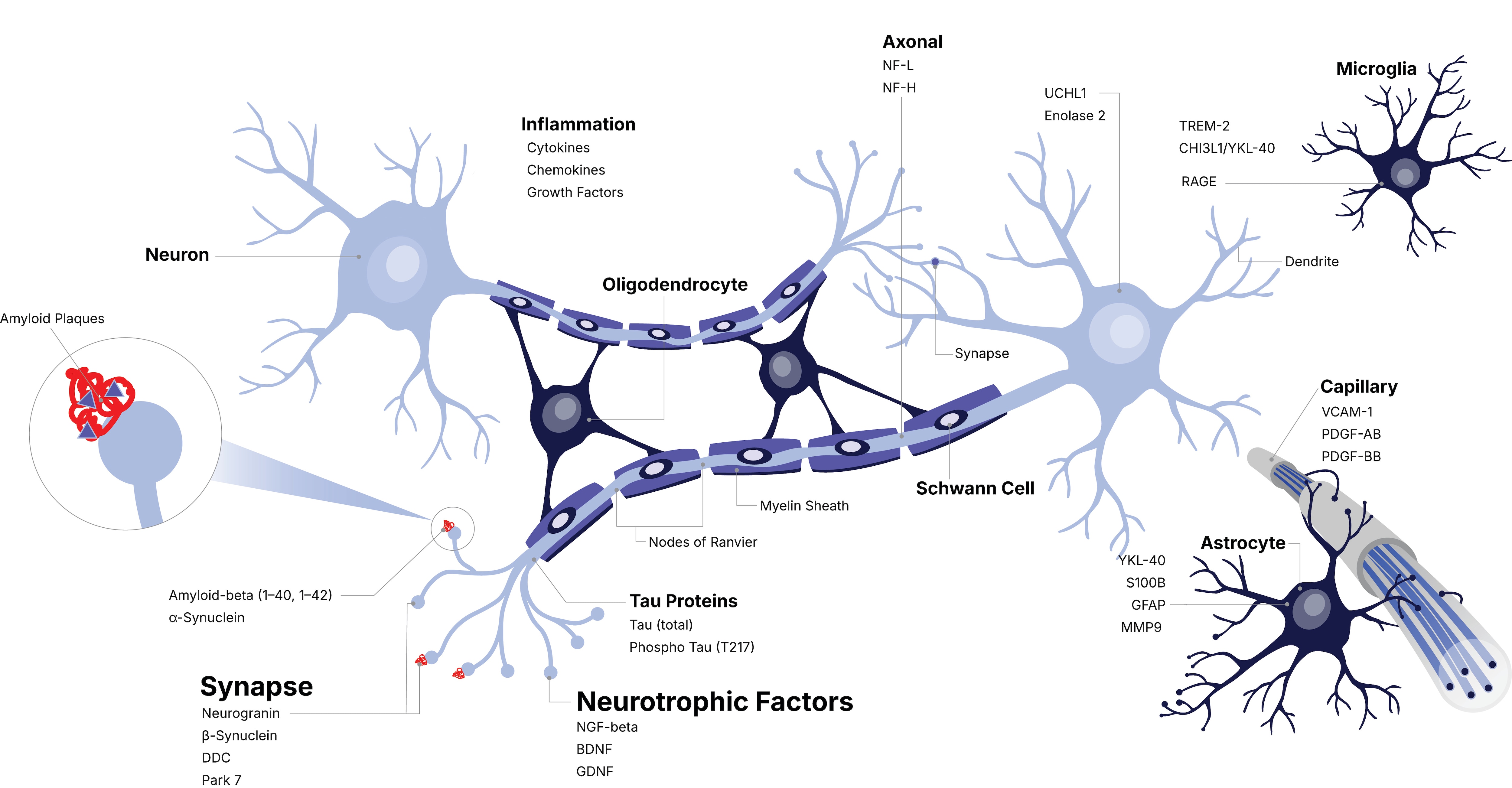
Key analytes available in Simple Plex Assays for the study of neurological health and disease including neuroinflammation, neurodegeneration, synaptic dysfunction, neuronal injury/ traumatic brain injury, and neurotrophic factors.
Neurodegeneration and Biomarker Detection with Simple Plex Assays
Neurodegenerative diseases, such as Alzheimer’s disease, Parkinson’s disease, Multiple Sclerosis, Amyotrophic Lateral Sclerosis (AL), and other related disorders, are marked by the progressive loss of neuronal structure and function, leading to cognitive decline, motor impairments, and other debilitating symptoms. Early detection and monitoring are key to understanding disease progression and developing effective treatments. Biomarkers found in blood and cerebrospinal fluid (CSF) are transforming how neurodegenerative conditions are diagnosed, enabling precision medicine and advancing research in this critical area. Simple Plex Assays offer highly sensitive and reliable detection of key biomarkers associated with neurodegeneration, including NF-L, NF-H.
NF-L: A Game-changing Biomarker for Neurological Disorders
The utility of NF-L as a neurodegeneration biomarker is enhanced by its ability to be measured in less invasive blood samples rather than CSF. However, because NF-L exists in very low concentrations in blood (in the low picogram per milliliter range), a highly sensitive assay is required to deliver accurate, reproducible data. In response, researchers have turned to advanced immunoassay platforms that combine sensitivity with efficiency. These systems incorporate enhanced detection methods, enabling the detection of low abundance biomarkers that traditional assays like ELISA might miss.
Evaluating Advanced Platforms for NF-L Measurement
Recent studies have demonstrated that Simple Plex Assays offer the sensitivity required to reliably measure NF-L in serum, plasma, and CSF across neurological conditions. Their effectiveness in blood samples has been confirmed through several head-to-head platform comparisons. Measuring blood levels of NF-L with Simple Plex permits earlier neurodegenerative disease detection with a reduced need for invasive CSF collection.
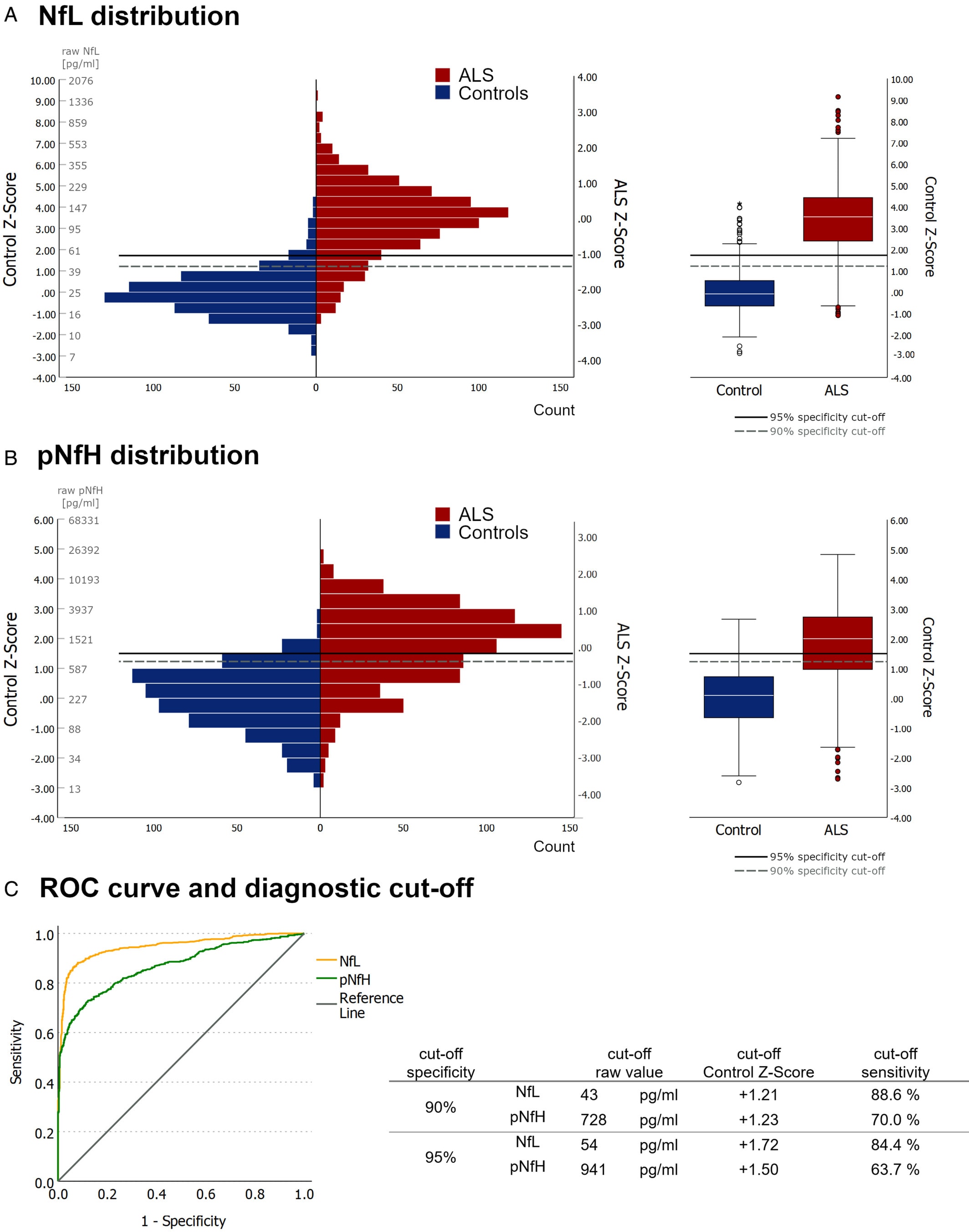
Quantitation of NfL in serum samples with Simple Plex NF-L Assays in patients with ALS (red) and controls (blue). Published by Witzel et. al., 2024. Figure reproduced under CCBY 4.0.
Assessing Neuroinflammation
Assessing neuroinflammation with immunoassays involves quantifying biomarkers associated with glial activation, immune response, and cytokine signaling, which help elucidate underlying neuroinflammatory processes. Glial fibrillary acidic protein (GFAP) is a specific astrocytic marker indicating astrocyte activation and injury. Triggering Receptor Expressed on Myeloid Cells 2 (TREM2) serves as a key microglial biomarker, reflecting microglial activity, particularly in neurodegenerative conditions like Alzheimer’s disease. Chemokine and cytokine assays enable the evaluation of pro-inflammatory (e.g., IL-1β, TNF-α) and anti-inflammatory (e.g., IL-4, IL-10) signaling molecules, offering insights into the balance of neuroimmune responses. Together, these biomarkers provide a comprehensive profile of neuroinflammatory states, facilitating research and potential clinical applications.
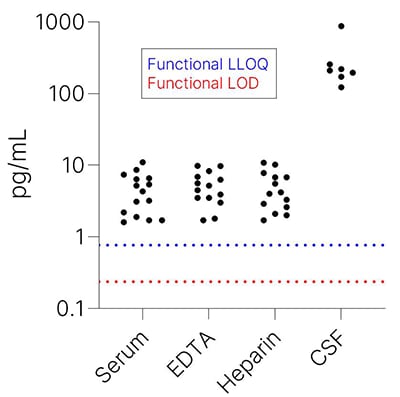
Measuring endogenous levels with Simple Plex Ultra-Sensitive Human GFAP Assay
Functional LOD and functional LLOQ are calculated as the LOD and LLOQ of the assay multiplied by the minimum required dilution (MRD) for the sample type.
Alzheimer’s Disease and Protein Misfolding Pathologies
Biomarkers in blood and cerebrospinal fluid (CSF) have emerged as valuable tools for diagnosing and monitoring protein misfolding pathologies and disease progression. Amyloid-beta, phospho-tau 217 (pTau 217), and alpha-synuclein biomarkers offer invaluable insights into protein misfolding pathologies:
- Amyloid-beta: Changes in amyloid-beta levels, particularly the 40/42 ratio, are critical for early detection and disease monitoring, with Simple Plex assays providing ultra-sensitive measurements in blood and CSF.
- Phospho-tau 217 (pTau 217): Phosphorylated tau protein (pTau-217) has emerged as one of the most promising biomarkers in Alzheimer’s disease research.
- Alpha-synuclein: This protein, known for its role in synucleinopathies like Parkinson’s disease and dementia with Lewy bodies, can exhibit pathological aggregation in the brain. Detecting alpha-synuclein levels in biofluids helps uncover mechanisms of disease and track progression across a range of neurodegenerative diseases.
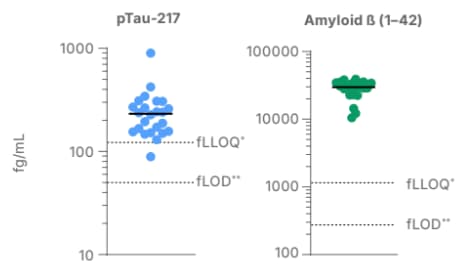
pTau-217 and Amyloid B (1-42) were quantified in plasma of healthy donors (age 55+) using Simple Plex Ultra-Sensitive Assays. The results indicate full detectability and near complete quantifiability of all samples. fLLOQ = functional Lower Limit of Quantitation (=analytical LLOQ x dilution factor). fLOD = functional Lower Limit of Detection (=analytical LOD x dilution factor)
Parkinson's disease (PD) is a progressive neurodegenerative disorder characterized by motor and non-motor impairments resulting from the loss of dopaminergic neurons in the brain. Early and accurate detection of Parkinson's disease is critical for improving disease management and advancing research into effective treatments. Simple Plex Assays enable the highly sensitive detection of key Parkinson’s-related biomarkers, including Dopa Decarboxylase (DDC), alpha-synuclein, and PARK-7. These biomarkers play essential roles in understanding the pathology of Parkinson’s disease:
- Dopa Decarboxylase (DDC): This enzyme is central to dopamine synthesis, and its dysregulation can provide insight into the neuronal processes impaired in Parkinson’s disease.
- Alpha-synuclein: A hallmark of Parkinson’s pathology, alpha-synuclein aggregation in the brain is a key contributor to neuronal dysfunction and degeneration. Changes in alpha-synuclein levels in CSF or blood are promising indicators for early detection and tracking disease progression.
- PARK7- also known as DJ-1, is a cytoplasmic protein that belongs to the ThiJ/Pfp1/DJ-1 superfamily of highly conserved proteins that function as protein chaperones, catalases, proteases and kinases. Park7 is widely expressed in the brain as well as in peripheral tissues. Park7 is a redox-sensitive protein that has been ascribed various functions including that as a redox sensor and antioxidant protein. Mutations in Park7 are associated with a small percentage of hereditary early onset Parkinson's disease.
Using Simple Plex technology, these biomarkers can be reliably and reproducibly detected in serum, plasma, or CSF, offering exceptional accuracy without invasive measures. The simplified workflow and high sensitivity of Simple Plex Assays make them a powerful tool for driving innovation in Parkinson’s disease research.
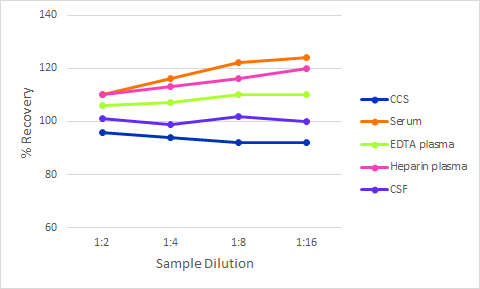
Simple Plex Discovery Human DDC Assay Linearity in different sample types.
Neuronal Injury and TBI Research
Traumatic Brain Injury (TBI) is a significant global health challenge, accounting for countless lives lost and causing long-term disabilities. Beyond the immediate trauma, emerging evidence highlights the pivotal role of systemic inflammation—not merely as a consequence of TBI, but potentially as a driver of ongoing neurological damage. This inflammatory cascade may hold the key to improving outcomes for TBI patients, making its understanding and mitigation a critical focus of research.
Recognizing the complexity of TBI-associated neuroinflammation, Simple Plex assays provide powerful tools for advancing TBI research. These assays offer highly sensitive and reliable quantification of key brain injury biomarkers, including GFAP, UCH-L1, NF-L, S100B, Total Tau, and Enolase 2. Designed to detect these biomarkers with precision across a wide dynamic range—even at extremely low concentrations—Simple Plex assays allow researchers to capture the subtle yet critical changes underpinning TBI progression and recovery.
For Dr. Ed Needham, PhD, Consultant Neurologist and Senior Clinical Research Associate at the University of Cambridge, reliable detection of these biomarkers is essential to his work. Dr. Needham leads a laboratory dedicated to decoding the immunological response to severe TBI, which plays a crucial role in understanding how inflammation drives neurological outcomes.
“We chose Simple Plex Assays because of their ability to multiplex across a broad dynamic range. Some of these mediators are expressed at extremely low concentrations and being able to capture those reliably is essential.”

Dr. Ed Needham, Senior Clinical Research Associate, University of Cambridge
Simple Plex Neuroscience Assays
| Simple Plex Assays | Catalog Number | Simple Plex Assays | Catalog Number |
|---|---|---|---|
| Phospho-Tau (T217) (Ultra-Sensitive) | SPCKB-PS-015536 | NF-L (Ultra-Sensitive) | SPCKB-PS-015538 |
| Amyloid Beta (aa1-42) (Ultra-Sensitive) | SPCKB-PS-015537 | GFAP (Ultra-Sensitive) | SPCKB-PS-015539 |
| alpha-Synuclein | SPCKC-PS-011989 | Neurofilament Light (NF-H) (Discovery) | SPCKB-PS-013074 |
| Amyloid beta 1-40 | SPCKB-PS-008817 | Neurogranin | SPCKB-PS-009250 |
| Amyloid beta 1-42 | SPCKB-PS-008816 | Phospho-Tau (T217) | SPCKB-PS-011938 |
| BDNF | SPCKB-PS-000389 | S100B | SPCKC-PS-009486 |
| beta-NGF | SPCKB-PS-000623 | sTREM-2 | SPCKB-PS-001847 |
| beta-Synuclein | SPCKB-PS-010127 | Syndecan-1 (Discovery) | SPCKB-PS-014654 |
| Dopa Decarboxylase/DDC (Discovery) | SPCKB-PS-015351 | Syndecan-4 | SPCKB-PS-009775 |
| GFAP | SPCKB-PS-009134 | Total Tau | SPCKC-PS-009562 |
| GDNF (Discovery) | SPCKB-PS-012636 | UCH-L1 | SPCKB-PS-010947 |
| Neurofilament Heavy (NF-L) | SPCKB-PS-002448 | YKL-40/ CHI3L1 | SPCKB-PS-000255 |
| Park 7 (Discovery) | SPCKB-PS-012424 | Ella System | 600-100 |

Meet Ella
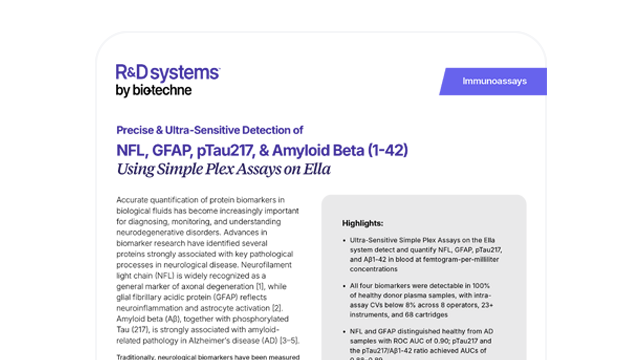
Precise & Ultra-Sensitive Detection of NFL, GFAP, pTau217, Amyloid Beta
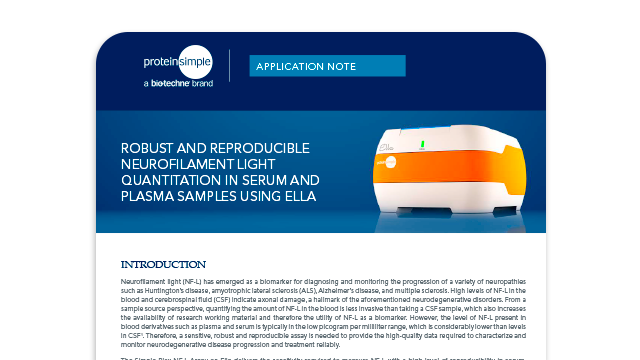
Reproducible Neurofilament Light Quantitation
Case Study: Advancing Neuroscience Discovery
Webinar: Next Generation Analysis of Blood-based Neurological Biomarkers
Webinar: Explore How Validated Fluid Biomarker Assays Advance Clinical Research for Neurological Diseases.