
Interleukin 6 (IL-6) is a pleiotropic alpha -helical cytokine that plays important roles in acute phase reactions, inflammation, hematopoiesis, bone metabolism, and cancer progression. IL-6 activity is central to the transition from acute inflammation to either acquired immunity or chronic inflammatory disease. It is secreted by multiple cell types as a 22 kDa‑28 kDa phosphorylated and variably glycosylated molecule (1‑4). Mature feline IL-6 is 181 amino acids (aa) in length and shares 76%, 58%, 39%, and 41% aa sequence identity with canine, human, mouse, and rat IL-6, respectively (5). IL-6 induces signaling through a cell surface heterodimeric receptor complex composed of a ligand binding subunit (IL-6 R) and a signal transducing subunit (gp130). IL-6 binds to IL-6 R, triggering IL-6 R association with gp130 and gp130 dimerization (6). gp130 is also a component of the receptors for CLC, CNTF, CT-1, IL-11, IL-27, LIF, and OSM (7). Soluble forms of IL-6 R are generated by both alternate splicing and proteolytic cleavage (3). In a mechanism known as trans-signaling, complexes of soluble IL-6 and IL-6 R elicit responses from gp130‑expressing cells that lack cell surface IL-6 R (3). Trans-signaling enables a wider range of cell types to respond to IL-6, as the expression of gp130 is ubiquitous while that of IL-6 R is predominantly restricted to hepatocytes, leukocytes, and lymphocytes (3). Soluble splice forms of gp130 block trans-signaling from IL-6/IL-6 R but not from other cytokines that utilize gp130 as a coreceptor (4, 8).

Key Product Details
Species Reactivity
Feline
Applications
Western Blot, Neutralization, Immunocytochemistry
Label
Unconjugated
Antibody Source
Polyclonal Goat IgG
Loading...
Product Specifications
Immunogen
E. coli-derived recombinant feline IL‑6
Thr28-Met208 (Glu133Lys)
Accession # P41683
Thr28-Met208 (Glu133Lys)
Accession # P41683
Specificity
Detects feline IL‑6 in direct ELISAs and Western blots. In direct ELISAs, approximately 15% cross-reactivity with recombinant canine IL‑6, recombinant porcine IL‑6 and recombinant human IL‑6 is observed and less than 10% cross-reactivity with recombinant mouseIL‑6 and recombinant rat IL‑6 is observed.
Clonality
Polyclonal
Host
Goat
Isotype
IgG
Endotoxin Level
<0.20 EU per 1 μg of the antibody by the LAL method.
Scientific Data Images for Feline IL-6 Antibody
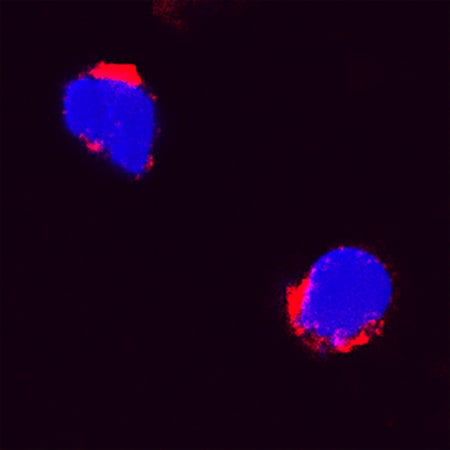
IL‑6 in Feline PBMCs.
IL-6 was detected in immersion fixed feline peripheral blood mononuclear cells (PBMCs) using Goat Anti-Feline IL-6 Antigen Affinity-purified Polyclonal Antibody (Catalog # AF2305) at 15 µg/mL for 3 hours at room temperature. Cells were stained using the NorthernLights™ 557-conjugated Anti-Goat IgG Secondary Antibody (red; Catalog # NL001) and counterstained with DAPI (blue). Specific staining was localized to cytoplasm. View our protocol for Fluorescent ICC Staining of Non-adherent Cells.
Cell Proliferation Induced by IL‑6 and Neutralization by Feline IL‑6 Antibody.
Recombinant Feline IL-6 (Catalog # 2305-FL) stimulates proliferation in the T1165.85.2.1 mouse plasmacytoma cell line in a dose-dependent manner (orange line). Proliferation elicited by Recombinant Feline IL-6 (10 ng/mL) is neutralized (green line) by increasing concentrations of Goat Anti-Feline IL-6 Antigen Affinity-purified Polyclonal Antibody (Catalog # AF2305). The ND50 is typically 0.2-0.6 µg/mL.Applications for Feline IL-6 Antibody
Application
Recommended Usage
Immunocytochemistry
5-15 µg/mL
Sample: Immersion fixed feline peripheral blood mononuclear cells (PBMCs)
Sample: Immersion fixed feline peripheral blood mononuclear cells (PBMCs)
Western Blot
0.1 µg/mL
Sample: Recombinant Feline IL‑6 (Catalog # 2305-FL)
Sample: Recombinant Feline IL‑6 (Catalog # 2305-FL)
Neutralization
Measured by its ability to neutralize IL‑6-induced proliferation in the T1165.85.2.1 mouse plasmacytoma cell line. Nordan, R. P. and M. Potter (1986) Science 233:566. The Neutralization Dose (ND50) is typically 0.2-0.6 µg/mL in the presence of 10 ng/mL Recombinant Feline IL‑6.
Formulation, Preparation, and Storage
Purification
Antigen Affinity-purified
Reconstitution
Reconstitute at 0.2 mg/mL in sterile PBS. For liquid material, refer to CoA for concentration.
Loading...
Formulation
Lyophilized from a 0.2 μm filtered solution in PBS with Trehalose. *Small pack size (SP) is supplied either lyophilized or as a 0.2 µm filtered solution in PBS.
Shipping
Lyophilized product is shipped at ambient temperature. Liquid small pack size (-SP) is shipped with polar packs. Upon receipt, store immediately at the temperature recommended below.
Stability & Storage
Use a manual defrost freezer and avoid repeated freeze-thaw cycles.
- 12 months from date of receipt, -20 to -70 °C as supplied.
- 1 month, 2 to 8 °C under sterile conditions after reconstitution.
- 6 months, -20 to -70 °C under sterile conditions after reconstitution.
Calculators
Background: IL-6
References
- Van Snick, J. (1990) Annu. Rev. Immunol. 8:253.
- Hodge, D.R. et al. (2005) Eur. J. Cancer 41:2502.
- Jones, S.A. (2005) J. Immunol. 175:3468.
- Rose-John, S. et al. (2006) J. Leukoc. Biol. 80:227.
- Ohashi, T. et al. (1993) J. Vet. Med. Sci. 5:941.
- Murakami, M. et al. (1993) Science 260:1808.
- Muller-Newen, G. (2003) Sci. STKE 2003:PE40.
- Mitsuyama, K. et al. (2006) Clin. Exp. Immunol. 143:125.
Long Name
Interleukin 6
Alternate Names
BSF-2, BSF2, IFNB2, IL6, MGI-2A
Entrez Gene IDs
Gene Symbol
IL6
UniProt
Additional IL-6 Products
Product Documents for Feline IL-6 Antibody
Certificate of Analysis
To download a Certificate of Analysis, please enter a lot or batch number in the search box below.
Note: Certificate of Analysis not available for kit components.
Product Specific Notices for Feline IL-6 Antibody
For research use only
Related Research Areas
Citations for Feline IL-6 Antibody
 Powered by Bioz
Customer Reviews for Feline IL-6 Antibody
There are currently no reviews for this product. Be the first to review Feline IL-6 Antibody and earn rewards!
Have you used Feline IL-6 Antibody?
Submit a review and receive an Amazon gift card!
$25/€18/£15/$25CAN/¥2500 for a review with an image
$10/€7/£6/$10CAN/¥1110 for a review without an image
Submit a review
Protocols
Find general support by application which include: protocols, troubleshooting, illustrated assays, videos and webinars.
- Appropriate Fixation of IHC/ICC Samples
- Cellular Response to Hypoxia Protocols
- ClariTSA™ Fluorophore Kits
- Detection & Visualization of Antibody Binding
- ICC Cell Smear Protocol for Suspension Cells
- ICC Immunocytochemistry Protocol Videos
- ICC for Adherent Cells
- Immunocytochemistry (ICC) Protocol
- Immunocytochemistry Troubleshooting
- Immunofluorescence of Organoids Embedded in Cultrex Basement Membrane Extract
- Immunohistochemistry (IHC) and Immunocytochemistry (ICC) Protocols
- Preparing Samples for IHC/ICC Experiments
- Preventing Non-Specific Staining (Non-Specific Binding)
- Primary Antibody Selection & Optimization
- Protocol for VisUCyte™ HRP Polymer Detection Reagent
- Protocol for the Fluorescent ICC Staining of Cell Smears - Graphic
- Protocol for the Fluorescent ICC Staining of Cultured Cells on Coverslips - Graphic
- Protocol for the Preparation and Fluorescent ICC Staining of Cells on Coverslips
- Protocol for the Preparation and Fluorescent ICC Staining of Non-adherent Cells
- Protocol for the Preparation and Fluorescent ICC Staining of Stem Cells on Coverslips
- Protocol for the Preparation of a Cell Smear for Non-adherent Cell ICC - Graphic
- R&D Systems Quality Control Western Blot Protocol
- TUNEL and Active Caspase-3 Detection by IHC/ICC Protocol
- The Importance of IHC/ICC Controls
- Troubleshooting Guide: Western Blot Figures
- Western Blot Conditions
- Western Blot Protocol
- Western Blot Protocol for Cell Lysates
- Western Blot Troubleshooting
- Western Blot Troubleshooting Guide
- View all Protocols, Troubleshooting, Illustrated assays and Webinars
Loading...
Associated Pathways

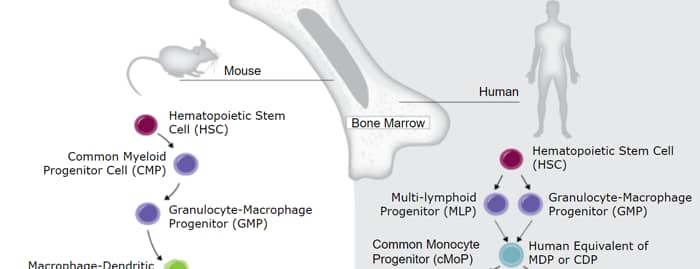


IL-21 Signaling Pathways and their Primary Biological Effects in Different Immune Cell Types
 Jak/STAT Signaling Pathway
 Mesenchymal Stem Cell Differentiation Pathways & Lineage-specific Markers
 NOD-like Receptor Signaling Pathways
 Th17 Differentiation Pathway
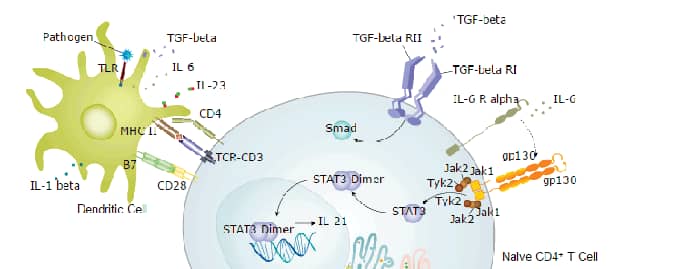 Toll-Like Receptor Signaling Pathways
