Epithelial Cellular Adhesion Molecule (EpCAM), also known as KS1/4, gp40, GA733-2, 17-1A, and TROP-1, is a 40 kDa transmembrane glycoprotein composed of a 242 amino acid (aa) extracellular domain with two epidermal-growth-factor-like (EGF-like) repeats within the cysteine-rich N-terminal region, a 23 aa transmembrane domain, and a 26 aa cytoplasmic domain. Human and mouse EpCAM share 82% aa sequence identity. In human, EpCAM also shares 49% aa sequence homology with TROP-2/EGP-1. During embryonic development, EpCAM is detected in fetal lung, kidney, liver, pancreas, skin, and germ cells. In adults, human EpCAM is detected in basolateral cell membranes of all simple, pseudo-stratified, and transitional epithelia, but is not detected in normal squamous stratified epithelia, mesenchymal tissue, muscular tissue, neuro-endocrine tissue, or lymphoid tissue (1). EpCAM expression has been found to increase in actively proliferating epithelia tissues and during adult liver regeneration (1, 2). EpCAM expression is also found to increase in human malignant neoplasias, with most carcinoma expressing EpCAM including those of arising from squamous epithelia (1). EpCAM has been shown function as a homophilic Ca2+ independent adhesion molecule (3). Homophilic adhesion via EpCAM requires the interaction of both EGF-like repeats, with the first EGF-like repeat mediating reciprocal interaction between EpCAM molecules on opposing cells, while the second repeat is involved in lateral interaction of EpCAM. Lateral interaction of EpCAM lead to the formation of dimers and tetramers (4). During homophilic adhesion the cytoplasmic tail of EpCAM interacts with the actin cytoskeleton via a direct association alpha -actinin (5).

Scientific images may be resized, cropped, or adjusted for brightness or contrast for presentation purposes. These updates are limited to presentation and do not affect the underlying scientific interpretation of the data. Where available, additional source data may be provided upon request.
Key Product Details
Species Reactivity
Validated:
Cited:
Applications
Validated:
Cited:
Label
Antibody Source
Product Specifications
Immunogen
Gln24-Lys265
Accession # CAA32870
Specificity
Clonality
Host
Isotype
Scientific Data Images for Human EpCAM/TROP1 Antibody
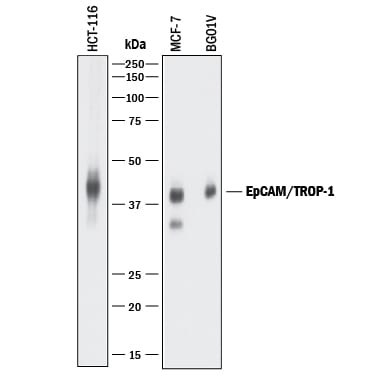
Detection of Human EpCAM/TROP‑1 by Western Blot.
Western blot shows lysates of HCT-116 human colorectal carcinoma cell line, MCF-7 human breast cancer cell line, and BG01V human embryonic stem cells. PVDF membrane was probed with 0.2 µg/mL of Goat Anti-Human EpCAM/TROP-1 Antigen Affinity-purified Polyclonal Antibody (Catalog # AF960) followed by HRP-conjugated Anti-Goat IgG Secondary Antibody (HAF017). A specific band was detected for EpCAM/TROP-1 at approximately 40 kDa (as indicated). This experiment was conducted under reducing conditions and using Immunoblot Buffer Group 1.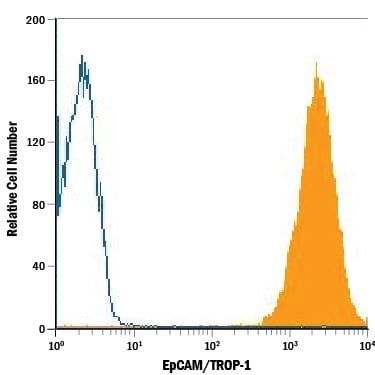
Detection of EpCAM/TROP‑1 in HT‑29 Human Cell Line by Flow Cytometry.
HT-29 human colon adenocarcinoma cell line was stained with Goat Anti-Human EpCAM/TROP-1 Antigen Affinity-purified Polyclonal Antibody (Catalog # AF960, filled histogram) or isotype control antibody (AB-108-C, open histogram), followed by Phycoerythrin-conjugated Anti-Goat IgG Secondary Antibody (F0107).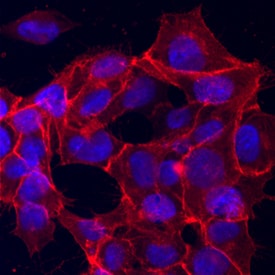
EpCAM/TROP‑1 in BG01V Human Embryonic Stem Cells.
EpCAM/TROP-1 was detected in immersion fixed BG01V human embryonic stem cells using Goat Anti-Human EpCAM/TROP-1 Antigen Affinity-purified Polyclonal Antibody (Catalog # AF960) at 10 µg/mL for 3 hours at room temperature. Cells were stained using the NorthernLights™ 557-conjugated Anti-Goat IgG Secondary Antibody (red; Catalog # NL001) and counterstained with DAPI (blue). Specific staining was localized to cytoplasm and cell membrane. View our protocol for Fluorescent ICC Staining of Cells on Coverslips.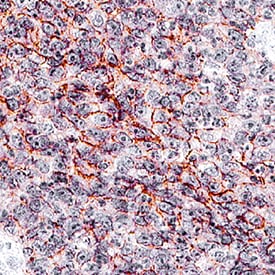
EpCAM/TROP‑1 in Human Colon.
EpCAM/TROP-1 was detected in immersion fixed paraffin-embedded sections of human colon using Goat Anti-Human EpCAM/TROP-1 Antigen Affinity-purified Polyclonal Antibody (Catalog # AF960) at 0.3 µg/mL for 1 hour at room temperature followed by incubation with the Anti-Goat IgG VisUCyte™ HRP Polymer Antibody (VC004). Before incubation with the primary antibody, tissue was subjected to heat-induced epitope retrieval using Antigen Retrieval Reagent-Basic (Catalog # CTS013). Tissue was stained using DAB (brown) and counterstained with hematoxylin (blue). Specific staining was localized to cytoplasm and plasma membrane. View our protocol for IHC Staining with VisUCyte HRP Polymer Detection Reagents.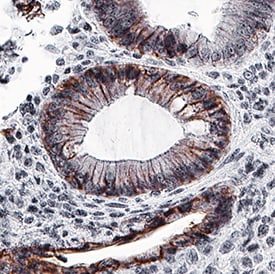
EpCAM/TROP‑1 in Human Colon.
EpCAM/TROP-1 was detected in immersion fixed paraffin-embedded sections of human colon using Goat Anti-Human EpCAM/TROP-1 Antigen Affinity-purified Polyclonal Antibody (Catalog # AF960) at 0.3 µg/mL for 1 hour at room temperature followed by incubation with the Anti-Goat IgG VisUCyte™ HRP Polymer Antibody (VC004). Before incubation with the primary antibody, tissue was subjected to heat-induced epitope retrieval using Antigen Retrieval Reagent-Basic (CTS013). Tissue was stained using DAB (brown) and counterstained with hematoxylin (blue). Specific staining was localized to cytoplasm and plasma membrane. View our protocol for IHC Staining with VisUCyte HRP Polymer Detection Reagents.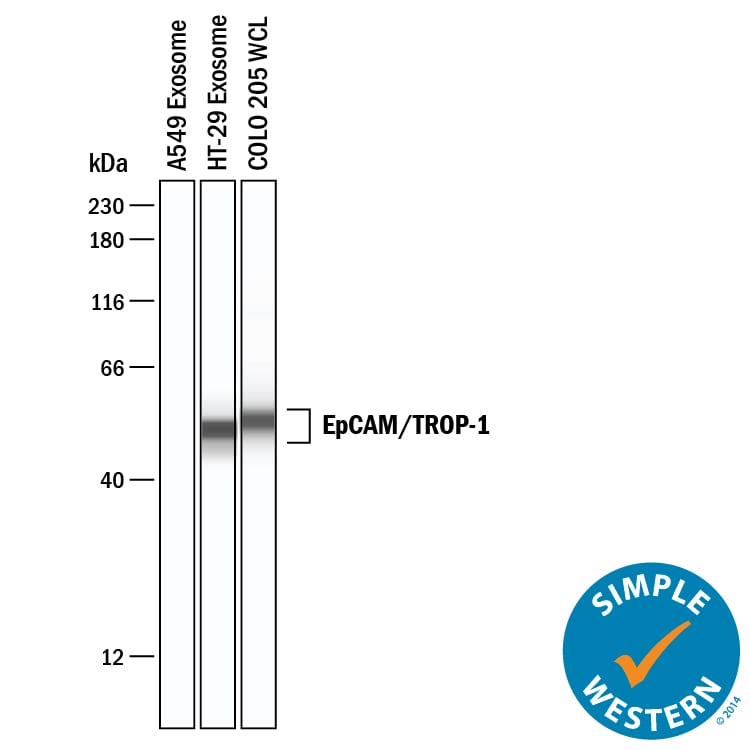
Detection of Human EpCAM/TROP‑1 by Simple WesternTM.
Simple Western lane view shows lysates of A549 human lung carcinoma cell line exosomes, HT‑29 human colon adenocarcinoma cell line exosomes, and COLO 205 human colorectal adenocarcinoma cell line whole cell lysate (WCL), loaded at 0.2 mg/mL. A specific band was detected for EpCAM/TROP‑1 at approximately 52 kDa (as indicated) using 10 µg/mL of Goat Anti-Human EpCAM/TROP‑1 Antigen Affinity-purified Polyclonal Antibody (Catalog # AF960). This experiment was conducted under reducing conditions and using the 12-230 kDa separation system.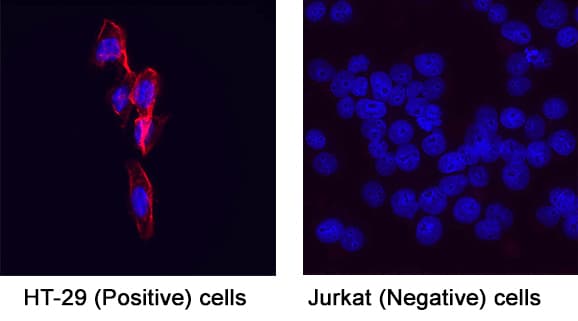
Detection of EpCAM/TROP‑1 in HT-29 Human Colon Adenocarcinoma Cell Line (Positive) and Jurkat Human Acute T Cell Leukemia Cell Line (Negative) Cells.
EpCAM/TROP‑1 was detected in immersion fixed HT‑29 human colon adenocarcinoma cell line (positive) and Jurkat human acute T cell leukemia cell line (negative) cells using Goat Anti-Human EpCAM/TROP‑1 Antigen Affinity-purified Polyclonal Antibody (Catalog # AF960) at 5 µg/mL for 3 hours at room temperature. Cells were stained using the NorthernLights™ 557-conjugated Anti-Goat IgG Secondary Antibody (red; Catalog # NL001) and counterstained with DAPI (blue). Specific staining was localized to cell surface. View our protocol for Fluorescent ICC Staining of Cells on Coverslips.
Human EpCAM / TROP1 ELISA Standard Curve
Recombinant HumanEpCAM/TROP‑1 Fc Chimera (Catalog # 960-EP) was serially diluted and captured by Mouse Anti-Human
EpCAM/TROP‑1 Monoclonal Antibody (Catalog # MAB9601) coated on a Clear Polystyrene Microplate (Catalog # DY990). Goat Anti-Human
EpCAM/TROP‑1 Antigen Affinity-purified Polyclonal Antibody (Catalog # AF960) was biotinylated and incubated with the protein captured on the plate. Detection of the standard curve was achieved by incubating Streptavidin-HRP (Catalog # DY998)
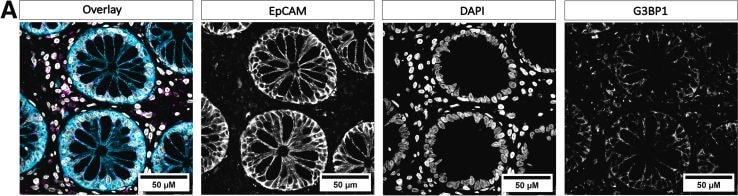
Detection of EpCAM/TROP1 by Immunohistochemistry
Laser-scanning confocal images of human colon cross sections with the PCP workflow applied. (A) Representative laser-scanning confocal images, stained with EpCAM (cyan), DAPI (gray), and G3BP1 (magenta). Scale bars represent 50 μm as indicated. (B) Illustrative images of the pipeline’s workflow to identify cells within the lamina propria. The IdentifyPrimaryObjects module was initially applied to delineate nuclei (I) and to recognize the intestinal feature within the whole image (II). The MaskObjects module was then implemented to remove the nuclei of cells that were within the specified intestinal region (III). Subsequently, the IdentifySecondaryObjects module was used to define a cell object by a specific set of pixels from the nucleus as starting point (IV). To identify G3BP1 spots, the IdentifyPrimaryObjects module was employed once more on the G3BP1 immunoreactivity channel (V). Image VI illustrates a comprehensive delineation of G3BP1-positive and -negative cells. The combination of all final objects permits the monitoring of individual cells (cyan for G3BP1-positive and magenta for G3BP1-negative), and G3BP1 spots (yellow) within a final image (VII and VIII). Image collected and cropped by CiteAb from the following open publication (https://pubmed.ncbi.nlm.nih.gov/41354404), licensed under a CC-BY license. Not internally tested by R&D Systems.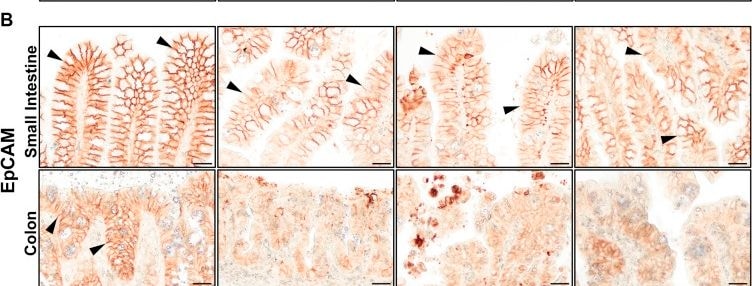
Detection of EpCAM/TROP1 by Immunohistochemistry
Cleavage-resistant EpCAM does not prevent deterioration of intestinal epithelia in HAI-2-deficient mice. (A-C) Representative images (from at least five mice per genotype) of H&E staining (A), and EpCAM (B) and claudin-7 (C) immunostaining of small (top panels) and large (bottom panels) intestines from 5 days old control (left), and HAI-2-deficient (Vil-Cre+/0;Spint2fl/−) mice expressing wildtype (Epcam+/+), R80L (EpcamL/L) or R80Q (EpcamQ/Q) EpCAM. Histological changes associated with a loss of HAI-2 function, including villous atrophy and tufting (A, arrowheads) in the small intestine, and increased epithelial erosion (A, open arrowheads), loss of mucin-producing goblet cells (A, arrows) and a loss of normal crypt structure in large intestines, were unaffected in mice expressing cleavage-resistant EpCAM. Similarly, loss of membrane-associated EpCAM expression (B, arrowheads) persisted in both the Vil-Cre+/0;Spint2fl/−;EpcamL/L and the Vil-Cre+/0;Spint2fl/−;EpcamQ/Q mice. In contrast, overall expression and membrane localization of claudin-7 (C, arrowheads) were largely restored in HAI-2-deficient mice expressing R80L or R80Q EpCAM. Scale bars: 50 µm (A); 25 µm (B,C). Image collected and cropped by CiteAb from the following open publication (https://pubmed.ncbi.nlm.nih.gov/37539662), licensed under a CC-BY license. Not internally tested by R&D Systems.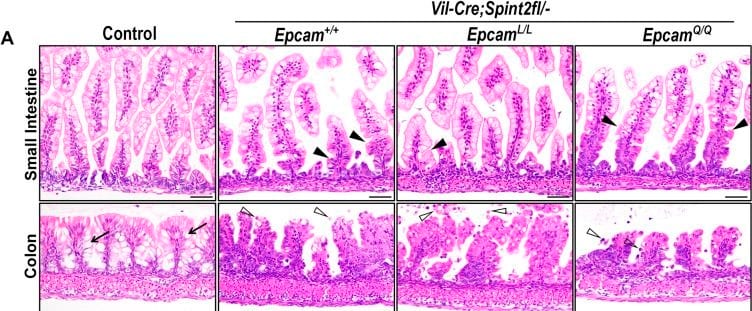
Detection of EpCAM/TROP1 by Immunohistochemistry
Cleavage-resistant EpCAM does not prevent deterioration of intestinal epithelia in HAI-2-deficient mice. (A-C) Representative images (from at least five mice per genotype) of H&E staining (A), and EpCAM (B) and claudin-7 (C) immunostaining of small (top panels) and large (bottom panels) intestines from 5 days old control (left), and HAI-2-deficient (Vil-Cre+/0;Spint2fl/−) mice expressing wildtype (Epcam+/+), R80L (EpcamL/L) or R80Q (EpcamQ/Q) EpCAM. Histological changes associated with a loss of HAI-2 function, including villous atrophy and tufting (A, arrowheads) in the small intestine, and increased epithelial erosion (A, open arrowheads), loss of mucin-producing goblet cells (A, arrows) and a loss of normal crypt structure in large intestines, were unaffected in mice expressing cleavage-resistant EpCAM. Similarly, loss of membrane-associated EpCAM expression (B, arrowheads) persisted in both the Vil-Cre+/0;Spint2fl/−;EpcamL/L and the Vil-Cre+/0;Spint2fl/−;EpcamQ/Q mice. In contrast, overall expression and membrane localization of claudin-7 (C, arrowheads) were largely restored in HAI-2-deficient mice expressing R80L or R80Q EpCAM. Scale bars: 50 µm (A); 25 µm (B,C). Image collected and cropped by CiteAb from the following open publication (https://pubmed.ncbi.nlm.nih.gov/37539662), licensed under a CC-BY license. Not internally tested by R&D Systems.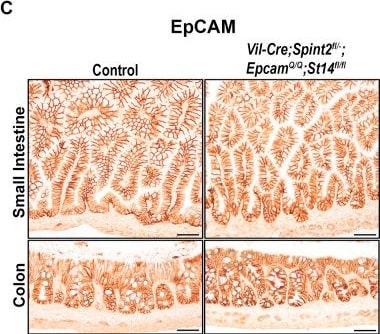
Detection of EpCAM/TROP1 by Immunohistochemistry
Intestinal defects in HAI-2-deficient mice expressing cleavage-resistant EpCAM are caused by matriptase. (A) Representative image (from at least five mice per genotype) of the overall appearance of 5-day-old matriptase-expressing (St14+/+) and intestinal matriptase-deficient (St14fl/fl) Vil-Cre+/0;Spint2fl/−;EpcamQ/Q mice, and their wildtype littermates (control). Inactivation of matriptase restored normal growth in mice lacking HAI-2 even when expressing cleavage-resistant EpCAM. (B-D) Representative images (from at least five mice per genotype) of H&E staining (B), and EpCAM (C) and claudin-7 (D) immunostaining of small (top panels) and large (bottom panels) intestines from 5-day-old control mice (left) and Vil-Cre+/0;Spint2fl/−;EpcamQ/Q mice lacking intestinal matriptase (Vil-Cre+/0;Spint2fl/−;EpcamQ/Q;St14fl/fl, right). Inactivation of matriptase restored normal histological appearance, and EpCAM and claudin-7 expression and cellular localization were all indistinguishable from those in wildtype littermate controls. (E,F) Representative image (four mice per genotype) of the overall appearance (E) and the intestinal histology (H&E) (F) of 21-day-old control and Vil-Cre+/0;Spint2fl/−;EpcamQ/Q;St14fl/fl mice. Mice with a combined HAI-2/matriptase deficiency presented with smaller size and abnormal histological morphology. Scale bars: 1 cm (A,E); 50 µm (B-D,F). Image collected and cropped by CiteAb from the following open publication (https://pubmed.ncbi.nlm.nih.gov/37539662), licensed under a CC-BY license. Not internally tested by R&D Systems.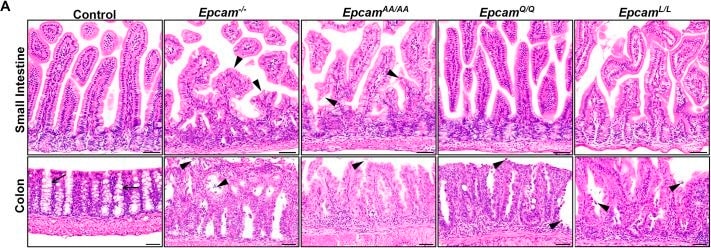
Detection of EpCAM/TROP1 by Immunohistochemistry
Elimination of Arg80 leads to compromised intestinal development, growth retardation and shortened lifespan in mice. (A) Representative images (from at least five mice per genotype) of H&E staining of small (top panels) and large (bottom panels) intestines from 21-day-old wildtype (control), Epcam null (Epcam−/−), EpcamAA/AA, EpcamQ/Q and EpcamL/L mice. Mice expressing EpCAM variants exhibited abnormal crypt architecture in the colon, associated with a loss of mucin-producing goblet cells (control, arrows) and increased shedding of intestinal epithelial cells (arrowheads). EpcamAA/AA, but not EpcamQ/Q and EpcamL/L, mice also present with irregular and tufted villi in the small intestine (arrowheads), similar to Epcam−/− mice. Scale bars: 50 µm. (B) Serum levels of FITC-dextran 3 h after oral gavage in 21-day-old wildtype (control, n=16), Epcam null (Epcam−/−, n=4), EpcamL/L (n=6), EpcamQ/Q (n=8), EpcamAA/AA (n=4) and Vil-Cre;St14fl/fl (n=7) mice. Complete loss of EpCAM or the expression of any of the variant lacking Arg80 increased intestinal permeability. Each data point represents a separate mouse. (C) Survival curve (left) and median survival (right) of wildtype (control, black), Epcam−/− (brown), EpcamL/L (green), EpcamQ/Q (red) and EpcamAA/AA (blue) mice. The numbers of mice of each genotype enrolled in the experiment are shown in parentheses. The expression of EpCAM variants was associated with significantly shortened lifespan. n.s., not significant; *P<0.05; ***P<0.001; ****P<0.0001. Image collected and cropped by CiteAb from the following open publication (https://pubmed.ncbi.nlm.nih.gov/37539662), licensed under a CC-BY license. Not internally tested by R&D Systems.Applications for Human EpCAM/TROP1 Antibody
CyTOF-ready
Flow Cytometry
Sample: HT‑29 human colon adenocarcinoma cell line
Immunocytochemistry
Sample: Immersion fixed BG01V human embryonic stem cells, HT-29 Human Colon Adenocarcinoma Cell Line and Jurkat Human Acute T Cell Leukemia Cell Line cells.
Immunohistochemistry
Sample: Immersion fixed paraffin-embedded sections of human colon
Simple Western
Sample: A549 human lung carcinoma cell line exosomes, HT‑29 human colon adenocarcinoma cell line exosomes, and COLO 205 human colorectal adenocarcinoma cell line whole cell lysate (WCL)
Western Blot
Sample: HCT‑116 human colorectal carcinoma cell line, MCF‑7 human breast cancer cell line, and BG01V human embryonic stem cells
Reviewed Applications
Read 1 review rated 5 using AF960 in the following applications:
Flow Cytometry Panel Builder
Bio-Techne Knows Flow Cytometry
Save time and reduce costly mistakes by quickly finding compatible reagents using the Panel Builder Tool.
Advanced Features
- Spectra Viewer - Custom analysis of spectra from multiple fluorochromes
- Spillover Popups - Visualize the spectra of individual fluorochromes
- Antigen Density Selector - Match fluorochrome brightness with antigen density

Formulation, Preparation, and Storage
Purification
Reconstitution
Reconstitute at 0.2 mg/mL in sterile PBS. For liquid material, refer to CoA for concentration.
Formulation
Shipping
Stability & Storage
- 12 months from date of receipt, -20 to -70 °C as supplied.
- 1 month, 2 to 8 °C under sterile conditions after reconstitution.
- 6 months, -20 to -70 °C under sterile conditions after reconstitution.
Calculators
Background: EpCAM/TROP1
References
- Balzar, M. et al. (1999) J. Mol. Med. 77:699.
- Boer, C.J. et al. (1999) J. Pathol. 188:201.
- Litvinow, S.V. et al. (1994) J. Cell Biol. 125:437.
- Balzar, M. et al. (2001) Mol. Cell. Biol. 21:2570.
- Balzar, M. et al. (1998) Mol. Cell. Biol. 18:4388.
Long Name
Alternate Names
Gene Symbol
UniProt
Additional EpCAM/TROP1 Products
Product Documents for Human EpCAM/TROP1 Antibody
Certificate of Analysis
To download a Certificate of Analysis, please enter a lot or batch number in the search box below.
Note: Certificate of Analysis not available for kit components.
Product Specific Notices for Human EpCAM/TROP1 Antibody
For research use only
Citations for Human EpCAM/TROP1 Antibody
 Powered by Bioz
Customer Reviews for Human EpCAM/TROP1 Antibody (1)
Have you used Human EpCAM/TROP1 Antibody?
Submit a review and receive an Amazon gift card!
$25/€18/£15/$25CAN/¥2500 for a review with an image
$10/€7/£6/$10CAN/¥1110 for a review without an image
Submit a review
Customer Images
-
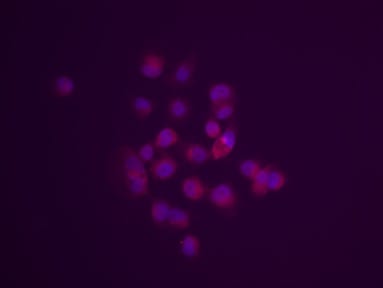
Application: ImmunocytochemistrySample Tested: MDA MB 231 cellsSpecies: HumanVerified Customer | Posted 11/16/2023MDA-MB 231 cells stained with AF960 antibody (red)

There are no reviews that match your criteria.
Protocols
Find general support by application which include: protocols, troubleshooting, illustrated assays, videos and webinars.
- 7-Amino Actinomycin D (7-AAD) Cell Viability Flow Cytometry Protocol
- Antigen Retrieval Protocol (PIER)
- Antigen Retrieval for Frozen Sections Protocol
- Appropriate Fixation of IHC/ICC Samples
- Cellular Response to Hypoxia Protocols
- Chromogenic IHC Staining of Formalin-Fixed Paraffin-Embedded (FFPE) Tissue Protocol
- Chromogenic Immunohistochemistry Staining of Frozen Tissue
- ClariTSA™ Fluorophore Kits
- Detection & Visualization of Antibody Binding
- Extracellular Membrane Flow Cytometry Protocol
- Flow Cytometry Protocol for Cell Surface Markers
- Flow Cytometry Protocol for Staining Membrane Associated Proteins
- Flow Cytometry Staining Protocols
- Flow Cytometry Troubleshooting Guide
- Fluorescent IHC Staining of Frozen Tissue Protocol
- Graphic Protocol for Heat-induced Epitope Retrieval
- Graphic Protocol for the Preparation and Fluorescent IHC Staining of Frozen Tissue Sections
- Graphic Protocol for the Preparation and Fluorescent IHC Staining of Paraffin-embedded Tissue Sections
- Graphic Protocol for the Preparation of Gelatin-coated Slides for Histological Tissue Sections
- ICC Cell Smear Protocol for Suspension Cells
- ICC Immunocytochemistry Protocol Videos
- ICC for Adherent Cells
- IHC Sample Preparation (Frozen sections vs Paraffin)
- Immunocytochemistry (ICC) Protocol
- Immunocytochemistry Troubleshooting
- Immunofluorescence of Organoids Embedded in Cultrex Basement Membrane Extract
- Immunofluorescent IHC Staining of Formalin-Fixed Paraffin-Embedded (FFPE) Tissue Protocol
- Immunohistochemistry (IHC) and Immunocytochemistry (ICC) Protocols
- Immunohistochemistry Frozen Troubleshooting
- Immunohistochemistry Paraffin Troubleshooting
- Intracellular Flow Cytometry Protocol Using Alcohol (Methanol)
- Intracellular Flow Cytometry Protocol Using Detergents
- Intracellular Nuclear Staining Flow Cytometry Protocol Using Detergents
- Intracellular Staining Flow Cytometry Protocol Using Alcohol Permeabilization
- Intracellular Staining Flow Cytometry Protocol Using Detergents to Permeabilize Cells
- Preparing Samples for IHC/ICC Experiments
- Preventing Non-Specific Staining (Non-Specific Binding)
- Primary Antibody Selection & Optimization
- Propidium Iodide Cell Viability Flow Cytometry Protocol
- Protocol for Heat-Induced Epitope Retrieval (HIER)
- Protocol for Liperfluo
- Protocol for Making a 4% Formaldehyde Solution in PBS
- Protocol for VisUCyte™ HRP Polymer Detection Reagent
- Protocol for the Characterization of Human Th22 Cells
- Protocol for the Characterization of Human Th9 Cells
- Protocol for the Fluorescent ICC Staining of Cell Smears - Graphic
- Protocol for the Fluorescent ICC Staining of Cultured Cells on Coverslips - Graphic
- Protocol for the Preparation & Fixation of Cells on Coverslips
- Protocol for the Preparation and Chromogenic IHC Staining of Frozen Tissue Sections
- Protocol for the Preparation and Chromogenic IHC Staining of Frozen Tissue Sections - Graphic
- Protocol for the Preparation and Chromogenic IHC Staining of Paraffin-embedded Tissue Sections
- Protocol for the Preparation and Chromogenic IHC Staining of Paraffin-embedded Tissue Sections - Graphic
- Protocol for the Preparation and Fluorescent ICC Staining of Cells on Coverslips
- Protocol for the Preparation and Fluorescent ICC Staining of Non-adherent Cells
- Protocol for the Preparation and Fluorescent ICC Staining of Stem Cells on Coverslips
- Protocol for the Preparation and Fluorescent IHC Staining of Frozen Tissue Sections
- Protocol for the Preparation and Fluorescent IHC Staining of Paraffin-embedded Tissue Sections
- Protocol for the Preparation of Gelatin-coated Slides for Histological Tissue Sections
- Protocol for the Preparation of a Cell Smear for Non-adherent Cell ICC - Graphic
- Protocol: Annexin V and PI Staining by Flow Cytometry
- Protocol: Annexin V and PI Staining for Apoptosis by Flow Cytometry
- R&D Systems Quality Control Western Blot Protocol
- TUNEL and Active Caspase-3 Detection by IHC/ICC Protocol
- The Importance of IHC/ICC Controls
- Troubleshooting Guide: Fluorokine Flow Cytometry Kits
- Troubleshooting Guide: Immunohistochemistry
- Troubleshooting Guide: Western Blot Figures
- Western Blot Conditions
- Western Blot Protocol
- Western Blot Protocol for Cell Lysates
- Western Blot Troubleshooting
- Western Blot Troubleshooting Guide
- View all Protocols, Troubleshooting, Illustrated assays and Webinars