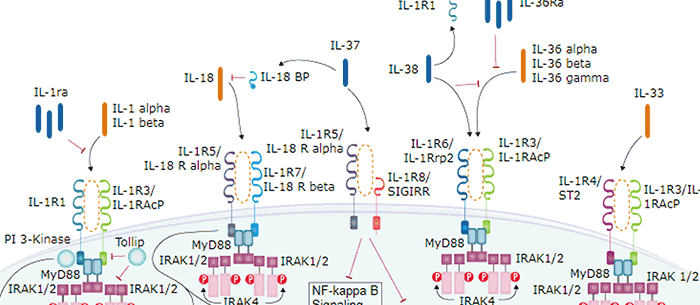
IL-18/IL-1F4 Antibody
R&D Systems | Catalog # AF2548


Scientific images may be resized, cropped, or adjusted for brightness or contrast for presentation purposes. These updates are limited to presentation and do not affect the underlying scientific interpretation of the data. Where available, additional source data may be provided upon request.
Key Product Details
Validated by
Species Reactivity
Validated:
Cited:
Applications
Validated:
Cited:
Label
Antibody Source
Product Specifications
Immunogen
Tyr37-Asp193
Accession # AAK13416
Specificity
Clonality
Host
Isotype
Endotoxin Level
Scientific Data Images for IL-18/IL-1F4 Antibody
Detection of Human IL‑18/IL‑1F4 by Western Blot.
Western blot shows lysates of PC-3 human prostate cancer cell line, MCF 10A human breast epithelial cell line, A431 human epithelial carcinoma cell line, and HEK293T human embryonic kidney cell line (negative control cell line). PVDF membrane was probed with 0.5 µg/mL of Goat Anti-Human/Rhesus Macaque IL-18/IL-1F4 Antigen Affinity-purified Polyclonal Antibody (Catalog # AF2548) followed by HRP-conjugated Anti-Goat IgG Secondary Antibody (Catalog # HAF017). A specific band was detected for IL-18/IL-1F4 at approximately 22 kDa (as indicated). GAPDH (Catalog # AF5718) is shown as a loading control. This experiment was conducted under reducing conditions and using Immunoblot Buffer Group 1.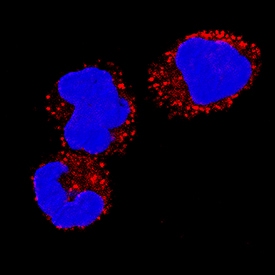
IL‑18/IL‑1F4 in Human PBMCs.
IL-18/IL-1F4 was detected in immersion fixed human peripheral blood mononuclear cells (PBMCs) using Goat Anti-Human/Rhesus Macaque IL-18/IL-1F4 Antigen Affinity-purified Polyclonal Antibody (Catalog # AF2548) at 5 µg/mL for 3 hours at room temperature. Cells were stained using the NorthernLights™ 557-conjugated Anti-Goat IgG Secondary Antibody (red; Catalog # NL001) and counterstained with DAPI (green). Specific staining was localized to cytoplasm. View our protocol for Fluorescent ICC Staining of Non-adherent Cells.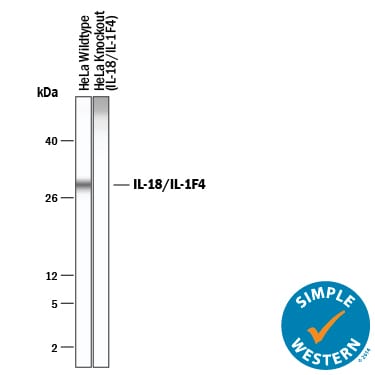
Detection of Human IL‑18/IL‑1F4 by Simple WesternTM.
Simple Western lane view shows lysates of HeLa human cervical epithelial carcinoma parental cell line and IL-18/IL-1F4 knockout HeLa cell line, loaded at 0.2 mg/mL. A specific band was detected for IL-18/IL-1F4 at approximately 29 kDa (as indicated) in the HeLa parental cell line using 50 µg/mL of Goat Anti-Human/Rhesus Macaque IL-18/IL-1F4 Antigen Affinity-purified Polyclonal Antibody (Catalog # AF2548) followed by 1:50 dilution of HRP-conjugated Anti-Goat IgG Secondary Antibody (Catalog # HAF109). This experiment was conducted under reducing conditions and using the 2-40. kDa separation system.
IFN‑ gamma Secretion Induced by IL‑18/IL‑1F4 and Neutralization by Primate IL‑18/IL‑1F4 Antibody.
In the presence of Recombinant Human TNF-alpha (20 ng/mL, Catalog # 210-TA), Recombinant Rhesus Macaque IL-18/IL-1F4 (Catalog # 2548-RM) stimulates IFN-gamma secretion in the KG-1 human acute myelogenous leukemia cell line in a dose-dependent manner (orange line), as measured by the Human IFN-gamma Quantikine ELISA Kit (Catalog # DIF50C). Under these conditions, IFN-gamma secretion elicited by Recombinant Rhesus Macaque IL-18/IL-1F4 (10 ng/mL) is neutralized (green line) by increasing concentrations of Goat Anti-Human/Rhesus Macaque IL-18/IL-1F4 Antigen Affinity-purified Polyclonal Antibody (Catalog # AF2548). The ND50 is typically 0.4-1.2 µg/mL.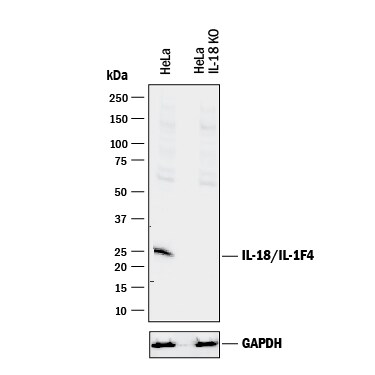
Western Blot Shows Human IL‑18/IL‑1F4 Specificity by Using Knockout Cell Line.
Western blot shows lysates of HeLa human cervical epithelial carcinoma parental cell line and IL-18/IL-1F4 knockout HeLa cell line (KO). PVDF membrane was probed with 1 µg/mL of Goat Anti-Human/Rhesus Macaque IL-18/IL-1F4 Antigen Affinity-purified Polyclonal Antibody (Catalog # AF2548) followed by HRP-conjugated Anti-Goat IgG Secondary Antibody (Catalog # HAF017). A specific band was detected for IL-18/IL-1F4 at approximately 25 kDa (as indicated) in the parental HeLa cell line, but is not detectable in knockout HeLa cell line. GAPDH (Catalog # AF5718) is shown as a loading control. This experiment was conducted under reducing conditions and using Immunoblot Buffer Group 1.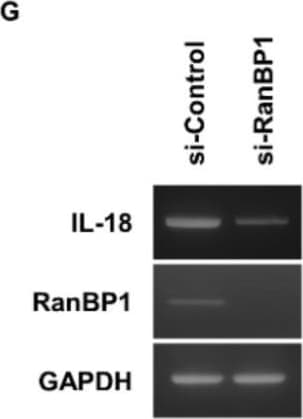
Detection of Macaque IL-18/IL-1F4 by Western Blot
Characteristics of CSC and EMT events regulated by RanBP1 in glioma. (A) Comparison of the expression of GSC marker proteins by RanBP1 gene suppression in GSCs. U87 cells are differentiated into GSCs using TM. (B) Comparison of the marker protein expression according to the expression of RanBP1 using ICC in GSCs. (C) Comparison of differences in sphere formation according to the expression level of RanBP1 in GSCs. Experiments performed in triplicate. (D) Comparison of the EMT marker protein expression after RanBP1 gene suppression using si-RNA. (E) Confirmation of EMT marker protein expression according to the expression of RanBP1 using ICC. (F) Analysis of cell migration and invasion ability after the suppression of RanBP1 expression using si-RNA. (G) Analysis of regulation of IL-18 expression by RanBP1 in GSCs. Error bars represent mean ± SD. Triplicate samples. * p < 0.001, ** p < 0.0005, versus control. Scale bar = 50 μm. Image collected and cropped by CiteAb from the following open publication (https://pubmed.ncbi.nlm.nih.gov/37047826), licensed under a CC-BY license. Not internally tested by R&D Systems.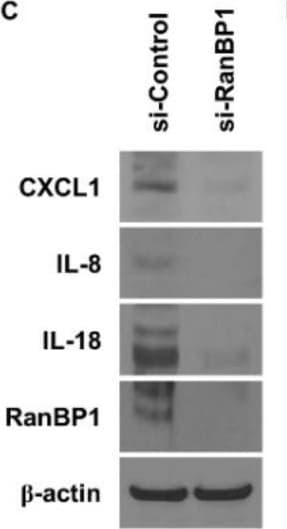
Detection of Macaque IL-18/IL-1F4 by Western Blot
Cytokines regulated by RanBP1 in lung cancer. (A) Identification of secreted factors regulated by RanBP1 using cytokine arrays. A549 cells are used, and the expression of RanBP1 is suppressed using si-RNA. (B) Comparison of the gene expression of cytokines regulated by RanBP1. (C) Analysis of cytokines regulated by RanBP1 using WB. (D) Comparison of the sphere formation ability after each neutralizing antibody treatment. The p value is less than 0.0001 versus the IgG Ab value. (E) Comparison of migration and invasion ability of cells after each neutralizing antibody treatment. Experiments performed in triplicate. (F) CSC marker protein analysis in A549 after treatment with IL-18 neutralizing antibody. (G) Confirmation of the expression levels of EMT marker proteins after treatment with the IL-18 neutralizing antibody. (H) Expression analysis of RanBP1 regulated by IL-18 using neutralizing antibodies. Error bars represent mean ± SD. Triplicate samples. * p < 0.05, ** p < 0.001, versus control. Scale bar = 50 μm. Image collected and cropped by CiteAb from the following open publication (https://pubmed.ncbi.nlm.nih.gov/37047826), licensed under a CC-BY license. Not internally tested by R&D Systems.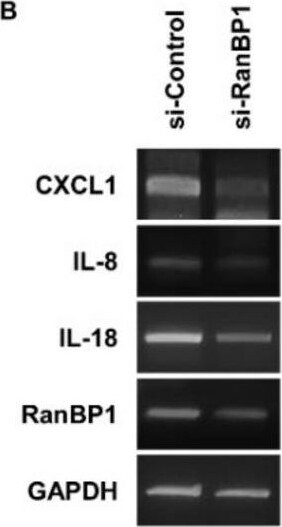
Detection of Macaque IL-18/IL-1F4 by Western Blot
Cytokines regulated by RanBP1 in lung cancer. (A) Identification of secreted factors regulated by RanBP1 using cytokine arrays. A549 cells are used, and the expression of RanBP1 is suppressed using si-RNA. (B) Comparison of the gene expression of cytokines regulated by RanBP1. (C) Analysis of cytokines regulated by RanBP1 using WB. (D) Comparison of the sphere formation ability after each neutralizing antibody treatment. The p value is less than 0.0001 versus the IgG Ab value. (E) Comparison of migration and invasion ability of cells after each neutralizing antibody treatment. Experiments performed in triplicate. (F) CSC marker protein analysis in A549 after treatment with IL-18 neutralizing antibody. (G) Confirmation of the expression levels of EMT marker proteins after treatment with the IL-18 neutralizing antibody. (H) Expression analysis of RanBP1 regulated by IL-18 using neutralizing antibodies. Error bars represent mean ± SD. Triplicate samples. * p < 0.05, ** p < 0.001, versus control. Scale bar = 50 μm. Image collected and cropped by CiteAb from the following open publication (https://pubmed.ncbi.nlm.nih.gov/37047826), licensed under a CC-BY license. Not internally tested by R&D Systems.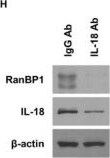
Detection of Macaque IL-18/IL-1F4 by Western Blot
Cytokines regulated by RanBP1 in lung cancer. (A) Identification of secreted factors regulated by RanBP1 using cytokine arrays. A549 cells are used, and the expression of RanBP1 is suppressed using si-RNA. (B) Comparison of the gene expression of cytokines regulated by RanBP1. (C) Analysis of cytokines regulated by RanBP1 using WB. (D) Comparison of the sphere formation ability after each neutralizing antibody treatment. The p value is less than 0.0001 versus the IgG Ab value. (E) Comparison of migration and invasion ability of cells after each neutralizing antibody treatment. Experiments performed in triplicate. (F) CSC marker protein analysis in A549 after treatment with IL-18 neutralizing antibody. (G) Confirmation of the expression levels of EMT marker proteins after treatment with the IL-18 neutralizing antibody. (H) Expression analysis of RanBP1 regulated by IL-18 using neutralizing antibodies. Error bars represent mean ± SD. Triplicate samples. * p < 0.05, ** p < 0.001, versus control. Scale bar = 50 μm. Image collected and cropped by CiteAb from the following open publication (https://pubmed.ncbi.nlm.nih.gov/37047826), licensed under a CC-BY license. Not internally tested by R&D Systems.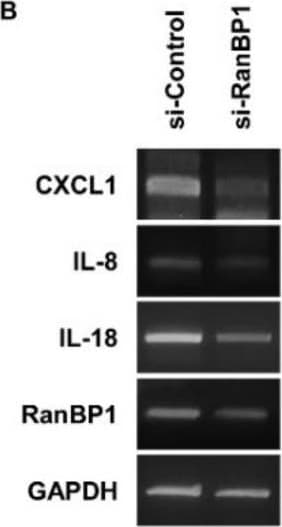
Detection of Macaque IL-18/IL-1F4 by Western Blot
Cytokines regulated by RanBP1 in lung cancer. (A) Identification of secreted factors regulated by RanBP1 using cytokine arrays. A549 cells are used, and the expression of RanBP1 is suppressed using si-RNA. (B) Comparison of the gene expression of cytokines regulated by RanBP1. (C) Analysis of cytokines regulated by RanBP1 using WB. (D) Comparison of the sphere formation ability after each neutralizing antibody treatment. The p value is less than 0.0001 versus the IgG Ab value. (E) Comparison of migration and invasion ability of cells after each neutralizing antibody treatment. Experiments performed in triplicate. (F) CSC marker protein analysis in A549 after treatment with IL-18 neutralizing antibody. (G) Confirmation of the expression levels of EMT marker proteins after treatment with the IL-18 neutralizing antibody. (H) Expression analysis of RanBP1 regulated by IL-18 using neutralizing antibodies. Error bars represent mean ± SD. Triplicate samples. * p < 0.05, ** p < 0.001, versus control. Scale bar = 50 μm. Image collected and cropped by CiteAb from the following open publication (https://pubmed.ncbi.nlm.nih.gov/37047826), licensed under a CC-BY license. Not internally tested by R&D Systems.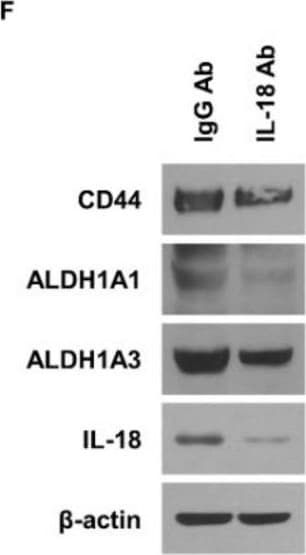
Detection of Macaque IL-18/IL-1F4 by Western Blot
Cytokines regulated by RanBP1 in lung cancer. (A) Identification of secreted factors regulated by RanBP1 using cytokine arrays. A549 cells are used, and the expression of RanBP1 is suppressed using si-RNA. (B) Comparison of the gene expression of cytokines regulated by RanBP1. (C) Analysis of cytokines regulated by RanBP1 using WB. (D) Comparison of the sphere formation ability after each neutralizing antibody treatment. The p value is less than 0.0001 versus the IgG Ab value. (E) Comparison of migration and invasion ability of cells after each neutralizing antibody treatment. Experiments performed in triplicate. (F) CSC marker protein analysis in A549 after treatment with IL-18 neutralizing antibody. (G) Confirmation of the expression levels of EMT marker proteins after treatment with the IL-18 neutralizing antibody. (H) Expression analysis of RanBP1 regulated by IL-18 using neutralizing antibodies. Error bars represent mean ± SD. Triplicate samples. * p < 0.05, ** p < 0.001, versus control. Scale bar = 50 μm. Image collected and cropped by CiteAb from the following open publication (https://pubmed.ncbi.nlm.nih.gov/37047826), licensed under a CC-BY license. Not internally tested by R&D Systems.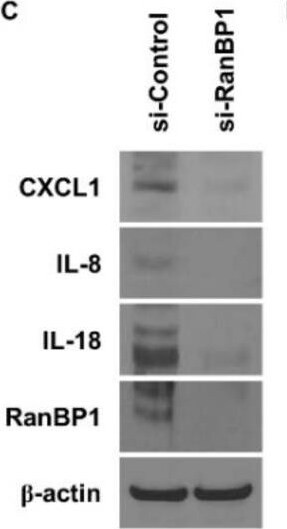
Detection of Macaque IL-18/IL-1F4 by Western Blot
Cytokines regulated by RanBP1 in lung cancer. (A) Identification of secreted factors regulated by RanBP1 using cytokine arrays. A549 cells are used, and the expression of RanBP1 is suppressed using si-RNA. (B) Comparison of the gene expression of cytokines regulated by RanBP1. (C) Analysis of cytokines regulated by RanBP1 using WB. (D) Comparison of the sphere formation ability after each neutralizing antibody treatment. The p value is less than 0.0001 versus the IgG Ab value. (E) Comparison of migration and invasion ability of cells after each neutralizing antibody treatment. Experiments performed in triplicate. (F) CSC marker protein analysis in A549 after treatment with IL-18 neutralizing antibody. (G) Confirmation of the expression levels of EMT marker proteins after treatment with the IL-18 neutralizing antibody. (H) Expression analysis of RanBP1 regulated by IL-18 using neutralizing antibodies. Error bars represent mean ± SD. Triplicate samples. * p < 0.05, ** p < 0.001, versus control. Scale bar = 50 μm. Image collected and cropped by CiteAb from the following open publication (https://pubmed.ncbi.nlm.nih.gov/37047826), licensed under a CC-BY license. Not internally tested by R&D Systems.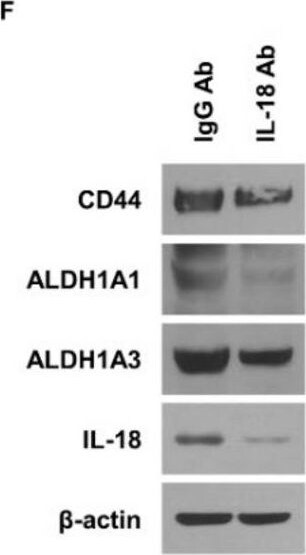
Detection of Macaque IL-18/IL-1F4 by Western Blot
Cytokines regulated by RanBP1 in lung cancer. (A) Identification of secreted factors regulated by RanBP1 using cytokine arrays. A549 cells are used, and the expression of RanBP1 is suppressed using si-RNA. (B) Comparison of the gene expression of cytokines regulated by RanBP1. (C) Analysis of cytokines regulated by RanBP1 using WB. (D) Comparison of the sphere formation ability after each neutralizing antibody treatment. The p value is less than 0.0001 versus the IgG Ab value. (E) Comparison of migration and invasion ability of cells after each neutralizing antibody treatment. Experiments performed in triplicate. (F) CSC marker protein analysis in A549 after treatment with IL-18 neutralizing antibody. (G) Confirmation of the expression levels of EMT marker proteins after treatment with the IL-18 neutralizing antibody. (H) Expression analysis of RanBP1 regulated by IL-18 using neutralizing antibodies. Error bars represent mean ± SD. Triplicate samples. * p < 0.05, ** p < 0.001, versus control. Scale bar = 50 μm. Image collected and cropped by CiteAb from the following open publication (https://pubmed.ncbi.nlm.nih.gov/37047826), licensed under a CC-BY license. Not internally tested by R&D Systems.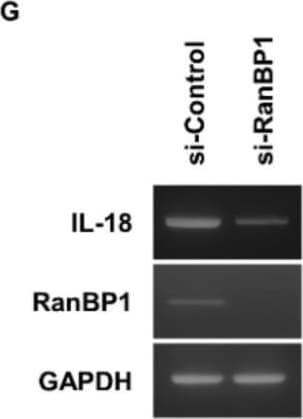
Detection of Macaque IL-18/IL-1F4 by Western Blot
Characteristics of CSC and EMT events regulated by RanBP1 in glioma. (A) Comparison of the expression of GSC marker proteins by RanBP1 gene suppression in GSCs. U87 cells are differentiated into GSCs using TM. (B) Comparison of the marker protein expression according to the expression of RanBP1 using ICC in GSCs. (C) Comparison of differences in sphere formation according to the expression level of RanBP1 in GSCs. Experiments performed in triplicate. (D) Comparison of the EMT marker protein expression after RanBP1 gene suppression using si-RNA. (E) Confirmation of EMT marker protein expression according to the expression of RanBP1 using ICC. (F) Analysis of cell migration and invasion ability after the suppression of RanBP1 expression using si-RNA. (G) Analysis of regulation of IL-18 expression by RanBP1 in GSCs. Error bars represent mean ± SD. Triplicate samples. * p < 0.001, ** p < 0.0005, versus control. Scale bar = 50 μm. Image collected and cropped by CiteAb from the following open publication (https://pubmed.ncbi.nlm.nih.gov/37047826), licensed under a CC-BY license. Not internally tested by R&D Systems.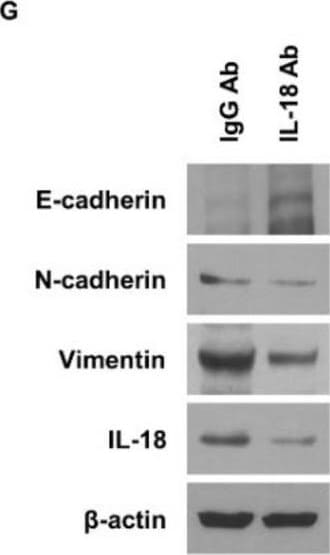
Detection of Macaque IL-18/IL-1F4 by Western Blot
Cytokines regulated by RanBP1 in lung cancer. (A) Identification of secreted factors regulated by RanBP1 using cytokine arrays. A549 cells are used, and the expression of RanBP1 is suppressed using si-RNA. (B) Comparison of the gene expression of cytokines regulated by RanBP1. (C) Analysis of cytokines regulated by RanBP1 using WB. (D) Comparison of the sphere formation ability after each neutralizing antibody treatment. The p value is less than 0.0001 versus the IgG Ab value. (E) Comparison of migration and invasion ability of cells after each neutralizing antibody treatment. Experiments performed in triplicate. (F) CSC marker protein analysis in A549 after treatment with IL-18 neutralizing antibody. (G) Confirmation of the expression levels of EMT marker proteins after treatment with the IL-18 neutralizing antibody. (H) Expression analysis of RanBP1 regulated by IL-18 using neutralizing antibodies. Error bars represent mean ± SD. Triplicate samples. * p < 0.05, ** p < 0.001, versus control. Scale bar = 50 μm. Image collected and cropped by CiteAb from the following open publication (https://pubmed.ncbi.nlm.nih.gov/37047826), licensed under a CC-BY license. Not internally tested by R&D Systems.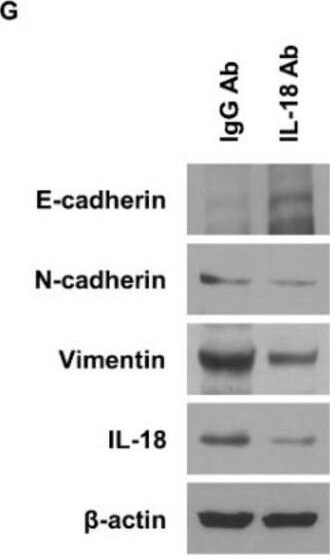
Detection of Macaque IL-18/IL-1F4 by Western Blot
Cytokines regulated by RanBP1 in lung cancer. (A) Identification of secreted factors regulated by RanBP1 using cytokine arrays. A549 cells are used, and the expression of RanBP1 is suppressed using si-RNA. (B) Comparison of the gene expression of cytokines regulated by RanBP1. (C) Analysis of cytokines regulated by RanBP1 using WB. (D) Comparison of the sphere formation ability after each neutralizing antibody treatment. The p value is less than 0.0001 versus the IgG Ab value. (E) Comparison of migration and invasion ability of cells after each neutralizing antibody treatment. Experiments performed in triplicate. (F) CSC marker protein analysis in A549 after treatment with IL-18 neutralizing antibody. (G) Confirmation of the expression levels of EMT marker proteins after treatment with the IL-18 neutralizing antibody. (H) Expression analysis of RanBP1 regulated by IL-18 using neutralizing antibodies. Error bars represent mean ± SD. Triplicate samples. * p < 0.05, ** p < 0.001, versus control. Scale bar = 50 μm. Image collected and cropped by CiteAb from the following open publication (https://pubmed.ncbi.nlm.nih.gov/37047826), licensed under a CC-BY license. Not internally tested by R&D Systems.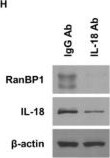
Detection of Macaque IL-18/IL-1F4 by Western Blot
Cytokines regulated by RanBP1 in lung cancer. (A) Identification of secreted factors regulated by RanBP1 using cytokine arrays. A549 cells are used, and the expression of RanBP1 is suppressed using si-RNA. (B) Comparison of the gene expression of cytokines regulated by RanBP1. (C) Analysis of cytokines regulated by RanBP1 using WB. (D) Comparison of the sphere formation ability after each neutralizing antibody treatment. The p value is less than 0.0001 versus the IgG Ab value. (E) Comparison of migration and invasion ability of cells after each neutralizing antibody treatment. Experiments performed in triplicate. (F) CSC marker protein analysis in A549 after treatment with IL-18 neutralizing antibody. (G) Confirmation of the expression levels of EMT marker proteins after treatment with the IL-18 neutralizing antibody. (H) Expression analysis of RanBP1 regulated by IL-18 using neutralizing antibodies. Error bars represent mean ± SD. Triplicate samples. * p < 0.05, ** p < 0.001, versus control. Scale bar = 50 μm. Image collected and cropped by CiteAb from the following open publication (https://pubmed.ncbi.nlm.nih.gov/37047826), licensed under a CC-BY license. Not internally tested by R&D Systems.Applications for IL-18/IL-1F4 Antibody
ELISA
This antibody functions as an ELISA detection antibody when paired with Mouse Anti-Human IL‑18/IL‑1F4 Monoclonal Antibody (Catalog # MAB91242).
This product is intended for assay development on various assay platforms requiring antibody pairs. We recommend the Human Total IL-18 DuoSet ELISA Kit (Catalog # DY318-05) for convenient development of a sandwich ELISA or the Human Total IL-18/IL-1F4 Quantikine ELISA Kit (Catalog # DL180) for a complete optimized ELISA.
Immunocytochemistry
Sample: Immersion fixed human peripheral blood mononuclear cells (PBMCs)
Knockout Validated
Simple Western
Sample: HeLa human cervical epithelial carcinoma cell line
Western Blot
Sample: PC‑3 human prostate cancer cell line, MCF 10A human breast epithelial cell line, and A431 human epithelial carcinoma cell line
Neutralization
Formulation, Preparation, and Storage
Purification
Reconstitution
Reconstitute at 0.2 mg/mL in sterile PBS. For liquid material, refer to CoA for concentration.
Formulation
Shipping
Stability & Storage
- 12 months from date of receipt, -20 to -70 °C as supplied.
- 1 month, 2 to 8 °C under sterile conditions after reconstitution.
- 6 months, -20 to -70 °C under sterile conditions after reconstitution.
Calculators
Background: IL-18/IL-1F4
References
- Arend, W.P. et al. (2008) Immunol. Rev. 223:20.
- Giavedoni, L.D. et al. (2001) J. Interferon Cytokine Res. 21:173.
- Ghayur, T. et al. (1997) Nature 386:619.
- Gu, Y. et al. (1997) Science 275:206.
- Boraschi, D. and C.A. Dinarello (2006) Eur. Cytokine Netw. 17:224.
- Novick, D. et al. (1999) Immunity 10:127.
- Torigoe, K. et al. (1997) J. Biol. Chem. 272:25737.
- Born, T.L. et al. (1998) J. Biol. Chem. 273:29445.
- Bufler, P. et al. (2002) Proc. Natl. Acad. Sci. USA 99:13723.
- Takeda, K. et al. (1998) Immunity 8:383.
- Park, S. et al. (2007) Cell. Mol. Immunol. 4:329.
- Yoshimoto, T. et al. (1998) J. Immunol. 161:3400.
- Hoshino, T. et al. (2001) J. Immunol. 166:7014.
- Iannello, A. et al. (2009) AIDS Rev. 11:115.
- Rabkin, S.W. (2009) Nat. Clin. Pract. Cardiovasc. Med. 6:192.
- Netea, M.G. et al. (2006) Nat. Med. 12:650.
Long Name
Alternate Names
Gene Symbol
UniProt
Additional IL-18/IL-1F4 Products
Product Documents for IL-18/IL-1F4 Antibody
Certificate of Analysis
To download a Certificate of Analysis, please enter a lot or batch number in the search box below.
Note: Certificate of Analysis not available for kit components.
Product Specific Notices for IL-18/IL-1F4 Antibody
For research use only
Citations for IL-18/IL-1F4 Antibody
 Powered by Bioz
Customer Reviews for IL-18/IL-1F4 Antibody
There are currently no reviews for this product. Be the first to review IL-18/IL-1F4 Antibody and earn rewards!
Have you used IL-18/IL-1F4 Antibody?
Submit a review and receive an Amazon gift card!
$25/€18/£15/$25CAN/¥2500 for a review with an image
$10/€7/£6/$10CAN/¥1110 for a review without an image
Submit a review
Protocols
Find general support by application which include: protocols, troubleshooting, illustrated assays, videos and webinars.
- Appropriate Fixation of IHC/ICC Samples
- Cellular Response to Hypoxia Protocols
- ClariTSA™ Fluorophore Kits
- Detection & Visualization of Antibody Binding
- ELISA Sample Preparation & Collection Guide
- ELISA Troubleshooting Guide
- How to Run an R&D Systems DuoSet ELISA
- How to Run an R&D Systems Quantikine ELISA
- How to Run an R&D Systems Quantikine™ QuicKit™ ELISA
- ICC Cell Smear Protocol for Suspension Cells
- ICC Immunocytochemistry Protocol Videos
- ICC for Adherent Cells
- Immunocytochemistry (ICC) Protocol
- Immunocytochemistry Troubleshooting
- Immunofluorescence of Organoids Embedded in Cultrex Basement Membrane Extract
- Immunohistochemistry (IHC) and Immunocytochemistry (ICC) Protocols
- Preparing Samples for IHC/ICC Experiments
- Preventing Non-Specific Staining (Non-Specific Binding)
- Primary Antibody Selection & Optimization
- Protocol for VisUCyte™ HRP Polymer Detection Reagent
- Protocol for the Fluorescent ICC Staining of Cell Smears - Graphic
- Protocol for the Fluorescent ICC Staining of Cultured Cells on Coverslips - Graphic
- Protocol for the Preparation and Fluorescent ICC Staining of Cells on Coverslips
- Protocol for the Preparation and Fluorescent ICC Staining of Non-adherent Cells
- Protocol for the Preparation and Fluorescent ICC Staining of Stem Cells on Coverslips
- Protocol for the Preparation of a Cell Smear for Non-adherent Cell ICC - Graphic
- Quantikine HS ELISA Kit Assay Principle, Alkaline Phosphatase
- Quantikine HS ELISA Kit Principle, Streptavidin-HRP Polymer
- R&D Systems Quality Control Western Blot Protocol
- Sandwich ELISA (Colorimetric) – Biotin/Streptavidin Detection Protocol
- Sandwich ELISA (Colorimetric) – Direct Detection Protocol
- TUNEL and Active Caspase-3 Detection by IHC/ICC Protocol
- The Importance of IHC/ICC Controls
- Troubleshooting Guide: ELISA
- Troubleshooting Guide: Western Blot Figures
- Western Blot Conditions
- Western Blot Protocol
- Western Blot Protocol for Cell Lysates
- Western Blot Troubleshooting
- Western Blot Troubleshooting Guide
- View all Protocols, Troubleshooting, Illustrated assays and Webinars