
EMMPRIN is expressed in areas of tissue remodeling, including tumors, endometrium, placenta, skin, and regions undergoing angiogenesis (1, 2, 6-9). It is also expressed in cells with high metabolic activity, such as lymphoblasts, macrophages and tumor cells (2, 10). On cells with elevated metabolic rates, EMMPRIN is often co-expressed with the amino acid transporter CD98h (11). EMMPRIN also interacts with caveolin-1 (via its C2-like domain), and this reduces the level of EMMPRIN glycosylation and subsequent EMMPRIN multimerization and activity (12). EMMPRIN’s TM sequence contains a Glu and a Pro which are important for intracellular interactions with cyclophilins (CyP) (3, 13, 14). CyPA (cyclosporin A receptor) and CyP60 interactions with the TM segment promote leukocyte inflammatory chemotaxis and surface expression of EMMPRIN, respectively (13, 14). An active 22 kDa fragment can be shed from tumor cells by MT1-MMP (1). Tumor cells can also release active, full-length EMMPRIN in microvesicles (15, 16). Functionally, EMMPRIN is known to induce urokinase-type plasminogen activator (uPA), VEGF, hyaluronan, and multiple MMPs (1, 2, 7, 8, 9). Human EMMPRIN (269 aa) shows 58%, 58%, 62%, and 52% aa identity with mouse, rat, bovine, and chicken EMMPRIN, respectively. It also shows 25% and 38% aa identity with the related proteins, embigin and neuroplastin (SDR-1), respectively (4).

Scientific images may be resized, cropped, or adjusted for brightness or contrast for presentation purposes. These updates are limited to presentation and do not affect the underlying scientific interpretation of the data. Where available, additional source data may be provided upon request.
Key Product Details
Validated by
Species Reactivity
Validated:
Cited:
Applications
Validated:
Cited:
Label
Antibody Source
Product Specifications
Immunogen
Thr25-His205
Accession # Q54A51
Specificity
Clonality
Host
Isotype
Scientific Data Images for Human EMMPRIN/CD147 Antibody
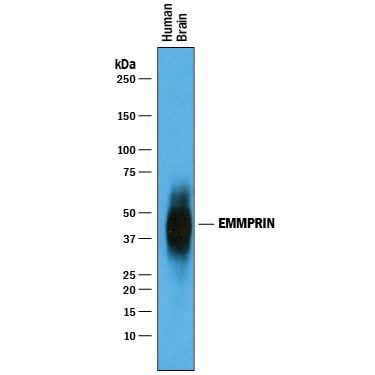
Detection of Human EMMPRIN/CD147 by Western Blot.
Western blot shows lysates of human brain tissue. PVDF membrane was probed with 1 µg/mL of Goat Anti-Human EMMPRIN/CD147 Antigen Affinity-purified Polyclonal Antibody (Catalog # AF972) followed by HRP-conjugated Anti-Goat IgG Secondary Antibody (Catalog # HAF019). A specific band was detected for EMMPRIN/CD147 at approximately 38-50 kDa (as indicated). This experiment was conducted under reducing conditions and using Immunoblot Buffer Group 1.
EMMPRIN/CD147 in Human Stomach Cancer Tissue.
EMMPRIN/CD147 was detected in immersion fixed paraffin-embedded sections of human stomach cancer tissue using Goat Anti-Human EMMPRIN/ CD147 Antigen Affinity-purified Polyclonal Antibody (Catalog # AF972) at 5 µg/mL overnight at 4 °C. Tissue was stained using the Anti-Goat HRP-DAB Cell & Tissue Staining Kit (brown; Catalog # CTS008) and counterstained with hematoxylin (blue). Specific labeling was localized to the plasma membrane of epithelial cells. View our protocol for Chromogenic IHC Staining of Paraffin-embedded Tissue Sections.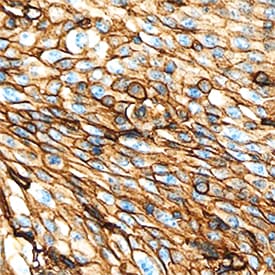
EMMPRIN/CD147 in Human Cervix.
EMMPRIN/CD147 was detected in immersion fixed paraffin-embedded sections of human cervix using Goat Anti-Human EMMPRIN/CD147 Antigen Affinity-purified Polyclonal Antibody (Catalog # AF972) at 1 µg/mL overnight at 4 °C. Tissue was stained using the Anti-Goat HRP-DAB Cell & Tissue Staining Kit (brown; Catalog # CTS008) and counterstained with hematoxylin (blue). Specific staining was localized to plasma membranes. View our protocol for Chromogenic IHC Staining of Paraffin-embedded Tissue Sections.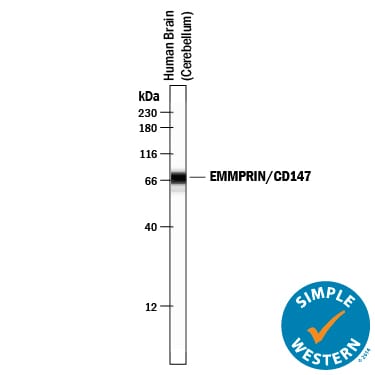
Detection of Human EMMPRIN/CD147 by Simple WesternTM.
Simple Western lane view shows lysates of human brain (cerebellum) tissue, loaded at 0.2 mg/mL. A specific band was detected for EMMPRIN/CD147 at approximately 70 kDa (as indicated) using 10 µg/mL of Goat Anti-Human EMMPRIN/CD147 Antigen Affinity-purified Polyclonal Antibody (Catalog # AF972) followed by 1:50 dilution of HRP-conjugated Anti-Goat IgG Secondary Antibody (Catalog # HAF109). This experiment was conducted under reducing conditions and using the 12-230 kDa separation system.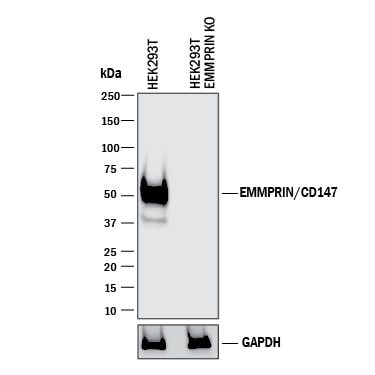
Western Blot Shows Human EMMPRIN/CD147 Specificity by Using Knockout Cell Line.
Western blot shows lysates of HEK293T human embryonic kidney parental cell line and EMMPRIN/CD147 knockout HEK293T cell line (KO). PVDF membrane was probed with 1 µg/mL of Goat Anti-Human EMMPRIN/CD147 Antigen Affinity-purified Polyclonal Antibody (Catalog # AF972) followed by HRP-conjugated Anti-Goat IgG Secondary Antibody (Catalog # HAF017). A specific band was detected for EMMPRIN/CD147 at approximately 51 kDa (as indicated) in the parental HEK293T cell line, but is not detectable in knockout HEK293T cell line. GAPDH (Catalog # AF5718) is shown as a loading control. This experiment was conducted under reducing conditions and using Immunoblot Buffer Group 1.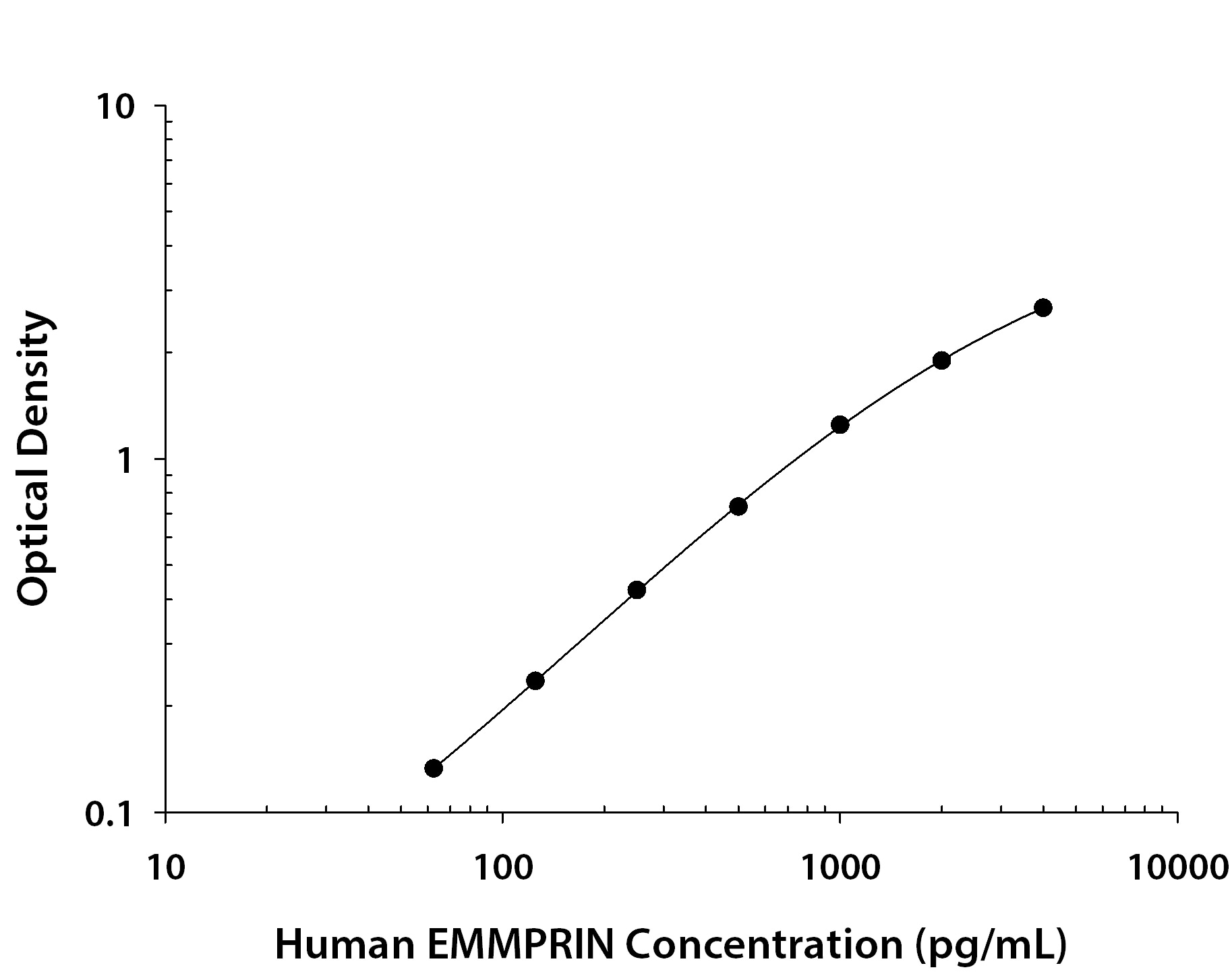
Human EMMPRIN/CD147 ELISA Standard Curve.
Recombinant Human EMMPRIN/CD147 protein was serially diluted 2-fold and captured by Mouse Anti-Human EMMPRIN/CD147 Monoclonal Antibody (MAB972) coated on a Clear Polystyrene Microplate (DY990). Goat Anti-Human EMMPRIN/CD147 Antigen Affinity-purified Polyclonal Antibody (Catalog # AF972) was biotinylated and incubated with the protein captured on the plate. Detection of the standard curve was achieved by incubating Streptavidin-HRP (DY998) followed by Substrate Solution (DY999) and stopping the enzymatic reaction with Stop Solution (DY994).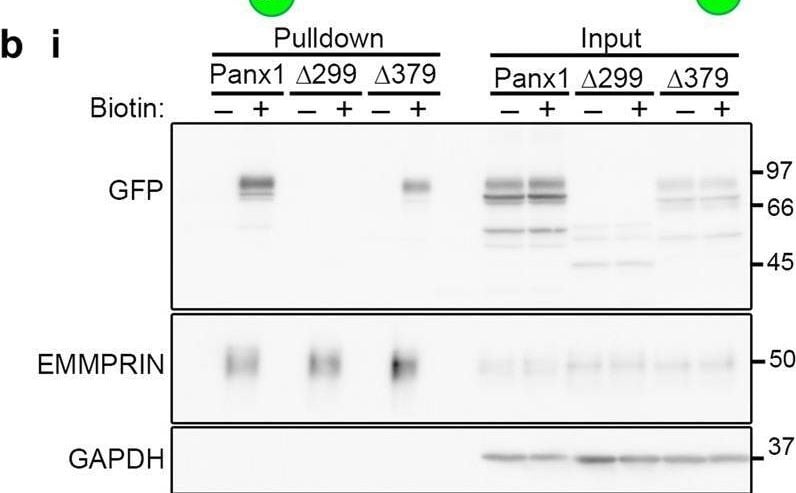
Detection of Human EMMPRIN/CD147 by Western Blot
The proximal Panx1CT is necessary for cell surface localization of Panx1-EGFP. (b) Cell surface biotinylation assays reveal that the proximal Panx1CT is required for cell surface localization in HEK293T cells. (i) Representative Western blot of pulldown (cell surface protein) and input. Anti-EMMPRIN was used as a positive control for biotin pulldown and as a loading control, and anti-GAPDH was used as a negative control against biotin internalization. Image collected and cropped by CiteAb from the following open publication (https://pubmed.ncbi.nlm.nih.gov/31278290), licensed under a CC-BY license. Not internally tested by R&D Systems.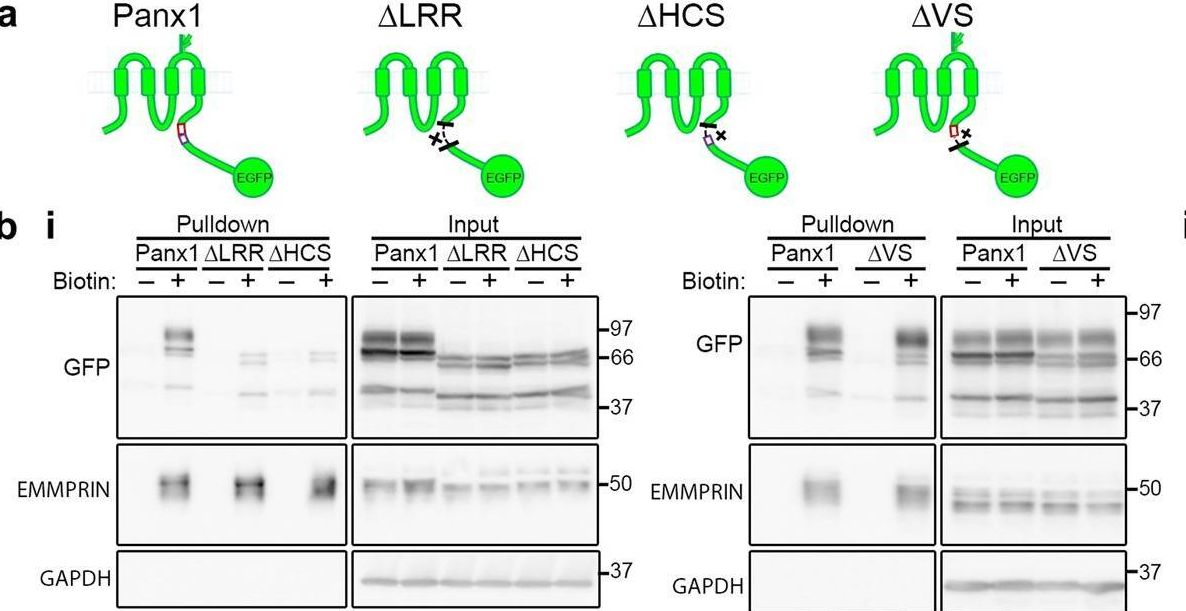
Detection of Human EMMPRIN/CD147 by Western Blot
A novel putative LRR motif in the Panx1CT is necessary for trafficking Panx1-EGFP to the cell surface. (a) Schematic of full length Panx1-EGFP and the Panx1∆LRR-EGFP, Panx1∆HCS-EGFP, and Panx1∆VS-EGFP deletion mutants. Image collected and cropped by CiteAb from the following open publication (https://pubmed.ncbi.nlm.nih.gov/31278290), licensed under a CC-BY license. Not internally tested by R&D Systems.
Human EMMPRIN / CD147 ELISA Standard Curve
Recombinant Human EMMPRIN/CD147 Fc Chimera (Catalog # 972-EMN) was serially diluted and captured by Mouse Anti-Human EMMPRIN/CD147 Monoclonal Antibody (Catalog # MAB972) coated on a Clear Polystyrene Microplate (Catalog # DY990). Goat Anti-Human EMMPRIN/CD147 Antigen Affinity-purified Polyclonal Antibody (Catalog # AF972) was biotinylated and incubated with the protein captured on the plate. Detection of the standard curve was achieved by incubating Streptavidin-HRP (Catalog # DY998)Applications for Human EMMPRIN/CD147 Antibody
ELISA
This antibody functions as an ELISA detection antibody when paired with Mouse Anti-Human EMMPRIN/CD147 Monoclonal Antibody (Catalog # MAB972).
This product is intended for assay development on various assay platforms requiring antibody pairs. We recommend the Human EMMPRIN/CD147 DuoSet ELISA Kit (Catalog # DY972) for convenient development of a sandwich ELISA or the Human EMMPRIN/CD147 Quantikine ELISA Kit (Catalog # DEMP00) for a complete optimized ELISA.
Immunohistochemistry
Sample: Immersion fixed paraffin-embedded sections of human breast, gastric, lung, stomach, pancreatic cancer tissue, and cervix
Knockout Validated
Simple Western
Sample: Human brain (cerebellum) tissue
Western Blot
Sample: Human brain tissue
Reviewed Applications
Read 1 review rated 4 using AF972 in the following applications:
Formulation, Preparation, and Storage
Purification
Reconstitution
Reconstitute at 0.2 mg/mL in sterile PBS. For liquid material, refer to CoA for concentration.
Formulation
Shipping
Stability & Storage
- 12 months from date of receipt, -20 to -70 °C as supplied.
- 1 month, 2 to 8 °C under sterile conditions after reconstitution.
- 6 months, -20 to -70 °C under sterile conditions after reconstitution.
Calculators
Background: EMMPRIN/CD147
References
- Gabison, E.E. et al. (2005) Biochimie 87:361.
- Yurchenko, V. et al. (2006) Immunology 117:301.
- Kasinrerk, W. et al. (1992) J. Immunol. 149:847.
- Miyauchi, T. et al. (1991) J. Biochem. 110:770.
- Hanna, S.M. et al. (2003) BMC Biochem. 4:17.
- Riethdorf, S. et al. (2006) Int. J. Cancer 119:1800.
- Braundmeier, A.G. et al. (2006) J. Clin. Endocrinol. Metab. 91:2358.
- Tang, Y. et al. (2006) Mol. Cancer Res. 4:371.
- Quemener, C. et al. (2007) Cancer Res. 67:9.
- Wilson, M.C. et al. (2005) J. Biol. Chem. 280:27213.
- Xu, D. and M.E. Hemler (2005) Mol. Cell. Proteomics 4:1061.
- Tang, W. et al. (2004) Mol. Biol. Cell 15:4043.
- Arora, K. et al. (2005) J. Immunol. 175:517.
- Pushkarsky, T. et al. (2005) J. Biol. Chem. 280:27866.
- Egawa, N. et al. (2006) J. Biol. Chem. 281:37576.
- Sidhu, S.S. et al. (2004) Oncogene 23:956.
Long Name
Alternate Names
Gene Symbol
UniProt
Additional EMMPRIN/CD147 Products
Product Documents for Human EMMPRIN/CD147 Antibody
Certificate of Analysis
To download a Certificate of Analysis, please enter a lot or batch number in the search box below.
Note: Certificate of Analysis not available for kit components.
Product Specific Notices for Human EMMPRIN/CD147 Antibody
For research use only
Citations for Human EMMPRIN/CD147 Antibody
 Powered by Bioz
Customer Reviews for Human EMMPRIN/CD147 Antibody (1)
Have you used Human EMMPRIN/CD147 Antibody?
Submit a review and receive an Amazon gift card!
$25/€18/£15/$25CAN/¥2500 for a review with an image
$10/€7/£6/$10CAN/¥1110 for a review without an image
Submit a review
-
Application: Immunohistochemistry-FrozenSample Tested: See PMID 24527394Species: MouseVerified Customer | Posted 01/12/2015
There are no reviews that match your criteria.
Protocols
Find general support by application which include: protocols, troubleshooting, illustrated assays, videos and webinars.
- Antigen Retrieval Protocol (PIER)
- Antigen Retrieval for Frozen Sections Protocol
- Appropriate Fixation of IHC/ICC Samples
- Cellular Response to Hypoxia Protocols
- Chromogenic IHC Staining of Formalin-Fixed Paraffin-Embedded (FFPE) Tissue Protocol
- Chromogenic Immunohistochemistry Staining of Frozen Tissue
- ClariTSA™ Fluorophore Kits
- Detection & Visualization of Antibody Binding
- ELISA Sample Preparation & Collection Guide
- ELISA Troubleshooting Guide
- Fluorescent IHC Staining of Frozen Tissue Protocol
- Graphic Protocol for Heat-induced Epitope Retrieval
- Graphic Protocol for the Preparation and Fluorescent IHC Staining of Frozen Tissue Sections
- Graphic Protocol for the Preparation and Fluorescent IHC Staining of Paraffin-embedded Tissue Sections
- Graphic Protocol for the Preparation of Gelatin-coated Slides for Histological Tissue Sections
- How to Run an R&D Systems DuoSet ELISA
- How to Run an R&D Systems Quantikine ELISA
- How to Run an R&D Systems Quantikine™ QuicKit™ ELISA
- IHC Sample Preparation (Frozen sections vs Paraffin)
- Immunofluorescent IHC Staining of Formalin-Fixed Paraffin-Embedded (FFPE) Tissue Protocol
- Immunohistochemistry (IHC) and Immunocytochemistry (ICC) Protocols
- Immunohistochemistry Frozen Troubleshooting
- Immunohistochemistry Paraffin Troubleshooting
- Preparing Samples for IHC/ICC Experiments
- Preventing Non-Specific Staining (Non-Specific Binding)
- Primary Antibody Selection & Optimization
- Protocol for Heat-Induced Epitope Retrieval (HIER)
- Protocol for Making a 4% Formaldehyde Solution in PBS
- Protocol for VisUCyte™ HRP Polymer Detection Reagent
- Protocol for the Preparation & Fixation of Cells on Coverslips
- Protocol for the Preparation and Chromogenic IHC Staining of Frozen Tissue Sections
- Protocol for the Preparation and Chromogenic IHC Staining of Frozen Tissue Sections - Graphic
- Protocol for the Preparation and Chromogenic IHC Staining of Paraffin-embedded Tissue Sections
- Protocol for the Preparation and Chromogenic IHC Staining of Paraffin-embedded Tissue Sections - Graphic
- Protocol for the Preparation and Fluorescent IHC Staining of Frozen Tissue Sections
- Protocol for the Preparation and Fluorescent IHC Staining of Paraffin-embedded Tissue Sections
- Protocol for the Preparation of Gelatin-coated Slides for Histological Tissue Sections
- Quantikine HS ELISA Kit Assay Principle, Alkaline Phosphatase
- Quantikine HS ELISA Kit Principle, Streptavidin-HRP Polymer
- R&D Systems Quality Control Western Blot Protocol
- Sandwich ELISA (Colorimetric) – Biotin/Streptavidin Detection Protocol
- Sandwich ELISA (Colorimetric) – Direct Detection Protocol
- TUNEL and Active Caspase-3 Detection by IHC/ICC Protocol
- The Importance of IHC/ICC Controls
- Troubleshooting Guide: ELISA
- Troubleshooting Guide: Immunohistochemistry
- Troubleshooting Guide: Western Blot Figures
- Western Blot Conditions
- Western Blot Protocol
- Western Blot Protocol for Cell Lysates
- Western Blot Troubleshooting
- Western Blot Troubleshooting Guide
- View all Protocols, Troubleshooting, Illustrated assays and Webinars