Neural cell adhesion molecule 1 (NCAM-1) is a multifunctional member of the Ig superfamily. It belongs to a family of membrane-bound glycoproteins that are involved in Ca++ independent cell matrix and homophilic or heterophilic cell-cell interactions. NCAM-1 specifically binds to heparan sulfate proteoglycans (1), the extracellular matrix protein agrin (2), and several chondroitin sulfate proteoglycans that include neurocan and phosphocan (3). There are three main forms of human NCAM-1 that arise by alternate splicing. These are designated NCAM-120/NCAM-1 (761 amino acids [aa]), NCAM-140 (848 aa), and NCAM-180 (1120 aa). NCAM-120 is GPI-linked, while NCAM-140 and NCAM-180 are type I transmembrane glycoproteins (4‑6). Additional alternate splicing adds considerable diversity to all three forms, and extracellular proteolytic processing is possible for NCAM-180 (7‑8). NCAM-1 is synthesized as a 761 aa preproprecursor that contains a 19 aa signal sequence, a 722 aa GPI-linked mature region, and a 20 aa C-terminal prosegment (4). The molecule contains five C-2 type Ig-like domains and two fibronectin type-III domains. Human to mouse, NCAM-1 is 93% aa identical. NCAM-1 appears to be highly sialylated. The polysialyation of NCAM-1 reduces its adhesive property and increases its neurite outgrowth promoting features (9). NCAM-1 in the adult brain shows a decline of sialylation relative to earlier developmental periods. In regions that retain a high degree of neuronal plasticity, however, the adult brain continues to express polysialylation-NCAM-1, suggesting sialylation of NCAM-1 is involved in regenerative processes and synaptic plasticity (10‑13).

Scientific images may be resized, cropped, or adjusted for brightness or contrast for presentation purposes. These updates are limited to presentation and do not affect the underlying scientific interpretation of the data. Where available, additional source data may be provided upon request.
Key Product Details
Validated by
Species Reactivity
Validated:
Cited:
Applications
Validated:
Cited:
Label
Antibody Source
Product Specifications
Immunogen
Leu20-Pro603
Accession # NP_001070150
Specificity
Clonality
Host
Isotype
Scientific Data Images for NCAM-1/CD56 Antibody
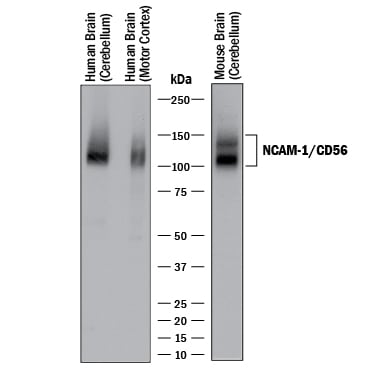
Detection of Human and Mouse NCAM‑1/CD56 by Western Blot.
Western blot shows lysates of human brain (cerebellum and motor cortex) tissue and mouse brain (cerebellum) tissue. PVDF membrane was probed with 0.5 µg/mL of Goat Anti-Human/Mouse NCAM-1/CD56 Antigen Affinity-purified Polyclonal Antibody (Catalog # AF2408) followed by HRP-conjugated Anti-Goat IgG Secondary Antibody (Catalog # HAF017). Specific bands were detected for NCAM-1/CD56 at approximately 100-150 kDa (as indicated). This experiment was conducted under reducing conditions and using Immunoblot Buffer Group 1.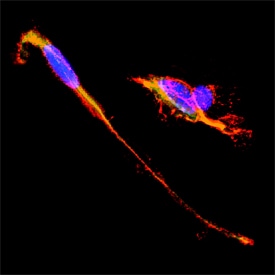
NCAM-1/CD56 in SH-SY5Y Human Neuroblastoma Cells.
SH-SY5Y human neuroblastoma cells were cultured overnight in the presence of 1 μM Retinoic Acid (0695/50) prior to immersion fixation. Neural Cell Adhesion Molecule 1 (NCAM-1)/CD56 was detected using a Goat Anti-Human/Mouse NCAM-1/CD56 Antigen Affinity-purified Polyclonal Antibody (Catalog # AF2408). The cells were stained with the NorthernLights 557-conjugated Donkey Anti-Goat IgG Affinity-purified Secondary Antibody (red; Catalog # NL001). Actin filaments were stained with FITC-conjugated Phalloidin (green) and cell nuclei were counter-stained with DAPI (blue). NCAM-1/CD56 immuno-reactivity was localized to the plasma membrane. View our protocol for Fluorescent ICC Staining of Cells on Coverslips.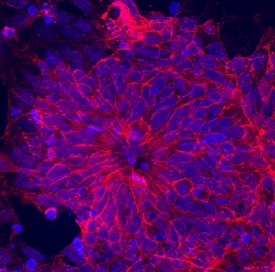
NCAM‑1/CD56 in BG01V Human Embryonic Stem Cells.
NCAM-1/CD56 was detected in immersion fixed BG01V human embryonic stem cells differentiated into neural progenitor cells using Goat Anti-Human/Mouse NCAM-1/CD56 Antigen Affinity-purified Polyclonal Antibody (Catalog # AF2408) at 10 µg/mL for 3 hours at room temperature. Cells were stained using the NorthernLights™ 557-conjugated Anti-Goat IgG Secondary Antibody (red; Catalog # NL001) and counterstained with DAPI (blue). Specific staining was localized to cytoplasm. View our protocol for Fluorescent ICC Staining of Stem Cells on Coverslips.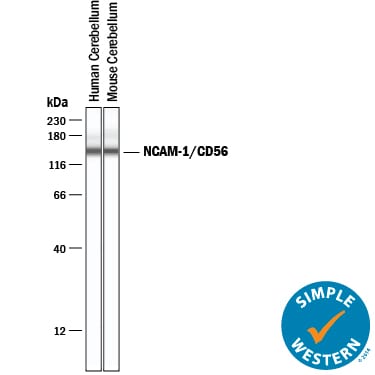
Detection of Human and Mouse NCAM‑1/CD56 by Simple WesternTM.
Simple Western lane view shows lysates of human and mouse brain (cerebellum) tissue, loaded at 0.2 mg/mL. A specific band was detected for NCAM-1/CD56 at approximately 143 kDa (as indicated) using 5 µg/mL for human lysates and 25 µg/mL for mouse lysates of Goat Anti-Human/Mouse NCAM-1/ CD56 Antigen Affinity-purified Polyclonal Antibody (Catalog # AF2408) followed by 1:50 dilution of HRP-conjugated Anti-Goat IgG Secondary Antibody (Catalog # HAF109). This experiment was conducted under reducing conditions and using the 12-230 kDa separation system.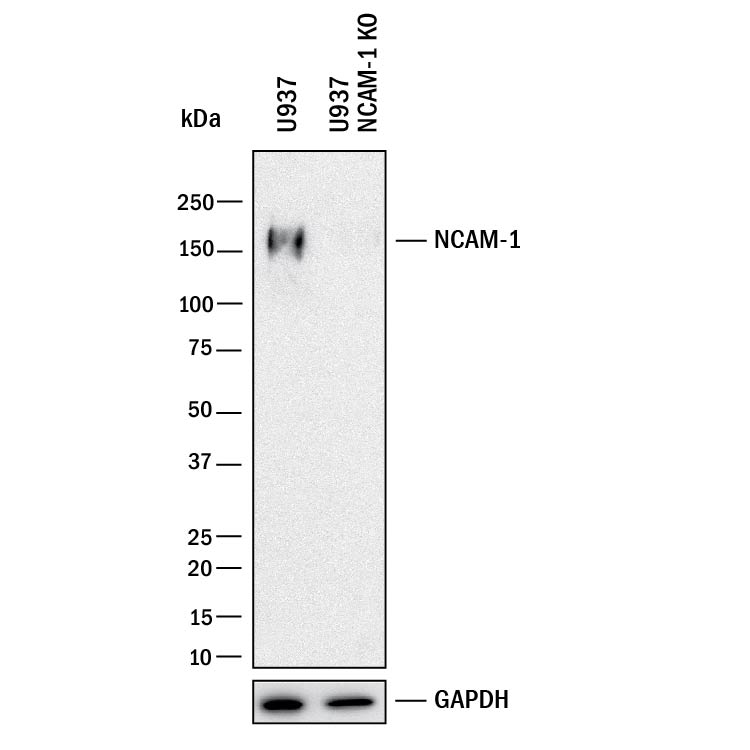
Western Blot Shows Human NCAM‑1/CD56 Specificity by Using Knockout Cell Line.
Western blot shows lysates of U937 human histiocytic lymphoma cell line and human NCAM-1 knockout U937 human histiocytic lymphoma cell line (KO). PVDF membrane was probed with 0.25 µg/mL of Goat Anti-Human/Mouse NCAM‑1/CD56 Antigen Affinity-purified Polyclonal Antibody (Catalog # AF2408) followed by HRP-conjugated Anti-Goat IgG Secondary Antibody (HAF017). A specific band was detected for NCAM‑1/CD56 at approximately 160 kDa (as indicated) in the parental U937 human histiocytic lymphoma cell line, but is not detectable in knockout U937 human histiocytic lymphoma cell line. GAPDH (AF5718) is shown as a loading control. This experiment was conducted under reducing conditions and using Western Blot Buffer Group 1.
Human NCAM-1 / CD56 ELISA Standard Curve
Recombinant Human NCAM‑1/CD56 120 isoform (Catalog # 2408-NC) was serially diluted and captured by Mouse Anti-Human/Primate NCAM‑1/CD56 Monoclonal Antibody (Catalog # MAB2408) coated on a Clear Polystyrene Microplate (Catalog # DY990). Goat Anti-Human/Mouse NCAM‑1/CD56 Antigen Affinity-purified Polyclonal Antibody (Catalog # AF2408) was biotinylated and incubated with the protein captured on the plate. Detection of the standard curve was achieved by incubating Streptavidin-HRP (Catalog # DY998)
Human NCAM-1/CD56 DuoSet ELISA
Recombinant Human NCAM‑1/CD56 120 isoform (Catalog # 2408-NC) was serially diluted and captured by Mouse Anti-Human/Primate NCAM‑1/CD56 Monoclonal Antibody (Catalog # MAB2408) coated on a Clear Polystyrene Microplate (Catalog # DY990). Goat Anti-Human/Mouse NCAM‑1/CD56 Antigen Affinity-purified Polyclonal Antibody (Catalog # AF2408) was biotinylated and incubated with the protein captured on the plate. Detection of the standard curve was achieved by incubating Streptavidin-HRP (Catalog # DY998)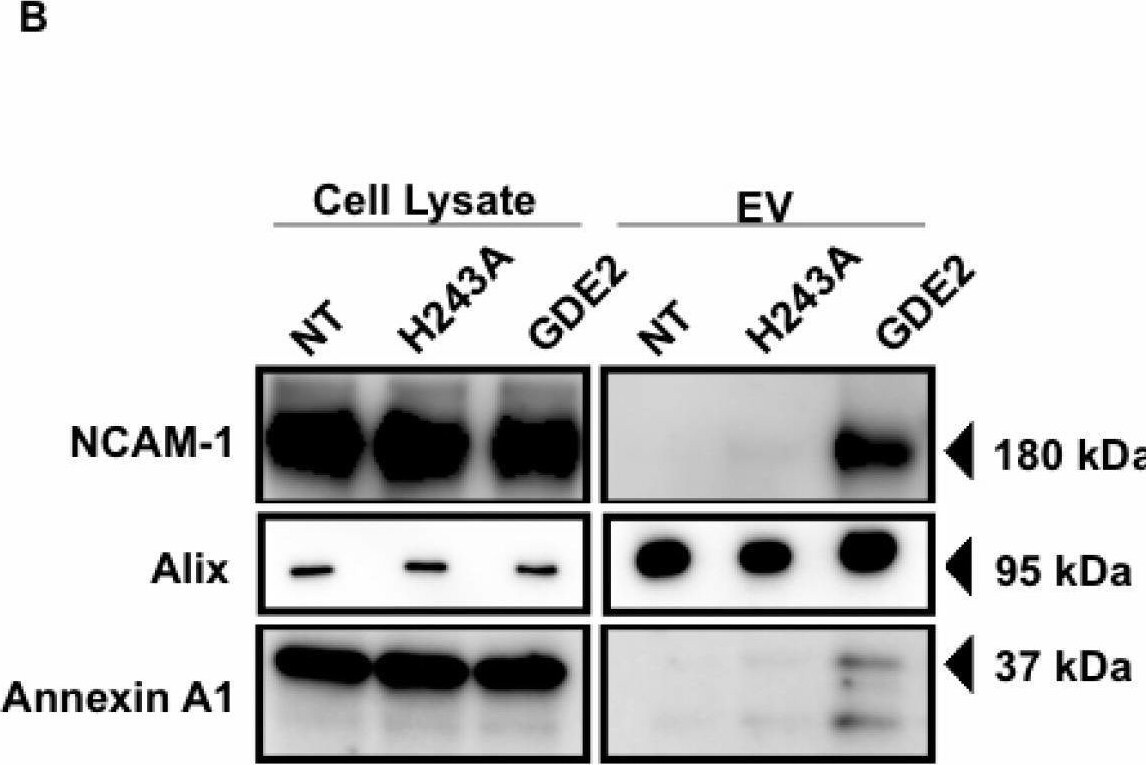
Detection of NCAM-1/CD56 by Western Blot
GDE2 overexpression promotes EV release in HEK293T cells. (A) Schematic of the workflow used to produce, purify, and analyze EVs from HEK293T cells, along with representative TEM image of purified EVs (scale bar = 100 nm). (B) Representative Western blots displaying markers, NCAM-1, Alix, and Annexin A1 in cell lysates and EVs from transfected HEK293T cells. (C) Quantification of fold change (FC) for each marker analyzed, normalized to signal derived from corresponding cell lysate. DMEM, Dulbecco’s modified Eagle medium; EV, extracellular vesicle; HEK293T, Human Embryonic Kidney 293T; NCAM-1, neural cell adhesion molecule-1; NT, non-transfected; SEC, size exclusion chromatography; UC, ultracentrifugation; ns p > 0.05, * p < 0.05, ** p < 0.01; *** p < 0.001; mean ± SEM, one-way ANOVA with Tukey’s multiple comparisons test. N = 3 biological replicates. Image collected and cropped by CiteAb from the following open publication (https://www.mdpi.com/2073-4409/13/17/1414), licensed under a CC-BY license. Not internally tested by R&D Systems.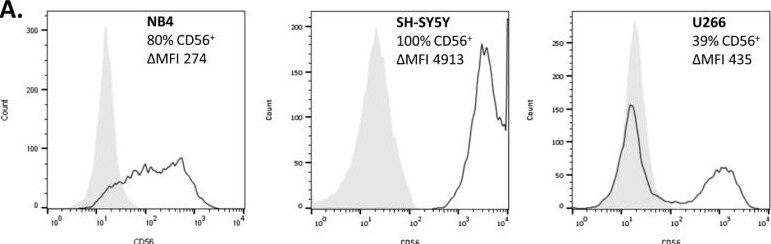
Detection of NCAM-1/CD56 by Flow Cytometry
Cluster of differentiation (CD)56 expression by human tumor cell lines. (A) Flow cytometric analysis of tumor cells labelled with CD56-PE (black line) or corresponding isotype control (filled grey), represented as histogram overlays. (B) Real-time qPCR data of the expression levels of the different CD56 isoforms by NB4, U266 (left y-axis) and SH-SY5Y (right y-axis). Fold-changes are scaled to average. Each bar is the mean ± standard error of the mean (SEM) of technical replicates (n = 2). Image collected and cropped by CiteAb from the following open publication (https://pubmed.ncbi.nlm.nih.gov/31336622), licensed under a CC-BY license. Not internally tested by R&D Systems.Applications for NCAM-1/CD56 Antibody
CyTOF-ready
Flow Cytometry
Sample: Human peripheral blood mononuclear cells
Immunocytochemistry
Sample: Immersion fixed SH-SY5Y human neuroblastoma cell line and BG01V human embryonic stem cells differentiated into neural progenitor cells
Knockout Validated
Simple Western
Sample: Human and mouse brain (cerebellum) tissue
Western Blot
Sample: Human brain (cerebellum and motor cortex) tissue and mouse brain (cerebellum) tissue
Reviewed Applications
Read 2 reviews rated 5 using AF2408 in the following applications:
Flow Cytometry Panel Builder
Bio-Techne Knows Flow Cytometry
Save time and reduce costly mistakes by quickly finding compatible reagents using the Panel Builder Tool.
Advanced Features
- Spectra Viewer - Custom analysis of spectra from multiple fluorochromes
- Spillover Popups - Visualize the spectra of individual fluorochromes
- Antigen Density Selector - Match fluorochrome brightness with antigen density

Formulation, Preparation, and Storage
Purification
Reconstitution
Reconstitute at 0.2 mg/mL in sterile PBS. For liquid material, refer to CoA for concentration.
Formulation
Shipping
Stability & Storage
- 12 months from date of receipt, -20 to -70 °C as supplied.
- 1 month, 2 to 8 °C under sterile conditions after reconstitution.
- 6 months, -20 to -70 °C under sterile conditions after reconstitution.
Calculators
Background: NCAM-1/CD56
References
- Burg, M.A. et al. (1995) J. Neurosci. Res. 41:49.
- Storms, S.D. and U. Rutishauser (1998) J Biol. Chem. 273:27124.
- Margolis, R.K. et al. (1996) Perspect. Dev. Neurobiol. 3:273.
- Dickson, G. et al. (1987) Cell 50:1119.
- Lanier, L.L. et al. (1991) J. Immunol. 146:4421.
- Hemperly, J.J. et al. (1990) J. Mol. Neurosci. 2:71.
- Rutishauser, U.and C. Goridis (1986) Trends Genet. 2:72.
- Vawter, M.P. et al. (2001) Exp. Neurol. 172:29.
- Rutihauser, U. (1990) Adv. Exp. Med. Biol. 265:179.
- Becker, C.G. et al. (1996) J. Neurosci. Res. 45:143.
- Doherty, P. et al. (1995) J. Neurobiol. 26:437.
- Eckardt, M. et al. (2000) J. Neurosci. 20:5234.
- Muller, D. et al. (1996) Neuron 17:413.
Long Name
Alternate Names
Gene Symbol
UniProt
Additional NCAM-1/CD56 Products
Product Documents for NCAM-1/CD56 Antibody
Certificate of Analysis
To download a Certificate of Analysis, please enter a lot or batch number in the search box below.
Note: Certificate of Analysis not available for kit components.
Product Specific Notices for NCAM-1/CD56 Antibody
For research use only
Related Research Areas
Citations for NCAM-1/CD56 Antibody
 Powered by Bioz
Customer Reviews for NCAM-1/CD56 Antibody (2)
Have you used NCAM-1/CD56 Antibody?
Submit a review and receive an Amazon gift card!
$25/€18/£15/$25CAN/¥2500 for a review with an image
$10/€7/£6/$10CAN/¥1110 for a review without an image
Submit a review
Customer Images
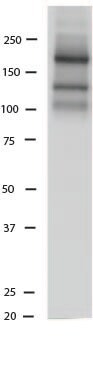
-
Application: Western BlotSample Tested: Adult brain (hippocampus), Brain olfactory membrane fraction and mouse brainSpecies: MouseVerified Customer | Posted 04/15/2021This antibody is working great without non-specific bands.

-
Application: ImmunohistochemistrySample Tested: Mouse brain cancer sample and Mouse brain cancer tissueSpecies: MouseVerified Customer | Posted 01/19/2017Immunohistochemistry-Floating section
There are no reviews that match your criteria.
Protocols
Find general support by application which include: protocols, troubleshooting, illustrated assays, videos and webinars.
- 7-Amino Actinomycin D (7-AAD) Cell Viability Flow Cytometry Protocol
- Appropriate Fixation of IHC/ICC Samples
- Cellular Response to Hypoxia Protocols
- ClariTSA™ Fluorophore Kits
- Detection & Visualization of Antibody Binding
- Extracellular Membrane Flow Cytometry Protocol
- Flow Cytometry Protocol for Cell Surface Markers
- Flow Cytometry Protocol for Staining Membrane Associated Proteins
- Flow Cytometry Staining Protocols
- Flow Cytometry Troubleshooting Guide
- ICC Cell Smear Protocol for Suspension Cells
- ICC Immunocytochemistry Protocol Videos
- ICC for Adherent Cells
- Immunocytochemistry (ICC) Protocol
- Immunocytochemistry Troubleshooting
- Immunofluorescence of Organoids Embedded in Cultrex Basement Membrane Extract
- Immunohistochemistry (IHC) and Immunocytochemistry (ICC) Protocols
- Intracellular Flow Cytometry Protocol Using Alcohol (Methanol)
- Intracellular Flow Cytometry Protocol Using Detergents
- Intracellular Nuclear Staining Flow Cytometry Protocol Using Detergents
- Intracellular Staining Flow Cytometry Protocol Using Alcohol Permeabilization
- Intracellular Staining Flow Cytometry Protocol Using Detergents to Permeabilize Cells
- Preparing Samples for IHC/ICC Experiments
- Preventing Non-Specific Staining (Non-Specific Binding)
- Primary Antibody Selection & Optimization
- Propidium Iodide Cell Viability Flow Cytometry Protocol
- Protocol for Liperfluo
- Protocol for VisUCyte™ HRP Polymer Detection Reagent
- Protocol for the Characterization of Human Th22 Cells
- Protocol for the Characterization of Human Th9 Cells
- Protocol for the Fluorescent ICC Staining of Cell Smears - Graphic
- Protocol for the Fluorescent ICC Staining of Cultured Cells on Coverslips - Graphic
- Protocol for the Preparation and Fluorescent ICC Staining of Cells on Coverslips
- Protocol for the Preparation and Fluorescent ICC Staining of Non-adherent Cells
- Protocol for the Preparation and Fluorescent ICC Staining of Stem Cells on Coverslips
- Protocol for the Preparation of a Cell Smear for Non-adherent Cell ICC - Graphic
- Protocol: Annexin V and PI Staining by Flow Cytometry
- Protocol: Annexin V and PI Staining for Apoptosis by Flow Cytometry
- R&D Systems Quality Control Western Blot Protocol
- TUNEL and Active Caspase-3 Detection by IHC/ICC Protocol
- The Importance of IHC/ICC Controls
- Troubleshooting Guide: Fluorokine Flow Cytometry Kits
- Troubleshooting Guide: Western Blot Figures
- Western Blot Conditions
- Western Blot Protocol
- Western Blot Protocol for Cell Lysates
- Western Blot Troubleshooting
- Western Blot Troubleshooting Guide
- View all Protocols, Troubleshooting, Illustrated assays and Webinars
Associated Pathways