
Dopamine Receptors
Dopamine is the major catecholamine neurotransmitter present in the mammalian brain where it is responsible for a variety of functions, including locomotion, neuroendocrine secretion, cognition and emotion. Dopamine also plays a role in the periphery where it regulates a range of other processes, including catecholamine release, hormone secretion, and gastrointestinal motility.
Related Targets
Caged Dopamine Compounds | Monoamine Oxidases (Monoamine Oxidases) |
Dopamine Transporters (Dopamine Transporters) | Non-selective Dopamine |
Dopaminergic-Related |
The application of molecular cloning techniques to the study of dopamine receptors has expanded the classical dopamine D1/D2 classification scheme to include five dopamine receptor subtypes. These may be divided into D1-like (D1 and D5) and D2-like (D2, D3 and D4 receptors) based on their predicted transmembrane topologies, and functional and pharmacological properties. Dysregulation of dopamine transmission causes a variety of conditions such as Parkinson's disease, Tourette's syndrome, schizophrenia and hyperprolactemia.
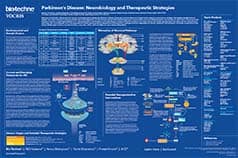
Parkinson's Disease Poster
Parkinson's disease (PD) causes chronic disability and is the second most common neurodegenerative condition. This poster outlines the neurobiology of the disease, as well as highlighting current therapeutic treatments for symptomatic PD, and emerging therapeutic strategies to delay PD onset and progression.
Dopamine Receptor Data
| Receptor Subtype | D1-like Receptors | D2-like Receptors | |||
|---|---|---|---|---|---|
| D1 | D5 | D2 | D3 | D4 | |
| G protein | Gs | Gs | Gi/o | Gi/o | Gi/o |
| Transduction Mechanism | ↑ AC, ↑ PLC, ↑ L-type Ca2+ channels | ↑ AC | ↓ AC, ↑ [Ca2+]i, K+ conductance, ↓ Ca2+ conductance | ↓ AC, activation of MAP kinase | ↓ AC, ↓ Ca2+ conductance |
| Localization | Caudate, putamen, nucleus accumbens, olfactory tubercle | Hippocampus, hypothalamus | Caudate, putamen, nucleus accumbens, olfactory tubercle | Nucleus accumbens, olfactory tubercle, islands of Calleja | Frontal cortex, midbrain, amygdala, cardiovascular system |
| Likely Physiological Roles | Locomotion, reward, reinforcement, learning and memory, renin secretion | Learning and memory | Locomotion, reward, reinforcement, learning and memory | Locomotion, possible role in cognition and emotion | Mostly unknown - possible role in cognition and emotion, hypertension |
| Key Compounds | Ki Values (nM) | |||||
|---|---|---|---|---|---|---|
| D1-like Agonists | SKF 38393 (0922) SKF 83822 (2075) | 1 3.2 | ~ 0.5 3.1 | ~ 150 186 | ~ 5000 66 | ~ 1000 335 |
| D1-like Antagonists | SCH 23390 (0925) | ~ 0.2 | 0.3 | ~ 1100 | ~ 800 | ~ 3000 |
| D2-like Agonists | Bromocriptine (0427) 7-HydroxyDPAT (0706) Cabergoline (2664) | ~ 440 ~ 5000 - | ~ 450 - 165 | ~ 8 10 0.7 | ~ 5 ~ 1 1.5 | ~ 290 650 9.0 |
| D2-like Antagonists | Clozapine (0444) Haloperidol (0931) Nemonapride (1746) NGB 2904 (2635) Raclopride (1810) Remoxipride (0916) Spiperone (0995) (S)-(-)-Sulpride (0895) | ~ 170 ~ 80 - > 10000 18000 - ~ 350 ~ 45000 | ~ 330 ~ 100 - 217 - - ~ 3500 77000 | ~ 230 1.2 0.06 1.4 1.8 ~ 300 0.06 ~ 15 | ~ 170 ~ 7 0.3 > 5000 3.5 ~ 1600 0.6 ~ 13 | 21 2.3 0.15 > 10000 2400 ~ 2800 0.08 1000 |
All Ki values for agonists were determined at the high-affinity state for all receptors, except for D3 receptors.
References
Seeman and Van Tol (1994) Dopamine receptor pharmacology. TiPS 15 264. Missale et al (1998) Dopamine receptors: from structure to function. Physiol.Rev. 78 189. O'Sullivan et al (2004) SK&F 83822 distinguishes adenylyl cyclase from phospholipase C-coupled D1-like receptors: behavioural topography. Eur.J.Pharmacol. 486 273. Kvernmo et al (2006) A review of the receptor-binding and pharmacokinetic properties of dopamine agonists. Clin.Ther. 28 1065. Yuan et al (1998) NGB 2904 and NGB 2849: two highly selective dopamine D3 receptor antagonists. Bioorg.Med.Chem.Lett. 8 2715.