
Stem Cell-Derived Beta Cell Therapies
Generate functional beta islet cells, standardize identity and insulin response, and translate faster with GMP‑ready reagents.
β-Cell Therapy | Workflow | Resources | FAQ | Contact Us
The Pathway to Clinical β‑Cell Therapies
Pluripotent stem cell- (PSC) derived beta cell and islet therapies are poised to revolutionize the treatment of type 1 diabetes beyond standard pharmaceuticals. As diabetes research pushes toward clinically viable cell-based therapy products, the ability to consistently generate highly functional beta cells at scale has become a critical driver of innovation and investment. R&D Systems reagents and analytical solutions support the development and clinical manufacture of beta cell therapies, from research breakthroughs to clinical trials.
Benefits of PSC-Derived β‑Islet Therapy
- Supply: While donor sources remain limited, stem cells offer a renewable, controlled source of functional beta cells that can be produced in larger quantities and standardized more easily.
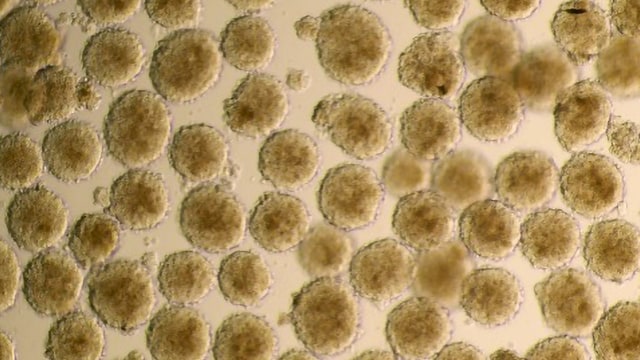
- Cell Quality: Donor islets can be inconsistent. Recent advances to improve endocrine maturation are enabling researchers to generate physiologically relevant PSC-derived beta cells capable of stronger and more consistent insulin secretion responses.
Overcome the Challenges of Translation
- Consistency: Small variations in the in vitro culture environment can significantly impact endocrine maturation outcomes. R&D Systems reagents minimize lot-to-lot variability and support reproducible late‑stage differentiation.
- Regulatory Compliance: R&D Systems cell culture reagents are tested to be functionally consistent across research- and GMP-grades, facilitating IND submissions with the FDA and easing your transition to clinical manufacturing.
- Scalability: Large-scale beta cell manufacturing requires consistent raw material inputs and secure supply to maintain performance across manufacture batches and sites. Our defined, reliable culture reagents and robust immunoassays are designed to scale with your workflow.
PSC-Derived β‑Islet Therapy Workflow Solutions
Developing effective beta cells for insulin replacement therapies requires precise control of differentiation, while confirming cell fate and functionality at multiple steps throughout the workflow. R&D Systems products include well-characterized animal-free recombinant proteins, small molecules, media, supplements, antibodies and ELISA kits to support each of these steps. With consistent high-quality performance, these products help researchers generate reliable results to advance their cell therapy programs with confidence.
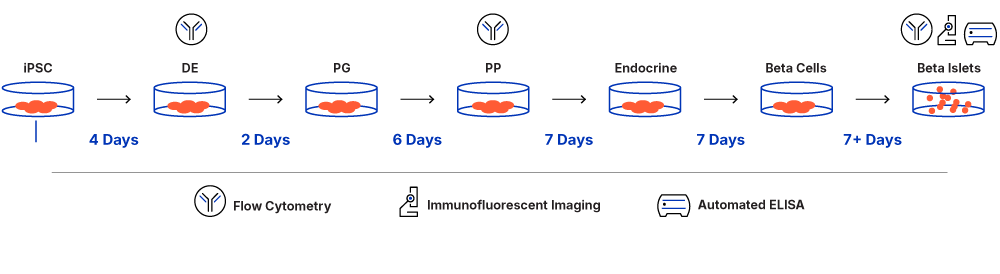
Induced Pluripotent Stem Cell (iPSC) Maintenance & Expansion
Pancreatic Beta Cell Differentiation
Cell Lineage Characterization
- Alexa Fluor® 488-conjugated Goat Anti-Human HNF-3 beta/FoxA2 Antigen Affinity-Purified Polyclonal Antibody
- APC-Conjugated Goat Anti-Human SOX17 Antigen Affinity-Purified Polyclonal Antibody
- APC-Conjugated Rat Anti-Human/Mouse Oct-3/4 Monoclonal Antibody
- DA ZP1
- FlowX FoxP3/Transcription Factor Fixation & Perm Buffer Kit
- Mouse Anti-Human C-Peptide Monoclonal Antibody
- NorthernLights™ NL493-conjugated Donkey Anti-Mouse IgG Antigen Affinity-Purified Polyclonal Antibody
- NorthernLights NL557-conjugated Goat Anti-Rat IgG Antigen Affinity-Purified Polyclonal Antibody
- PE-Conjugated Mouse Anti-Human Chromogranin A Monoclonal Antibody
- PE-Conjugated Mouse Anti-Human/Mouse PDX-1/IPF1 Monoclonal Antibody
- PE-Conjugated Goat Anti-Human Nanog Antigen Affinity-Purified Polyclonal Antibody
- Rat Anti-Human/Mouse Somatostatin Monoclonal Antibody
Functional Characterization of Beta Islets
Featured Resources
β‑Islet Symposium

A panel of experts explores scalable human islet therapies including autologous islets for beta cell replacement therapy. Strategies aim to reduce reliance on insulin therapy, with potential insulin independence, less glucose monitoring, and fewer episodes of severe hypoglycemia, plus better diabetes care follow-up in healthcare models.
β‑Islet Application Note
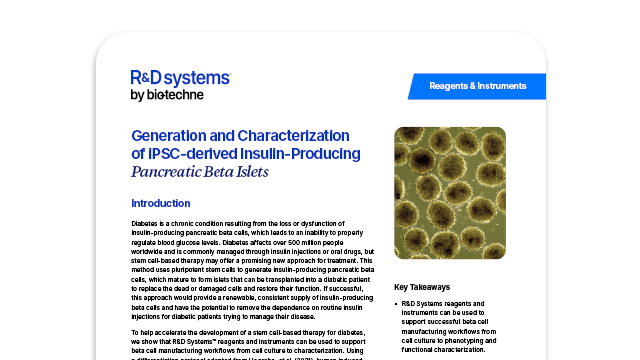
This application note highlights how pluripotent stem cells can generate functional insulin-producing pancreatic cells, for use in islet cell transplantation. Learn how to differentiate with high efficiency and reproducibility, characterizing at endoderm, primitive gut tube, pancreatic progenitor, endocrine cell, and beta cell stages.
Functional Islets Poster
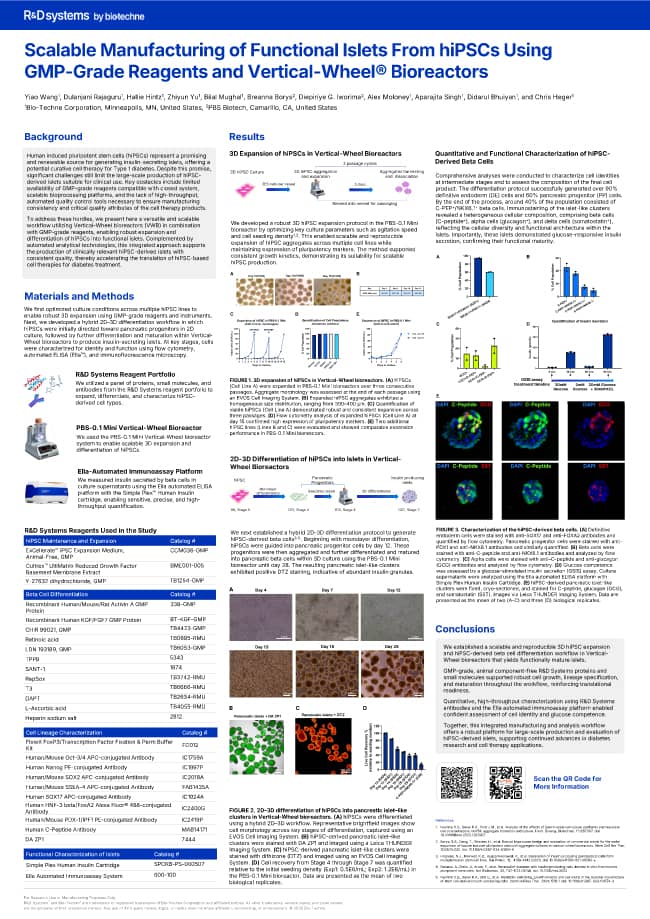
Discover a scalable, reproducible workflow for generating functional hiPSC-derived islets using GMP proteins and small molecules. This study demonstrates robust cell expansion, differentiation, and maturation, with automated, high-throughput analysis to assess cell identity and glucose responsiveness.
What are stem‑cell‑derived β‑islets?
Stem cell–derived β islets are cell clusters for insulin production, generated from pluripotent stem cells (PSCs). These PSC‑derived beta cells are engineered to mimic the function of native pancreatic islets and hold transformative treatment potential for insulin-dependent type 1 diabetes patients. As donor-derived cells remain limited and variable, PSC‑based β islets offer a renewable and scalable source of functional insulin‑secreting cells that can be standardized for both research and clinical manufacturing.
What challenges exist in endocrine maturation?
A primary challenge in producing clinically viable β islets is achieving consistent endocrine maturation. Even small variations in the culture environment can alter maturation outcomes and diminish insulin‑secreting performance. Researchers must manage differentiation conditions carefully, as variability across reagents, culture matrices, and growth factors can impact the physiological relevance and viability of the resulting PSC‑derived beta cells. R&D Systems' defined, low‑variability biotechnology reagents help minimize lot‑to‑lot differences and support reproducible late‑stage maturation.
What GMP requirements apply to β‑islet manufacturing?
β‑islet manufacturing for clinical applications requires strict adherence to Good Manufacturing Practice (GMP). GMP‑grade raw materials-including media, growth factors, small molecules, and extracellular matrices-must be tested and validated for functional consistency to support IND submissions and ensure regulatory compliance. R&D Systems provides research‑ and GMP‑grade reagents that are functionally aligned, easing the transition from discovery workflows to clinical manufacturing and helping maintain consistency across batches and manufacturing sites.
How can I improve reproducibility in β‑cell differentiation?
Improving reproducibility relies on controlling variability at every stage of the stem‑to‑β‑cell workflow. Defined, reliable culture media; consistent basement membrane extracts; and GMP‑grade growth factors help reduce variation across experiments, batches, and production sites. Using high‑quality endocrine differentiation tools, including Activin A, KGF, CHIR99021, and other stage‑specific small molecules, enhances consistent lineage progression and insulin‑secreting function. Together, these standardized inputs support reproducible PSC‑to‑β‑cell differentiation and higher‑confidence experimental outcomes for transplanted cells.
What is the difference between type 1 and type 2 diabetes, and how can beta islet research help?
Type 1 diabetes is an autoimmune condition where the immune system mistakenly launches an immune attack and destroys insulin-producing beta cells. Type 2 diabetes is not strictly immunological, it develops when the body becomes resistant to insulin and beta cells gradually lose function, rather than being directly attacked by immune cells.
Beta islet research, including that from Breakthrough T1D, aims to restore the body’s ability to make insulin. This includes using transplanted islets, often from allogeneic donor or stem cell sources, to replace lost cells. To protect cells after implantation, approaches like encapsulation and gene editing can help shield them from the immune system. These therapies are now being studied in vivo, measuring key metrics like insulin production and blood sugar control.
For people with diabetes, this research offers hope for more lasting treatments that could reduce daily management and improve overall outcomes.
What tools support clinical translation of β‑islet therapies?
Successful clinical translation requires tools that support the full β‑islet therapy workflow—from stem cell expansion through functional characterization. Key solutions include:
- iPSC Maintenance & Expansion Tools such as ExCellerate iPSC Expansion Medium, CEPT cocktail and ROCKi, Basement Membrane Extract, and FGF‑basic, enabling stable pluripotent cell propagation.
- Differentiation Reagents like Activin A, KGF, CHIR99021, retinoic acid, and stage‑specific signaling inhibitors that drive reliable progression toward pancreas cells.
- Cell Lineage Characterization Antibodies that confirm successful stage transitions (e.g., Oct‑3/4, Nanog, SOX17, PDX‑1, Chromogranin A).
- Functional Analytics such as Simple Plex™ Ella human insulin assays to quantify insulin secretion and validate islet‑like performance.
Connect with a Cell Therapy Specialist
Fill in the form below to discuss your cell therapy project with one of our experts.