
Siglecs: targets for immune regulation and cancer therapy
Siglecs (sialic acid-binding immunoglobulin-type lectins) are receptors predominantly located on the surface of hematopoietic cells. Recent publications highlight the important roles Siglecs play in tumor immunosurveillance making them attractive anti-cancer drug targets. Inhibitory receptors Siglec-7 and Siglec-9 are expressed on NK cells and recognize tumor-associated sialosides (1,2). Also, Siglec-15 (Catalog # 9227-SL) was identified as an immune suppressor by engaging an unknown receptor on T cells. Similar to PD-L1/PD-1 immune checkpoint blockade, Siglec-15 may be a potential target for cancer immunotherapy (3).
Siglecs interact with an array of linkage-specific sialic acids on a glycan structure expressed on host cells, as well as pathogens. So far, there are 15 different human and 9 murine Siglecs. Each type of Siglec generally recognizes a particular set of sialylated glycan containing differently linked sialic acid molecules (4,5). On the cytoplasmic side, most Siglecs have immune receptor tyrosine-based inhibition motifs (ITIM), which initiate signaling cascades resulting in downregulation of proinflammatory responses.
R&D Systems provides you with the widest selection of high-quality, bioactive Siglecs on the market. Can’t find what you are looking for? The R&D Systems Custom Protein Development Team can work with you to create a customized protein solution to meet your specific research needs.
| Protein | Species | Source | Tag | Catalog # | Activity |
|---|---|---|---|---|---|
| Siglec-1/CD169 | Human | NS0 | His | 5197-SL | Supports RBC adhesion |
| Mouse | NS0 | Fc | 5610-SL | ||
| Siglec-2/CD22 | Human | NS0 | Fc | 1968-SL | Supports RBC adhesion |
| Human | CHO | Fc, Avi-tag | AVI1968 | ||
| Human | NS0 | Fc, Alexa Fluor® 488 | AFG1968 | Binds anti-Siglec-2 / CD22 monoclonal antibody conjugated beads | |
| Human | NS0 | Fc, Alexa Fluor® 647 | AFR1968 | ||
| Human | NS0 | Fc, Atto 488 | ATJ1968 | ||
| Human | NS0 | Fc, Atto 647N | ATM1968 | ||
| Human | CHO | His | 10191-SL | Supports RBC adhesion | |
| Human | CHO | His, Avi-tag | AVI10191 | ||
| Mouse | NS0 | Fc | 2296-SL | ||
| Cynomolgus Monkey | HEK293 | Fc | 10031-SL | ||
| Cynomolgus Monkey | HEK293 | His | 9864-SL | ||
| Rat | CHO | Fc | 10572-SL | ||
| Rat | CHO | His | 10571-SL | ||
| Siglec-3/CD33 | Human | NS0 | Fc | 1137-SL | Supports RBC adhesion |
| Human | CHO | His, Avi-tag | AVI1137 | ||
| Human | NS0 | Fc, Alexa Fluor® 488 | AFG1137 | Binds anti-Siglec-3 / CD33 monoclonal antibody conjugated beads | |
| Human | NS0 | Fc, Alexa Fluor® 647 | AFR1137 | ||
| Human | NS0 | Fc, Atto 488 | ATJ1137 | ||
| Human | NS0 | Fc, Atto 647N | ATM1137 | ||
| Human | CHO | His | 10375-SL | Supports RBC adhesion | |
| Human | HEK293 | Fc, Avi-tag | AVI10467 | ||
| Mouse | NS0 | Fc | 10102-SL | Binds Siglec H (Caalog # 10264-SH) | |
| Cynomolgus Monkey | CHO | Fc | 10885-SL | Binds Galectin-3BP/MAC-2BP (Catalog # 2226-GAB) | |
| Cynomolgus Monkey | CHO | His | 11217-SL | ||
| Siglec-4a/MAG | Human | HEK293 | Fc | 8940-MG | Inhibits neurite outgrowth of E13 chick embryonic DRG neurons |
| Mouse | NS0 | Fc | 8580-MG | ||
| Rat | NS0 | Fc | 538-MG | ||
| Siglec-5/CD170 | Human | NS0 | Fc | 1072-SL | Supports RBC adhesion |
| Siglec-6/CD327 | Human | CHO | Fc | 2859-SL | Binds biotinylated Neu5Ac alpha 2-6GalNAc alpha |
| Siglec-7/CD328 | Human | NS0 | Fc | 1138-SL | Supports RBC adhesion |
| Siglec-8 | Human | NS0 | Fc | 9045-SL | Binds biotinylated Sialyl Lewis X |
| Siglec-9 | Human | NS0 | Fc | 1139-SL | Supports RBC adhesion |
| Cynomolgus Monkey | HEK293 | Fc | 11242-SL | ||
| Siglec-10 | Human | NS0 | Fc | 2130-SL | Binds biotinylated 6’-Sialyllactose-Polyacrylamide |
| Human | CHO | Fc, Avi-tag | AVI2130 | Binds CD52 (Catalog # 9116-CD) | |
| Siglec-11 | Human | CHO | Fc | 3258-SL | Binds biotinylated (Neu5Aca2-8)2-Polyacrylamide |
| Siglec-14 | Human | NS0 | Fc | 4905-SL | Supports RBC adhesion |
| Siglec-15 | Human | CHO | Fc | 9227-SL | Inhibits anti-CD3 induced IFN-gamma secretion by T cells |
| Human | CHO | His | 10698-SL | ||
| Mouse | NS0 | Fc | 10101-SL | Inhibits anti-CD3 induced IL-2 secretion by T cells | |
| Mouse | NS0 | His | 10288-SL | ||
| Siglec-E | Mouse | NS0 | Fc | 5806-SL | Binds biotinylated Neu5Ac alpha 2-6GalNAc alpha -Polyacrylamide |
| Siglec-F | Mouse | NS0 | Fc | 1706-SF | Supports RBC adhesion |
| Mouse | NS0 | His | 10171-SF | ||
| Siglec-G | Mouse | NS0 | Fc | 10103-SL | Binds biotinylated 6'-Sialylactose-PAA |
| Siglec-H | Mouse | NS0 | Fc | 10264-SH | Binds Siglec-3 (Catalog # 10102-SL) |
| Alexa Fluor® is a registered trademark of Molecular Probes, Inc., Eugene, OR. | |||||
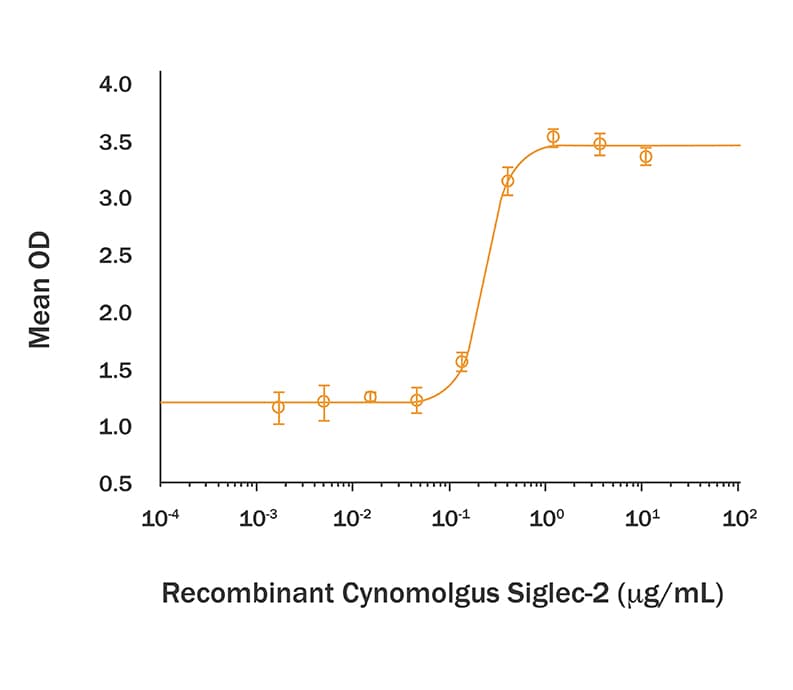
Recombinant Cynomolgus Monkey Siglec‑2/CD22 Fc Chimera (Catalog # 10031-SL) supports the adhesion of human red blood cells. The ED50 for this effect is 0.07-0.42 ug/mL.
.jpg)
Recombinant Human Siglec-15 Fc Chimera (Catalog # 9227-SL) inhibits anti-CD3 antibody induced IFN-gamma secretion by human T cells. The ED50 for this effect is 1-10 μg/mL.
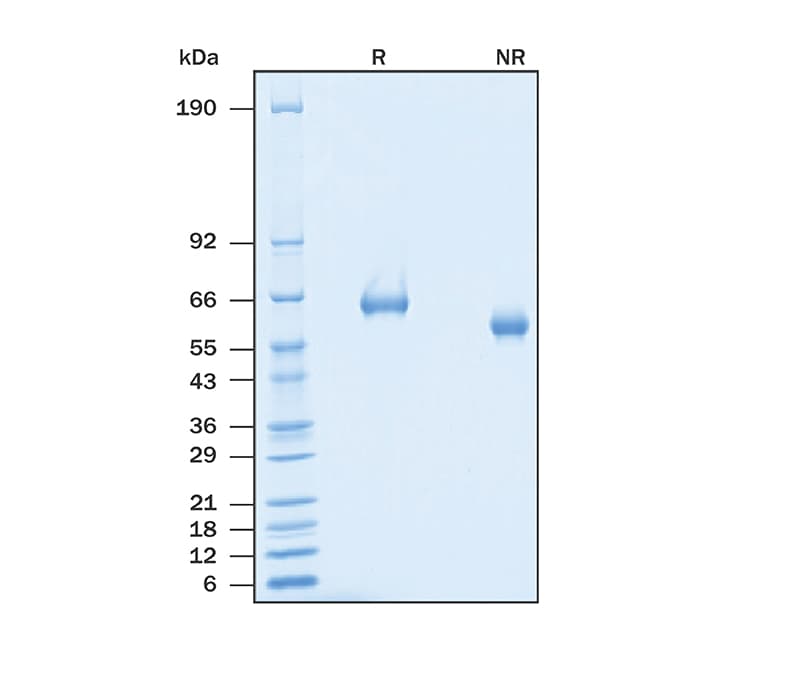
2 μg/lane of Recombinant Mouse Siglec‑F His-tag (Catalog # 10171-SF) was resolved with SDS-PAGE under reducing (R) and non-reducing (NR) conditions and visualized by Coomassie® Blue staining, showing bands at 59-68 kDa.
References:
1. Jandus, C. et al. (2014) J. Clin. Investig. 124:1810.
2. Stanczak, M.A. et al. (2018) J. Clin. Investig. 128:4912.
3. Wang, J. et al. (2019) Nat. Med. 25:656.
4. Bornhöfft, K.F. et al. (2018) Dev. Comp. Immunol. 86:219.
5. Zhou, J.Y. et al. (2018) Trends Immunol. 39:523.
View other Immune-checkpoint blockade targets
Some of the most targeted checkpoint proteins
Products for Butyrophilin-related Research
New Data: AMIGOs as T Cell Suppressors
Checkpoint Targets with Novel Ligands
IgG Superfamily Members: Data Supports Their Potential as Immunotherapeutic Drug Targets
New B7-like immune checkpoint targets
Adhesion Molecules as Novel Targets for Cancer Therapies
Paired receptors with either activating or inhibitory signals.
Related Pathways
T Cell Co-Signaling Pathway: Ligand-Receptor Interactions
Mechanisms of Regulatory T Cell-Mediated Suppression
Other immune-checkpoint blockade resources:
- Immune Checkpoint
- Immune Checkpoint Blockade: Immune Checkpoint Molecule Expression
- Immune Checkpoint Blockade: Immune Cell Phenotyping and Isolation
- VSIG8 Poster: Co-inhibitory Immune Checkpoint Molecule
- Webinar Short: B7-related Butryophilins as Immune Modulators
- Immunotherapy
- A Role for VSIG-3/VISTA Signaling in Acquired Resistance to Anti-PD-1 Therapy?